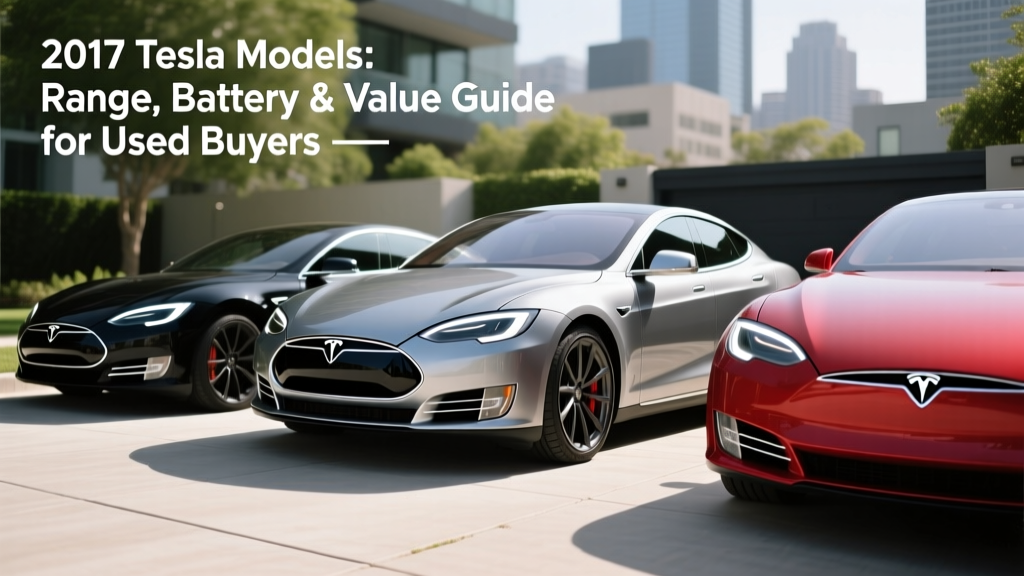
If you're researching 2017 Tesla models on the used market in 2026, you're likely weighing significant depreciation against the appeal of Tesla's Supercharger network and over-the-air updates. The 2017 lineup included the Model S sedan, Model X SUV, and the earliest Model 3 deliveries (which began in late July 2017 for employees and a handful of reservation holders). These vehicles are now approaching 8–9 years old, and their batteries, charging hardware, and software capabilities differ meaningfully from today's lineup. Here's what a data-driven buyer needs to know before signing the check.
2017 Tesla Lineup at a Glance: S, X, and Early Model 3
The 2017 model year was a transitional one for Tesla. The Model S and Model X were mature products receiving incremental updates (the 100 kWh battery option arrived mid-cycle), while the Model 3 was in its earliest production ramp. Below is a consolidated spec reference for the most common configurations sold that year.
| Model / Trim | Battery (usable kWh) | EPA Range (mi) | 0-60 mph | Drivetrain | Peak DC Charge kW |
|---|---|---|---|---|---|
| Model S 75 / 75D | ~72.6 (NMC) | 249 (RWD) / 259 (AWD) | 4.2–4.9s | RWD / Dual-Motor AWD | ~120 kW |
| Model S 100D | ~98 (NMC) | 335 | 4.1s | Dual-Motor AWD | ~120 kW |
| Model S P100D | ~98 (NMC) | 315 | 2.5s | Dual-Motor AWD | ~120 kW |
| Model X 75D | ~72.6 (NMC) | 237 | 5.2s | Dual-Motor AWD | ~120 kW |
| Model X 100D | ~98 (NMC) | 295 | 4.7s | Dual-Motor AWD | ~120 kW |
| Model 3 Long Range (late 2017) | ~75 (NMC) | 310 | 5.1s | RWD | ~120 kW (early CCS adapter) / NACS native |
Sources: EPA via fueleconomy.gov, Tesla 2017 press materials.
Real-World Range: What the EPA Sticker Doesn't Tell You
The 2017 Model S 100D carries a 335-mile EPA estimate — the highest of any 2017 Tesla. Expect ~280–300 miles in mixed real-world driving at 65–70 mph, and as low as ~230–250 miles in sub-freezing winter conditions due to cabin heating load and increased battery resistance. The Model 3 Long Range's 310-mile EPA figure typically yields ~260–280 real-world miles on the highway.
All 2017 Teslas use NMC (nickel manganese cobalt) chemistry — Tesla had not yet adopted LFP for any production vehicle. NMC offers higher energy density than LFP but is more sensitive to prolonged high state-of-charge (SoC) storage. Tesla's battery management system (BMS) includes a top-end buffer, but owners who routinely charged to 100% and left the car sitting in hot climates may see accelerated degradation.
Critically, a 2017 Tesla's battery is now 8–9 years old. EPA figures reflect a new vehicle; expect 5–12% capacity loss depending on charging habits, climate, and mileage. Always request a State of Health (SoH) reading — available via third-party tools like TeslaFi or a service-center diagnostic — before purchasing.
Charging Speeds: V2 Superchargers and Level 2 Reality
2017 Teslas charge at significantly slower rates than current models. Here's what to expect across charging levels:
| Charging Level | Power (kW) | Miles Added / Hour | Notes |
|---|---|---|---|
| Level 1 (120V household) | ~1.4 kW | ~3–4 mi/hr | Emergency/trickle only |
| Level 2 (240V home, 48A) | ~11.5 kW | ~30–37 mi/hr | Full charge in ~8–10 hours |
| DC Fast (V2 Supercharger) | Peak ~120 kW | ~170–200 mi in 30 min | 10–80% in ~35–40 min; tapers sharply above 80% |
| DC Fast (V3 Supercharger) | Capped at ~120 kW | Same as V2 for these models | 2017 hardware cannot utilize V3's 250 kW peak |
A key ownership insight: 2017 Model S and X vehicles use Tesla's proprietary connector (now called NACS). The Model 3 also uses NACS natively. Unlike 2018+ Model 3s that gained CCS compatibility via adapter in some markets, 2017 vehicles rely entirely on Tesla Superchargers or NACS-equipped third-party stations (which have expanded significantly since the 2023–2024 industry adoption of NACS).
Home Level 2 charging requires a Wall Connector or compatible J1772 station with a Tesla adapter. The onboard charger in the 2017 Model S/X supports up to 48 amps (11.5 kW); the Model 3 supports up to 32 amps (7.7 kW) on its standard onboard charger, or 48 amps (11.5 kW) with the optional dual-charger configuration (rare). Plan for a 240V/60A circuit installation — budget $800–$2,000 for electrician labor depending on panel proximity.
Performance, Efficiency, and Practicality
Even by 2026 standards, the 2017 Model S P100D's 2.5-second 0-60 mph time remains ferocious. The dual-motor AWD system delivers instantaneous torque with no gear shifts. Efficiency varies by model:
- Model S 100D: 104 MPGe combined (~32 kWh/100 mi)
- Model S P100D: 98 MPGe combined (~34 kWh/100 mi)
- Model X 100D: 93 MPGe combined (~36 kWh/100 mi)
- Model 3 Long Range: 130 MPGe combined (~26 kWh/100 mi)
The Model 3's superior efficiency reflects its lighter weight (~4,000 lbs vs. ~4,900 lbs for the Model S) and more aerodynamic packaging.
Cargo and passenger space:
- Model S: 26.3 cu ft rear cargo (hatchback) + 5.3 cu ft frunk; 42.0" front / 35.4" rear legroom
- Model X: Up to 88.1 cu ft with seats folded + 6.6 cu ft frunk; available 6- or 7-seat config; falcon-wing doors require 12" side clearance
- Model 3: 15 cu ft trunk + 3.1 cu ft frunk; 42.7" front / 35.2" rear legroom
Used Pricing and Tax Credit Reality
As of early 2026, used-market pricing for 2017 Teslas has dropped considerably from new-vehicle MSRPs:
| Model | Original MSRP (2017) | Typical Used Price (2026) |
|---|---|---|
| Model S 75/75D | $69,500–$74,500 | $22,000–$30,000 |
| Model S 100D / P100D | $94,000–$140,000+ | $30,000–$45,000 |
| Model X 75D / 100D | $79,500–$96,000 | $24,000–$38,000 |
| Model 3 Long Range | $44,000–$49,000 | $18,000–$25,000 |
Does a 2017 Tesla Qualify for the Federal EV Tax Credit?
Under current IRS §30D rules, the $7,500 new clean vehicle credit does not apply — it is exclusively for new purchases. However, the Used Clean Vehicle Credit (§25E) offers up to $4,000 (30% of sale price, capped at $4,000) if:
- The sale price is $25,000 or less
- The buyer's modified AGI is ≤$75,000 (single) / $150,000 (joint)
- The vehicle is at least 2 model years old (2017 qualifies in 2026)
- The vehicle is purchased from a licensed dealer (private-party sales excluded)
- The battery capacity is ≥7 kWh (all 2017 Teslas meet this)
In practice, this means a 2017 Model 3 Long Range priced at $22,000 from a dealer could yield a $4,000 credit, bringing effective cost to ~$18,000. Higher-priced Model S/X examples above $25,000 do not qualify for the used credit.
Tech, Autopilot, and What to Watch For
2017 Teslas shipped with Hardware 2.0 (HW2) or Hardware 2.5 (HW2.5) for Autopilot. This is a critical distinction: HW2 vehicles (built roughly through mid-2017) received a partial sensor suite that Tesla later acknowledged was insufficient for full self-driving capability. HW2.5 vehicles (late 2017 onward) added redundant computing and improved cameras.
Tesla Autopilot and FSD (Supervised) are SAE Level 2 driver-assistance systems — the driver must remain fully engaged, hands on or near the wheel, eyes on the road. These are not self-driving systems. Only Level 4 services (Waymo, Zoox in geofenced areas) operate without driver supervision.
2017 Teslas do not receive current FSD (Supervised) feature updates. Tesla has limited HW2 vehicles to basic Autopilot (lane centering + adaptive cruise). HW2.5 vehicles received enhanced features but remain behind HW3/HW4-equipped cars. If advanced driver assist is a priority, this is a significant limitation.
The 17" touchscreen (Model S/X) or 15" screen (Model 3) still receives basic software updates for navigation, media, and climate, but features like the latest UI redesigns, Theater mode, and advanced visualization are HW3+ only.
Warranty Coverage on a 2017 Tesla
Tesla's original warranty terms for 2017 models:
- Battery & Drive Unit: 8 years / 150,000 miles (Model S/X 100D/P100D); 8 years / 120,000 miles (Model S/X 75/75D); 8 years / 120,000 miles (Model 3 Long Range) — with minimum 70% capacity retention
- Bumper-to-Bumper: 4 years / 50,000 miles (expired on all 2017 vehicles)
In 2026, a 2017 Tesla's battery warranty is either expired (by time, if the car was delivered before mid-2018) or expiring imminently. This means battery replacement, if needed, is an out-of-pocket expense. Tesla Service quotes for a remanufactured 100 kWh pack range from $12,000–$18,000; a 75 kWh pack runs $10,000–$14,000. Third-party EV battery shops may offer repairs for $5,000–$9,000 by replacing individual modules.
Pros, Cons, and the Buyer Verdict
- Supercharger network access (NACS native)
- Strong performance even by 2026 standards
- Over-the-air updates for core functions
- Model 3 Long Range remains highly efficient (130 MPGe)
- Used prices make 100D models accessible
- Potential $4,000 used-EV credit on sub-$25K examples
- Peak DC charge rate ~120 kW (slow vs. 250+ kW modern EVs)
- HW2/HW2.5 Autopilot — no current FSD features
- Battery warranty expired or expiring
- Model X falcon-wing doors prone to seal/alignment issues
- Model S/X MCU1 (pre-March 2018) is sluggish; upgrade costs ~$2,000
- No heat pump (resistive cabin heater reduces winter range)
Who Should Buy a 2017 Tesla?
Choose a 2017 Model S 100D if you need a comfortable, long-range commuter sedan with Supercharger access and can accept the ~35–40 minute DC charge time on road trips.
Choose a 2017 Model 3 Long Range if you want the best efficiency (130 MPGe), lowest running costs, and the highest likelihood of qualifying for the $4,000 used-EV credit.
Look elsewhere if you prioritize cutting-edge ADAS, 200+ kW fast charging, or want a vehicle still under battery warranty. A 2021+ Model 3 or a used Hyundai Ioniq 5 / Kia EV6 (with 800V architecture and 200+ kW charging) may serve you better.
Frequently Asked Questions
What is the real-world range of a 2017 Tesla Model S 100D?
EPA-rated at 335 miles, expect ~280–300 miles in mixed real-world driving and ~230–250 miles in cold weather (below 32°F). Battery degradation of 5–12% at this age will further reduce usable range.
How fast does a 2017 Tesla charge at a Supercharger?
Peak rate is ~120 kW on V2 Superchargers. A 10–80% charge takes approximately 35–40 minutes. These vehicles cannot take advantage of V3 Superchargers' 250 kW peak — they are hardware-limited to ~120 kW.
Can I get FSD (Full Self-Driving) on a 2017 Tesla?
No. Tesla's current FSD (Supervised) requires Hardware 3 or newer. 2017 vehicles with HW2 or HW2.5 are limited to basic Autopilot (lane centering + traffic-aware cruise control), which is SAE Level 2 — not autonomous driving.
Is a 2017 Tesla eligible for any tax credit?
Not the $7,500 new-vehicle credit. The Used Clean Vehicle Credit (§25E) offers up to $4,000, but only on vehicles selling for $25,000 or less, purchased from a dealer, and subject to buyer income caps. Many 2017 Model S/X examples exceed the price cap.
What's the biggest risk of buying a 2017 Tesla?
Out-of-warranty battery replacement. If the pack degrades below 70% capacity or develops a fault, replacement costs $10,000–$18,000 out of pocket. Always verify State of Health before purchase, and budget for this contingency.
How does a 2017 Model 3 compare to a new budget EV?
A used 2017 Model 3 Long Range (~$20,000 after credit) offers 310 EPA miles and Supercharger access. A new 2026 Chevy Equus EV or base Hyundai Kona Electric starts around $33,000–$36,000 with 250–300 miles of range and modern 150+ kW charging. The used Tesla wins on range-per-dollar; the new EV wins on warranty, charging speed, and current tech.