Quick Verdict: The 2017 Model X in Today's Used EV Market
The 2017 Tesla Model X occupies a tricky spot in the used EV market. On paper, it delivers supercar-beating acceleration, a usable 200+ mile range, free Supercharging (on some VINs), and the practicality of a three-row SUV with falcon-wing rear doors. In reality, it's a nine-year-old luxury EV with complex mechanical systems, a battery that has seen meaningful degradation, and no eligibility for the federal used-EV tax credit due to its original MSRP. For buyers who understand what they're signing up for — and who can verify battery health before purchase — it remains one of the most capable used electric SUVs available. For everyone else, the ownership risks demand careful homework.
2017 Model X Battery Options, Range, and Efficiency
Tesla offered three battery configurations for the 2017 Model X, each with distinct range and performance characteristics. All packs use NMC (nickel manganese cobalt) lithium-ion chemistry — not the LFP (lithium iron phosphate) cells Tesla later adopted for Standard Range vehicles. NMC offers higher energy density but is more sensitive to sustained high states of charge and deep discharge cycles.
| Spec | 75D | 90D | 100D | P100D |
|---|---|---|---|---|
| Usable Battery (kWh) | ~72.5 | ~83.5 | ~98 | ~98 |
| EPA Range (miles) | 238 | 257 | 295 | 289 |
| EPA Efficiency (MPGe) | 92 | 92 | 97 | 89 |
| kWh/100 mi | 36 | 36 | 35 | 38 |
| 0-60 mph (seconds) | 6.0 | 4.8 | 4.7 | 2.9 |
| Horsepower | ~518 | ~518 | ~518 | ~670 |
| Drivetrain | AWD Dual Motor | AWD Dual Motor | AWD Dual Motor | AWD Dual Motor (Perf) |
The 90D is the rarest variant in the used market — Tesla phased out the 90 kWh pack mid-cycle in favor of the 100D. If you encounter one, verify whether it has the original pack or a warranty replacement, as some 90D owners received 100 kWh packs under the battery warranty.
According to EPA data on fueleconomy.gov, the 100D's 97 MPGe combined rating makes it one of the more efficient large electric SUVs of its era, though it falls well short of modern competitors like the 2025 Hyundai Ioniq 5 (114 MPGe combined). Expect real-world consumption of 35–42 kWh/100 mi depending on driving style, terrain, and climate control use.
Charging Speeds: DC Fast Charging and Home Level 2
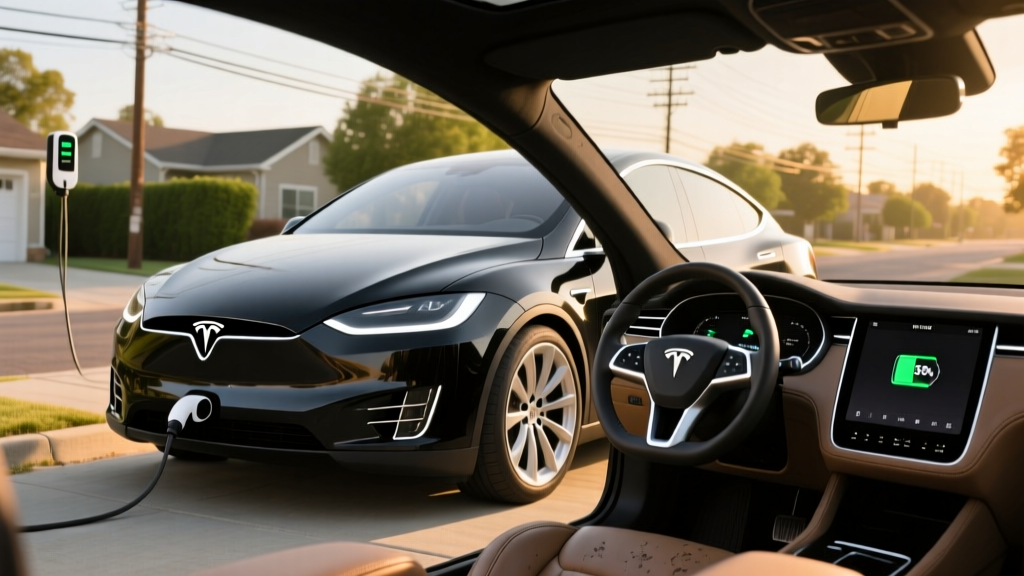
Charging infrastructure compatibility is a key consideration for any used Tesla, and the 2017 Model X presents a specific situation: it uses the legacy Tesla connector (pre-NACS standardization), which is physically the same plug used on all Teslas through 2024. This means it connects natively to all Tesla Superchargers and Destination Chargers. For non-Tesla networks (Electrify America, EVgo, ChargePoint), you'll need a CCS-to-Tesla adapter — Tesla sells one for approximately $250, and third-party options exist.
| Charging Level | Power (kW) | Speed | Notes |
|---|---|---|---|
| Level 1 (120V household) | ~1.4 kW | ~3–4 mi/hr | Emergency/trickle only; ~75+ hours for full charge |
| Level 2 (240V, 48A) | 11.5 kW | ~30 mi/hr | Full charge in ~8–10 hours; requires NEMA 14-50 or hardwired Wall Connector |
| Level 2 (240V, 32A Mobile Connector) | 7.7 kW | ~20 mi/hr | Included Mobile Connector with NEMA 14-50 adapter |
| DC Fast Charge (V2 Supercharger) | Peak ~120 kW | 10–80% in ~40–45 min | Sustained rate drops significantly above 60% SoC |
| DC Fast Charge (V3 Supercharger) | Peak ~120 kW (capped) | 10–80% in ~40–45 min | 2017 Model X cannot utilize V3's 250 kW peak; hardware-limited to ~120 kW |
The critical limitation: the 2017 Model X's onboard charging architecture caps DC fast charging at approximately 120 kW regardless of the station's capability. You will not see faster charging at a 250 kW V3 Supercharger compared to a 150 kW V2 station. The charge curve also tapers aggressively — expect to see 100+ kW only between roughly 10–40% state of charge, with rates dropping to 40–60 kW by 70% and below 20 kW above 90%.
For home charging, the dual onboard chargers (optional on early 2017 models, standard on later builds) allow up to 72A / 17.3 kW on Level 2 — but Tesla later disabled this via software on some vehicles due to contactor wear concerns. Verify the car's charge settings screen to confirm whether 72A charging is enabled. Most owners will be well served by a 48A / 11.5 kW Wall Connector installation, which adds roughly 30 miles of range per hour of charging.
Real-World Range: What to Actually Expect
The EPA sticker is a starting point, not a guarantee. Here's what 2017 Model X owners consistently report across forums and long-term ownership data:
- Mild weather, mixed driving (55–65 mph): 250–275 miles
- Highway at 75 mph, 70°F: 230–250 miles
- Highway at 75 mph, 30°F: 190–220 miles (cabin heat and battery thermal management consume significant energy)
- City driving with regen, 50°F: 260–280 miles (regen recovers energy in stop-and-go)
Note: A 2017 Model X with 100,000+ miles will likely show 8–15% battery degradation, reducing these figures proportionally. A car that originally delivered 270 real-world miles may now deliver 230–245.
The Model X's large frontal area and falcon-wing door seals create more aerodynamic drag than the Model S sedan, which directly impacts highway efficiency. If your commute is predominantly highway miles, budget for the lower end of these estimates. Cold-weather impact is severe — the resistive cabin heater (no heat pump on the 2017 model year) and battery warming draw heavily from the pack.
Performance, Interior Space, and Standout Technology
Even by 2026 standards, the 2017 Model X P100D's 2.9-second 0-60 mph time is astonishing for a 5,400-pound SUV. The standard 100D hits 60 mph in 4.7 seconds, and even the base 75D manages 6.0 seconds — quicker than most V6 midsize SUVs. All variants feature dual-motor all-wheel drive with torque vectoring, providing confident traction in rain and light snow.
Cargo and passenger space:
- Front trunk (frunk): 5.3 cu ft — enough for a charging cable bag and small groceries
- Cargo behind 3rd row: 26.6 cu ft
- Cargo behind 2nd row (3rd row folded): 57.2 cu ft
- Max cargo (all rear seats folded): 81.5 cu ft
- Seating: 5-seat (bench), 6-seat (captain's chairs), or 7-seat configurations
- Front legroom: 41.2 inches | 2nd-row legroom: 36.7 inches | 3rd-row legroom: 32.7 inches
The third row is genuinely tight — suitable for children or short trips only. The six-seat configuration with center console is the most comfortable for four adults but eliminates the bench option for a fifth passenger.
Notable technology for the model year:
- 17-inch touchscreen with navigation, media, and vehicle controls (no Apple CarPlay or Android Auto — Tesla's proprietary system only)
- Enhanced Autopilot (optional, $5,000 at purchase): adaptive cruise, lane-keeping, auto lane change, self-park, and Summon. This is SAE Level 2 driver assistance — the driver must remain fully engaged at all times
- Full Self-Driving Capability (optional): hardware 2.5 suite; some vehicles received FSD software updates, others did not. Verify FSD transfer status with Tesla before purchase, as FSD does not always transfer to second owners
- Falcon-wing rear doors with ultrasonic obstacle detection — dramatic but mechanically complex (see drawbacks below)
- HEPA air filtration with "Bioweapon Defense Mode" — genuinely excellent cabin air quality
- Air suspension with adjustable ride height — useful for speed bumps, steep driveways, and loading
Used Pricing, Tax Credits, and Total Ownership Cost
The 2017 Model X originally carried an MSRP of $79,500 (75D) to $145,000+ (P100D with options). In the 2026 used market, prices have depreciated substantially:
| Trim | Original MSRP | 2026 Used Price (est.) | Federal Used-EV Credit | Effective Cost |
|---|---|---|---|---|
| 75D | $79,500 | $25,000–$32,000 | Not eligible* | $25,000–$32,000 |
| 90D | $94,000 | $28,000–$36,000 | Not eligible* | $28,000–$36,000 |
| 100D | $99,500 | $32,000–$42,000 | Not eligible* | $32,000–$42,000 |
| P100D | $145,000+ | $38,000–$50,000 | Not eligible* | $38,000–$50,000 |
*The IRS §30D used-EV tax credit (up to $4,000 or 30% of sale price, whichever is lower) requires the vehicle's original MSRP to have been $25,000 or less when new, per IRS guidelines. Since every 2017 Model X variant exceeded $79,000 new, none qualify. The credit also has buyer income caps ($75,000 single / $150,000 joint) and requires purchase from a licensed dealer.
Ongoing ownership costs to budget for:
- Insurance: $2,500–$4,000/year depending on state, driving record, and coverage — Teslas carry higher premiums due to repair costs and parts pricing
- Tires: The Model X wears through 20–22 inch tires quickly due to its 5,000+ lb curb weight and instant torque. Budget $1,200–$2,000 for a set of four every 25,000–35,000 miles
- Home charging: ~$0.13/kWh national average × 98 kWh = ~$12.75 for a full charge (100D). At 35 kWh/100 mi, that's roughly $0.045/mile — significantly cheaper than gasoline
- Free Supercharging: Some 2017 Model X vehicles came with unlimited free Supercharging tied to the VIN (transfers with the car). Others have it tied to the original owner's account (does not transfer). Verify this with Tesla using the VIN before purchase — free Supercharging adds $1,500–$3,000/year in value for road-trip-heavy owners
- Out-of-warranty repairs: The 8-year/150,000-mile battery and drive unit warranty on 100D/P100D models (8-year/unlimited miles on 75D/90D) may still be active for low-mileage examples. Once expired, drive unit replacement runs $5,000–$8,000 and battery replacement (if needed) is $15,000–$22,000 at Tesla Service
Warranty Coverage and Battery Degradation
Tesla's original warranty for the 2017 Model X:
- Basic vehicle: 4 years / 50,000 miles — expired on all examples
- Battery and drive unit: 8 years / 150,000 miles (100D, P100D) or 8 years / unlimited miles (75D, 90D), whichever comes first, with minimum 70% capacity retention
- Falcon-wing doors and air suspension: Covered under basic warranty only — now out of warranty on all examples
For a 2017 model in 2026, the battery/drive unit warranty is either recently expired or about to expire (depending on exact build date). This is a critical consideration. Battery degradation on NMC packs in the Model X typically follows this pattern:
- Year 1–2: 3–5% loss (initial "break-in" degradation)
- Year 3–6: Gradual 1–2% per year
- Year 7–9: Degradation curve flattens; total loss typically 10–16%
Most 2017 Model X vehicles with 80,000–120,000 miles show 85–92% state of health (SoH). You can check this approximately by fully charging to 100% and comparing the displayed range to the original EPA rating. A 100D showing 250+ rated miles at 100% SoC is in good health; below 235 rated miles suggests above-average degradation.
Pros, Cons, and Known Issues
Pros
- Class-leading acceleration and performance (P100D: 2.9s 0-60)
- Spacious interior with genuine three-row seating and 81.5 cu ft max cargo
- Access to Tesla Supercharger network (most reliable DC fast-charging network in the US)
- Over-the-air software updates still being delivered (though feature additions have slowed for HW2.5 vehicles)
- HEPA air filtration system is best-in-class
- Frunk + rear cargo offers versatile storage
- Some examples include free unlimited Supercharging (VIN-dependent)
Cons
- Falcon-wing doors are prone to sensor errors, seal leaks, and actuator failures ($2,000–$4,000 per door to repair)
- No Apple CarPlay or Android Auto — Tesla's proprietary infotainment only
- DC fast charging capped at ~120 kW — slow compared to modern 250–350 kW capable EVs
- No heat pump — resistive heater significantly reduces cold-weather range
- High tire wear due to vehicle weight and torque
- Insurance premiums 30–50% higher than comparable ICE SUVs
- No federal tax credit eligibility (new or used)
- Hardware 2.5 Autopilot computer is outdated; no path to modern FSD neural network capabilities
- Build quality inconsistencies (panel gaps, interior rattles) common for this production era
Known issues to inspect before purchase:
- Front drive unit whine or clunk: Early dual-motor Teslas had front drive unit failures; listen for unusual sounds during test drive
- Air suspension failure: Strut and compressor failures are common at 80,000+ miles; replacement is $1,500–$2,500 per corner
- Falcon-wing door sensors: Ultrasonic sensors can fail, preventing doors from opening in tight spaces; test all doors in various positions
- MCU1 (Media Control Unit) yellowing/delamination: The original 17-inch screen is prone to display delamination; check for yellow tinting or bubbling. MCU2 retrofit is available from Tesla for ~$1,500–$2,000
- 12V battery: The auxiliary 12V battery should be checked; Tesla switched to a lithium 12V in later years, but 2017 models use lead-acid, which fails every 3–4 years
Who Should Buy the 2017 Model X?
Best for: Families who need three rows and cargo space, want Supercharger access for road trips, can verify a healthy battery, and have budget flexibility for out-of-warranty repairs. The 100D is the sweet spot — best range, good performance, and the most sensible used value.
Not ideal for: Budget-conscious buyers who can't absorb a $3,000–$5,000 surprise repair, daily commuters in extreme cold climates where range drops below 200 miles, or anyone who prioritizes modern infotainment (CarPlay/Android Auto) and the latest driver-assistance hardware.
Consider instead: A used 2020+ Model Y (more efficient, newer hardware, no falcon-wing complexity) or a 2021+ Kia EV6 / Hyundai Ioniq 5 (faster charging, CarPlay, more modern platform) if three rows aren't mandatory.
Frequently Asked Questions
Does the 2017 Tesla Model X qualify for any federal tax credit?
No. The IRS §30D used-EV credit requires the vehicle's original MSRP to have been $25,000 or less when new. The cheapest 2017 Model X (75D) started at $79,500, making all variants ineligible. The new-vehicle §30D credit also no longer applies to used purchases. Some states offer their own used-EV rebates — check your state's energy office for current programs.
How fast does a 2017 Model X charge at a Supercharger?
The 2017 Model X peaks at approximately 120 kW on DC fast charging, regardless of whether you use a V2 (150 kW) or V3 (250 kW) Supercharger. A 10–80% charge takes roughly 40–45 minutes. The charge curve tapers significantly above 60% state of charge — plan to unplug around 80% to avoid wasting time at very low charge rates.
What is the real-world highway range of the 2017 Model X 100D?
Expect 230–250 miles at highway speeds (70–75 mph) in mild weather. In winter conditions below freezing, highway range drops to 190–220 miles due to resistive cabin heating and battery thermal management. The 75D delivers roughly 185–210 highway miles in mild weather.
Is the 2017 Model X battery warranty still valid?
The battery warranty is 8 years / 150,000 miles (100D/P100D) or 8 years / unlimited miles (75D/90D). For a vehicle built in early 2017, the time-based coverage expired in early 2025. For late-2017 builds, coverage may extend into late 2025 or early 2026. Mileage-based coverage may still apply for low-mile examples. Check the exact in-service date and odometer reading with Tesla.
Can I charge a 2017 Model X at non-Tesla charging stations?
Yes, but you need a CCS-to-Tesla adapter (available from Tesla or third parties for ~$150–$250). The 2017 Model X uses Tesla's proprietary connector, which predates the industry-wide NACS adoption. With the adapter, you can use Electrify America, EVgo, ChargePoint, and other CCS-equipped networks. The Tesla app will not initiate sessions on non-Tesla networks — you'll need each network's app or RFID card.
Is a 2017 Model X worth buying over a newer Model Y?
It depends on your priorities. The Model X offers three-row seating, more cargo space, falcon-wing doors, and air suspension — features the Model Y lacks. But the Model Y (2020+) has newer Autopilot hardware (HW3/HW4), a heat pump for better cold-weather efficiency, faster DC charging, and lower maintenance complexity. If you don't need three rows, a 2021+ Model Y Long Range is generally the smarter used buy. If three rows are non-negotiable and budget allows for potential repairs, the 100D remains compelling.