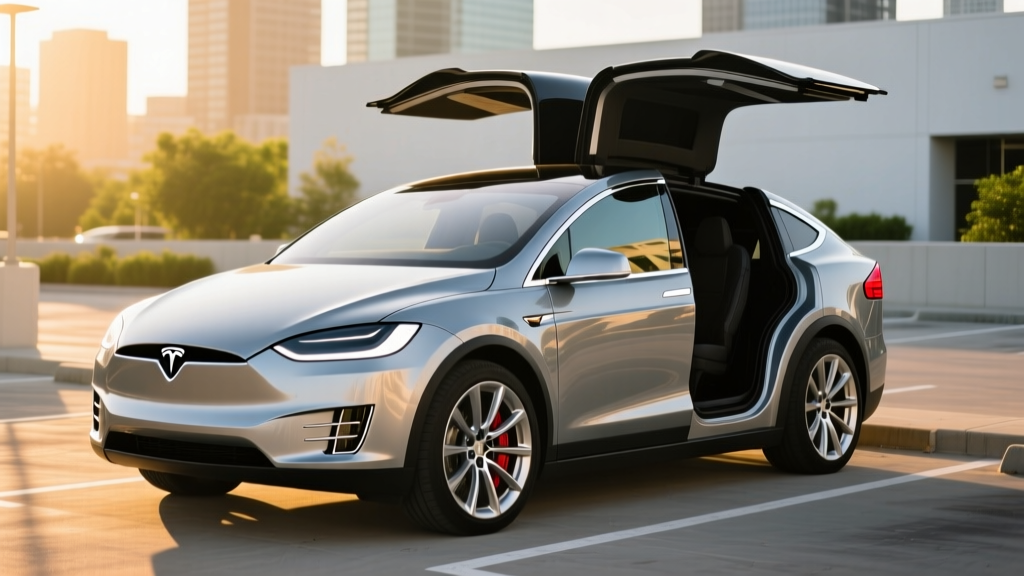
If you've been searching for a suv tesla 2017 model year, you're almost certainly looking at the used market. The 2017 Tesla Model X was the company's flagship electric SUV — a falcon-wing-doored, three-row family hauler that pushed boundaries in performance and tech. Nearly a decade later, it remains one of the most distinctive used EVs available, with prices that have dropped into territory where they compete with new mainstream electric crossovers.
But buying a used 2017 Model X in 2026 requires careful homework. Battery health, Supercharger access, out-of-warranty repair costs, and the reality of 2017-era charging hardware all factor into whether this is a smart buy or an expensive lesson. Here's the data-driven breakdown.
2017 Tesla Model X Trim Lineup and Core Specs
Tesla offered the Model X in three main configurations for the 2017 model year, each defined by battery size and performance tuning. Tesla's naming convention used the battery capacity in kWh (though actual usable capacity was slightly lower due to buffer protections).
| Spec | 75D | 100D | P100D (Performance) |
|---|---|---|---|
| EPA Range (original) | 237 miles | 295 miles | 289 miles |
| Battery (total / usable) | 75 kWh / ~72.6 kWh | 100 kWh / ~98 kWh | 100 kWh / ~98 kWh |
| Battery Chemistry | NMC (Nickel Manganese Cobalt) | NMC | NMC |
| Drivetrain | Dual-Motor AWD | Dual-Motor AWD | Dual-Motor AWD |
| Horsepower | ~518 hp (combined) | ~518 hp (combined) | ~670 hp (Ludicrous mode) |
| 0-60 mph | 6.0 seconds | 4.7 seconds | 2.9 seconds |
| Efficiency (MPGe combined) | 93 MPGe | 97 MPGe | 92 MPGe |
| Efficiency (kWh/100mi) | ~36 kWh | ~35 kWh | ~37 kWh |
| Original MSRP (approx.) | $82,500 | $99,500 | $145,000+ |
| Typical 2026 Used Price | $22,000 – $30,000 | $28,000 – $38,000 | $35,000 – $50,000 |
All 2017 Model X variants came standard with dual-motor all-wheel drive, air suspension, and a 17-inch touchscreen running Tesla's software stack. The 100 kWh battery packs in the 100D and P100D used higher-density NMC cells — a critical detail for long-term degradation, which we'll cover below.
Real-World Range: What to Actually Expect in 2026
EPA Sticker (100D): 295 miles
Real-World Highway (70 mph, moderate temps): ~235–255 miles
Cold Weather Highway (below 30°F): ~185–215 miles
After Battery Degradation (8+ years, ~80% SoH): ~190–210 miles highway
The EPA range figures on the 2017 Model X were optimistic even when new. Tesla's heavy, aerodynamically challenged SUV body — those falcon-wing doors add weight and drag — means real-world highway efficiency drops noticeably compared to the combined-cycle EPA test.
For the 100D, the most common long-range variant, expect roughly 80–85% of EPA range on highway trips at sustained 70–75 mph speeds. The 75D is the most range-constrained: its 237-mile EPA figure shrinks to around 180–195 miles on the highway, which limits it primarily to commuting and regional travel.
Battery degradation is the wildcard for any 2017 vehicle in 2026. NMC chemistry in Tesla's 100 kWh packs typically shows 10–15% capacity loss after 80,000–120,000 miles, depending on charging habits. Owners who frequently DC fast-charged to 100% and stored at high state-of-charge will see the higher end of that degradation range. Always request a battery health reading (State of Health, or SoH) before purchasing — this can be checked via the Tesla app or third-party diagnostic tools.
Charging Speed: 2017 Hardware in a 2026 World
This is where the 2017 Model X shows its age most clearly. Tesla's Supercharger network has expanded dramatically, but the vehicle's onboard charging hardware limits how fast it can accept power.
| Charging Level | 75D | 100D / P100D |
|---|---|---|
| DC Fast Charge (Peak kW) | ~120 kW (V2 Supercharger) | ~120 kW (V2 Supercharger) |
| DC Fast Charge (Sustained Avg.) | ~75–90 kW | ~80–100 kW |
| 10–80% DC Fast Charge Time | ~40–50 minutes | ~50–60 minutes |
| Level 2 Home (Max kW) | 11.5 kW (48A) | 11.5 kW (48A) |
| Level 2 Miles per Hour | ~30 mi/hr | ~34 mi/hr |
| Level 1 (120V, 12A) | ~3 mi/hr | ~3 mi/hr |
| Connector | Tesla proprietary (NACS) | Tesla proprietary (NACS) |
The 2017 Model X maxes out at roughly 120 kW on V2 Superchargers, which were the standard during its production era. It cannot take full advantage of Tesla's V3 (250 kW) or V4 Superchargers that now populate much of the network — the vehicle's battery management system and thermal hardware simply weren't designed for those charge rates. On a V3 stall, you'll still peak around 120 kW.
The charge curve matters too. The 100D's large battery sustains reasonable charge rates up to about 50–60% state of charge, then tapers significantly. Expect the final 20% (60–80%) to take nearly as long as the first 50%. On road trips, plan stops at 20–25 minutes for a 10–60% top-up rather than waiting for 80%.
At home on a Level 2 charger (NEMA 14-50 outlet or Tesla Wall Connector on a 60-amp circuit), the onboard charger accepts up to 48 amps / 11.5 kW. A full charge from 20% takes roughly 6–7 hours for the 100D — overnight charging is the sweet spot.
The proprietary Tesla connector (now standardized as NACS) means you have access to the full Supercharger network natively, which remains the most reliable public DC fast-charging ecosystem in the U.S. as of 2026. For non-Tesla CCS chargers, you'll need a Tesla CCS adapter (sold by Tesla for ~$175), which unlocks Electrify America, EVgo, and other networks — useful when Superchargers are sparse or occupied.
Performance, Cargo, and Practicality
The 2017 Model X is genuinely quick by any standard. Even the "base" 75D hits 60 mph in 6.0 seconds, while the P100D with Ludicrous mode does it in a supercar-rivaling 2.9 seconds — in a three-row SUV weighing over 5,000 pounds. The dual-motor AWD system provides confident traction in rain and light snow, though the Model X's weight means longer braking distances than lighter EVs.
Air suspension is standard and offers adjustable ride height — useful for steep driveways, speed bumps, and light off-pavement use. At highway speeds, the suspension lowers automatically to improve aerodynamic efficiency.
Cargo and Passenger Dimensions
- Seating: 5-passenger standard (2-row); optional 6-passenger (captain's chairs) or 7-passenger (third-row bench)
- Cargo behind 3rd row: ~21.8 cu ft (limited — the third row is tight)
- Cargo behind 2nd row (3rd row folded): ~56.8 cu ft
- Cargo behind 1st row (all rear seats folded): ~88.1 cu ft
- Front trunk (frunk): ~6.6 cu ft
- Second-row legroom: ~38.4 inches
- Third-row legroom: ~32.7 inches (best for children)
- Towing capacity: 5,000 lbs (with tow package; reduces range by ~25–30%)
The falcon-wing rear doors are the Model X's signature feature. They articulate upward and outward, making third-row access easier in tight parking spaces — but they're also a known source of maintenance issues (sensors, struts, water sealing) that can be costly out of warranty.
Technology, Autopilot, and Software in 2026
The 2017 Model X was built during Tesla's transition from Hardware 1 (Mobileye-based) to Hardware 2.0/2.5 (Tesla's custom vision system). Vehicles built after approximately October 2016 shipped with HW2 or HW2.5, which supports Tesla's current Autopilot and Full Self-Driving (Supervised) software through over-the-air updates.
Tesla Autopilot and FSD (Supervised) are SAE Level 2 driver-assist systems. The driver must remain fully attentive, hands on or near the wheel, and ready to take over at any moment. These are not self-driving systems. Only Level 4 services like Waymo operate without a human driver in defined areas.
Key tech features still functional on a 2017 Model X in 2026:
- 17-inch touchscreen with navigation, streaming, and web browser
- Over-the-air (OTA) updates — Tesla continues to push software updates to 2017-era vehicles, though newer features may be limited by hardware
- Tesla app integration — remote climate control, charging management, location tracking, Summon
- Autopilot (basic): adaptive cruise control, lane centering, automatic emergency braking
- Enhanced Autopilot / FSD (optional add-on): Navigate on Autopilot, auto lane change, Smart Summon, traffic light/stop sign recognition — availability depends on whether the previous owner purchased the package
- HEPA air filtration with "Bioweapon Defense Mode" — a genuine differentiator for allergy sufferers
Notable drawbacks: The 2017 Model X lacks the refreshed interior, yoke/round steering wheel options, AMD Ryzen processor, and rear-seat entertainment screen found in the 2021+ "Palladium" refresh. The Intel Atom-based MCU (MCU2) can feel sluggish by 2026 standards, and some newer Tesla software features may not be fully supported on older hardware.
Warranty Coverage and Out-of-Pocket Risk
This is the most important section for any used 2017 Model X buyer. Here's where things stand in 2026:
| Warranty | Original Coverage | Status in 2026 |
|---|---|---|
| Basic Vehicle (Bumper-to-Bumper) | 4 years / 50,000 miles | ❌ Expired on all 2017 models |
| Battery & Drive Unit | 8 years / 150,000 miles (75D) 8 years / unlimited miles (100D/P100D) |
⚠️ Time-expired or expiring in 2025–2026 for most; mileage coverage may remain on low-mile 100D/P100D examples |
The battery and drive unit warranty on the 100D and P100D originally covered 8 years with no mileage limit, which means a 2017 model's time-based coverage expired in 2025. The 75D's warranty was 8 years/150,000 miles — also expired by time.
This means you are likely buying a 2017 Model X fully out of warranty. A battery replacement (if needed) runs approximately $15,000–$22,000 at a Tesla Service Center, depending on pack configuration and labor. Drive unit (motor) replacements have ranged from $5,000–$8,000. Falcon-wing door mechanism repairs can run $1,500–$3,000 per door.
Before purchasing, consider:
- Requesting a pre-purchase inspection at a Tesla Service Center or qualified independent EV shop
- Checking the battery's State of Health (SoH) — anything above 85% is acceptable for a 9-year-old pack
- Reviewing the vehicle's service history in the Tesla app (transfers with the VIN)
- Budgeting $2,000–$4,000 annually for potential out-of-warranty repairs
Federal Tax Credit Eligibility for Used Buyers
As a used vehicle purchase, the 2017 Model X does not qualify for the new-vehicle §30D federal tax credit (up to $7,500). However, it may qualify for the Used Clean Vehicle Credit (§25E), which provides up to $4,000 (or 30% of the sale price, whichever is less).
- Vehicle must be at least 2 model years old ✅ (2017 qualifies)
- Sale price must be $25,000 or less — this eliminates most 100D and P100D examples
- Buyer income caps: $75,000 single / $112,500 head of household / $150,000 joint (modified AGI)
- Must purchase from a licensed dealer (private-party sales excluded)
- Credit can be transferred to the dealer as a point-of-sale discount
- Claimable once per buyer per year; vehicle must not have been transferred after 8/16/2022 at a price above $25,000
Source: IRS §25E Used Clean Vehicle Credit. Rules subject to change — consult a tax professional.
In practice, the $25,000 price cap means the §25E credit primarily applies to 75D examples priced at or below $25,000 from a dealer. Higher-priced 100D and P100D listings won't qualify, though they may still represent better value per mile of range.
2017 Model X vs. Used EV Alternatives
How does a 2017 Model X stack up against other used electric SUVs you might cross-shop in 2026?
| Vehicle | Typical Price | EPA Range | DC Fast Charge (Peak) | 3rd Row? |
|---|---|---|---|---|
| 2017 Tesla Model X 100D | $28,000–$38,000 | 295 mi | ~120 kW | Yes (optional) |
| 2019–2020 Tesla Model Y LR | $28,000–$35,000 | 316–326 mi | ~250 kW | Yes (optional, tight) |
| 2022 Hyundai Ioniq 5 Limited AWD | $32,000–$38,000 | 256 mi | ~240 kW | No |
| 2022 Kia EV6 GT-Line AWD | $33,000–$40,000 | 274 mi | ~240 kW | No |
| 2022 Ford Mustang Mach-E ER AWD | $28,000–$35,000 | 270–305 mi | ~150 kW | No |
The Model X's advantages are clear: three-row seating, the largest cargo area, Supercharger network access, and air suspension. Its disadvantages are equally clear: older charging hardware, out-of-warranty risk, and falcon-wing door complexity that none of its competitors share.
If you don't need three rows, a 2019–2020 Model Y Long Range offers newer hardware, faster V3 Supercharging (~250 kW), lower maintenance risk, and similar range at a comparable price. The Ioniq 5 and EV6 charge significantly faster on non-Tesla DC networks thanks to 800V architecture.
Pros, Cons, and Who Should Buy
- Three-row seating (up to 7 passengers)
- Supercharger network access (NACS native)
- Air suspension standard — excellent ride quality
- P100D performance is supercar-level (2.9s 0–60)
- Continued OTA software updates from Tesla
- HEPA cabin air filtration
- Strong towing capacity (5,000 lbs)
- Frunk + large rear cargo area
- All factory warranties expired — expensive repair risk
- DC fast charging limited to ~120 kW (slow by 2026 standards)
- Falcon-wing doors: sensor, strut, and seal issues are common
- Older MCU2 infotainment feels sluggish
- Third row is cramped (best for children only)
- High insurance premiums (check quotes before buying)
- No heat pump (resistive cabin heater reduces winter range)
- Heavy vehicle = higher tire wear and energy consumption
Who This EV Suits Best
Buy the 2017 Model X if: You need three-row electric seating on a budget, value Supercharger network access for road trips, and can budget $2,000–$4,000/year for potential repairs. The 100D is the sweet spot — best range, reasonable used pricing, and a large battery that tolerates degradation better than the 75D.
Look elsewhere if: You want modern charging speeds, minimal repair risk, or don't need three rows. A newer Model Y, Ioniq 5, or EV6 will serve most families better with lower ownership stress.
Frequently Asked Questions
What is the real-world range of a 2017 Tesla Model X in 2026?
For a 100D with typical battery degradation (~85–90% SoH), expect roughly 230–260 miles in mixed driving, 200–230 miles highway, and 170–200 miles in cold weather (below freezing). The 75D delivers approximately 175–200 miles mixed after degradation. Always check the specific vehicle's battery health before purchase.
How fast does the 2017 Model X charge at home and on the road?
At home on a Level 2 charger (240V, 48A), it adds approximately 30–34 miles per hour, fully charging overnight in 6–8 hours. On DC fast chargers, it peaks around 120 kW but averages 75–100 kW over a session, making 10–80% take approximately 40–60 minutes depending on battery size. It cannot utilize V3/V4 Supercharger speeds.
Does a used 2017 Model X qualify for any federal tax credit?
Not the new-vehicle §30D credit. It may qualify for the §25E Used Clean Vehicle Credit (up to $4,000), but only if the dealer sale price is $25,000 or less and the buyer's income falls under IRS caps ($75K single / $150K joint). Most 100D and P100D examples exceed the price cap. Verify current rules at IRS.gov and consult a tax professional.
Is the 2017 Model X worth buying versus a newer Model Y?
Only if you need genuine three-row seating, air suspension, or maximum cargo space. A 2019–2020 Model Y Long Range offers faster charging (~250 kW), newer hardware, similar or better range, and lower maintenance risk at a comparable price. For two-row families, the Model Y is the more pragmatic used buy.
What are the biggest repair risks on a 2017 Model X?
The top concerns are: falcon-wing door mechanisms (struts, sensors, seals — $1,500–$3,000 per door), battery degradation (replacement: $15,000–$22,000), drive unit failures ($5,000–$8,000), and touchscreen/MCU issues. A pre-purchase inspection is strongly recommended, and budgeting for repairs is essential.
Can I use non-Tesla chargers with a 2017 Model X?
Yes, but you'll need a Tesla CCS adapter (~$175 from Tesla) to use Electrify America, EVgo, and other CCS-equipped networks. The Model X's native NACS connector works directly at all Tesla Superchargers and Tesla Destination Chargers without adapters.
Sources: EPA range and efficiency data from fueleconomy.gov; warranty and specification data from Tesla owner's manuals and press materials; tax credit rules from IRS.gov §25E. Used pricing reflects market observations as of early 2026 and varies by condition, mileage, and region.