2017 Tesla Model X SUV: Still a Compelling Electric Family Hauler?
The 2017 Tesla Model X was the vehicle that proved a three-row electric SUV could deliver supercar acceleration, 200+ miles of range, and genuine family practicality — all wrapped in falcon-wing doors that turned every grocery-store parking lot into an event. Nearly a decade later, this pioneering electric SUV is a fixture on the used-EV market, often priced between $25,000 and $45,000 depending on battery size, mileage, and condition.
But does a 2017 Tesla SUV still make sense in 2026, when newer EVs offer faster charging, fresher interiors, and full federal tax credits? We break down the real-world range, charging speeds, ownership costs, and critical buying considerations for this early electric SUV.
Range, Battery, and Efficiency: What the Numbers Actually Mean
The 2017 Model X was offered in three main battery configurations: the 60D (later discontinued), the 75D, and the 100D, with the high-performance P100D sitting at the top. Battery chemistry across all variants is NMC (nickel manganese cobalt), which offers high energy density but requires careful charge management for long-term health.
| Variant | Battery (kWh usable) | EPA Range (mi) | MPGe (combined) | kWh/100mi |
|---|---|---|---|---|
| 60D | 60 (software-limited 75) | 200 | 92 | 36 |
| 75D | 75 | 237 | 93 | 36 |
| 100D | 100 | 289 | 97 | 35 |
| P100D | 100 | 289 | 89 | 38 |
Real-World Range Reality Check
EPA sticker: Up to 289 miles (100D). Expect in practice: 240–260 miles on a mixed highway/city drive in mild weather. At sustained 75 mph highway speeds, plan for 210–230 miles. In sub-30°F winter conditions, range drops 20–30%, bringing a 100D down to roughly 175–200 miles. The 75D realistically delivers 180–200 miles in temperate conditions and 140–160 in deep cold.
Degradation factor: A 2017 Model X in 2026 has 7–9 years of battery age. Expect 10–18% capacity loss depending on charging habits. A well-maintained 100D might show 82–90% State of Health (SoH), meaning real range could be 240–255 miles when new-equivalent, minus the age penalty.
The 100D's 97 MPGe combined is respectable, though newer SUVs like the Hyundai Ioniq 5 and Tesla's own refreshed Model X achieve 100–110+ MPGe thanks to improved heat pumps and motor efficiency. The 2017 Model X uses resistive cabin heating (no heat pump), which is a significant energy draw in cold weather.
Charging Speed: DC Fast Charge and Home Level 2
Charging speed is where the 2017 Model X shows its age most clearly. Tesla's battery management system on this generation is conservative above 80% State of Charge (SoC), and peak DC rates are well below modern 250+ kW standards.
| Charging Method | Max Rate | Speed / Time |
|---|---|---|
| DC Fast Charge (Supercharger V2) | ~145 kW peak (100D) | 10–80% in ~40–50 minutes |
| DC Fast Charge (75D) | ~120 kW peak | 10–80% in ~35–45 minutes |
| Level 2 (240V, 48A onboard charger) | 11.5 kW | ~29 mi/hr (100D), ~23 mi/hr (75D) |
| Level 2 (240V, optional 72A charger) | 17.3 kW | ~43 mi/hr (100D) |
| Level 1 (120V household) | ~1.4 kW | ~3 mi/hr |
Charge curve reality: The 100D peaks near 145 kW only between roughly 10–30% SoC. By 50%, the rate drops to ~90 kW, and above 80% it tapers sharply to under 30 kW. A full 10–80% session on a V2 Supercharger takes 40–50 minutes — adequate for road trips but noticeably slower than the 2026 Model X on V3/V4 Superchargers (10–80% in ~25 minutes).
Home charging: The standard 48-amp onboard charger delivers 11.5 kW on a 60-amp circuit, adding about 29 miles of range per hour on the 100D. This is sufficient to replenish a full day's driving overnight. The optional 72-amp High Amperage Charger upgrade (rare on used examples) cuts overnight time significantly. A Tesla Wall Connector on a dedicated 60A circuit is the recommended home setup; budget $500–$1,500 for installation depending on your electrical panel.
Performance and Drivetrain
The 2017 Model X is absurdly quick for a 5,000+ pound three-row SUV. Every variant uses dual-motor all-wheel drive (AWD), with an AC induction motor on each axle.
| Variant | 0–60 mph | Horsepower (est.) | Drivetrain | Top Speed |
|---|---|---|---|---|
| 60D | 6.0 sec | ~328 hp | Dual-motor AWD | 130 mph |
| 75D | 6.0 sec | ~328 hp | Dual-motor AWD | 130 mph |
| 100D | 4.7 sec | ~417 hp | Dual-motor AWD | 155 mph |
| P100D (Ludicrous) | 2.9 sec | ~532 hp | Dual-motor AWD | 155 mph |
The P100D's 2.9-second 0–60 time made it the quickest production SUV in the world at launch, and it still holds up against most performance SUVs today. Even the base 75D's 6.0-second sprint is brisk for daily driving. Instant torque delivery means real-world acceleration feels faster than the numbers suggest, particularly in stoplight-to-stoplight driving.
Towing capacity is rated at 5,000 lbs when properly equipped, though towing significantly reduces range — expect a 30–40% range penalty when pulling a trailer at highway speeds.
Interior, Cargo, and Technology
The 2017 Model X seats five, six, or seven depending on configuration. The second row offers either a three-passenger bench or two individual captain's chairs (the six-seat layout). The optional third row is best suited for children — legroom is tight at 28.0 inches, compared to 38.4 inches in the second row.
Cargo volume: 26.6 cubic feet behind the third row, 58.0 cu ft behind the second row, and 88.1 cu ft with both rear rows folded. The front trunk (frunk) adds 6.6 cu ft — useful for charging cables and groceries.
Infotainment: A 17-inch portrait touchscreen dominates the dashboard, running Tesla's proprietary software. In 2017, this was class-leading. By 2026 standards, it still works well for navigation, media, and vehicle controls, but lacks wireless Apple CarPlay and Android Auto (Tesla has never offered either). Over-the-air (OTA) updates have kept the software reasonably current, though the 2017 hardware (MCU1 or early MCU2) is noticeably slower than Tesla's current AMD Ryzen-based infotainment.
Driver assistance: The 2017 Model X includes Autopilot hardware (HW2 or HW2.5), which supports Traffic-Aware Cruise Control and Autosteer (lane centering). This is an SAE Level 2 system — the driver must remain fully attentive with hands on the wheel at all times. Full Self-Driving (FSD) capability was sold as an option, but even with the latest FSD (Supervised) software, this remains a Level 2 system requiring constant driver supervision. It is not autonomous driving.
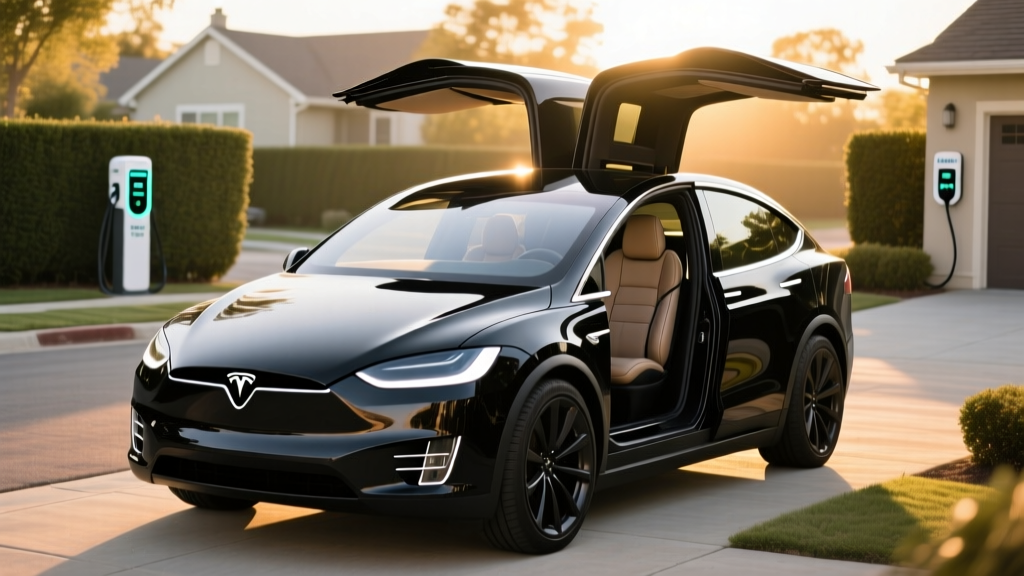
Falcon Wing doors: The signature rear doors open upward, providing dramatic access to the second and third rows. They're genuinely useful in tight parking spaces (they need less lateral clearance than conventional doors) but add mechanical complexity. Door sensor issues and hydraulic strut replacements are known pain points on used examples.
Pricing, Used Market Value, and Tax Credit Eligibility
The 2017 Model X originally started at $79,500 (75D) and climbed past $145,000 for a fully loaded P100D with Ludicrous Mode. In 2026's used market, expect to pay:
| Variant | Original MSRP | 2026 Used Price Range | Used EV Tax Credit (up to $4,000) |
|---|---|---|---|
| 75D | $79,500 | $22,000 – $32,000 | Potentially eligible |
| 100D | $96,000 | $28,000 – $40,000 | Potentially eligible |
| P100D | $145,000+ | $35,000 – $50,000 | Potentially eligible |
Critical: federal tax credit rules for used EVs. Under IRS §25E (Previously Owned Clean Vehicle Credit), you may qualify for up to $4,000 (or 30% of the sale price, whichever is less) when buying from a dealer. Key requirements:
- Sale price cap: Vehicle must be sold for $25,000 or less to qualify. This eliminates most 100D and P100D examples. Some high-mileage 75D models may sneak under the cap.
- Buyer income limits (2026): Modified AGI must not exceed $75,000 (single), $112,500 (head of household), or $150,000 (joint filers).
- Dealer sale required: Private-party purchases do not qualify.
- Vehicle age: Must be at least 2 model years old (2017 qualifies).
- One-time use: The credit can only be claimed once per buyer every 3 years.
The $25,000 sale-price cap is the biggest obstacle. Most 2017 Model X examples sell above this threshold. A high-mileage 75D at a dealer might just squeak under — but verify the final sale price on the dealer invoice before counting on the credit. Consult a tax professional for your specific situation.
The new-EV §30D credit ($7,500) does not apply to used vehicle purchases — it's only for new vehicles. The used-EV credit under §25E is the relevant incentive here.
Warranty, Reliability, and Ownership Costs
Tesla's original warranty on the 2017 Model X included:
- Basic vehicle: 4 years / 50,000 miles (expired on all 2017 examples)
- Battery and drive unit: 8 years / 150,000 miles (100D, P100D) or 8 years / 125,000 miles (75D) — with a minimum 70% capacity retention threshold
- Falcon Wing doors and related hardware: Covered under basic warranty only (expired)
As of 2026, most 2017 Model X vehicles are out of battery warranty unless they have exceptionally low mileage (under 125K–150K miles). This is a critical buying consideration. A Model X battery replacement costs $15,000–$22,000 at a Tesla Service Center, though third-party repair shops increasingly offer module-level repairs for $5,000–$10,000.
Known reliability concerns for used buyers:
- Falcon Wing door mechanisms (sensors, struts, seals) — expensive out of warranty
- Front trunk (frunk) latch and actuator failures
- Half-shaft and drive unit wear on high-mileage examples
- Windshield replacement is costly due to the panoramic glass roof integration
- MCU1 infotainment units (early 2017 builds) are prone to failure; check if the MCU was upgraded to MCU2 under Tesla's recall campaign
- Interior panel rattles and trim quality were common complaints on this generation
Insurance: Model X insurance premiums run 20–40% higher than comparable gas SUVs due to repair costs and performance. Expect $2,500–$4,000/year depending on your state, driving record, and coverage level.
Pros, Cons, and Who Should Buy
Pros
- Class-leading acceleration (P100D: 2.9s 0–60)
- Genuine three-row seating with usable cargo space
- Access to Tesla Supercharger network (17,000+ stalls in North America)
- Over-the-air updates keep software current
- Strong towing capacity (5,000 lbs) for an EV
- Falcon Wing doors are practical in tight spaces
- No gasoline costs — home charging at ~$0.13/kWh means ~$0.045/mile
Cons
- Slow DC charging by 2026 standards (~40–50 min 10–80%)
- Most examples out of battery warranty — replacement risk is $15K+
- Falcon Wing door repairs are expensive and specialized
- No Apple CarPlay or Android Auto
- Resistive heating (no heat pump) hurts cold-weather range
- High insurance premiums
- MCU1 infotainment hardware is sluggish
- Used prices often exceed $25K, disqualifying from $4,000 used-EV tax credit
Who the 2017 Model X suits best:
- Family commuters with home charging: If you can charge overnight and your daily drive is under 100 miles, the 100D's real-world range is more than adequate.
- Performance SUV buyers on a budget: A P100D at $40K delivers acceleration that rivals a Lamborghini Urus for a fraction of the price.
- Tesla Supercharger loyalists: Long-distance road trippers benefit from Tesla's reliable, widespread DC fast-charging network.
Who should look elsewhere:
- Buyers who can't absorb a potential $15K+ battery replacement: Without warranty coverage, this is a real financial risk.
- Cold-climate drivers: The lack of a heat pump and NMC chemistry mean significant winter range loss.
- Tech-forward buyers: The 2017 interior and infotainment feel dated next to a 2026 Rivian R1S, Hyundai Ioniq 9, or refreshed Model X.
2017 Model X vs. Key Used-EV Competitors
At $25,000–$50,000, the 2017 Model X competes with several used electric SUVs. Here's how it stacks up:
| Model | EPA Range | DC Fast Charge | Seats | Used Price Range |
|---|---|---|---|---|
| 2017 Tesla Model X 100D | 289 mi | ~145 kW peak | 5–7 | $28K–$40K |
| 2019 Audi e-tron | 204 mi | 150 kW peak | 5 | $25K–$35K |
| 2018 Jaguar I-PACE | 234 mi | 100 kW peak | 5 | $22K–$32K |
| 2020 Tesla Model Y LR | 326 mi | ~250 kW peak | 5–7 | $28K–$38K |
The Model X wins on range, seating capacity, and Supercharger access. The Model Y (2020+) is a newer design with faster charging and lower maintenance risk. The Audi e-tron offers a more premium interior but sacrifices range. Your choice depends on whether three-row seating and maximum range outweigh the age and maintenance risk of the 2017 platform.
Frequently Asked Questions
What is the real-world range of the 2017 Tesla Model X?
The EPA rates the 100D at 289 miles and the 75D at 237 miles. In real-world driving, expect 240–260 miles (100D) and 180–200 miles (75D) in mild weather. Highway driving at 75 mph reduces this to 210–230 and 155–175 miles respectively. Cold weather (below 30°F) can cut range by 20–30%. Factor in 10–18% battery degradation for a 7–9-year-old pack.
How fast does the 2017 Model X charge?
On a Tesla V2 Supercharger, the 100D peaks at ~145 kW and charges 10–80% in about 40–50 minutes. The 75D peaks at ~120 kW with a similar timeframe. At home on a Level 2 (240V, 48A) Tesla Wall Connector, you'll add about 29 miles of range per hour (100D) or 23 miles per hour (75D), fully replenishing overnight.
Does the 2017 Tesla Model X qualify for a federal tax credit?
The new-vehicle §30D credit ($7,500) does not apply — this is a used vehicle. The used-EV credit (§25E) offers up to $4,000, but only if the dealer sale price is $25,000 or less, the buyer meets income limits ($75K single / $150K joint), and the purchase is from a licensed dealer. Most 2017 Model X examples sell above $25,000, making the credit difficult to claim. Always verify with a tax professional and the IRS guidelines.
Is the 2017 Model X worth buying in 2026?
It depends on your priorities. If you need three-row seating, want Supercharger access, and can accept the out-of-warranty risk (especially the $15K–$22K battery replacement exposure), it's a compelling used EV. If you prioritize low maintenance risk, modern charging speeds, and the latest tech, a 2020+ Model Y or a newer EV SUV is a safer bet.
What are the biggest things to check before buying a used 2017 Model X?
Request a battery health report (SoH percentage) from Tesla or a third-party diagnostic tool. Verify the MCU version (MCU2 is preferred — MCU1 units are slow and failure-prone). Check the Falcon Wing door struts and sensors for smooth operation. Review service records for drive unit or half-shaft replacements. Confirm whether the vehicle has an active battery warranty (requires under 125K–150K miles depending on variant).
How much does it cost to charge a 2017 Model X at home?
At the US average residential rate of ~$0.16/kWh (EIA data), fully charging a 100D from 10% to 90% (~80 kWh) costs about $12.80, yielding roughly 230 real-world miles. That's approximately $0.055 per mile — compared to $0.14–$0.18 per mile for a gas SUV getting 20 MPG at $3.50/gallon.