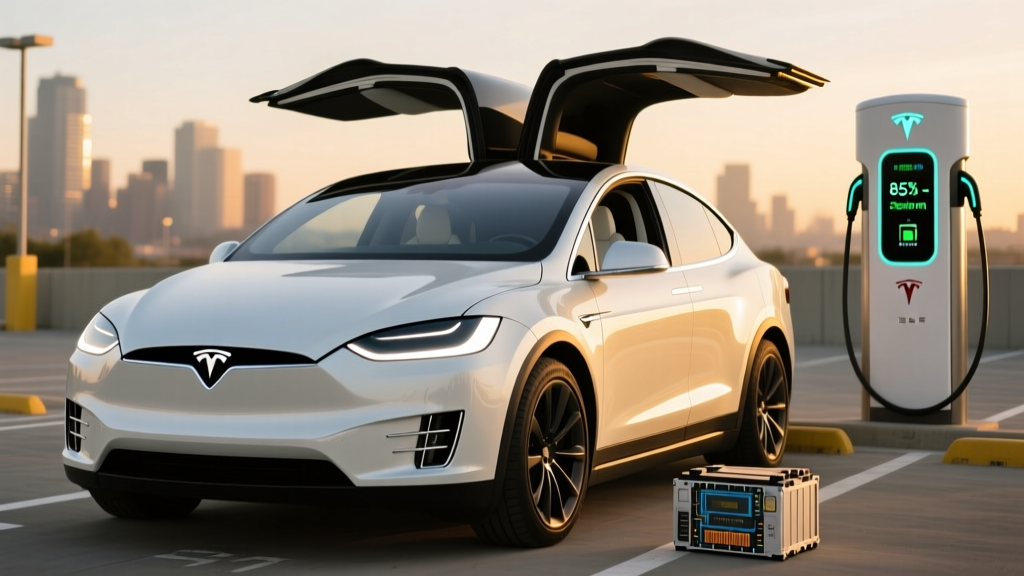
The 2017 Tesla Model X occupies a strange space in the used EV market. It's a falcon-wing-doored, three-row electric SUV from an era when Tesla was still iterating rapidly on build quality and battery chemistry. For buyers searching for a 2017 Tesla Model X in 2026, the value proposition hinges on one question: can a nine-year-old luxury EV with a 75 or 100 kWh battery still deliver practical daily range, acceptable charging speeds, and reliable ownership? This review breaks down every number that matters.
2017 Tesla Model X Quick Verdict
The 2017 Model X is best understood as a high-risk, high-reward used EV purchase. You get genuine three-row seating, standard all-wheel drive, access to the Tesla Supercharger network, and a driving experience that still feels modern. What you sacrifice is range (by 2026 standards), predictable build quality, and the peace of mind that comes with a new-vehicle warranty. Most 2017 Model X examples on the used market fall between $18,000 and $32,000 depending on mileage, condition, and battery variant — a steep discount from original MSRPs that exceeded $80,000.
| Spec | Model X 75D | Model X 100D | Model X P100D |
|---|---|---|---|
| Original MSRP | $79,500 | $96,000 | $135,000+ |
| EPA Range (new) | 237 mi | 295 mi | 289 mi |
| Battery (usable, est.) | ~72.5 kWh (NMC) | ~98 kWh (NMC) | ~98 kWh (NMC) |
| 0-60 mph | 6.0 sec | 4.7 sec | 2.9 sec (Ludicrous) |
| Horsepower | ~328 hp | ~417 hp | ~588 hp |
| Drivetrain | Dual-motor AWD | Dual-motor AWD | Dual-motor AWD |
| MPGe (combined, EPA) | 92 MPGe | 100 MPGe | 97 MPGe |
| DC Fast Charge Peak | ~120 kW | ~120 kW | ~120 kW |
| Battery Warranty (orig.) | 8 yr / 150,000 mi | 8 yr / 150,000 mi | 8 yr / 150,000 mi |
Range and Real-World Efficiency
The EPA-rated range for the 2017 Model X varies by variant. The 75D delivers an EPA-estimated 237 miles, the 100D reaches 295 miles, and the P100D sits at 289 miles. These figures were competitive in 2017 but fall well short of what modern EVs like the 2026 Hyundai Ioniq 9 (320+ mi EPA) or refreshed Tesla Model X (348 mi EPA) offer.
Real-World Range Expectations
EPA Sticker: 237 mi (75D) / 295 mi (100D) / 289 mi (P100D)
Real-World Highway (70 mph, mild weather): Expect 190-210 mi (75D) or 240-265 mi (100D). The Model X's tall, boxy profile and ~5,000-lb curb weight hurt highway efficiency significantly.
Cold Weather (below 32°F): Deduct 20-30%. A 100D that delivers 260 highway miles in summer may drop to 180-200 mi in freezing conditions, even with battery preconditioning.
Battery Degradation Factor: A 2017 model in 2026 has likely lost 10-18% of original capacity depending on charging habits and mileage. A 100D with 15% degradation starts from ~250 mi EPA equivalent before real-world losses compound.
The efficiency numbers tell the story: at 92-100 MPGe combined, the 2017 Model X consumes roughly 36-38 kWh per 100 miles. That's noticeably less efficient than a 2026 Model Y (roughly 28 kWh/100 mi) or a Rivian R1S (33-35 kWh/100 mi). On a practical level, expect to spend more per mile charging a 2017 Model X than most modern EVs.
According to fueleconomy.gov, the 2017 Model X 100D achieves 100 MPGe combined (34 kWh/100 mi), with a city rating of 101 MPGe and highway rating of 99 MPGe.
Charging Speed: DC Fast and Home Level 2
The 2017 Model X uses Tesla's proprietary connector (pre-NACS standardization) and charges on V2 Superchargers at a peak rate of approximately 120 kW. This is a significant limitation by 2026 standards, where modern EVs routinely peak at 200-350 kW on DC fast chargers.
| Charging Method | Power (kW) | Speed (mi/hr added) | Notes |
|---|---|---|---|
| Level 1 (120V outlet) | ~1.4 kW | ~3-4 mi/hr | Emergency/trickle only; 72+ hrs for full charge |
| Level 2 (240V, 48A) | ~11.5 kW | ~30-33 mi/hr | Full charge in ~8-10 hrs; requires NEMA 14-50 or hardwired wall connector |
| Level 2 (240V, 72A dual charger) | ~17.3 kW | ~45-50 mi/hr | Some 2017 X models equipped with optional dual onboard chargers |
| DC Fast (V2 Supercharger) | ~120 kW peak | ~200-280 mi/hr at peak | 10-80% in ~40-50 min; tapers sharply above 80% |
| DC Fast (V3 Supercharger) | ~120 kW (capped) | Same as V2 | 2017 Model X cannot utilize V3's 250 kW capability due to older battery architecture |
The 10-80% DC fast charge takes roughly 40-50 minutes in ideal thermal conditions. The charge curve tapers hard: you'll pull close to 120 kW up to roughly 50% state of charge, then watch it step down through 80, 60, and eventually 40 kW as the battery fills. Plan road-trip stops around 25-35 minutes for meaningful range additions, not full charges.
For home charging, the single onboard charger (48 amps / 11.5 kW) is adequate for overnight replenishment. If your 2017 Model X has the optional dual charger package (72 amps / 17.3 kW), you'll recover range roughly 50% faster on a properly provisioned Level 2 circuit. A standard NEMA 14-50 outlet on a 50-amp circuit delivers about 40 amps / 9.6 kW — sufficient for most daily needs.
Performance and Driving Dynamics
Even in 2026, a 2017 Model X P100D in Ludicrous mode remains genuinely quick: 0-60 mph in 2.9 seconds is supercar territory from a 5,000-lb three-row SUV. The 100D at 4.7 seconds and 75D at 6.0 seconds are both brisk by any family-SUV standard.
All 2017 Model X variants use a dual-motor all-wheel-drive system with independent front and rear motors. The air suspension provides adjustable ride height (useful for rough driveways or light off-pavement use) and automatically lowers at highway speeds for aerodynamic efficiency. However, the air suspension on 2017-era Model X vehicles is a known maintenance item — failures are common past 80,000 miles, and replacement struts run $1,500-$3,000 per corner.
Handling is competent but not sporty. The tall center of gravity, heavy weight, and relatively numb steering remind you this is a family hauler, not a canyon carver. Ride quality on the air suspension is generally comfortable, though 2017 models can exhibit more road noise than expected at this price point.
Interior, Cargo, and Technology
The 2017 Model X seats up to seven passengers in a 2-3-2 configuration (six-passenger with second-row captain's chairs was also available). Cargo volume is generous: 88.1 cu ft behind the front seats with second and third rows folded, 26.6 cu ft behind the third row. The front trunk (frunk) adds approximately 6.6 cu ft.
Second-row legroom measures 38.4 inches, and third-row legroom is a tight 32.7 inches — suitable for children on short trips but uncomfortable for adults beyond 30 minutes. The falcon-wing rear doors are dramatic and genuinely useful in tight parking spaces (they require less lateral clearance than conventional doors), but they add mechanical complexity and are prone to sensor issues and seal leaks.
The 17-inch center touchscreen runs Tesla's infotainment software, which receives over-the-air updates. However, 2017-era hardware (MCU1 or early MCU2) is noticeably slower than current Tesla interfaces. MCU1 units in particular suffer from eMMC memory failure — a well-documented issue that Tesla addressed via a recall and free replacement for affected vehicles. Verify whether your prospective purchase has the upgraded MCU2 hardware.
Autopilot hardware on 2017 models is Hardware 2.0 or 2.5 (HW2/HW2.5), which supports basic Autopilot (adaptive cruise + lane centering) but is limited in its Full Self-Driving capability compared to HW3/HW4 vehicles. FSD on HW2.5 is functional but slower and less capable than on newer hardware. Note: Autopilot and FSD (Supervised) are SAE Level 2 driver-assistance systems — the driver must remain fully engaged at all times.
Battery Health, Degradation, and Warranty
All 2017 Model X variants use NMC (nickel manganese cobalt) lithium-ion battery packs. NMC chemistry offers high energy density but is more sensitive to repeated deep cycling and high state-of-charge storage than LFP chemistry. Expect 10-18% capacity loss over nine years depending on use patterns.
Tesla's original battery warranty for the 2017 Model X was 8 years / 150,000 miles (whichever comes first), with a minimum 70% capacity retention threshold. As of 2026, most 2017 Model X vehicles have exceeded the time-based warranty limit (8 years from delivery = expired by 2025). This means battery replacement, if needed, is entirely out of pocket.
A Model X battery replacement through Tesla currently costs between $12,000 and $20,000 depending on pack size and refurbishment availability. Third-party EV repair shops may offer replacements for $8,000-$14,000 using salvaged or refurbished packs. Before purchasing, request a battery health report (accessible via the Tesla app or service menu) showing current State of Health (SoH) percentage.
Pricing, Tax Credits, and Ownership Costs
Used 2017 Tesla Model X pricing in 2026 typically ranges from $18,000 to $32,000 depending on trim, mileage, condition, and battery health. The 75D commands the lower end ($18,000-$23,000), while well-maintained 100D examples sit in the $24,000-$28,000 range. P100D models with low miles can still fetch $28,000-$32,000+.
| Cost Factor | Details |
|---|---|
| Used Market Price (2026) | $18,000 - $32,000 (varies by trim/miles/condition) |
| Federal Used EV Tax Credit (§25E) | Up to $4,000 or 30% of sale price (whichever is lower) for qualifying used EVs sold through a dealer. Income caps apply: $75K single / $150K married filing jointly. Vehicle must be at least 2 model years old and sold for $25,000 or less. |
| New EV Tax Credit (§30D) | NOT applicable — §30D applies only to new vehicle purchases. |
| Estimated Insurance (annual) | $2,200 - $3,500 (Model X insurance remains elevated due to repair costs) |
| Estimated Annual Maintenance | $800 - $2,000 (tires, cabin air filter, wipers, potential suspension/door issues) |
| Home Charging Cost (est.) | $0.13/kWh avg → ~$470-$620/year for 12,000 mi driven |
An important note on the federal used EV tax credit (IRC §25E): to qualify, the vehicle must be purchased from a licensed dealer (not a private party), the sale price must be $25,000 or less, and buyer income must not exceed $75,000 (single) or $150,000 (married filing jointly). The credit is 30% of the sale price up to a maximum of $4,000. This means a 2017 Model X 75D purchased for $22,000 from a dealer could net a $4,000 credit, while a $28,000 100D would not qualify because it exceeds the $25,000 price cap. Always verify current IRS rules at irs.gov before relying on credit eligibility.
Pros and Cons of the 2017 Model X in 2026
Pros
- Supercharger network access — still the most reliable DC fast-charging ecosystem in North America
- Genuine three-row seating with usable cargo space (88.1 cu ft max)
- Strong performance even in base 75D trim; P100D is supercar-quick
- Over-the-air software updates keep infotainment current (within hardware limits)
- Standard dual-motor AWD with capable traction in snow and rain
- Falcon-wing doors genuinely useful in tight parking spaces
- Used pricing has dropped significantly — value potential for informed buyers
Cons
- Original battery warranty has expired — replacement risk is real ($12K-$20K)
- Range (237-295 mi EPA new, less with degradation) is below 2026 standards
- DC fast charging capped at ~120 kW — 40-50 min for 10-80%, slow for road trips
- Falcon-wing doors and air suspension are expensive maintenance items
- Build quality inconsistency — panel gaps, rattles, and seal issues common
- HW2/HW2.5 Autopilot hardware limits FSD capability vs newer Teslas
- Insurance costs remain high relative to vehicle value
- Efficiency (92-100 MPGe) means higher charging costs per mile
Who Should Buy a 2017 Tesla Model X?
The 2017 Model X makes the most sense for a specific buyer profile: someone who needs three rows of seating, wants Supercharger access for road trips, can accept the battery degradation and out-of-warranty risk, and finds a well-maintained example at the right price. It works as a family daily driver for school runs and grocery trips, with occasional longer trips supported by Tesla's charging network.
It is not ideal for buyers who prioritize range (consider a used 2022+ Model Y Long Range or a Rivian R1S), who want minimal maintenance risk (a newer, still-warrantied EV is wiser), or who need the fastest road-trip charging (modern 800V-architecture EVs charge twice as fast).
Decision Framework
Choose the 2017 Model X if: You need three rows, want Supercharger access, can budget $2,000-$5,000/year for potential repairs, and find a 100D with verified battery SoH above 85% for under $26,000.
Look elsewhere if: You prioritize low maintenance risk, need 300+ miles of real-world range, take frequent 400+ mile road trips, or cannot absorb a surprise $15,000 battery replacement.
Frequently Asked Questions
What is the real-world range of a 2017 Tesla Model X in 2026?
With typical battery degradation of 10-18%, expect 190-230 real-world miles from a 75D and 230-270 miles from a 100D in moderate weather. Highway driving at 70+ mph and cold weather will reduce these numbers by 15-30%. Always check the specific vehicle's battery State of Health before purchasing.
How fast does the 2017 Model X charge?
On DC fast chargers (Superchargers), the 2017 Model X peaks at approximately 120 kW, achieving a 10-80% charge in roughly 40-50 minutes. At home on a Level 2 (240V, 48A) charger, it adds about 30-33 miles of range per hour, fully charging overnight in 8-10 hours.
Does a used 2017 Model X qualify for any federal tax credit?
It may qualify for the federal used clean vehicle credit (§25E) — up to $4,000 or 30% of sale price — but only if purchased from a dealer for $25,000 or less, and only if buyer income is under $75,000 (single) or $150,000 (MFJ). It does NOT qualify for the new-vehicle §30D credit. Verify current rules at irs.gov.
Is the 2017 Model X worth buying vs competitors?
Against a used 2020+ Model Y Long Range ($28K-$35K), the 2017 Model X offers three rows and more cargo space but sacrifices range, charging speed, and reliability confidence. Against a used 2022 Rivian R1S ($45K+), the Model X is far cheaper but less capable off-road and less modern. The Model X wins on value-per-seat for families on a budget who accept the risk profile.
What are the most common problems with the 2017 Model X?
The most frequently reported issues include: falcon-wing door sensor and actuator failures, air suspension strut leaks, MCU1 touchscreen eMMC failure (check for recall completion), windshield cracking (the panoramic windshield is large and expensive to replace at $1,500-$2,500), and drive unit whine or failure. A pre-purchase inspection by a Tesla-experienced technician is strongly recommended.
What battery warranty remains on a 2017 Model X?
None from Tesla directly. The original 8-year/150,000-mile battery warranty expired no later than 2025 for all 2017 vehicles. Some extended third-party warranties may be transferable — verify with the seller. Budget for potential battery replacement ($12,000-$20,000) as part of your total cost of ownership calculation.