Quick Verdict: A Flagship That Still Commands Respect
The 2017 Tesla Model S P100D was the performance king of its era — a full-size luxury sedan that could outrun most supercars while offering over 300 miles of range. In 2026, it exists exclusively on the used market, where depreciation has made it an intriguing value proposition for buyers who want flagship Tesla performance without the six-figure price tag. But buying a nearly decade-old EV demands scrutiny of battery health, charging infrastructure compatibility, and real ownership costs.
This profile breaks down every number that matters: EPA range versus what you will actually see, DC fast-charging realities, battery degradation expectations, and whether the 2017 Model S P100D still makes financial sense against modern rivals.
Range and Efficiency: 315 Miles on Paper, Less in Practice
The 2017 Model S P100D carries a 100 kWh battery pack (approximately 98 kWh usable) using NMC (nickel-manganese-cobalt) lithium-ion chemistry. The EPA rated it at 315 miles of combined range — a benchmark figure in 2017 that placed it atop the EV market.
EPA Sticker: 315 miles
Highway (70 mph, moderate temps): ~255–275 miles
City / mixed driving: ~280–300 miles
Cold weather (below 32°F): ~210–240 miles (30–35% reduction typical for NMC packs without a heat pump)
The 2017 Model S lacks a heat pump, relying on resistive cabin heating. This makes winter range loss more pronounced than in newer EVs with heat-pump systems. Plan for roughly 200–220 miles of usable range on a cold highway run before needing to charge.
Efficiency lands at 98 MPGe combined (35 kWh/100 mi) per fueleconomy.gov. That is respectable for a 4,900-pound sedan, though modern EVs like the Lucid Air and updated Model S achieve significantly better efficiency through improved aerodynamics and powertrain design.
Charging Speeds: CCS Adapter Required, Peak 120 kW
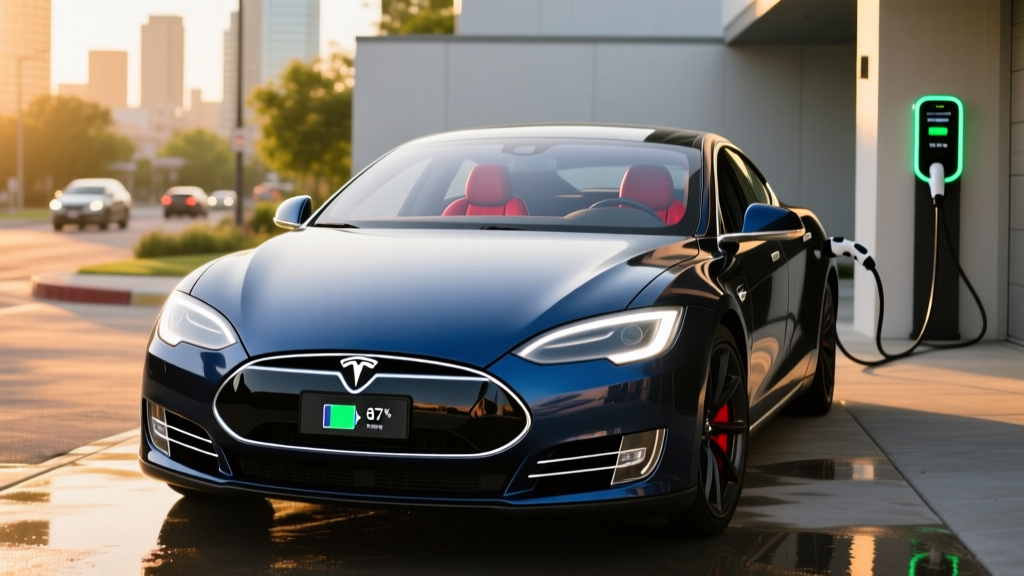
The 2017 Model S P100D uses Tesla's proprietary connector (pre-NACS standardization) and was originally designed for Tesla Supercharger V2 stations. Here is what you need to know about charging this car in 2026:
| Charging Level | Power (kW) | Speed / Time | Notes |
|---|---|---|---|
| Level 1 (120V household) | ~1.4 kW | ~3 mi/hr | Emergency only; 100+ hours for full charge |
| Level 2 (240V home, 48A) | ~11.5 kW | ~30 mi/hr | Requires HPWC or J1772 with Tesla adapter; ~10 hr for full charge |
| DC Fast (Supercharger V2) | Peak ~120 kW | 10–80% in ~40 min | Tapers significantly above 60% SoC; sustained avg ~70–80 kW |
| DC Fast (CCS station w/ adapter) | Peak ~120 kW (car-limited) | 10–80% in ~40–45 min | Tesla CCS adapter (~$175) required for non-Tesla networks |
Charging curve reality: The P100D's 100 kWh pack peaks at roughly 120 kW at low state of charge but tapers early. Expect an average rate of 70–80 kW across the 10–80% window. This means a typical road-trip stop adds about 180–200 miles in 30–35 minutes — adequate but noticeably slower than modern 800V architectures that sustain 200+ kW.
For home charging, a Level 2 station at 48 amps delivers about 30 miles of range per hour. A full charge from near-empty takes roughly 10 hours, which works well for overnight replenishment. Installation of a 60-amp circuit (to support 48A continuous) typically costs $500–$1,500 depending on panel proximity — consult a licensed electrician for your specific setup.
Performance: Ludicrous Mode and Dual-Motor AWD
The P100D pairs dual AC induction motors (one front, one rear) for full-time all-wheel drive. In standard mode, it produces roughly 588 horsepower. Engage Ludicrous Mode, and the 0–60 mph sprint drops to an astonishing 2.5 seconds — a figure that embarrassed hypercars costing ten times the price in 2017.
| Spec | 2017 Tesla Model S P100D |
|---|---|
| EPA Range | 315 miles |
| Battery (usable) | ~98 kWh, NMC chemistry |
| Drivetrain | Dual-motor AWD |
| Horsepower | ~588 hp (Ludicrous) |
| 0–60 mph | 2.5 seconds (Ludicrous Mode) |
| Top Speed | 155 mph |
| EPA Efficiency | 98 MPGe / 35 kWh/100mi |
| Max DC Fast Charge | ~120 kW peak |
| Level 2 Charge Rate | ~11.5 kW (48A) |
| Cargo Volume | 26.3 cu ft (rear) + 5.3 cu ft (frunk) |
| Rear Legroom | 35.4 inches |
| Curb Weight | ~4,941 lbs |
| Original Base MSRP | $134,500 |
| Original As-Tested (typical) | $142,000–$155,000 |
| Battery Warranty (original) | 8 yr / 150,000 mi |
| Powertrain Warranty | 8 yr / 150,000 mi |
Even by 2026 standards, a 2.5-second 0–60 time remains elite. The dual-motor torque-vectoring provides confident launches in wet conditions, and the air suspension offers adjustable ride height — useful for speed bumps and steep driveways.
Interior, Tech, and Driver Assistance
The 2017 Model S interior centers on a 17-inch portrait touchscreen that controls virtually every vehicle function. The instrument cluster is a smaller digital display behind the steering wheel. Notable tech features include:
- Autopilot (basic): Traffic-aware cruise control and lane-keeping assist — this is SAE Level 2 driver assistance, not self-driving. The driver must remain engaged at all times.
- Enhanced Autopilot (optional, ~$5,000): Added auto lane change, autosteer on highways, self-park, and summon. Still Level 2.
- Full Self-Driving (FSD) capability: Some 2017 models were sold with FSD packages, though Tesla's Hardware 2.0 in the 2017 model year has limited FSD performance compared to HW3/HW4 vehicles. Verify which hardware version is installed before paying a premium for FSD.
- Over-the-air updates: Tesla continues pushing software updates to 2017 vehicles, though feature additions have slowed significantly for older hardware.
- Premium interior package: Most P100D examples include upgraded leather, Alcantara headliner, premium audio with 11 speakers, and HEPA air filtration with Bioweapon Defense Mode.
Drawbacks to note: The 2017 interior materials, while acceptable, do not match the luxury standard set by Mercedes, BMW, or Audi at this price point. Panel gaps were inconsistent, the center console storage is limited, and rear-seat comfort is merely adequate for a car of this size. The large touchscreen, while impressive in 2017, shows its age with slower response times compared to current Tesla hardware.
Pricing, Depreciation, and Tax Credit Reality
The 2017 Model S P100D originally stickered at $134,500 before options, with most examples landing between $142,000 and $155,000 as-tested. In the 2026 used market, expect to find examples ranging from $28,000 to $48,000 depending on mileage, condition, battery health, and whether FSD is included and transferable.
| Rule | Detail |
|---|---|
| Credit Amount | 30% of sale price, up to $4,000 maximum |
| Vehicle Price Cap | Sale price must be $25,000 or less |
| Buyer Income Cap | $75,000 single / $112,500 head of household / $150,000 joint |
| Vehicle Age Requirement | Must be at least 2 model years old (2017 qualifies) |
| Dealer Requirement | Must purchase from a licensed dealer (private sales excluded) |
| Point-of-Sale Transfer | Available — credit applied at purchase |
Source: IRS §25E Used Clean Vehicle Credit. Confirm eligibility with a tax professional — rules are subject to legislative change.
Critical caveat: The §25E used-EV credit caps the vehicle sale price at $25,000. Most 2017 Model S P100D examples sell above this threshold, meaning the majority of buyers will not qualify for the $4,000 used-EV credit. Only high-mileage or lower-condition examples priced at or below $25,000 would be eligible, and income caps apply. The new-vehicle §30D credit ($7,500) does not apply to used purchases.
Battery Health and Longevity: What to Check Before Buying
The 2017 P100D's 100 kWh NMC pack is one of the largest ever fitted to a production EV. Tesla's original battery warranty covers 8 years or 150,000 miles (whichever comes first) with a capacity retention threshold of approximately 70%. For a 2017 model, this warranty window has either expired or is expiring in 2025–2026, meaning most examples are now out of battery warranty.
Degradation expectations: NMC chemistry in the P100D typically shows 10–18% capacity loss over 7–8 years of normal use, depending on charging habits and climate. A car that was frequently Supercharged to 100% and operated in hot climates (Arizona, Texas) may show 20%+ degradation. Before purchasing:
- Request a battery health report from Tesla service or a third-party EV inspector
- Check the car's displayed "typical range" at 100% charge — a healthy pack should show 260+ miles; anything below 240 suggests significant degradation
- Verify whether the battery has been replaced under warranty (some early P100D packs were swapped)
- Budget $12,000–$20,000 for a potential out-of-warranty battery replacement — though many packs last well beyond 150,000 miles
The AC induction motors in the P100D are mechanically simple and generally reliable. The 12V lead-acid auxiliary battery is a known maintenance item (replace every 3–4 years, ~$300–$500). The air suspension can develop leaks at higher mileage — budget $1,500–$3,000 per corner if replacement struts are needed.
Pros and Cons: The Honest Assessment
- 2.5-second 0–60 mph remains world-class performance
- 315-mile EPA range is still competitive for road trips
- Tesla Supercharger network access (largest reliable DC network in the US)
- Massive cargo space: 26.3 cu ft trunk + 5.3 cu ft frunk
- Over-the-air updates still arriving for older hardware
- Significant depreciation makes it accessible vs. original MSRP
- Air suspension with adjustable ride height
- Most examples exceed the $25,000 cap for the used-EV tax credit
- Battery warranty has expired or is expiring — replacement risk is on the buyer
- No heat pump — cold-weather range loss of 30–35%
- Peak DC charging limited to ~120 kW; slower than modern EVs
- Interior build quality and materials lag behind German luxury competitors
- Hardware 2.0 limits Autopilot/FSD capability vs. newer Teslas
- Insurance premiums can be elevated for high-performance used EVs
- Out-of-warranty air suspension and MCU repairs are costly
Who Should Buy the 2017 Model S P100D?
This car suits a specific buyer profile:
- Performance enthusiasts who want supercar-rivaling acceleration in a practical four-door sedan and are comfortable with used-EV risk
- Daily commuters with home Level 2 charging who value the 280+ mile real-world range for round-trip commutes without public charging dependency
- Tesla ecosystem fans who want Supercharger access and over-the-air updates at a fraction of the original price
It is less ideal for buyers who prioritize cutting-edge driver assistance (Hardware 2.0 limits FSD), those in extreme cold climates (no heat pump), or risk-averse shoppers who want a transferrable battery warranty. Families needing third-row seating should look at the Model X instead.
Frequently Asked Questions
What is the real-world range of the 2017 Tesla Model S P100D?
The EPA rates it at 315 miles combined. In real-world highway driving at 70 mph, expect 255–275 miles. In cold weather (below freezing), range drops to approximately 210–240 miles due to resistive heating and battery chemistry limitations.
How fast does the 2017 Model S P100D charge?
On a Tesla Supercharger V2 or equivalent DC fast charger, it peaks at ~120 kW but averages 70–80 kW across a 10–80% session, taking roughly 40 minutes. At home on a Level 2 charger (48A/11.5 kW), it adds about 30 miles per hour, fully charging in ~10 hours.
Does the 2017 Model S P100D qualify for any federal EV tax credit?
The new-vehicle §30D credit does not apply. The used-EV credit (§25E) offers up to $4,000, but only if the sale price is $25,000 or less and the buyer meets income caps. Most P100D examples sell above $25,000, disqualifying them. Verify with a tax professional per IRS guidelines.
Is the 2017 Model S P100D worth buying versus a newer used EV?
If you prioritize raw acceleration, range, and Supercharger access, the P100D offers tremendous value at $28,000–$48,000 used. However, a newer used Model 3 Long Range or Model Y may offer better efficiency, newer hardware (HW3/HW4), a heat pump, and lower maintenance risk — though with less performance and cargo space.
What should I check before buying a used 2017 Model S P100D?
Request a battery health report and verify displayed range at 100% SoC (target 260+ miles). Check service history for battery replacements, air suspension repairs, and MCU upgrades. Confirm whether the car has Hardware 2.0 or was upgraded to HW3. Get a pre-purchase inspection from a Tesla-certified shop or mobile EV inspector.
How reliable is the 2017 Model S P100D out of warranty?
The drivetrain (motors, battery) is generally robust, but ancillary systems — air suspension struts, the 12V battery, door handles, and the MCU touchscreen — are known failure points at higher mileage. Budget $2,000–$5,000 annually for maintenance and repairs on an out-of-warranty example. Extended third-party EV warranties are available but read exclusions carefully.