Quick Verdict: Still a Benchmark Sedan in 2026, With Caveats
The 2017 Tesla Model S was the full-size luxury EV to beat when new, and nearly a decade later it remains a compelling used buy — if you know what to look for. The minimalist 17-inch portrait touchscreen, available All-Glass Panoramic Roof, and optional Premium Interior package with Alcantara headliner still read as modern. But buyers in 2026 need to weigh aging battery chemistry, slower DC fast-charging by current standards, and the realities of a vehicle approaching its battery warranty cliff.
This profile covers every spec a used-EV shopper needs: real-world range reconciliation, Supercharger charge-curve behavior, interior dimensions and material quality, and whether the 2017 Model S still qualifies for a federal tax credit on the secondary market.
| Spec | 60 / 60D | 75 / 75D | 100D / P100D |
|---|---|---|---|
| Usable Battery (kWh) | ~62 kWh (NMC) | ~75 kWh (NMC) | ~100 kWh (NMC) |
| EPA Range (miles) | 210 / 218 | 249 / 259 | 335 / 315 |
| MPGe (combined) | 98 / 98 | 103 / 104 | 102 / 98 |
| kWh / 100 mi | 34 | 33 / 32 | 33 / 35 |
| 0-60 mph (sec) | 5.5 / 5.2 | 4.2 / 4.2 | 4.2 / 2.5 (P100D) |
| Horsepower | 315 / 328 | 328 / 328 | 417 / 762 (P100D, Ludicrous) |
| Drivetrain | RWD / AWD | RWD / AWD | AWD (Dual Motor) |
| Max DC Fast Charge | 120 kW | 120 kW | 120 kW (CHAdeMO adapter available) |
| 10–80% DCFC Time | ~30 min | ~40 min | ~55 min |
| Level 2 Home Charge | 11.5 kW (48A) — ~29 mi/hr | 11.5 kW (48A) — ~34 mi/hr | 11.5 kW (48A) — ~40 mi/hr |
| Battery Warranty (orig.) | 8 yr / 120,000 mi | 8 yr / 120,000 mi (unltd on 75 RWD) | 8 yr / 150,000 mi |
| Original Base MSRP | $68,000 | $74,500 | $94,000 / $135,700 (P100D) |
Sources: EPA fueleconomy.gov, Tesla 2017 Model S Owner's Manual.
2017 Tesla Model S Interior: Materials, Space, and the 17-Inch Screen Era
Searching for "2017 Tesla Model S interior" usually means one of two things: buyers want to know whether the cabin holds up in 2026, or they're comparing it to the refreshed 2021+ interior. Here's the honest breakdown.
Materials and Build Quality
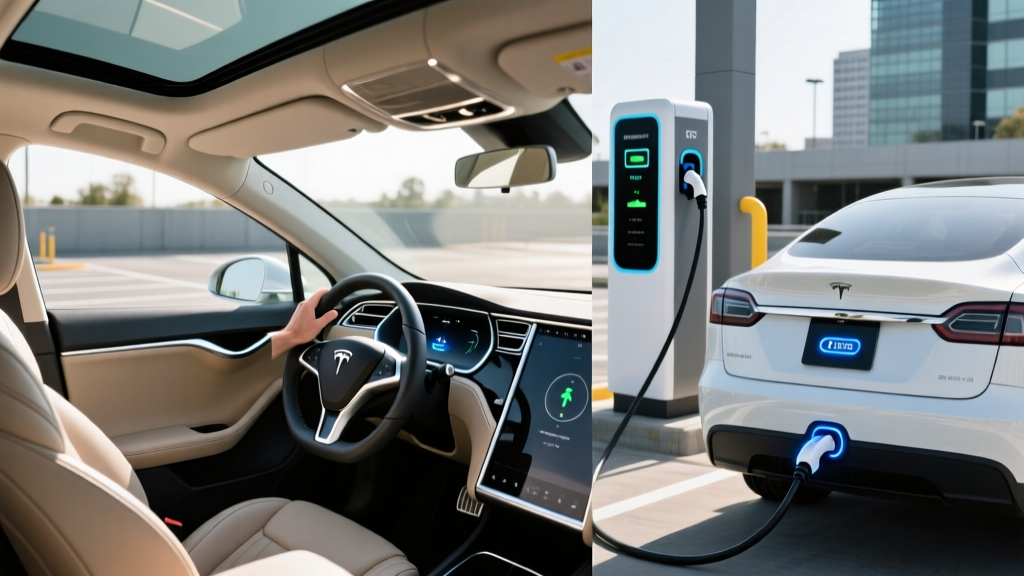
The 2017 Model S offered two interior tiers. The standard interior used synthetic leather (Tesla called it "vegan" even then) on seats with gloss-black or wood trim. The optional Premium Interior ($3,300 at the time) added Alcantara headliner, genuine wood or carbon-fiber decor, soft-touch door panels, and upgraded seat bolsters. In 2026, Premium Interior examples have aged noticeably better — the standard gloss-black trim shows fingerprints and micro-scratches, while the Alcantara headliner on Premium cars resists sagging.
Common wear points on 2017 interiors at ~100,000 miles: driver-seat bolster cracking, center-console cupholder rattle, and the chrome-plated plastic door handles developing stickiness in hot climates. None are deal-breakers, but budget $500–$1,200 for cosmetic refreshes.
Infotainment: MCU1 vs. MCU2 (Critical for Used Buyers)
Early 2017 Model S vehicles shipped with MCU1 (Media Control Unit 1), powered by an NVIDIA Tegra 3 chip. By mid-2018, Tesla began retrofitting MCU2 (Intel Atom) to address sluggishness and the well-documented eMMC flash-memory failure. If the 2017 car you're evaluating still has MCU1, expect slow map rendering, no Netflix/YouTube streaming, and a potential $1,500–$2,500 upgrade cost. Verify MCU version before purchase — go to Software → Additional Vehicle Information on the touchscreen.
Interior Dimensions
- Front headroom: 38.8 in
- Front legroom: 42.7 in
- Rear headroom: 35.3 in (37.1 in with Panoramic Roof delete)
- Rear legroom: 35.4 in
- Cargo (rear trunk): 26.3 cu ft
- Frunk (front trunk): 5.3 cu ft
- Total cargo with rear seats folded: 58.1 cu ft
The rear middle seat is essentially a penalty box — narrow, with a transmission-tunnel hump from the rear motor housing. Two adults ride comfortably; three is a compromise. The 26.3 cu ft trunk swallows four roll-aboard bags plus a stroller, which still beats most 2026 luxury sedans.
Real-World Range vs. EPA: What 2017 Owners Actually Get
EPA sticker: Up to 335 miles (100D) / 315 miles (P100D) / 259 miles (75D)
Real-world expectation in 2026: Subtract 10–15% for battery degradation on a typical 80,000–120,000-mile example. A 100D with 10% degradation delivers ~300 miles in mixed driving. Highway-only at 75 mph drops that to ~250–270 miles. Cold-weather (below 32°F) further reduces range by 20–30%, putting a degraded 100D at ~210–230 miles on a winter road trip.
The 2017 Model S uses NMC (nickel-manganese-cobalt) battery chemistry across all trims. NMC offers higher energy density than LFP but is more sensitive to sustained high-state-of-charge storage. A 2017 Model S that spent years parked at 100% SoC will show more degradation than one kept between 20–80%. Request a battery health report (accessible via the Tesla app or third-party services like Recurrent) before purchase — anything below 85% State of Health on a 100 kWh pack is negotiable price territory.
Efficiency in Practice
The 100D's EPA rating of 33 kWh/100 mi (combined) translates to roughly $0.11–$0.14 per mile on the national average residential rate of $0.16/kWh (as of early 2026). Highway driving at 80 mph pushes consumption to 38–40 kWh/100 mi. For comparison, a 2026 Lucid Air Grand Touring achieves 26 kWh/100 mi — the efficiency gap reflects nearly a decade of drivetrain and aero improvements.
Charging Speeds: Supercharger Curve and Home Level 2 Reality
| Charging Level | Max Rate | Miles Added per Hour | Notes |
|---|---|---|---|
| Level 1 (120V, 12A) | 1.4 kW | ~3–4 mi/hr | Emergency/trickle only; 30+ hr for full 100 kWh |
| Level 2 (240V, 48A) | 11.5 kW | ~29–40 mi/hr | Full charge in 7–10 hr; requires 60A circuit |
| DC Fast (Supercharger V2) | 120 kW peak | ~300+ mi/hr at peak | Peak only below 40% SoC; tapers sharply above 60% |
| DC Fast (V3 Supercharger) | ~120 kW (capped) | Same as V2 | 2017 Model S cannot utilize V3's 250 kW; hardware-limited |
The 2017 Model S charges at a peak of 120 kW on Superchargers, but that peak holds only from roughly 5–35% State of Charge. Above 50%, the curve tapers to ~80 kW; above 80%, it drops below 40 kW. A 10–80% session on a 100 kWh pack takes approximately 55 minutes — competitive in 2017 but noticeably slower than a 2026 Hyundai Ioniq 5 (10–80% in ~18 min at 240 kW) or even the 2024+ Model S (which supports up to 250 kW).
CHAdeMO Adapter Note
The 2017 Model S uses Tesla's proprietary connector (pre-NACS standardization). Tesla offered a CHAdeMO adapter (~$450) enabling access to non-Tesla DC fast chargers, but CCS compatibility requires a third-party adapter (Setec, ~$300–$450) that has mixed firmware reliability. For 2026 buyers, the expanding Tesla Supercharger network (now open to other brands) is actually an advantage — you'll rarely need non-Tesla DC chargers.
Home Charging Setup
The onboard charger supports up to 11.5 kW (48 amps), requiring a 60-amp dedicated circuit with a NEMA 14-60 outlet or hardwired Wall Connector. Expect $800–$2,200 for a licensed electrician to install a 60A circuit, depending on panel proximity and local permit fees. Homes with older 100A service panels may need a $2,000–$4,000 panel upgrade — factor this into total acquisition cost.
Performance and Driving Dynamics
The P100D with Ludicrous Mode remains one of the quickest production sedans ever built: 2.5 seconds 0–60 mph with 762 horsepower (combined, peak). The 100D is a more rational choice at 4.2 seconds and 417 hp, with better range. The 75D at 4.2 seconds and 328 hp is the volume model and the sweet spot for used buyers who want AWD without the P100D's insurance premiums.
Adaptive air suspension was standard on AWD models and optional on RWD. In 2026, check for air-strut leaks — replacement runs $1,200–$1,800 per corner at independent shops, or $2,500+ at Tesla Service. The Model S rides firmly but compliantly; it's a grand-tourer, not a sports sedan, and the ~4,900-lb curb weight is noticeable on tight switchbacks.
Autopilot and Driver Assistance (SAE Level 2)
SAE Automation Level: 2 (Partial Driving Automation)
The 2017 Model S with Enhanced Autopilot offers adaptive cruise control, lane-centering, automatic lane changes, and auto-park. The driver must remain engaged with hands on the wheel and eyes on the road. This is not self-driving. Full Self-Driving (FSD) Capability was available as a $8,000 software option, but on 2017 hardware (HW2.0/HW2.5), FSD performance in 2026 is inferior to HW3.0+ vehicles. Tesla does not currently offer a hardware retrofit path for 2017 models.
For highway commuting, 2017-era Autopilot is competent and reduces fatigue. For city-street navigation, it's dated compared to 2024+ FSD Supervised. Buyers should not pay a premium for FSD on a 2017 — the hardware ceiling limits its value.
Pricing in 2026: Used Market Values and Tax Credit Eligibility
| Trim | Used Price Range (2026) | Federal Used-EV Credit (§25E) | Net Cost After Credit |
|---|---|---|---|
| 60 / 60D | $16,000–$21,000 | Up to $4,000 (30% of sale price, capped) | $12,000–$17,000 |
| 75 / 75D | $19,000–$26,000 | Up to $4,000 | $15,000–$22,000 |
| 100D | $25,000–$33,000 | Up to $4,000 | $21,000–$29,000 |
| P100D | $32,000–$45,000 | Up to $4,000 | $28,000–$41,000 |
Federal Tax Credit: §25E Used-EV Rules (Not §30D)
The 2017 Model S does not qualify for the new-vehicle §30D credit (which applies to new purchases only). Instead, it may qualify for the §25E Previously-Owned Clean Vehicle Credit, which offers 30% of the sale price, up to $4,000. Key eligibility rules per IRS guidance:
- Sale price cap: $25,000 or less (this disqualifies most 100D and all P100D listings)
- Buyer income cap: $75,000 single / $112,500 head of household / $150,000 joint (modified AGI)
- Dealer requirement: Must be purchased from a licensed dealer (private-party sales excluded)
- Vehicle age: Model year must be at least 2 years older than the calendar year of purchase (2017 qualifies in 2026)
- First-time transfer: Credit applies only on the first qualifying resale since August 16, 2022 — if the car has already been resold with the credit claimed, it cannot be claimed again
Practical implication: a 2017 75D selling for $24,500 from a dealer nets a $4,000 credit for income-eligible buyers, bringing effective cost to $20,500. A P100D at $38,000 gets no federal credit because it exceeds the $25,000 sale-price cap. Consult a tax professional before relying on credit eligibility.
Warranty Status in 2026: The Battery Clock Is Ticking
This is the single most important section for 2017 Model S buyers. Original battery and drive-unit warranties were:
- 60 / 75 kWh: 8 years / 120,000 miles (75 RWD had unlimited-mile battery coverage)
- 100 kWh (100D/P100D): 8 years / 150,000 miles
- Basic vehicle: 4 years / 50,000 miles (long expired)
In 2026, a 2017 Model S is 8–9 years old. The 60 and 75 kWh models have passed or are within months of their 8-year warranty expiration regardless of mileage. The 100D/P100D warranty expires based on whichever comes first — 8 years from in-service date or 150,000 miles. A 2017 100D delivered in March 2017 lost warranty coverage in March 2025.
Battery replacement cost (out of warranty): $12,000–$18,000 for a remanufactured pack at Tesla Service, or $8,000–$12,000 at independent EV shops (e.g., Electrified Garage). Drive-unit replacement: $4,000–$7,000. Budget accordingly or negotiate price down to reflect remaining battery life.
Tesla warrants that the battery will retain at least 70% of original capacity during the warranty period. Out-of-warranty, degradation continues at a slower rate — expect ~1–2% additional loss per year with normal use.
Pros, Cons, and Who Should Buy the 2017 Model S
Pros
- Still one of the most spacious luxury EV sedans (26.3 cu ft trunk + 5.3 cu ft frunk)
- Supercharger network access — the largest reliable DC network in North America
- Premium Interior with Alcantara holds up better than most 2017 luxury cabins
- P100D performance (2.5s 0–60) remains supercar-tier in 2026
- Over-the-air updates still add features (though HW2.x limits FSD)
- Air suspension standard on most AWD trims
- Used-EV tax credit eligible on 60D/75D under $25K sale-price cap
Cons
- Battery warranty expired or expiring — $12K–$18K replacement risk
- 120 kW peak DC charging is slow by 2026 standards (55 min 10–80% on 100D)
- MCU1 infotainment (pre-mid-2017 builds) is sluggish; upgrade costs $1,500+
- HW2.0/2.5 Autopilot hardware limits FSD capability with no retrofit path
- Outdated styling vs. 2021+ refresh — no yoke, no rear screen, no matrix headlights
- NMC chemistry degrades faster than LFP if stored at high SoC
- Air suspension struts are a known failure point at 80K+ miles
- No federal tax credit on 100D/P100D (exceeds $25K price cap)
Who This EV Suits Best
Ideal buyer: A commuter with home Level 2 charging who wants a spacious, fast luxury sedan for under $25K (after credit), drives less than 15,000 miles/year, and accepts the battery-replacement risk as a cost of entry. The 75D at ~$22K after credit is the value sweet spot.
Not ideal for: High-mileage road-trippers (the 120 kW charge curve adds 15–20 minutes per stop vs. modern EVs), buyers without home charging (reliance on Superchargers accelerates battery wear), or anyone expecting cutting-edge ADAS — HW2.x is a dead end for autonomous features.
Competitor Check: 2017 Model S vs. 2026 Alternatives
At the $20K–$30K used-EV price point in 2026, the 2017 Model S competes against:
- 2019–2020 Tesla Model 3 Long Range: Faster charging (up to 250 kW), HW3.0 for full FSD, but smaller interior (15 cu ft trunk). Better for tech-focused buyers.
- 2018–2019 Jaguar I-PACE: Similar luxury, AWD, ~234 mi EPA, but slower 50 kW DC charging and sparse public network support. Worse road-trip choice.
- 2019–2020 Chevrolet Bolt EUV: Under $15K, qualifies for full $4K used credit, but 247 mi range and no DC fast charging above 55 kW. City-only commuter.
The 2017 Model S wins on interior space, ride comfort, and Supercharger access. It loses on charging speed, warranty coverage, and ADAS hardware. If interior volume and grand-touring comfort are your priorities, nothing else at this price matches it.
Frequently Asked Questions
What is the real-world range of a used 2017 Tesla Model S?
A 2017 Model S 100D with ~10% battery degradation delivers approximately 290–300 miles in mixed driving, 250–270 miles highway at 75 mph, and 210–230 miles in cold weather (below 32°F). The 75D yields roughly 220–230 miles mixed with similar degradation. Always verify State of Health via a pre-purchase battery report.
How fast does the 2017 Model S charge?
Peak DC fast charging is 120 kW on Tesla Superchargers (V2 or V3 — the car is hardware-capped at 120 kW regardless of station capability). A 10–80% session takes ~55 minutes on the 100 kWh pack, ~40 minutes on the 75 kWh. Home Level 2 charging at 11.5 kW adds 29–40 miles per hour depending on trim, fully replenishing overnight.
Does the 2017 Model S qualify for any federal tax credit in 2026?
Not the new-vehicle §30D credit. It may qualify for the §25E used-EV credit (30% of sale price, max $4,000) if the sale price is $25,000 or less, the buyer's income is under IRS caps ($75K single / $150K joint), the sale is through a licensed dealer, and the credit hasn't been previously claimed on this VIN since August 2022. This effectively limits the credit to 60D and 75D models priced at or below $25K.
Is the 2017 Model S worth buying vs. a newer Model 3?
For interior space, ride quality, and prestige, the 2017 Model S still beats a used Model 3. For technology (HW3.0+, faster charging, modern FSD), the Model 3 is the clear winner. If you need a family sedan with cargo room and don't road-trip often, the Model S is the better value. If you commute long distances or want the latest ADAS, choose the Model 3.
What are the most expensive repairs on a 2017 Model S?
Battery pack replacement ($12K–$18K out of warranty), air-suspension strut replacement ($1,200–$2,500 per corner), MCU1-to-MCU2 infotainment upgrade ($1,500–$2,500), and drive-unit replacement ($4K–$7K). A pre-purchase inspection at an independent EV shop ($200–$400) is essential.
Can I upgrade a 2017 Model S to the newer yoke steering or rear screen?
No. The yoke steering wheel and rear passenger touchscreen were introduced with the 2021 Model S refresh (Palladium platform). The 2017 chassis and wiring harness do not support these retrofits. Aftermarket yoke-style wheels exist but lack the integrated controls and are not recommended for safety reasons.