The 2017 Tesla Model S 100D in 2026: Flagship Range at a Fraction of the Price
Nine years after it launched, the 2017 Tesla Model S 100D remains one of the most capable used electric sedans on the market. With an EPA-estimated 335 miles of range — still competitive with many brand-new EVs in 2026 — a 100 kWh NMC battery pack, and dual-motor all-wheel drive, it offers long-distance comfort that few used alternatives can match. But buying a nearly decade-old EV requires scrutiny: battery degradation, expired warranties, outdated hardware, and zero federal tax credit eligibility all factor into the calculus. This profile breaks down the exact numbers you need before signing a purchase agreement.
The 2017 Model S 100D carries an EPA-estimated 335 miles of range. In real-world 2026 ownership, expect 270–310 miles depending on battery state of health (SoH), driving style, and ambient temperature. Highway driving at 75 mph typically yields 280–295 miles on a healthy pack. In freezing conditions (below 30°F), range can drop to 230–260 miles due to cabin heating demands and reduced battery chemistry efficiency. A unit with 10–15% degradation will proportionally reduce these figures.
Spec Table: 2017 Tesla Model S 100D at a Glance
| Attribute | Specification |
|---|---|
| EPA Range (original) | 335 miles |
| Battery Capacity (usable) | ~98 kWh (100 kWh nominal) |
| Battery Chemistry | NMC (Nickel Manganese Cobalt) |
| Drivetrain | Dual-motor AWD |
| Horsepower | 417 hp (combined) |
| 0–60 mph | 4.2 seconds |
| Top Speed | 155 mph |
| Efficiency | 102 MPGe combined / 33 kWh/100mi |
| Max DC Fast Charge | ~120 kW peak (Supercharger V2) |
| 10–80% DC Charge Time | ~45–50 minutes |
| Level 2 Home Charging | 11.5 kW (48A) — up to 37 mi/hr |
| Cargo Volume | 26.3 cu ft (rear) + 5.3 cu ft (frunk) |
| Rear Legroom | 35.4 inches |
| Battery Warranty (original) | 8 years / unlimited miles |
| Original MSRP | $94,000 (base) — $110,000+ as-tested |
| 2026 Used Price Range | $28,000–$42,000 |
Battery Health, Chemistry, and Degradation
The 100D uses a Panasonic-built NMC (nickel manganese cobalt) lithium-ion pack with a nominal capacity of 100 kWh and approximately 98 kWh usable. NMC chemistry delivers high energy density — critical for fitting 335 miles into a sedan floorpan — but it is more sensitive to sustained high states of charge and extreme heat than LFP (lithium iron phosphate) packs found in newer Tesla Standard Range models.
Based on aggregated owner data from TeslaFi and community fleet tracking, a 2017 Model S 100D battery typically shows 8–14% degradation after 80,000–120,000 miles. That translates to a realistic range of 288–308 miles on a full charge for a well-maintained unit. Packs that were routinely charged to 100% or frequently DC fast-charged in hot climates may sit at the higher end of that degradation range.
What to check before buying: Request the car's projected range at 100% SoC from the instrument cluster. Compare it against the original 335-mile figure. A reading below 290 miles suggests above-average degradation. Tesla service centers can pull a detailed battery health report, though this is not always offered proactively — ask specifically.
The original 8-year/unlimited-mile battery and drive unit warranty expired in 2025 for all 2017 units. Out-of-warranty battery replacement for a 100 kWh pack runs $18,000–$24,000 at a Tesla service center, including labor. This is the single largest financial risk when buying a high-mileage 100D.
Charging: Speeds, Connectors, and 2026 Network Access
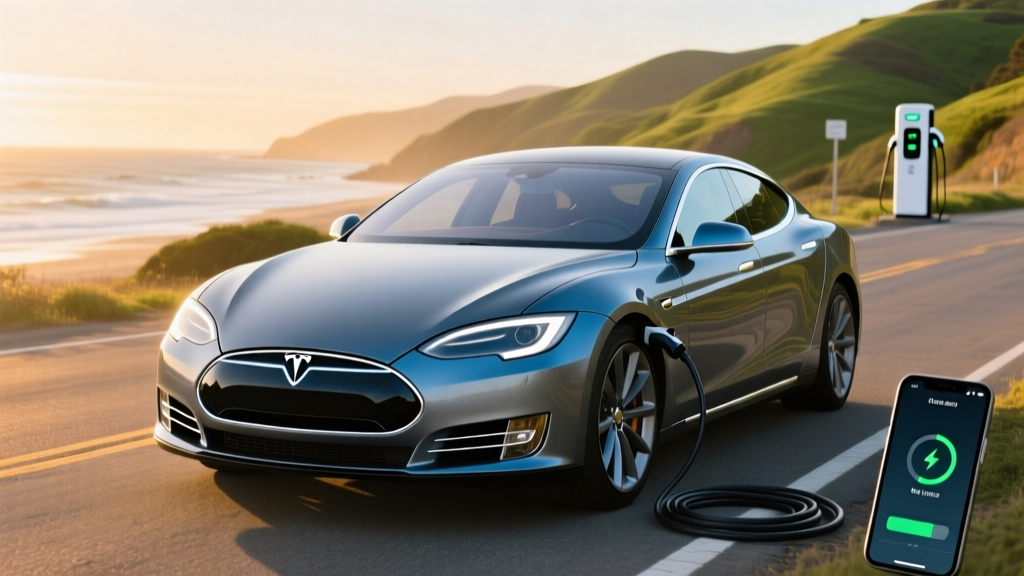
The 2017 Model S 100D charges via Tesla's proprietary connector (now standardized as NACS). With the industry's widespread adoption of NACS as the North American standard through 2025–2026, this car can access the full Tesla Supercharger network natively — a major advantage over 2017-era competitors using CCS or CHAdeMO that now require adapters.
| Charging Level | Power / Rate | Miles Added per Hour | Notes |
|---|---|---|---|
| Level 1 (120V household) | 1.4 kW | ~4 mi/hr | Emergency/trickle only |
| Level 2 (240V / 48A) | 11.5 kW | ~37 mi/hr | Full charge in ~9 hours |
| DC Fast (Supercharger V2) | ~120 kW peak | ~230 mi/hr (peak) | 10–80% in ~45–50 min |
| DC Fast (Supercharger V3/V4) | ~120 kW (car-limited) | ~230 mi/hr (peak) | Car caps below station max |
The 100D's onboard charge architecture peaks around 120 kW on DC fast charging. This means it cannot take advantage of the 250 kW speeds offered by Tesla's V3 and V4 Superchargers or third-party 350 kW stations. Expect a 10–80% charge in roughly 45–50 minutes, with the charge curve tapering significantly above 60% SoC. Plan road-trip stops accordingly — this is noticeably slower than a 2024+ Model S, which hits 250 kW and completes 10–80% in about 20 minutes.
For home Level 2 charging, the onboard charger supports up to 11.5 kW (48 amps on a 60-amp circuit). A full 0–100% charge takes approximately 9 hours, making overnight replenishment practical. If you're installing a home charger, budget $800–$2,000 for a Tesla Wall Connector plus electrician labor, assuming your electrical panel has sufficient capacity.
Performance and Driving Dynamics
The 100D's dual-motor setup produces 417 horsepower and delivers a 4.2-second 0–60 mph time — quick by any sedan standard and effortless for highway merging. The all-wheel-drive system provides confident traction in rain and light snow, though the car's 4,900-pound curb weight is noticeable in tight corners.
Ride quality is a highlight: the adaptive air suspension (standard on 100D) absorbs highway imperfections well and offers adjustable ride height. However, air suspension struts on 2017-era Model S vehicles are a known wear item. Replacement costs $1,500–$2,500 per corner if they fail out of warranty, and many 2017 units are now experiencing leaks or compressor fatigue at 80,000+ miles.
Regenerative braking offers two settings (Standard and Low). In Standard mode, one-pedal driving is practical around town, though the system does not bring the car to a complete hold at stoplights the way newer Tesla models do — you'll still need the brake pedal at low speeds.
Interior, Tech, and Driver Assistance
The 2017 Model S interior centers on a 17-inch touchscreen running Tesla's software stack. The car continues to receive over-the-air updates in 2026, though the hardware (MCU1 or MCU2, depending on build date) limits some newer UI features and entertainment apps. Units built before March 2018 shipped with MCU1 (Nvidia Tegra 3), which is noticeably sluggish by modern standards. Tesla offers an MCU upgrade to MCU2 for approximately $1,500–$2,000, which is strongly recommended if the car still has the original unit.
Driver assistance: The 2017 100D came with either Autopilot (basic) or Enhanced Autopilot (EAP) hardware. EAP includes adaptive cruise control, lane-keeping, auto lane-change, and summon. However, this is an SAE Level 2 driver-assist system — it requires continuous driver supervision and is not self-driving. Full Self-Driving (FSD) capability was not available on 2017 hardware in any meaningful form; the HW2.0 computer in these cars does not support the current FSD (Supervised) neural network stack. Do not buy a 2017 Model S expecting autonomous capability.
Tesla Autopilot and Enhanced Autopilot on the 2017 Model S are SAE Level 2 systems. The driver must keep hands on the wheel and eyes on the road at all times. These systems do not handle construction zones, unmapped roads, or complex intersections reliably. FSD is not functional on 2017 HW2.0 hardware.
Notable interior drawbacks include mediocre rear-seat headroom for taller passengers, a trunk opening that is narrower than competing luxury sedans, and the absence of USB-C ports (the 2017 model uses USB-A only). The panoramic glass roof, while visually striking, has been a source of reported creaks and leaks on some units — inspect seals carefully.
Pricing, Tax Credits, and Total Ownership Cost
The 2017 Model S 100D originally started at $94,000, with typical as-tested configurations reaching $105,000–$115,000 after options like Enhanced Autopilot, premium interior, and larger wheels. In the 2026 used market, expect to pay $28,000–$42,000 depending on mileage, condition, battery health, and hardware (MCU version, autopilot suite).
| Cost Factor | Amount |
|---|---|
| Original MSRP (base) | $94,000 |
| 2026 Used Market Price | $28,000–$42,000 |
| Federal §30D Tax Credit (new) | Not applicable — credit expired for Tesla in 2018 |
| Used EV Tax Credit (§25E) | Up to $4,000 — requires dealer sale, price ≤$25,000, income caps |
| Estimated Annual Insurance | $2,400–$3,600 |
| Annual Electricity Cost (12,000 mi, $0.16/kWh) | ~$634 |
| Estimated Annual Maintenance | $400–$900 |
Federal tax credit reality: The 2017 Model S 100D does not qualify for the new-vehicle §30D federal tax credit — Tesla's credit allocation was exhausted in 2018, and the car is no longer sold new. Under the §25E used EV credit, you may be eligible for up to $4,000 (30% of the sale price, capped at $4,000) if you purchase from a licensed dealer, the sale price is $25,000 or less, and your modified adjusted gross income falls below $75,000 (single) / $150,000 (joint). Given that most 100D examples sell above $25,000, qualifying for §25E is unlikely but possible on higher-mileage units. Confirm eligibility with a tax professional before relying on this credit.
Five-year ownership cost estimate (buying at $35,000, driving 12,000 mi/year):
- Purchase price: $35,000
- Insurance (5 years): $15,000
- Electricity (5 years): $3,170
- Maintenance & repairs (5 years): $3,500 (budget extra for air suspension or MCU upgrade)
- Estimated depreciation: $10,000–$14,000
- Total: ~$56,000–$60,000 over 5 years
Pros and Cons
- 335-mile EPA range still competitive in 2026
- NACS connector — native Supercharger access, no adapter needed
- Spacious cargo area (26.3 cu ft + 5.3 cu ft frunk)
- Smooth, quiet highway cruising with air suspension
- Continued OTA software updates from Tesla
- Strong 0–60 performance (4.2 seconds)
- Lower used prices offer flagship luxury at mid-market cost
- Battery warranty expired — replacement risk of $18K–$24K
- DC charging capped at ~120 kW — slow vs. modern EVs
- MCU1 hardware is sluggish; upgrade costs ~$1,500+
- FSD not supported on HW2.0 — no autonomous capability
- Air suspension failures common at this age/mileage
- No federal tax credit on most used examples
- Insurance costs higher than comparable ICE sedans
How It Compares: 2017 Model S 100D vs. Key Alternatives
If you're cross-shopping the 2017 Model S 100D in the 2026 used market, the most relevant alternatives include:
- 2018–2019 Tesla Model 3 Long Range AWD (~$22,000–$30,000 used): Slightly less range (310 mi EPA), significantly faster charging (up to 250 kW on V3 Superchargers for 2021+ models), newer hardware, and potentially eligible for the §25E used credit. Less cargo space and a firmer ride, but better long-term supportability.
- 2017–2018 Chevrolet Bolt EV (~$14,000–$18,000 used): 238-mile EPA range, far cheaper, but CCS charging (adapter needed for Superchargers), slower DC charging (~55 kW), and a smaller cabin. Best for budget-conscious commuters, not road-trippers.
- 2018–2020 Jaguar I-PACE (~$25,000–$35,000 used): 234-mile EPA range, premium interior, CCS charging. More engaging to drive but significantly less range and slower charging than the 100D.
The 100D wins on range and Supercharger convenience. It loses on charging speed, warranty coverage, and hardware modernity. If road-trip capability is your priority and you can budget for potential repairs, the 100D remains compelling. If you want lower risk and newer tech, a used Model 3 Long Range is the safer buy.
Who Should Buy the 2017 Model S 100D?
Buy the 2017 Model S 100D if: You need 300+ miles of range for frequent long-distance driving, you value the Supercharger network for road trips, you want a spacious luxury sedan with strong performance, and you can set aside $3,000–$5,000 for potential out-of-warranty repairs (air suspension, MCU, or battery).
Skip it if: You want the latest driver-assist technology, you need fast DC charging for frequent 200+ mile trips, you cannot absorb a potential $20K battery replacement, or you want federal tax credit benefits. In those cases, look at a 2021+ Model 3 Long Range or a newer Hyundai Ioniq 5/Kia EV6 on the used market.
Frequently Asked Questions
What is the real-world range of the 2017 Tesla Model S 100D?
With a healthy battery (85–92% SoH), expect 280–310 miles in mixed driving, 270–295 miles on the highway at 70–75 mph, and 230–260 miles in freezing weather. The EPA sticker of 335 miles assumed a brand-new pack under ideal test conditions.
How fast does the 2017 Model S 100D charge?
On DC fast charging (Supercharger), it peaks at approximately 120 kW, completing a 10–80% charge in about 45–50 minutes. At home on a Level 2 (240V/48A) charger, it adds roughly 37 miles of range per hour, with a full charge taking about 9 hours.
Does the 2017 Model S 100D qualify for any federal EV tax credit?
Not the new-vehicle §30D credit — Tesla's allocation was exhausted in 2018. Under the §25E used EV credit, you could receive up to $4,000 if you buy from a dealer for $25,000 or less and meet income caps ($75K single / $150K joint). Most 100D examples sell above the $25,000 threshold, making this credit unlikely but not impossible on high-mileage units. See IRS guidance on the used clean vehicle credit.
Is the 2017 Model S 100D worth buying vs. a used Model 3?
It depends on your priorities. The 100D offers more range, more cargo space, a smoother ride, and a larger cabin. The Model 3 (2021+ Long Range) offers faster charging, newer hardware (HW3.0+), potential FSD support, lower insurance, and possible §25E credit eligibility. For risk-averse buyers, the Model 3 is the safer bet. For road-trip range on a budget, the 100D wins.
What are the biggest risks of buying a 2017 Model S 100D?
The three largest financial risks are: (1) battery degradation or failure ($18K–$24K replacement), (2) air suspension strut or compressor failure ($1,500–$2,500 per corner), and (3) MCU1 hardware obsolescence ($1,500–$2,000 upgrade). All three are age/mileage-related and not covered by any warranty on a 2017 vehicle in 2026.
Can the 2017 Model S 100D use Tesla Superchargers in 2026?
Yes. The 2017 100D uses Tesla's proprietary connector, which is now designated as NACS — the North American standard. It has native access to the entire Supercharger network with no adapter required. This is a significant advantage over 2017-era competitors using CCS or CHAdeMO.
Does the 2017 Model S 100D support Full Self-Driving?
No. The 2017 Model S uses HW2.0 (or HW2.5 in late builds), which does not support Tesla's current FSD (Supervised) neural network. Even if FSD was purchased as a software option, it cannot run on this hardware generation. The car supports basic Autopilot and Enhanced Autopilot features (ACC, lane-keeping, auto lane-change) — all SAE Level 2 systems requiring active driver supervision.
Sources: EPA Fuel Economy — 2017 Tesla Model S 100D, IRS §25E Used Clean Vehicle Credit, Tesla Vehicle Warranty Information.