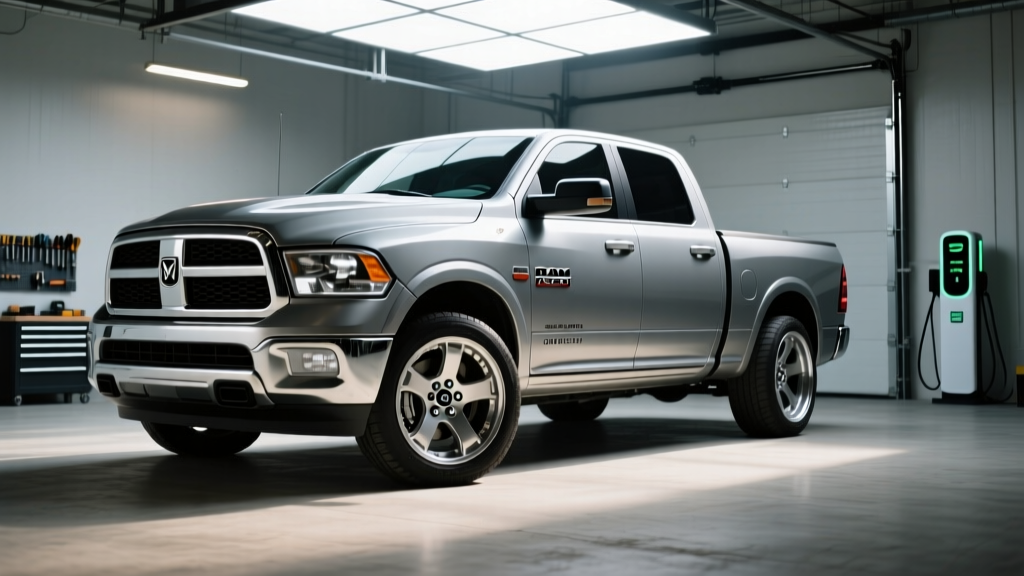
If you own a 2017 Ram 1500 and you're researching replacement wheels, hub-centric adapters, or even an EV conversion project, the single most important spec to nail down is the 2017 Ram 1500 bolt pattern. Get it wrong and nothing fits — not the lug nuts, not the rotors, and certainly not aftermarket wheels designed for a different platform. This guide breaks down the exact bolt pattern, center bore, thread pitch, and offset data for the 2017 Ram 1500, and explains how these dimensions interact with modern EV wheel-and-tire setups that are becoming popular in the swap and restomod community.
2017 Ram 1500 Bolt Pattern: The Exact Numbers
The 2017 Ram 1500 (DS generation, fourth-gen facelift) uses a 6-lug bolt pattern measuring 6×139.7 mm — also written as 6×5.5 inches in imperial notation. This is the same bolt circle shared by most half-ton Ram trucks from 2002 through the 2018 model year, and it's one of the most common light-truck patterns in North America, shared with many Toyota Tacoma, Toyota Tundra (earlier generations), Chevrolet Silverado 1500, and GMC Sierra 1500 applications.
| Specification | Value |
|---|---|
| Bolt Pattern (Lug Count × PCD) | 6 × 139.7 mm (6 × 5.5 in) |
| Center Bore | 77.8 mm (hub-centric) |
| Lug Nut Thread Size | M14 × 1.5 mm |
| Lug Nut Torque Spec | 130 lb-ft (176 Nm) |
| Stock Wheel Offset (ET) | +19 mm to +25 mm (trim-dependent) |
| Factory Wheel Sizes | 17", 18", 20" (trim-dependent) |
| Stock Tire Sizes | 265/70R17, 275/60R20 |
Two details here trip up even experienced buyers. First, the center bore of 77.8 mm is critical: any aftermarket wheel with a smaller bore simply won't mount, and wheels with a larger bore require hub-centric rings to prevent vibration at highway speed. Second, the M14 × 1.5 thread pitch differs from older SAE-thread Rams and from many imports — mismatching lug nuts is a serious safety risk.
Why Bolt Pattern Matters for EV Swaps and Wheel Upgrades
The 2017 Ram 1500's DS platform has become a popular candidate for electric-vehicle conversions, particularly in the restomod and fleet-repower segments. Shops are dropping in Tesla Large Drive Unit (LDU) assemblies, Cascadia Motion powertrains, or NetGain Hyper 9 setups to create zero-emission work trucks. In every one of these conversions, the stock bolt pattern becomes a decision point.
EV drivetrains produce instant torque — often substantially more than the stock 5.7L Hemi V8's 395 lb-ft. That torque is transmitted through the same half-ton axles, hubs, and lug studs originally engineered for internal-combustion power delivery. For EV swaps pushing 500+ lb-ft, many builders upgrade to ARP wheel studs rated for higher clamp loads and verify that the 130 lb-ft lug torque is maintained after the first 500 miles of operation.
Additionally, EV conversions add significant weight — battery packs of 60–100 kWh can add 800–1,500 lbs over a stock Ram 1500's curb weight of roughly 4,800–5,500 lbs. That extra mass increases the stress on wheel bearings and lug hardware, making correct bolt-pattern fitment and proper torque more important than ever.
EV Wheel Compatibility: Which Modern EV Wheels Fit the Ram 1500 Pattern?
A common question in the EV-swap community is whether wheels from production electric vehicles — such as the Rivian R1T, Ford F-150 Lightning, or Tesla Cybertruck — can be adapted to the 2017 Ram 1500's 6×139.7 pattern. Here's the compatibility picture:
| EV Model | Bolt Pattern | Center Bore | Direct Fit on 2017 Ram 1500? |
|---|---|---|---|
| Rivian R1T (2022–2026) | 6 × 139.7 mm | 77.8 mm | Yes — same pattern and bore |
| Ford F-150 Lightning (2022–2026) | 6 × 135 mm | 87.1 mm | No — different PCD; adapter required |
| Tesla Cybertruck (2024–2026) | 6 × 139.7 mm | 77.8 mm | Yes — pattern matches; offset differs |
| Chevrolet Silverado EV (2024–2026) | 6 × 139.7 mm | 77.8 mm | Yes — pattern and bore match |
| GMC Hummer EV (2022–2026) | 8 × 180 mm | 124.3 mm | No — 8-lug, entirely different |
The good news: the 6×139.7 mm pattern is the de facto standard for most North American half-ton trucks, including several EVs. Rivian R1T and Chevy Silverado EV wheels share the exact bolt circle and center bore, meaning direct fitment is possible — though offset, load rating, and brake clearance must still be verified. Ford's 6×135 mm pattern is incompatible without a wheel adapter, and adapters introduce their own load-rating and safety considerations that must be evaluated by a qualified fabricator.
Tire and Wheel Load Ratings for EV-Converted Ram 1500 Builds
Bolt pattern is only half the equation. When you're running an EV-swapped 2017 Ram 1500 with a heavy battery pack, load-rated wheels and tires become essential. The stock Ram 1500's Gross Axle Weight Rating (GAWR) for the rear axle is typically 3,900–4,100 lbs depending on configuration. Add 600+ lbs of battery in the bed or under-floor, and you may exceed the load capacity of stock-rated wheels.
For EV conversions, look for wheels with a minimum load rating of 2,500 lbs per wheel (10,000 lbs total across four corners provides margin for a 7,000-lb GVWR truck). Many aftermarket 6×139.7 wheels from brands like Method Race Wheels, Fuel Off-Road, and American Racing offer load ratings in the 2,500–3,000 lb range. Pair these with Load Range E (10-ply equivalent) tires rated for 3,000+ lbs per tire, such as the BFGoodrich All-Terrain T/A KO2 in 275/65R18 (3,195 lbs per tire at 80 psi) or the Goodyear Wrangler DuraTrac in equivalent sizing.
Aftermarket Wheel Options That Fit the 6×139.7 Pattern
Whether you're refreshing a stock 2017 Ram 1500 or fitting wheels to an EV conversion, the 6×5.5 bolt pattern opens up a massive aftermarket catalog. Here are popular fitment categories:
- OEM-style replacements: Factory 17" and 20" take-off wheels from later Ram models (2019+ DT generation use a different pattern — avoid those) or same-gen 2009–2018 Ram 1500 wheels.
- Off-road / overland: Method NV, Black Rhino Arsenal, or KMC XD series in 17" or 18" with appropriate backspacing (typically 4.5"–5" backspace for stock-width fenders).
- EV-specific low-drag: Some builders source Rivian R1T 20" or 21" aero wheels for reduced rolling resistance and improved EV range. These fit the bolt pattern but may require +20 mm offset spacers for proper brake caliper clearance on the Ram's front hubs.
- Work / fleet: Steel wheels from Pro Comp or Cragar in 16" or 17" with high load ratings and simple hub-centric fitment.
Regardless of wheel choice, always confirm three things: bolt pattern (6×139.7), center bore (77.8 mm or larger with hub-centric rings), and offset/backspacing (stay within ±10 mm of stock to avoid bearing wear and fender rub).
Measuring and Verifying Your Own Bolt Pattern
If you're buying a used 2017 Ram 1500 and want to verify the bolt pattern hasn't been modified (some fleet trucks get aftermarket hub conversions), here's how to measure a 6-lug pattern:
- Measure from the center of one lug stud to the center of the stud directly across from it (skip two studs in between).
- That center-to-center distance should read 139.7 mm (5.5 inches).
- Confirm all six studs are evenly spaced — irregular spacing indicates damage or a non-stock hub.
- Check the center bore with calipers — it should read 77.8 mm.
For 6-lug patterns, this direct-across measurement is straightforward. (4-lug and 5-lug patterns require different measurement methods because there's no directly opposing stud on a 5-lug hub.)
Torque Specs and Maintenance for High-Torque EV Applications
EV powertrains deliver peak torque at 0 RPM — unlike the Ram 1500's stock Hemi, which builds torque progressively through the rev range. This instantaneous torque spike puts more shear stress on lug studs during hard acceleration. For EV-swapped Ram 1500 builds, follow these maintenance practices:
- Re-torque after 100 miles and 500 miles following any wheel removal or conversion.
- Use a calibrated torque wrench set to 130 lb-ft — never an impact gun alone.
- Inspect lug studs for stretching or thread damage every 10,000 miles in high-torque EV applications.
- Consider upgrading to ARP 200,000-psi wheel studs if your EV swap produces over 500 lb-ft at the wheels.
- Apply a thin coat of anti-seize to the stud threads (not the seat surface) to ensure accurate torque readings and prevent galling.
Frequently Asked Questions
What is the bolt pattern on a 2017 Ram 1500?
The 2017 Ram 1500 uses a 6-lug bolt pattern measuring 6×139.7 mm (6×5.5 inches). The center bore is 77.8 mm, and lug nuts are M14 × 1.5 thread pitch torqued to 130 lb-ft.
Will 2019+ Ram 1500 (DT generation) wheels fit a 2017 model?
No. The 2019+ DT-generation Ram 1500 switched to a 6×135 mm bolt pattern, which is 4.7 mm smaller in pitch circle diameter than the 2017's 6×139.7 mm. They are not interchangeable without adapters, and adapters are generally not recommended for daily-driven or heavy-load applications.
Can I put Rivian R1T wheels on my 2017 Ram 1500?
Yes — the Rivian R1T shares the 6×139.7 mm bolt pattern and 77.8 mm center bore. However, verify offset and brake caliper clearance before mounting, as the R1T's wheel offset may differ from the Ram's stock +19 to +25 mm range.
Is the 2017 Ram 1500 bolt pattern the same as Chevy Silverado 1500?
Yes, most half-ton Chevy Silverado 1500 models (2007–2026) use the same 6×139.7 mm bolt pattern. However, center bore and offset may differ, so always verify those dimensions before swapping wheels.
What size are the lug nuts on a 2017 Ram 1500?
M14 × 1.5 mm thread pitch. Use only lug nuts designed for this thread — mixing thread pitches can cause cross-threading and catastrophic wheel separation. Always torque to 130 lb-ft in a star pattern.
Does bolt pattern affect an EV conversion's safety?
Absolutely. Incorrect bolt pattern fitment, mismatched center bores, or under-torqued lug nuts can cause wheel vibration, bearing failure, or wheel separation — especially under the high instant torque and added weight of an EV drivetrain. Always verify pattern, bore, offset, and torque spec before driving.
Sources: Ram Trucks official specifications, ramtrucks.com; wheel fitment data cross-referenced with aftermarket manufacturer catalogs; EV conversion community documentation from EV West and Cascadia Motion.