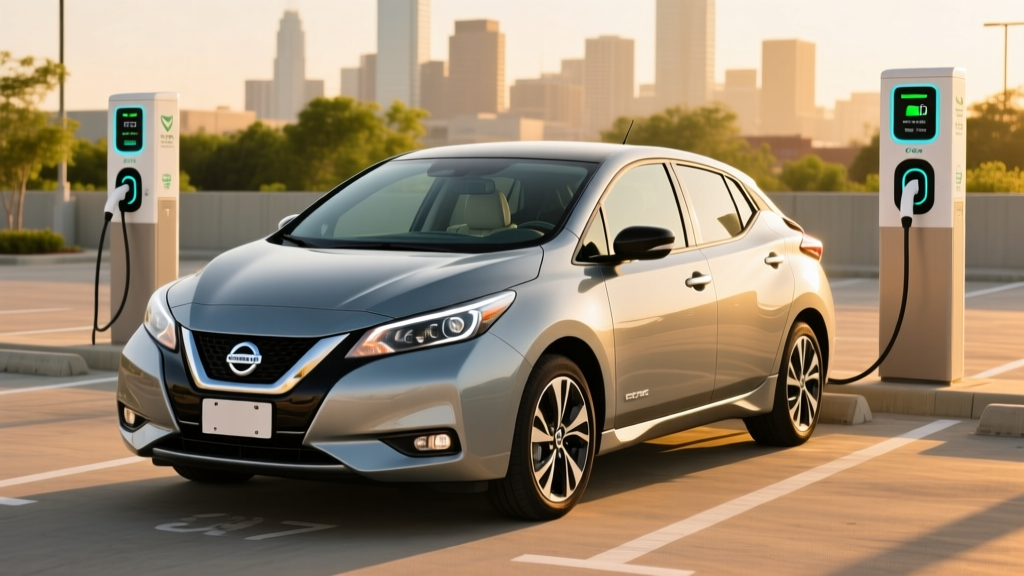
The 2017 Nissan Leaf S: A Budget Used-EV Entry Point
The 2017 Nissan Leaf S occupies a very specific niche in today's used EV market: it's one of the cheapest ways to get into a battery-electric vehicle, provided your daily driving stays under 80 miles round-trip and you understand exactly what you're signing up for. With its 30 kWh battery pack, 107-mile EPA range, and CHAdeMO DC fast-charging connector, this first-generation Leaf is a commuter appliance — not a road-trip machine. But at used prices that frequently fall between $6,000 and $10,000 in 2026, it warrants a serious look for budget-conscious electrification seekers.
This review breaks down the real-world ownership picture: actual range you can expect, charging speeds that haven't aged gracefully, the critical battery health check you must perform before buying, and whether the used clean vehicle credit under IRS §25E can knock up to $4,000 off the purchase price.
Spec Sheet: 2017 Nissan Leaf S at a Glance
| Specification | 2017 Nissan Leaf S |
|---|---|
| EPA Range | 107 miles |
| Battery Capacity (Total / Usable) | 30 kWh / ~28 kWh usable |
| Battery Chemistry | NMC (Lithium Manganese Oxide blend) |
| Battery Cooling | Passive (air-cooled, no active thermal management) |
| Motor Output | 80 kW (107 hp), 187 lb-ft torque |
| Drivetrain | FWD, single-speed reduction |
| 0–60 mph | ~11.5 seconds |
| EPA Efficiency | 112 MPGe combined (30 kWh/100 mi) |
| Max DC Fast Charge Rate | ~50 kW (CHAdeMO) |
| Level 2 Onboard Charger | 6.6 kW (J1772) |
| Level 1 (120V) Charging | ~1.4 kW (~4 mi/hr) |
| Cargo Volume | 24.0 cu ft (rear seats up) / 30.0 cu ft (folded) |
| Front / Rear Legroom | 42.1 in / 33.5 in |
| Curb Weight | 3,307 lbs |
| Original MSRP (S trim, 30 kWh) | $30,680 (before incentives) |
| Typical 2026 Used Price | $6,000–$10,000 |
| Battery Warranty (Original) | 8 yr / 100,000 mi (capacity loss below 9 bars of 12) |
Real-World Range: What 107 EPA Miles Actually Means
EPA Sticker: 107 miles
Real-World City/Commuting: 85–100 miles (mild weather, moderate speeds)
Real-World Highway (70+ mph): 70–85 miles
Cold Weather (below 32°F): 55–75 miles (30–45% range loss is common)
Hot Weather with A/C: 80–95 miles
The 2017 Leaf S uses a 30 kWh battery pack, of which roughly 28 kWh is usable — Nissan reserves a top and bottom buffer to protect cell longevity. On paper, 107 EPA miles was competitive for 2017, trailing the Chevrolet Bolt EV (238 mi) but beating the base BMW i3 (114 mi with the 33 kWh pack) and the Fiat 500e (84 mi).
In practice, the Leaf's passive air-cooled battery is the limiting factor. Without active liquid thermal management, the pack temperature fluctuates with ambient conditions and driving load. In summer heat, repeated fast charging triggers Nissan's battery-protection software, which throttles charge speed dramatically — owners colloquially call this "Rapidgate." In winter, the lack of a heat pump means cabin heating draws directly from the traction battery via a resistive PTC heater, consuming 2–4 kW continuously and slashing range by a third or more.
For a commuter doing 40–60 miles round trip with home charging, the 2017 Leaf S remains viable. For anyone needing flexibility beyond that, the 2018+ Leaf (150-mile, 40 kWh) or the 2019+ Leaf Plus (226-mile, 62 kWh) are substantially better choices, even at higher used prices.
Charging Speed: The Leaf's Biggest 2026 Limitation
| Charging Level | Connector | Max Power | Speed / Time |
|---|---|---|---|
| Level 1 (120V household) | J1772 (EVSE included) | ~1.4 kW | ~4 miles per hour; full charge in ~22 hours |
| Level 2 (240V home/public) | J1772 | 6.6 kW (onboard charger limit) | ~22 miles per hour; full charge in ~4.5 hours |
| DC Fast Charge | CHAdeMO | ~50 kW peak | 10–80% in ~30–35 min (ideal conditions); tapers heavily above 80% |
The 2017 Leaf S charges via CHAdeMO for DC fast charging — a connector standard that has been steadily losing ground in North America to CCS1 and, increasingly, NACS (the Tesla-standard connector now adopted by Ford, GM, Rivian, and others). As of 2026, Electrify America stations no longer include CHAdeMO connectors at new locations, and many ChargePoint and EVgo stations have deprioritized CHAdeMO in favor of CCS and NACS. This is the single biggest infrastructure risk for a used Leaf buyer.
At a functioning 50 kW CHAdeMO station, the Leaf S will accept peak charge rates around 40–46 kW when the battery is cool and at a low state of charge. The 10–80% session takes roughly 30–35 minutes under ideal conditions. However, the charge curve tapers steeply above 80% SoC — going from 80% to 100% on DC can take nearly as long as the 10–80% portion. Plan to unplug at 80% for efficient road-trip charging.
The 6.6 kW Level 2 onboard charger is adequate for overnight home charging. A full charge from empty takes about 4.5 hours on a 240V/30A circuit. Home Level 2 installation typically costs $500–$1,500 depending on panel proximity and local permit requirements — a cost that may rival the vehicle's purchase price at the low end of the used market.
Critically, kW (kilowatts) measures power — the rate at which energy flows into the battery. kWh (kilowatt-hours) measures energy — the total capacity of the battery. The Leaf's 30 kWh battery charged at 6.6 kW takes roughly 4.5 hours (30 ÷ 6.6 ≈ 4.5). This distinction matters when sizing home charging equipment.
Performance and Driving Dynamics
The 2017 Leaf S is powered by an 80 kW (107 horsepower) AC synchronous electric motor driving the front wheels through a single-speed reduction gear. Torque is rated at 187 lb-ft, available instantly from zero RPM, which gives the Leaf a surprisingly responsive feel around town despite its modest power figures.
The 0–60 mph time of approximately 11.5 seconds places the Leaf firmly in economy-car territory. Highway merging requires planning, and passing at speed demands a heavy right foot. Top speed is electronically limited to roughly 90 mph. This is not a performance vehicle — it's a compliance-era commuter, and it drives like one.
Ride quality is acceptable for a subcompact hatchback, though the 3,307-lb curb weight (heavy for its size, due to the battery) means the suspension works hard over broken pavement. The low center of gravity from the floor-mounted battery pack reduces body roll compared to gas-powered subcompacts, which is a genuine handling benefit.
Regenerative braking offers two modes: standard "D" mode with mild regen that allows coasting, and "B" mode with stronger regen that recovers more energy on deceleration but falls short of true one-pedal driving. The Leaf won't come to a complete stop using regen alone — you'll still need the friction brakes at low speeds. Nissan's e-Pedal feature, which enables full one-pedal driving, was introduced on the second-generation Leaf (2018+).
Interior, Cargo, and Technology
The 2017 Leaf S is the base trim, and it shows. The interior uses hard plastics throughout, and the S trim comes with a basic 5-inch color display (not touchscreen on the S — that's reserved for SV and SL trims), a four-speaker audio system, Bluetooth phone connectivity, and a rearview camera. There is no Apple CarPlay or Android Auto on any 2017 Leaf trim.
Passenger space is reasonable for the segment: 42.1 inches of front legroom and 33.5 inches in the rear. The rear seat accommodates two adults comfortably for short trips, though the floor is high due to the battery beneath it, creating a knees-up seating position. Cargo volume is 24.0 cubic feet behind the rear seats and 30.0 cubic feet with the 60/40 split seat folded — competitive with the Honda Fit and significantly more than the BMW i3.
The S trim includes a CHAdeMO DC fast-charge port (some very early base Leafs omitted it, but the 2017 30 kWh S includes it standard), a Level 1 trickle-charge cord, keyless entry with push-button start, and a battery-heater element (standard on 2017 models for cold-climate markets, which helps mitigate — but not eliminate — winter range loss).
Driver-assistance technology is minimal. The 2017 Leaf S lacks adaptive cruise control, lane-keeping assist, or automatic emergency braking. These features were not available even on the top SL trim for 2017. If advanced driver assists are a priority, the 2018+ Leaf or competing models like the Chevrolet Bolt EV (which offered forward collision alert and lane departure warning) are better options.
Battery Health: The #1 Used Leaf Buying Consideration
The 2017 Leaf's passive (air-cooled) battery thermal management is its Achilles' heel for long-term durability. Unlike the liquid-cooled packs in the Chevrolet Bolt EV, Tesla Model 3, and virtually every modern EV, the Leaf's NMC cells rely on ambient airflow for cooling. This means:
- Hot climates accelerate degradation. Leafs in Arizona, Texas, and Southern California typically show more capacity loss than those in cooler regions.
- Frequent DC fast charging increases wear. Repeated high-current charging without active cooling raises cell temperatures and hastens chemical degradation.
- Capacity loss is visible and measurable. The Leaf's dashboard displays battery health as a series of 12 bars. A new battery shows 12 bars; degradation is indicated by lost bars. A 2017 Leaf showing 10 or fewer bars has significant capacity loss.
Nissan's original battery warranty covers capacity loss below 9 of 12 bars (roughly 75% state of health) for 8 years or 100,000 miles. For a 2017 model, that warranty window expired or is expiring in 2025–2027, depending on mileage. Replacement battery packs cost $6,500–$9,000 installed through Nissan dealerships, though third-party refurbishment options exist for $3,500–$5,500.
Before purchasing any used 2017 Leaf, request a LeafSpy battery health report. This $20 OBD-II dongle and app combination reads the battery's actual state of health (SoH) percentage, individual cell voltages, and degradation history. A Leaf with 85%+ SoH is a solid buy; below 75%, factor in a battery replacement cost that may exceed the vehicle's value.
Pricing, Tax Credits, and Ownership Costs
| Cost Factor | Amount / Detail |
|---|---|
| Typical Used Price (2026) | $6,000–$10,000 (varies by mileage, battery SoH, region) |
| Federal Used Clean Vehicle Credit (§25E) | Up to $4,000 (30% of sale price, max $4,000) |
| Credit Eligibility — Vehicle | Must be at least 2 model years old ✓; sale price ≤ $25,000 ✓; purchased from a licensed dealer |
| Credit Eligibility — Buyer Income | AGI ≤ $75,000 single / $112,500 head of household / $150,000 joint |
| Credit Delivery | Point-of-sale transfer to dealer (reduces purchase price) or claim on tax return |
| Effective Price After Max Credit | As low as $2,000–$6,000 (if all eligibility criteria are met) |
| Home Level 2 Charger Install | $500–$1,500 (equipment + electrician + permit) |
| Estimated Annual Electricity Cost | ~$350–$500 (10,000 mi/yr at $0.15/kWh national average) |
| Estimated Annual Insurance | $900–$1,400 (varies by state and driver profile) |
The 2017 Nissan Leaf S is not eligible for the new-vehicle §30D federal tax credit (that credit applies only to new purchases). However, it can qualify for the IRS §25E Used Clean Vehicle Credit, which provides up to $4,000 — calculated as 30% of the sale price, capped at $4,000. On an $8,000 used Leaf, the maximum credit would be $2,400 (30% × $8,000).
Eligibility requirements under §25E are strict: the vehicle must be purchased from a licensed dealer (private-party sales don't qualify), the sale price must not exceed $25,000, the vehicle must be at least 2 model years old, and the buyer's adjusted gross income must fall below the caps ($75,000 single / $150,000 joint). The credit can be transferred to the dealer at point of sale, reducing your out-of-pocket cost immediately. Verify current-year rules with a tax professional, as incentive structures can shift.
On the operating-cost side, the Leaf S is exceptionally cheap to run. At the national average electricity rate of roughly $0.15/kWh and the Leaf's consumption of 30 kWh/100 miles, fuel cost is approximately $0.045 per mile — roughly one-third the per-mile fuel cost of a 30 MPG gas car at $3.50/gallon. Maintenance is minimal: no oil changes, no spark plugs, no transmission fluid, and regenerative braking significantly extends brake-pad life.
Pros, Cons, and Who Should Buy
- Very low purchase price ($6K–$10K used)
- Potential $4,000 federal used-EV credit
- Cheap to operate (~$0.045/mile electricity)
- Practical hatchback cargo space (24–30 cu ft)
- Smooth, quiet, zero-emission commuting
- Minimal maintenance costs
- Reliable drivetrain (few moving parts)
- Short range (70–100 real-world miles)
- CHAdeMO connector — declining infrastructure
- No active battery thermal management
- Severe cold-weather range loss (30–45%)
- Slow DC charging (~50 kW peak, tapers early)
- No Apple CarPlay / Android Auto
- No advanced driver-assist features
- Battery degradation risk in hot climates
- Expired or expiring battery warranty
- Buy it if: You need a sub-$10K commuter for a <80-mile daily round trip, have access to Level 2 home charging, live in a mild climate, and qualify for the §25E used-EV credit. It's one of the cheapest electrified vehicles available in 2026.
- Look elsewhere if: You need highway range flexibility, live in a very hot or very cold climate, rely on public DC fast charging (CHAdeMO availability is shrinking), or want modern infotainment and driver assists. The 2018+ Leaf (150 mi), 2017–2023 Chevrolet Bolt EV (238 mi, CCS charging), or a used Tesla Model 3 (220+ mi, NACS/Supercharger access) offer substantially more capability at higher prices.
2017 Nissan Leaf S FAQ
What is the real-world range of the 2017 Nissan Leaf S?
Expect 85–100 miles in mild city driving, 70–85 miles at highway speeds, and as little as 55–75 miles in freezing weather. The EPA sticker says 107 miles, but the passive-cooled battery and resistive cabin heater significantly reduce usable range in extreme conditions. According to fueleconomy.gov, the combined efficiency is 112 MPGe.
How fast does the 2017 Leaf S charge?
On a Level 2 (240V) home charger at 6.6 kW, a full charge takes roughly 4.5 hours and adds about 22 miles of range per hour. On a 50 kW CHAdeMO DC fast charger, 10–80% takes approximately 30–35 minutes under ideal conditions. However, charge speed degrades significantly if the battery is hot (summer, repeated fast charges) due to the lack of active cooling.
Does the 2017 Nissan Leaf S qualify for the federal EV tax credit?
Not the new-vehicle §30D credit, but it can qualify for the §25E Used Clean Vehicle Credit: up to $4,000 (30% of sale price, max $4,000) if purchased from a licensed dealer for $25,000 or less, and if your income is below $75K single / $150K joint. Confirm eligibility with your tax advisor, as rules are subject to change.
Is the 2017 Leaf S worth buying vs. a used Chevrolet Bolt EV or Tesla Model 3?
It depends on budget and use case. The Leaf S is the cheapest option ($6K–$10K), but the Bolt EV (typically $12K–$17K used) offers 238 miles of range, CCS charging, liquid-cooled battery, and available driver assists. A used Model 3 (typically $18K–$25K) adds Supercharger/NACS access, 220+ mile range, and modern tech. If budget is the primary constraint and your commute is short, the Leaf S works. If you need versatility, spend more.
What should I check before buying a used 2017 Leaf?
Run a LeafSpy battery health report to check state of health (SoH) percentage — aim for 85%+. Verify the number of dashboard battery bars (12 is ideal). Check for CHAdeMO charging port condition. Confirm the battery warranty status (8 yr/100,000 mi from original in-service date). Inspect for any signs of battery swelling or unusual cell-voltage variance in the LeafSpy report. Factor in potential battery replacement cost ($3,500–$9,000) if SoH is below 75%.
Can I install a home charger for the 2017 Leaf S?
Yes. The Leaf uses a standard J1772 connector for Level 1 and Level 2 AC charging. Any Level 2 home charger with a J1772 plug will work. A 240V/30A circuit with a 6.6 kW-capable EVSE (such as the ChargePoint Home Flex or Emporia Level 2) will maximize the Leaf's onboard charger. Have a licensed electrician assess your panel capacity before installation — older homes may need a panel upgrade ($1,000–$3,000) to support a dedicated 240V circuit.