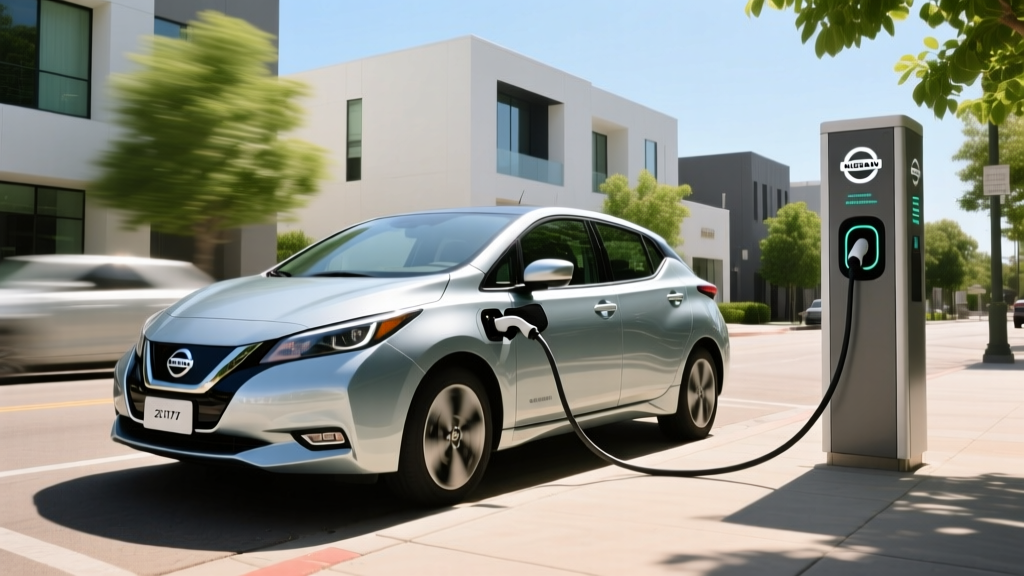
The 2017 Nissan Leaf holds a unique place in electric-vehicle history. As the final model year of the first-generation Leaf before Nissan's major redesign for 2018, it represents the culmination of seven years of iterative improvement to the world's first mass-market BEV. For budget-minded used-EV shoppers in 2026, the 2017 Leaf remains one of the most affordable entry points into electric driving — but its 107-mile EPA range, passive battery thermal management, and CHAdeMO connector demand careful consideration before purchase.
This review covers every spec, charging reality, and ownership factor you need to evaluate a used 2017 Leaf today, including battery degradation patterns, real-world range expectations, and whether the federal used-EV tax credit applies.
Quick Verdict: Who Should Buy a Used 2017 Leaf?
The 2017 Nissan Leaf electric is best suited for city commuters and second-car households with reliable home Level 2 charging and daily round trips under 70 miles. It is not a road-trip vehicle, and its lack of active battery thermal management means accelerated degradation in hot climates. If you can charge at home, drive mostly in moderate temperatures, and want a proven, simple EV at a bargain used price, the 2017 Leaf delivers. If you need highway range, fast DC charging, or plan to keep the car in Phoenix or Houston summers, look elsewhere.
Look at alternatives if: You need 200+ mile range, frequently DC fast-charge, live in extreme heat, or want NACS/Tesla Supercharger access.
Range, Battery & Efficiency
| Spec | 2017 Nissan Leaf (30 kWh) |
|---|---|
| EPA Range | 107 miles |
| Battery Capacity (usable) | 30 kWh (gross ~30 kWh, ~28 kWh usable) |
| Battery Chemistry | NMC (Lithium Manganese Oxide variant) |
| Battery Cooling | Passive air cooling (no liquid thermal management) |
| EPA Efficiency | 112 MPGe combined (30 kWh/100 mi) |
| Drivetrain | FWD, single-speed reduction gear |
| Motor Output | 80 kW (107 hp), 187 lb-ft torque |
| 0-60 mph | ~9.9 seconds |
The 30 kWh battery was an upgrade from the earlier 24 kWh pack (which rated at 84 miles EPA). Nissan achieved the bump by increasing cell energy density rather than physically enlarging the pack. The chemistry is an NMC variant — specifically, Nissan used lithium manganese oxide spinel cathodes in partnership with NEC. This chemistry offered decent energy density for its time but is more susceptible to calendar and heat-driven degradation than modern NMC 811 or LFP packs.
The passive air-cooling system is the 2017 Leaf's most significant engineering limitation. Unlike the Tesla Model 3, Chevrolet Bolt, or Hyundai Ioniq 5 — all of which use liquid-cooled packs — the Leaf relies on ambient airflow to manage battery temperature. This means repeated DC fast charging, high-speed driving, or hot-climate operation can push cell temperatures above optimal thresholds, accelerating capacity loss over time.
Charging: Speeds, Connectors & Real-World Expectations
| Charging Level | Power | Connector | Time / Rate |
|---|---|---|---|
| Level 1 (120V) | ~1.2 kW | J1772 | ~4 miles per hour of charging; full charge in ~26 hours |
| Level 2 (240V) | 3.3 kW (standard) / 6.6 kW (optional with Charge Package) | J1772 | 3.3 kW: ~12 mi/hr, full in ~9 hrs; 6.6 kW: ~22 mi/hr, full in ~5 hrs |
| DC Fast Charge | ~50 kW peak (CHAdeMO) | CHAdeMO | 0-80% in ~30 minutes under ideal conditions |
The 2017 Leaf uses the CHAdeMO DC fast-charging standard, which by 2026 has become a significant liability. The North American market has overwhelmingly adopted NACS (Tesla's connector) and CCS1, with CHAdeMO infrastructure declining. Electrify America stations do not support CHAdeMO. Your DC fast-charging options are largely limited to older EVgo stations, some Nissan dealer lots, and scattered legacy networks.
Peak DC charge rate is approximately 50 kW, but sustained rates are lower. The charge curve tapers noticeably after 60% state of charge, and because the battery lacks active thermal management, consecutive fast-charge sessions — or fast charging in hot weather — will trigger "rapidgate." This is Nissan's battery-protection protocol that aggressively throttles charge speed to prevent cell damage. On a hot summer day, your second DC fast charge of the trip may peak at only 20–30 kW, extending charge times substantially.
For daily use, home Level 2 charging is essential. The standard 3.3 kW onboard charger is slow; we strongly recommend finding a 2017 Leaf equipped with the optional Charge Package that includes the 6.6 kW onboard charger and a DC fast-charge port. With 6.6 kW, you'll replenish the battery overnight in about five hours — adequate for daily commuting. The 3.3 kW variant requires nine hours for a full charge, which is tight if you arrive home depleted.
Performance & Driving Dynamics
The 2017 Leaf's 80 kW (107 hp) AC synchronous motor delivers 187 lb-ft of instant torque to the front wheels. The 0-60 mph time of approximately 9.9 seconds feels adequate around town but sluggish for highway merging compared to modern EVs. Top speed is electronically limited to roughly 90 mph.
Driving dynamics are competent but unremarkable. The Leaf's 3,300-pound curb weight and soft suspension tuning prioritize comfort over sportiness. Regenerative braking offers two modes: standard "D" mode with mild regen, and "B" mode with stronger regen that approaches but does not achieve true one-pedal driving. The car will still creep at low speeds in B mode, requiring brake-pedal use to come to a complete stop.
NVH (noise, vibration, harshness) is a weak point. Wind and tire noise are noticeable above 55 mph, and the absence of a liquid-cooled thermal system means you may hear cooling fans working hard during or after fast charging in warm conditions.
Interior, Cargo & Technology
| Dimension | Measurement |
|---|---|
| Passenger Volume | 94 cu ft |
| Cargo Volume (rear seats up) | 24 cu ft |
| Cargo Volume (rear seats folded) | 30 cu ft |
| Front Legroom | 42.1 in |
| Rear Legroom | 33.5 in |
| Curb Weight | ~3,256 lbs |
The interior reflects the 2017 Leaf's economy-car origins. Materials are hard-plastic dominant, though the SV and SL trims add some soft-touch surfaces. The center-stack 5-inch touchscreen (SV/SL) supports a basic navigation system and a rearview camera. Bluetooth and USB connectivity are standard. There is no Apple CarPlay or Android Auto — a notable omission even for the era.
The instrument cluster uses a hybrid analog-digital layout with a prominent "Eco" meter and range-remaining display. The shifter is a conventional PRND lever rather than the rotary knob found in some competitors. Cargo space at 24 cu ft is generous for a hatchback and competitive with the segment. The rear seats fold 60/40, but the floor step between the cargo area and folded seatbacks is awkward.
Driver Assistance: The 2017 Leaf offers basic features by modern standards. Available equipment includes a rearview camera (standard on SV/SL), blind-spot monitoring, rear cross-traffic alert, and forward collision warning with automatic emergency braking on the SL trim. There is no adaptive cruise control, lane-keeping assist, or any Level 2 driver-assist system. This is strictly SAE Level 0–1 automation.
Pricing, Tax Credits & Used-Buyer Economics
| Item | Amount |
|---|---|
| Original Base MSRP (2017 S trim) | $30,680 |
| Original MSRP (SV trim) | $34,200 |
| Original MSRP (SL trim) | $36,790 |
| Typical Used Price (2026 market) | $6,500 – $11,000 |
| Federal Used EV Tax Credit (§25E) | Up to $4,000 (30% of sale price, max $4,000) |
| Estimated Price After Credit | $4,000 – $8,000 effective |
The 2017 Nissan Leaf did not qualify for the federal §30D new-EV tax credit at the time of its original sale because Nissan's cumulative EV sales had not yet triggered the phase-out threshold — however, the Leaf's battery sourcing and MSRP rules under the pre-2023 credit structure meant many buyers did claim the $7,500 credit. That credit is no longer available for new purchases of this vehicle.
For used buyers in 2026, the relevant incentive is the IRS §25E Used Clean Vehicle Credit. This credit provides 30% of the sale price, up to a maximum of $4,000, for qualifying used EVs. Key eligibility requirements per IRS guidelines:
- Sale price must be $25,000 or less (the 2017 Leaf easily qualifies)
- Buyer's adjusted gross income must not exceed $75,000 (single), $112,500 (head of household), or $150,000 (joint)
- Vehicle must be at least two model years old (2017 qualifies)
- Vehicle must be purchased from a licensed dealer (private-party sales do not qualify)
- The credit can be transferred to the dealer at point of sale as a down-payment reduction
- You cannot have claimed the used-EV credit more than once every three years
At typical 2026 used prices of $6,500–$11,000, the §25E credit could reduce your effective cost by $1,950–$3,300 (30% of sale price), making the 2017 Leaf one of the cheapest ways to get into an electric vehicle. Consult a tax professional to confirm your eligibility.
Battery Health & Longevity: What Used Buyers Must Check
Battery degradation is the single most important factor when evaluating a used 2017 Leaf. The passive air-cooling system makes this generation particularly vulnerable to capacity loss, especially in hot climates or for vehicles that were frequently DC fast-charged.
Nissan's battery warranty covers 8 years / 100,000 miles against capacity loss below 9 bars (out of 12 capacity bars on the dashboard display). For a 2017 model, this warranty expires in 2025 or upon reaching 100,000 miles — meaning most 2017 Leafs in 2026 are out of battery warranty. Some may still be covered if they were sold late in the model year and have low mileage, but assume you're buying as-is.
The dashboard displays battery health as capacity bars (12 bars = new, degrading downward). A 2017 Leaf showing 12/12 bars at 80,000+ miles should be viewed with suspicion — the instrument cluster has been known to be imprecise, and some dealers performed "battery resets" that temporarily restore the bar display without actually restoring capacity. The most reliable assessment comes from:
- Leaf Spy Pro app with an OBD-II dongle — reads actual State of Health (SoH) percentage, cell voltage variance, and battery temperature
- A pre-purchase inspection at a Nissan dealer with battery health report
- Checking the Ah (amp-hour) reading via Leaf Spy — a new 30 kWh pack reads ~66 Ah; a degraded pack may read 50 Ah or lower
Expect a well-maintained 2017 Leaf in a moderate climate to show 80–90% SoH at 60,000–80,000 miles. Vehicles from hot climates (Arizona, Texas, Southern California) with high fast-charge usage may show 65–75% SoH, translating to a real-world range of only 65–80 miles. Battery replacement for the 30 kWh pack runs approximately $6,500–$9,000 at a Nissan dealer, which often exceeds the vehicle's value.
Pros & Cons
- Extremely affordable used entry point — often under $8,000 after tax credit
- Proven, simple powertrain with abundant aftermarket knowledge
- Spacious hatchback cargo area (24 cu ft)
- Low operating cost — ~$0.04/mile on home electricity at $0.13/kWh
- Comfortable ride quality for city and suburban driving
- §25E used-EV tax credit eligible, further reducing cost
- 107-mile EPA range limits use to commuting and errands
- Passive battery cooling causes accelerated degradation in heat
- CHAdeMO connector — declining infrastructure support in 2026
- DC fast charging limited to ~50 kW with rapidgate throttling
- No Apple CarPlay, Android Auto, or modern infotainment
- No active driver-assist features (Level 0–1 only)
- Battery likely out of warranty; replacement cost exceeds car value
2017 Leaf vs. Key Used-EV Competitors
At the $6,000–$12,000 used price point, the 2017 Leaf competes with several alternatives worth cross-shopping:
| Spec | 2017 Nissan Leaf | 2017 Chevrolet Bolt EV | 2017 Volkswagen e-Golf |
|---|---|---|---|
| EPA Range | 107 mi | 238 mi | 125 mi |
| Battery | 30 kWh NMC | 60 kWh NMC (LG Chem) | 35.8 kWh NMC |
| Thermal Mgmt | Passive air | Active liquid | Active liquid |
| DC Fast Charge | 50 kW CHAdeMO | 55 kW CCS | 50 kW CCS |
| 0-60 mph | 9.9 sec | 6.5 sec | 9.6 sec |
| Typical Used Price | $6,500–$11,000 | $10,000–$15,000 | $9,000–$13,000 |
| Cargo | 24 cu ft | 16.9 cu ft | 22.8 cu ft |
The 2017 Chevrolet Bolt EV is the clear winner on range (238 miles EPA) and battery longevity (liquid-cooled), but commands a $3,000–$5,000 premium on the used market. The 2017 VW e-Golf offers slightly more range, a CCS connector, and a more refined driving experience, but cargo space is tighter and parts availability for VW-specific EV components can be spotty. The Leaf wins on pure affordability and hatchback practicality — but only if 107 miles of range fits your routine.
Frequently Asked Questions
What is the real-world range of the 2017 Nissan Leaf?
The EPA rates it at 107 miles. In practice, expect 85–95 miles at highway speeds, 95–110 miles in city driving with regenerative braking, and as low as 70–85 miles in cold weather below 35°F. A degraded battery (below 80% SoH) will reduce these figures proportionally.
How fast does the 2017 Leaf charge?
On DC fast charge (CHAdeMO), it peaks around 50 kW and reaches 80% in roughly 30 minutes under ideal conditions — but rapidgate can throttle this to 20–30 kW in warm weather or on repeated sessions. At home on Level 2, the standard 3.3 kW charger adds about 12 miles per hour; the optional 6.6 kW charger adds about 22 miles per hour.
Does the 2017 Leaf qualify for any federal tax credit in 2026?
Not the §30D new-vehicle credit. However, it may qualify for the IRS §25E Used Clean Vehicle Credit: up to $4,000 (30% of sale price) if you buy from a dealer for $25,000 or less and meet income limits ($75K single / $150K joint). Verify eligibility with a tax professional.
Is the 2017 Leaf worth buying versus a newer used EV?
It depends on budget and use case. At $6,500–$11,000 (potentially $4,000–$8,000 after the used-EV credit), it's one of the cheapest electric vehicles available. For a commuter who charges at home and drives under 70 miles daily, it's excellent value. If you need more range, faster charging, or better battery longevity, spending $4,000–$6,000 more on a used 2017–2018 Bolt EV is the smarter long-term play.
What should I check before buying a used 2017 Leaf?
Prioritize battery health. Use the Leaf Spy Pro app with an OBD-II dongle to check State of Health (SoH) percentage and cell voltage variance. Verify the capacity bars on the dash match the Leaf Spy reading. Check for service records, confirm whether the car has the optional 6.6 kW charger and DC fast-charge port (Charge Package), and inspect for any battery warranty remaining. Avoid vehicles from hot climates showing below 75% SoH unless priced accordingly.
Can I charge a 2017 Leaf at a Tesla Supercharger?
No. The 2017 Leaf uses a CHAdeMO DC fast-charging connector and a J1772 Level 2 connector. Tesla Superchargers use NACS. There is no commercially available, reliable CHAdeMO-to-NACS adapter as of 2026. You are limited to CHAdeMO-equipped public stations, which are increasingly scarce.
What is the battery replacement cost?
A new or refurbished 30 kWh battery pack from Nissan typically costs $6,500–$9,000 installed. Third-party battery rebuild services may offer lower prices ($4,000–$6,000) but vary in quality and warranty. Given that many 2017 Leafs sell for under $10,000, a battery replacement can represent 50–100% of the vehicle's value — a critical factor in your purchase decision.
Sources: EPA Fuel Economy – 2017 Nissan Leaf, IRS §25E Used Clean Vehicle Credit, NHTSA – 2017 Nissan Leaf Safety Ratings