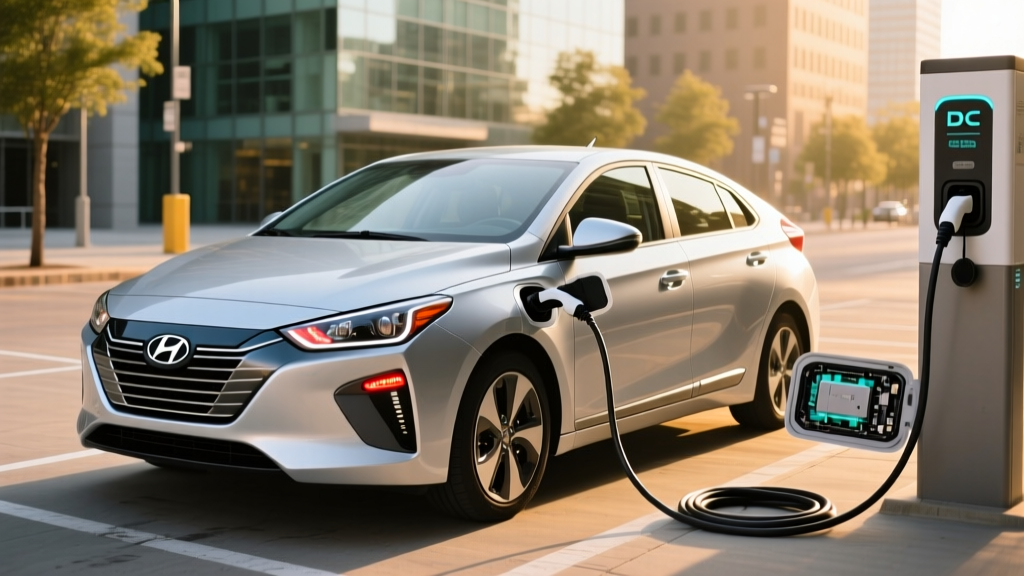
The 2017 Hyundai Ioniq Electric was one of the most efficient battery-electric vehicles ever sold in the United States, achieving an EPA-rated 136 MPGe combined — a figure that still outpaces most modern EVs nearly a decade later. But with only 124 miles of EPA-estimated range and a compact 28 kWh battery, this discontinued model occupies a very specific niche on the used-EV market in 2026. If you're considering a 2017 Hyundai Ioniq EV (Electric) as a budget commuter, this review breaks down exactly what you're getting, what to watch for, and whether the used-EV tax credit applies.
Quick Verdict: A Hyper-Efficient City Commuter
The 2017 Ioniq Electric is not a road-trip EV. It's a hyper-efficient urban and suburban commuter that rewards short, predictable drives with some of the lowest per-mile electricity costs of any vehicle ever built. With a small battery, modest power, and DC fast-charging capped at roughly 50 kW, it demands a buyer who can charge at home daily and doesn't need interstate range. For that buyer, it remains one of the smartest used-EV bargains available — especially if you qualify for the up-to-$4,000 used-EV federal tax credit.
Range, Efficiency, and Real-World Expectations
EPA Estimated: 124 miles (combined cycle)
Real-World Expectation: 95–115 miles on the highway at 70 mph; 110–125 miles in mixed city/suburban driving. In cold weather (below 32°F), expect a 20–30% reduction, dropping usable range to roughly 80–95 miles. The Ioniq Electric's exceptional efficiency means it squeezes more miles per kWh than almost anything else on the road, but physics limits what a 28 kWh pack can deliver.
The Ioniq Electric's 136 MPGe combined rating (150 city / 122 highway) translates to roughly 25 kWh per 100 miles driven, according to EPA data at fueleconomy.gov. That is remarkably efficient — for comparison, a 2025 Tesla Model 3 RWD consumes about 26 kWh/100mi despite being a larger, longer-range vehicle. The Ioniq's low curb weight (3,230 lbs), aerodynamic teardrop shape (0.24 Cd drag coefficient), and modest power output all contribute.
However, the small battery means range is unforgiving. There is no massive buffer to absorb detours, headwinds, or winter cold. If your one-way commute exceeds 40 miles and you lack workplace charging, this car will induce genuine range stress. For commutes under 30 miles each way with reliable home charging, the Ioniq Electric is nearly bulletproof.
Battery, Chemistry, and Longevity
| Spec | Value |
|---|---|
| Battery Capacity (Total / Usable) | 28 kWh total / ~27 kWh usable |
| Battery Chemistry | NMC (Nickel Manganese Cobalt) |
| EPA Range | 124 miles |
| EPA Efficiency | 136 MPGe combined (25 kWh/100mi) |
| Motor Output | 88 kW (118 hp) / 218 lb-ft torque |
| 0–60 mph | ~9.9 seconds |
| Drivetrain | FWD, single-speed reduction gear |
| Max DC Fast Charge | ~50 kW (CCS1) |
| Level 2 Charge Rate | 6.6 kW onboard charger |
| Cargo Volume | 19.9 cu ft (rear seats up) |
| Curb Weight | 3,230 lbs |
| Original MSRP (2017) | $29,500 (base Electric trim) |
| Battery Warranty (Original) | 8 years / 100,000 miles (10 yr / 100k in CARB states) |
The 28 kWh NMC lithium-ion pack was modest even in 2017 — the Chevy Bolt EV launched the same year with 60 kWh. By 2026, a nine-year-old NMC battery will have experienced measurable degradation. Expect 10–18% capacity loss depending on climate exposure, charging habits, and mileage. A 15% degraded pack yields roughly 105 miles of real-world range in mild weather. Before purchasing, request a battery State of Health (SoH) reading from a Hyundai dealer or use an OBD-II reader with EV-compatible software to check remaining capacity.
Hyundai's original battery warranty — 8 years/100,000 miles against defects and capacity loss below 70% — has expired for most 2017 models unless the vehicle was registered late or in a CARB state (where the warranty extends to 10 years/100,000 miles). If you're in California, New York, Massachusetts, or another CARB-adopting state, some 2017 Ioniq Electrics may still carry battery warranty coverage through 2027. Verify with Hyundai using the VIN.
Charging Speed: Home and DC Fast Charging
| Level | Power | Time (0–100% or 10–80%) | Miles Added per Hour |
|---|---|---|---|
| Level 1 (120V outlet) | ~1.2 kW | ~24 hours (full charge) | ~5 mi/hr |
| Level 2 (240V, 32A) | 6.6 kW (max onboard) | ~4.5 hours (full charge) | ~27 mi/hr |
| DC Fast Charge (CCS1) | ~50 kW peak | ~30 min (10–80%) | ~125 mi/hr (at peak) |
The Ioniq Electric's 6.6 kW onboard charger was competitive in 2017 and remains adequate for overnight home charging — a full recharge from empty takes about 4.5 hours on a Level 2 home station, which is more than sufficient for daily commuting needs. Most owners will plug in overnight and wake to a full battery every morning.
DC fast charging is the weak point. The car peaks at roughly 50 kW via its CCS1 connector, and the small battery means the charge curve tapers quickly. While 10–80% takes around 30 minutes, that's 30 minutes for roughly 87 miles of range — not competitive with modern EVs that add 150+ miles in 15 minutes. Plan road trips around longer stops, or better yet, avoid road-tripping this car entirely.
One practical note for 2026 buyers: the Ioniq Electric uses the CCS1 connector standard. With Tesla opening its Supercharger network to CCS-equipped vehicles via the Magic Dock adapter, and the industry broadly adopting NACS, CCS1 remains widely supported at Electrify America, EVgo, and ChargePoint stations. You won't have trouble finding compatible chargers, though the car's 50 kW cap means you'll never take advantage of newer 150–350 kW stations.
Performance and Driving Experience
The Ioniq Electric's 88 kW (118 hp) permanent-magnet synchronous motor delivers 218 lb-ft of instant torque to the front wheels. That torque figure sounds impressive, but the 9.9-second 0–60 mph time reveals the reality: this is a relaxed, efficiency-first commuter, not a performance EV. Highway merging is adequate but requires planning, and the single-speed reduction gear means there's no drama — just smooth, quiet, linear acceleration.
Ride quality is firm but composed, and the low center of gravity (battery pack under the floor) gives it surprisingly flat cornering for an economy hatchback. Regenerative braking is adjustable via steering-wheel paddles, allowing everything from mild coasting to near one-pedal driving. The strongest regen setting won't bring the car to a complete stop, so you'll still use the friction brake at the last moment.
NVH (noise, vibration, harshness) is well-managed. Without an engine, the Ioniq Electric is whisper-quiet at city speeds, with wind and tire noise becoming noticeable above 55 mph. It's a pleasant, low-stress driving experience — exactly what a commuter car should be.
Interior, Tech, and Cargo Practicality
The 2017 Ioniq Electric came in a single, well-equipped trim level. Standard features include:
- 7-inch touchscreen infotainment with Apple CarPlay and Android Auto
- Automatic climate control with EV-specific heat pump (improves cold-weather efficiency)
- Heated front seats and heated steering wheel
- LED headlights and taillights
- Smart cruise control (adaptive cruise)
- Lane departure warning and lane keep assist
- Blind spot detection with rear cross-traffic alert
- Automatic emergency braking with pedestrian detection
- Proximity key with push-button start
The tech suite was impressive for a sub-$30,000 EV in 2017 and holds up reasonably well today. Apple CarPlay and Android Auto mean the infotainment experience is only as outdated as your phone isn't. The 7-inch screen is small by 2026 standards but functional.
Cargo space measures 19.9 cubic feet behind the rear seats — comparable to a compact hatchback like the Toyota Prius — and expands with the 60/40 split-folding rear seats. Rear legroom is 35.6 inches, adequate for adults on shorter trips. Front legroom is generous at 42.7 inches. The battery pack sits beneath the rear seats and cargo floor, so interior space isn't compromised compared to the hybrid Ioniq variants.
Pricing, Used Market Value, and Tax Credit Eligibility
The 2017 Hyundai Ioniq Electric originally started at $29,500 MSRP (before the $7,500 federal credit available at the time). In the 2026 used-EV market, expect to pay between $9,000 and $14,000 depending on mileage, condition, battery health, and region. Low-mileage examples under 40,000 miles command the premium end.
The 2017 Ioniq Electric may qualify for the used clean vehicle credit under IRS §25E — up to $4,000 or 30% of the sale price (whichever is less). Key requirements:
- Sale price must be $25,000 or less
- Buyer income cap: $75,000 single / $112,500 head of household / $150,000 joint (MAGI)
- Vehicle must be at least 2 model years old (2017 qualifies)
- Must purchase from a licensed dealer (private-party sales don't qualify)
- Buyer must not have claimed the used-EV credit in the prior 3 years
- Credit is non-refundable but can be transferred to the dealer as a point-of-sale discount
This is where the 2017 Ioniq Electric becomes compelling. A well-maintained example at $12,000, minus a $3,600 credit, delivers a sub-$9,000 electric commuter with a heat pump, DC fast charging, and a full ADAS suite. That's a price point few other EVs can touch.
Important: The 2017 Ioniq Electric does not qualify for the new-vehicle §30D credit (it's discontinued). Only the used-vehicle §25E credit applies. Always confirm eligibility with a tax professional before relying on credit estimates.
Pros and Cons: The Honest Assessment
Pros
- Class-leading efficiency: 136 MPGe combined still ranks among the best ever
- Low used-EV price — often under $12,000 before credits
- Heat pump included standard (rare for 2017, helps cold-weather range)
- Full ADAS suite: AEB, smart cruise, blind spot, lane keep assist
- 6.6 kW Level 2 onboard charger is solid for overnight home charging
- Practical hatchback cargo (19.9 cu ft)
- Apple CarPlay / Android Auto standard
- Low operating cost — pennies per mile on electricity
Cons
- 124-mile EPA range is severely limiting — not viable for road trips
- DC fast charging capped at ~50 kW; 30 min for 10–80%
- 9.9-second 0–60 mph is slow; highway merging requires planning
- NMC battery degradation at 9 years old may reduce range to ~105 mi
- Battery warranty expired for most examples (unless CARB state)
- Single trim — no options for customization
- Small rear seat compared to modern crossovers
- CCS1 connector (industry shifting to NACS, though adapters exist)
Who Should Buy the 2017 Hyundai Ioniq Electric?
Buy this EV if:
- Your round-trip commute is under 60 miles and you can charge at home every night
- You want the lowest possible per-mile transportation cost
- You live in a mild climate or value the included heat pump for winter
- You qualify for the used-EV tax credit (income under $75k single / $150k joint)
- You want a well-equipped commuter under $10,000 (after credit)
- You need more than 100 miles of daily range or take frequent road trips
- You lack reliable home Level 2 charging access
- You need a family vehicle with spacious rear seating
- You live in an extreme-cold climate where winter range could drop below 70 miles
- Highway performance and quick acceleration matter to you
The 2017 Ioniq Electric is a specialist, not a generalist. It excels as a second car or dedicated commuter for singles and couples with short, predictable routes. It is not a family's only vehicle, and it's not a road-trip machine. But within its lane, it's nearly impossible to beat on cost-per-mile and value.
Competitor Comparison: Ioniq Electric vs. 2017 Bolt EV and 2017 Leaf
The 2017 Ioniq Electric competed against two other affordable EVs that year. Here's how they stack up:
| Spec | Hyundai Ioniq Electric | Chevrolet Bolt EV | Nissan Leaf (30 kWh) |
|---|---|---|---|
| EPA Range | 124 mi | 238 mi | 107 mi |
| Battery (kWh) | 28 | 60 | 30 |
| MPGe Combined | 136 | 119 | 112 |
| HP / 0–60 | 118 hp / 9.9s | 200 hp / 6.5s | 107 hp / 9.8s |
| DC Fast Charge | ~50 kW (CCS1) | ~55 kW (CCS1) | ~50 kW (CHAdeMO) |
| Original MSRP | $29,500 | $37,495 | $30,680 |
| Heat Pump | Yes | No | No |
The Bolt EV crushes the Ioniq on range and power — if you need 200+ miles, the Bolt is the clear pick, though used prices are higher ($13,000–$18,000). The Nissan Leaf uses the CHAdeMO connector (now largely deprecated in the US) and lacks liquid battery cooling, making its long-term battery health less predictable. The Ioniq Electric wins on efficiency and standard equipment value, but loses on range to the Bolt by a wide margin.
Frequently Asked Questions
What is the real-world range of the 2017 Hyundai Ioniq Electric?
Expect 95–115 miles on the highway and 110–125 miles in mixed city driving in mild weather. In winter temperatures below freezing, range drops to approximately 80–95 miles due to battery chemistry limitations and cabin heating demands — though the Ioniq's standard heat pump mitigates some of this loss compared to EVs that use resistive heating.
How fast does it charge at home and on DC fast chargers?
On a Level 2 home charger (240V), the 6.6 kW onboard charger delivers a full charge in about 4.5 hours, adding roughly 27 miles of range per hour. On a DC fast charger, it peaks at about 50 kW, reaching 10–80% in approximately 30 minutes. Level 1 (120V) trickle charging takes roughly 24 hours from empty.
Does the 2017 Ioniq Electric qualify for any federal tax credit in 2026?
It is no longer eligible for the new-vehicle §30D credit (the model is discontinued). However, it may qualify for the used clean vehicle credit (§25E) — up to $4,000 or 30% of the sale price, whichever is less — if purchased from a licensed dealer for $25,000 or less and the buyer meets income requirements ($75,000 single / $150,000 joint MAGI). Confirm current rules at irs.gov.
Is the 2017 Ioniq Electric worth buying vs. a used Chevy Bolt EV?
If your daily driving is under 60 miles round-trip and budget is your top priority, the Ioniq Electric is often $2,000–$5,000 cheaper than a comparable Bolt EV on the used market and delivers better efficiency (136 vs. 119 MPGe). If you need more range for road trips, unpredictable schedules, or a longer commute, the Bolt EV's 238-mile EPA range makes it the more versatile choice despite the higher price.
What should I check before buying a used 2017 Ioniq Electric?
Prioritize a battery State of Health (SoH) check — request this from a Hyundai dealer or use an OBD-II EV scanner. Verify remaining battery warranty (8 yr/100k mi standard, 10 yr/100k mi in CARB states). Check service records for the cabin air filter, brake fluid, and 12V auxiliary battery (a common failure point in all EVs, separate from the traction battery). Inspect for any recall campaigns via NHTSA's recall lookup.