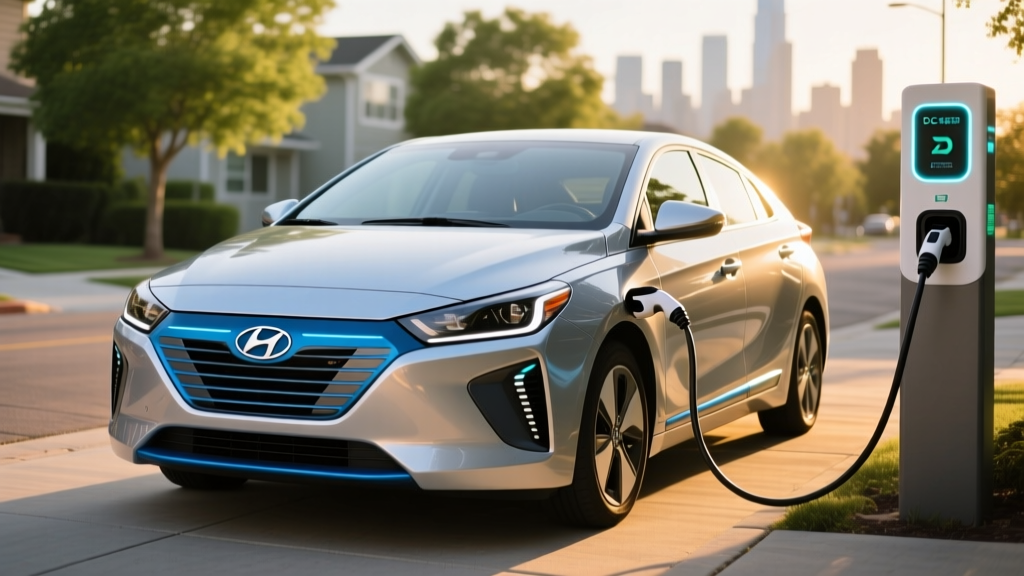
The 2017 Hyundai Ioniq Electric was never designed to chase headlines. With an EPA-estimated 124 miles of range and a modest 28 kWh battery, it targeted commuters who wanted maximum efficiency per kilowatt-hour rather than maximum distance per charge. Nearly a decade later, it remains one of the most energy-efficient battery-electric vehicles ever sold in the United States — and on the used market, it has become an intriguing budget entry into EV ownership.
This review examines the 2017 Ioniq Electric from a 2026 ownership perspective: real-world range expectations, charging practicality, battery longevity considerations, used-market pricing, and whether it still makes sense against modern competitors. Note that Hyundai also sold the Ioniq as a hybrid and plug-in hybrid; this review covers only the all-electric variant.
Range, Efficiency, and Real-World Expectations
The 2017 Ioniq Electric carries an EPA-estimated range of 124 miles on a full charge. That figure was competitive in 2017, when the original Nissan Leaf managed only 107 miles and the BMW i3 (without range extender) delivered 114. But efficiency — not raw range — is where the Ioniq truly excelled.
Real-World Expectation: 95–115 miles on mixed highway driving; 110–130 miles in city commuting with regenerative braking. In cold weather (below 32°F), expect a 20–30% reduction, dropping effective range to roughly 80–100 miles. The Ioniq's heat pump (standard on this model) mitigates some winter loss compared to EVs using resistive cabin heating.
At 136 MPGe combined (city 150 / highway 122), the 2017 Ioniq Electric held the title of most efficient EPA-rated vehicle of any kind for several years. Its consumption rate of approximately 25 kWh per 100 miles means you are extracting more distance from every unit of electricity than nearly any other EV on the road — past or present. For context, the 2024 Tesla Model 3 RWD achieves roughly 132 MPGe combined. The Ioniq's lightweight construction (3,230 lbs curb weight), low-drag body (0.24 Cd), and conservative powertrain calibration all contribute to this efficiency.
| Specification | Value |
|---|---|
| EPA Range | 124 miles |
| Battery (gross / usable) | 28 kWh / ~26.4 kWh |
| Battery Chemistry | NMC (Nickel Manganese Cobalt) — LG Chem cells |
| MPGe (city / hwy / combined) | 150 / 122 / 136 |
| Energy Consumption | 25 kWh / 100 mi |
| Motor Output | 88 kW (118 hp) / 218 lb-ft torque |
| Drivetrain | Front-wheel drive (single motor) |
| 0–60 mph | 9.7 seconds |
| Top Speed | 93 mph (electronically limited) |
| Curb Weight | 3,230 lbs |
| Drag Coefficient | 0.24 Cd |
| Cargo Volume (rear seats up / folded) | 18.8 cu ft / 44.3 cu ft |
| Front / Rear Legroom | 43.3 in / 33.9 in |
| Original MSRP (base Limited) | $29,500 (before incentives) |
Source: fueleconomy.gov, EPA ratings.
Battery Chemistry, Degradation, and Longevity
The 2017 Ioniq Electric uses a 28 kWh gross lithium-ion NMC (nickel manganese cobalt) pack supplied by LG Chem. Usable capacity is approximately 26.4 kWh, with a top-and-bottom buffer to protect cell health. This is a conventional NMC chemistry — not the LFP (lithium iron phosphate) found in some modern EVs — meaning it offers higher energy density but is more sensitive to sustained high or low states of charge.
Battery degradation on the Ioniq Electric has proven relatively mild in owner reports. Most 2017 examples tested between 2022 and 2025 showed 5–12% capacity loss depending on climate, charging habits, and mileage. A vehicle originally capable of 124 EPA miles might realistically deliver 110–118 miles at 80,000–100,000 miles on the odometer. Units in hot climates (Arizona, Texas) that were routinely fast-charged to 100% tend toward the higher end of that degradation range.
Hyundai's original battery warranty covers 10 years or 100,000 miles (whichever comes first) against capacity falling below approximately 70% of original. For a 2017 model, this warranty extends into 2027, meaning many examples on the used market still carry active battery coverage — a significant ownership safety net. However, warranty transfer to second owners varies by state and circumstance; confirm with a Hyundai dealer before purchase.
Charging Speed: DC Fast, Level 2, and Level 1
Charging is where the 2017 Ioniq's age shows most clearly. The DC fast-charging capability was modest even at launch, and by 2026 standards it is a limiting factor for anyone planning road trips.
| Charging Level | Connector | Max Rate | Time / Range Added |
|---|---|---|---|
| Level 1 (120V household) | J1772 | ~1.2 kW | ~4–5 miles per hour; full charge in ~24 hours |
| Level 2 (240V home/public) | J1772 | 6.6 kW (onboard charger) | ~25 miles per hour; full charge in ~4.5 hours |
| DC Fast Charge | CCS1 (Combo) | ~50 kW peak (typically 30–40 kW sustained) | 10–80% in approximately 30–35 minutes |
The 6.6 kW onboard Level 2 charger is adequate for overnight home charging. Plug in at 10 PM, and you will wake to a full battery by 6 AM — more than sufficient for daily commuting. Most owners install a 32-amp or 40-amp Level 2 wallbox, which delivers the full 6.6 kW the car can accept.
DC fast charging is the Ioniq's weak point. The ~50 kW peak rate (often sustaining closer to 30–40 kW in practice) means a 10–80% session takes roughly 30–35 minutes. On a road trip, that translates to a 25–30 minute stop for about 70–80 miles of added range. The charge curve tapers noticeably above 60% state of charge, and the battery management system is conservative to protect the relatively small pack. For comparison, a 2025 Hyundai Ioniq 5 peaks at 240 kW on an 800V architecture and completes 10–80% in roughly 18 minutes.
If your use case is strictly commuting with home charging, the Ioniq's charging speed is perfectly workable. If you plan regular drives beyond 100 miles, the slow fast-charging will test your patience.
Performance, Driving Impressions, and Tech
The single front-mounted motor produces 118 horsepower and 218 lb-ft of torque. The 0–60 mph time of 9.7 seconds is unhurried by modern EV standards, but the instant torque delivery makes the Ioniq feel peppy around town and in stoplight-to-stoplight driving. Highway merging requires planning, and the 93 mph top-speed limiter means this is not a car for the autobahn.
Ride quality is firm but well-damped, with the low center of gravity (battery pack under the floor) contributing to composed handling. The Ioniq's light weight — nearly 1,000 lbs lighter than many modern EVs — gives it an agility that heavier competitors lack, especially on twisty roads. Regenerative braking is adjustable via steering-wheel paddles, allowing everything from mild coasting to near one-pedal driving.
The 2017 Ioniq Electric came exclusively in the Limited trim, which was well-equipped:
- 7-inch touchscreen infotainment with Apple CarPlay and Android Auto
- Infinity premium audio (8 speakers)
- Blue Link connected services (remote start, climate preconditioning, SoC monitoring)
- Leather seats, heated and ventilated front seats, heated steering wheel
- Automatic emergency braking with pedestrian detection
- Lane departure warning, blind-spot detection, rear cross-traffic alert
- Adaptive cruise control (stops to full stop)
- LED headlights and taillights
Notable drawbacks include the absence of a heat-pump preconditioning feature for DC fast charging (the heat pump warms the cabin, not the battery pack on demand), a small rear window with limited visibility, and an infotainment system that feels dated by 2026 standards — no wireless CarPlay, no OTA updates, and a resistive-touch feel on the display.
Pros
- Class-leading efficiency: 136 MPGe combined, 25 kWh/100 mi
- Lightweight and nimble handling for an EV
- Generous standard equipment on the single Limited trim
- Heat pump reduces winter cabin-heating energy draw
- Strong battery warranty (10 yr / 100,000 mi) still active on many 2017 examples
- Low used-market pricing — affordable EV entry point
- Adjustable regenerative braking via paddles
Cons
- 124-mile EPA range is limiting for anything beyond commuting
- Slow DC fast charging (~50 kW peak, ~30–35 min 10–80%)
- Modest 118 hp and 9.7-second 0–60 time
- Small 28 kWh battery degrades more noticeably than larger packs
- Rear-seat legroom is tight (33.9 in) for taller passengers
- No battery thermal preconditioning for fast charging
- Infotainment feels outdated; no wireless smartphone integration
Pricing, Used Market Value, and Federal Tax Credits
The 2017 Hyundai Ioniq Electric originally carried an MSRP of $29,500 (the single Limited trim, before the $7,500 federal tax credit and any state incentives that were available at the time). It was sold only in California and select ZEV-mandate states, which limits used-market availability in other regions.
As of early 2026, used-market pricing for the 2017 Ioniq Electric typically falls between $8,500 and $13,000, depending on mileage, condition, battery state of health, and location. Low-mileage, well-maintained examples in California can command the higher end; higher-mileage units or those with documented battery degradation cluster near the lower end.
| Scenario | Amount |
|---|---|
| Original MSRP (2017) | $29,500 |
| Typical Used Price (2026) | $8,500 – $13,000 |
| Federal Used EV Credit (§25E, max) | Up to $4,000 (30% of sale price, capped) |
| Effective Price After Max Credit | $4,500 – $9,000 |
Federal Used EV Tax Credit (§25E)
The 2017 Ioniq Electric does not qualify for the §30D new-vehicle credit (production ended years ago). However, it may qualify for the §25E Previously-Owned Clean Vehicle Credit, which provides 30% of the sale price, up to a maximum of $4,000, when purchased from a licensed dealer. Key eligibility requirements per the IRS:
- Sale price must be $25,000 or less — the Ioniq's used pricing easily meets this cap
- Buyer income limits: AGI must not exceed $75,000 (single), $112,500 (head of household), or $150,000 (joint filers)
- Vehicle must be at least 2 model years old — the 2017 model qualifies
- Must purchase from a licensed dealer (private-party sales do not qualify)
- The vehicle must not have been transferred to a qualified buyer after August 16, 2022, more than once — check the title history
- Point-of-sale transfer is available — you can apply the credit as a down-payment reduction at the dealer
At a typical used price of $11,000, the credit would be $3,300 (30% of sale price, below the $4,000 cap), bringing the effective cost to roughly $7,700. This makes the Ioniq Electric one of the most affordable paths into EV ownership in 2026 — particularly for buyers who qualify for the full benefit. Always verify eligibility with a tax professional before relying on credit assumptions.
Who Should Buy the 2017 Ioniq Electric?
Buy the 2017 Ioniq Electric if:
- Your daily round-trip commute is under 70 miles and you can charge at home
- You live in a mild climate (less cold-weather range loss)
- You want the lowest possible cost-per-mile EV for city and suburban driving
- You qualify for the §25E used-EV credit and want a sub-$10,000 EV
- Efficiency and low operating costs matter more than range and performance
Look elsewhere if:
- You regularly drive more than 100 miles in a day
- You need a practical road-trip vehicle (the 50 kW DC charging is a bottleneck)
- You live in a cold-winter state and cannot charge at home or work
- You need rear-seat space for adults or bulky child seats
- You want modern infotainment, OTA updates, or advanced driver-assist features
The 2017 Ioniq Electric excels as a dedicated commuter and city runabout. Its unmatched efficiency means home electricity costs are extraordinarily low — at $0.14/kWh national average, a full charge costs approximately $3.65 and delivers roughly 110 real-world miles. That equates to roughly 3.3 cents per mile in energy cost, compared to 12–15 cents per mile for a 30 MPG gasoline car at $3.50/gallon.
It is not a family road-trip vehicle, a performance EV, or a tech showcase. It is a purpose-built efficiency machine that, on the used market, represents outstanding value for the right buyer.
Competitor Comparison: 2017 Ioniq Electric vs. Alternatives
| Spec | 2017 Hyundai Ioniq Electric | 2017 Nissan Leaf (30 kWh) | 2017 BMW i3 (94 Ah) | 2017 VW e-Golf |
|---|---|---|---|---|
| EPA Range | 124 mi | 107 mi | 114 mi | 125 mi |
| Battery | 28 kWh NMC | 30 kWh NMC | 33.2 kWh NMC | 35.8 kWh NMC |
| MPGe Combined | 136 | 112 | 111 | 119 |
| DC Fast Charge | ~50 kW (CCS) | ~50 kW (CHAdeMO) | ~50 kW (CCS) | ~50 kW (CCS) |
| 0–60 mph | 9.7 sec | 9.9 sec | 7.2 sec | 9.6 sec |
| Used Price (2026) | $8,500–$13,000 | $7,000–$11,000 | $10,000–$15,000 | $9,000–$13,000 |
The Ioniq's key advantage over these contemporaries is efficiency. It uses less energy per mile than all three competitors, which translates to lower charging costs and less strain on its smaller battery. The VW e-Golf offers slightly more range and a more refined ride, but at a higher used price. The Nissan Leaf's CHAdeMO connector is a growing liability as CCS and NACS dominate public charging infrastructure. The BMW i3 is quicker and more distinctive, but its premium used pricing and unconventional styling limit its appeal.
Against modern used EVs — such as a 2020 Chevrolet Bolt EV (259-mile range, typically $14,000–$18,000 used) or a 2021 Nissan Leaf Plus (226-mile range, $13,000–$17,000) — the Ioniq trades range and charging speed for a substantially lower entry price. If your commute fits within its range envelope, the savings are significant.
Frequently Asked Questions
What is the real-world range of the 2017 Hyundai Ioniq Electric?
In mild weather with mixed city and suburban driving, expect 110–120 miles. Highway driving at 70+ mph reduces this to roughly 95–105 miles. In winter conditions (below 32°F), range can drop to 80–100 miles due to battery chemistry limitations and cabin heating demand, though the heat pump helps mitigate losses compared to resistive heating systems.
How fast does the 2017 Ioniq Electric charge?
On a Level 2 (240V) home charger, the 6.6 kW onboard charger delivers about 25 miles of range per hour, fully charging the 28 kWh battery in approximately 4.5 hours. On a DC fast charger (CCS1), the peak rate is roughly 50 kW but typically sustains 30–40 kW, making a 10–80% charge take 30–35 minutes.
Does the 2017 Ioniq Electric qualify for the federal EV tax credit?
It does not qualify for the §30D new-vehicle credit. It may qualify for the §25E used-EV credit of up to $4,000 (30% of sale price) when purchased from a licensed dealer for $25,000 or less. Buyer income caps apply ($75K single / $150K joint). Confirm eligibility with a tax professional and the IRS guidelines.
How long will the 2017 Ioniq Electric battery last?
Most 2017 examples show 5–12% degradation at 80,000–100,000 miles. Hyundai's 10-year/100,000-mile battery warranty (covering capacity below ~70%) remains active on many 2017 models through 2027. With proper care — avoiding routine 100% charges and minimizing DC fast charging in extreme heat — NMC packs of this generation can deliver 150,000+ miles before significant capacity loss.
Is the 2017 Ioniq Electric worth buying in 2026?
For a budget-conscious commuter with home charging and a sub-70-mile daily drive, the Ioniq Electric at $8,500–$13,000 (potentially $4,500–$9,000 after the used-EV credit) is one of the most cost-efficient EVs available. Its limitations — short range, slow fast charging, modest performance — are real trade-offs. If you need more than 100 miles of daily range, consider a used Chevrolet Bolt EV or Nissan Leaf Plus instead.
What connector does the 2017 Ioniq Electric use?
It uses a J1772 connector for Level 1 and Level 2 AC charging, and a CCS1 (Combo) connector for DC fast charging. It does not have a NACS (Tesla) port. Adapters for Tesla Supercharger access (CCS-to-NACS) are available from third-party manufacturers but were not originally supplied by Hyundai.