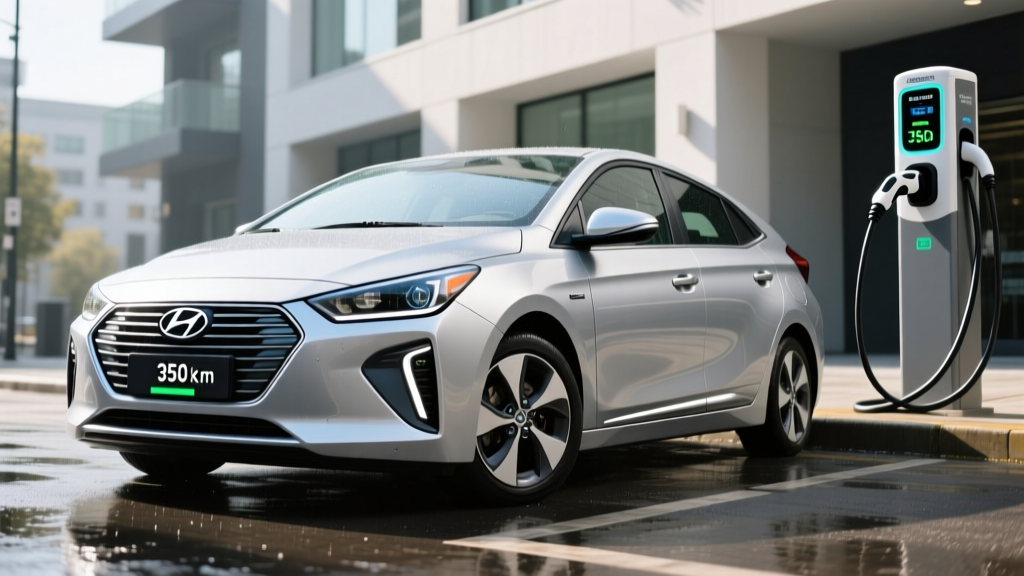
The 2017 Hyundai Ioniq Electric was never designed to be a cross-country cruiser. Built for a specific mission — affordable, hyper-efficient daily commuting — it arrived at a time when most EVs were either expensive long-range sedans or short-range compliance cars. Today, on the used market, it occupies a compelling niche: one of the cheapest ways to get into a reliable, efficient electric vehicle with solid build quality and surprisingly modern tech for its era.
If you're considering a used 2017 Ioniq Electric in 2026, this profile covers every spec that matters — real-world range expectations, charging realities, battery longevity, and whether it still qualifies for any federal incentives. Let's break down the numbers.
2017 Ioniq Electric at a Glance: Full Spec Sheet
| Specification | 2017 Hyundai Ioniq Electric |
|---|---|
| EPA Range | 124 miles |
| Battery (Gross / Usable) | 28 kWh / ~26.5 kWh |
| Battery Chemistry | NMC (Nickel Manganese Cobalt) |
| Motor Output | 88 kW (118 hp) / 218 lb-ft torque |
| Drivetrain | FWD (single motor) |
| 0–60 mph | ~9.7 seconds |
| EPA Efficiency | 136 MPGe combined (25 kWh/100 mi) |
| Max DC Fast Charge | ~50 kW (CCS) |
| Level 2 Charge Rate | 6.6 kW onboard charger |
| Cargo Volume (rear seats up) | 19.9 cu ft |
| Cargo Volume (rear seats folded) | 44.3 cu ft |
| Original Base MSRP | $29,500 |
| Battery/Powertrain Warranty (new) | 8 yr / 100,000 mi (10 yr / 100,000 mi in CARB states) |
| Connector | CCS1 (DC) / J1772 (AC) |
Range and Efficiency: EPA vs. the Real World
Real-World Expectation: ~105–120 miles in mixed city/highway driving; as low as 80–95 miles in sustained cold weather (below 32°F) or at highway speeds above 70 mph.
The Ioniq Electric's 136 MPGe combined rating made it one of the most efficient EVs ever sold when it debuted, and it still ranks near the top today. That 25 kWh/100 mi figure is genuinely impressive — it means you spend less on electricity per mile than nearly any competing EV.
But 124 miles of EPA range is 124 miles. There's no getting around the physics of a 28 kWh battery pack. Here's what to actually expect:
- City commuting (30–45 mph, mild weather): You can push 130+ miles thanks to regenerative braking and low aerodynamic drag. The Ioniq's 0.24 Cd drag coefficient helps enormously.
- Mixed driving (suburban + some highway): Expect 105–120 miles before you're hunting for a plug.
- Highway cruising (70+ mph): Range drops to roughly 90–100 miles. Small batteries are disproportionately affected by high-speed energy demand.
- Cold weather (below freezing): Without a heat pump (the Ioniq uses resistive cabin heating), expect 20–30% range loss, landing you at 80–95 real-world miles.
For a commuter covering 30–50 miles round trip with home charging, this range is perfectly adequate. For anything else, you'll need to plan carefully. According to fueleconomy.gov, the Ioniq Electric achieves 136 MPGe combined — a figure that remains competitive even against 2026 models.
Charging Speed: DC Fast, Level 2, and Level 1
Charging speed is where the Ioniq Electric shows its age most clearly. In 2017, 50 kW DC fast charging was respectable. By 2026 standards, with many new EVs charging at 150–350 kW, it's slow — but still functional for a car with a small battery.
| Charging Level | Power / Rate | Time / Miles Added |
|---|---|---|
| Level 1 (120V household) | ~1.2 kW | ~4–5 miles per hour; 0–100% in ~24 hours |
| Level 2 (240V, 6.6 kW onboard) | 6.6 kW | ~26 miles per hour; 0–100% in ~4.5 hours |
| DC Fast Charge (CCS) | ~50 kW peak | 10–80% in ~30–35 minutes |
DC fast charging reality: The 2017 Ioniq Electric peaks at approximately 50 kW on a CCS connector, but that peak only holds at low states of charge. Expect the curve to taper significantly above 60% SoC. A 10–80% session takes roughly 30–35 minutes at a capable station. Because the battery is small, even a "slow" 50 kW charger replenishes a meaningful percentage — going from 20% to 80% adds about 75 miles of range.
Level 2 home charging: The 6.6 kW onboard charger is a genuine strength. A full charge from empty takes about 4.5 hours on a 240V Level 2 station. If you install a 32-amp or 40-amp home charger (costing roughly $500–$1,200 installed, depending on your electrical panel), you'll wake up to a full battery every morning — more than enough for the Ioniq's range envelope.
Important note on connectors: The 2017 Ioniq Electric uses CCS1 for DC fast charging and J1772 for AC. As the industry shifts toward NACS (Tesla's connector), CCS remains widely supported at Electrify America, EVgo, and ChargePoint stations. You won't need an adapter for most public networks, but if you want to use Tesla Superchargers (which are opening to non-Tesla vehicles via the Magic Dock adapter), verify compatibility before relying on it.
Performance and Driving Dynamics
The Ioniq Electric's 118-horsepower electric motor and 218 lb-ft of torque deliver adequate — not exciting — acceleration. The 0–60 mph time of roughly 9.7 seconds places it firmly in economy-car territory. This is a car optimized for efficiency, not performance.
What it does well is city drivability. Electric torque delivery makes it feel peppier than the numbers suggest in stop-and-go traffic. The low center of gravity (battery pack under the floor) gives it surprisingly composed handling for a compact hatchback. Ride quality is firm but controlled — Hyundai tuned this for efficiency-minded buyers, not enthusiasts.
The single-speed reduction gear means no shifting, no noise, and a smooth, linear power delivery. Regenerative braking is adjustable via steering-wheel paddles, letting you dial in anything from mild coasting to aggressive one-pedal-style deceleration (though it won't come to a complete stop on regen alone).
Interior, Cargo, and Technology
The Ioniq Electric seats five, though the rear middle seat is best reserved for short trips. Front legroom is generous at 42.2 inches; rear legroom comes in at 35.7 inches — adequate for adults on shorter rides. The sloping roofline (a design choice for aerodynamic efficiency) cuts into rear headroom slightly.
Cargo space is a highlight: 19.9 cubic feet behind the rear seats, expanding to 44.3 cubic feet with the 60/40 split rear seats folded. That's competitive with compact crossovers and makes the Ioniq practical for grocery runs, luggage, or even modest IKEA hauls.
Infotainment: The 2017 model features a 7-inch touchscreen with Apple CarPlay and Android Auto — a significant advantage over some competitors of the era that lacked smartphone integration. Navigation is available on higher trims. The interface is dated by 2026 standards but remains functional and responsive.
Driver assists: The Ioniq Electric offers Hyundai's SmartSense suite on well-equipped trims, including:
- Lane Keep Assist
- Automatic Emergency Braking with Pedestrian Detection
- Blind Spot Detection
- Rear Cross-Traffic Alert
- Adaptive Cruise Control (Limited trim)
These are SAE Level 0–1 features — basic driver assistance, not semi-autonomous driving. They work well for their generation but lack the sophistication of modern Level 2 systems like Hyundai's current Highway Driving Assist.
Pricing, Tax Credits, and Used-Buying Economics
The 2017 Hyundai Ioniq Electric originally started at $29,500 (base SE trim), with the well-equipped Limited trim reaching approximately $33,500. A federal $7,500 tax credit was available to original buyers.
In the 2026 used market, expect to pay roughly $8,000–$14,000 depending on mileage, condition, and region. That makes it one of the most affordable entry points into EV ownership.
The 2017 Ioniq Electric may qualify for the Used Clean Vehicle Credit under IRS §25E — up to $4,000 or 30% of the sale price (whichever is lower). Key requirements:
- Sale price must be $25,000 or less
- Buyer income caps: $75,000 single / $112,500 head of household / $150,000 joint
- Vehicle must be at least 2 model years old (2017 qualifies)
- Must purchase from a licensed dealer
- Credit can be transferred to the dealer at point of sale for an upfront price reduction
The original §30D new-vehicle credit no longer applies to 2017 models purchased used — only the §25E used-vehicle credit is relevant here.
Battery Longevity, Degradation, and Warranty
The 2017 Ioniq Electric uses a 28 kWh NMC (nickel manganese cobalt) battery pack with an advanced liquid-cooling thermal management system. This was a significant advantage over the passively air-cooled Nissan Leaf of the same era, which suffered notorious degradation in hot climates.
Degradation data: Real-world owner reports and fleet data suggest the Ioniq Electric's battery holds up well. Most high-mileage examples (80,000–120,000 miles) show 8–15% capacity loss after 7–9 years. That means a 2017 model in 2026 might deliver 105–115 miles of range instead of the original 124 — still viable for commuting.
Warranty coverage: When new, the battery and powertrain were covered for 8 years / 100,000 miles (extended to 10 years / 100,000 miles in CARB states including California, New York, Massachusetts, and others). For a 2017 model, the 8-year federal warranty expired in 2025. However, in CARB states, coverage extends through 2027 — a significant advantage for used buyers in those jurisdictions. Hyundai defines warranty-covered degradation as falling below 70% of original capacity.
Battery replacement cost: If out of warranty, a replacement pack runs approximately $5,000–$8,000 including labor at a Hyundai dealer. Given the vehicle's used value, a battery failure would be a near-total-loss scenario — making a pre-purchase battery health check essential.
2017 Ioniq Electric: Pros and Cons
✓ Pros
- Outstanding efficiency — 136 MPGe / 25 kWh/100 mi
- Affordable used pricing ($8K–$14K)
- Liquid-cooled battery resists degradation
- Strong cargo space for a compact hatch (19.9 cu ft)
- Apple CarPlay / Android Auto standard
- 6.6 kW onboard charger enables fast Level 2 top-ups
- May qualify for $4,000 used-EV tax credit
✗ Cons
- Only 124 miles EPA range (80–95 mi in cold)
- 50 kW DC fast charging is slow by 2026 standards
- No heat pump — resistive heating drains range in winter
- Modest 118 hp / 9.7-sec 0–60 time
- Original battery warranty expiring or expired in most states
- Dated infotainment and interior materials
- CCS-only DC charging (no native NACS)
Who Should Buy the 2017 Ioniq Electric?
Not for: Anyone who needs 200+ miles of range, frequently drives in extreme cold, takes regular road trips, or needs to tow anything.
The Ioniq Electric is a specialist, not a generalist. It excels at exactly one thing: moving one or two people short distances on electricity as cheaply and reliably as possible. At roughly $10,000–$12,000 after the potential used-EV credit, it's nearly unbeatable as a second car or dedicated commuter.
Compared to a used 2017 Nissan Leaf (30 kWh, 107 mi range, air-cooled battery), the Ioniq offers more range, better thermal management, and greater efficiency. Compared to a used Chevrolet Bolt EV (238 mi range), the Bolt offers dramatically more range but typically costs $4,000–$7,000 more on the used market.
Frequently Asked Questions
What is the real-world range of the 2017 Ioniq Electric?
Expect 105–120 miles in mild-weather mixed driving, 90–100 miles at sustained highway speeds, and 80–95 miles in freezing temperatures. The 124-mile EPA figure is achievable in ideal city conditions but optimistic for most real-world scenarios.
How fast does the 2017 Ioniq Electric charge?
On DC fast charging (CCS), it peaks at roughly 50 kW, reaching 10–80% in about 30–35 minutes. On a 240V Level 2 home charger, the 6.6 kW onboard charger delivers a full charge in approximately 4.5 hours. Level 1 (120V) adds about 4–5 miles per hour.
Does the 2017 Ioniq Electric qualify for any tax credit in 2026?
Not the new-vehicle §30D credit. However, it may qualify for the IRS §25E Used Clean Vehicle Credit — up to $4,000 or 30% of the sale price, whichever is lower. Requirements include a sale price under $25,000, buyer income limits, and purchase from a licensed dealer. Confirm eligibility at IRS.gov and consult a tax professional.
Is the 2017 Ioniq Electric worth buying vs. a used Chevy Bolt or Nissan Leaf?
If range is your priority, the used Chevy Bolt EV (238 mi EPA) is the clear winner, though it typically costs more. If budget is paramount and your commute is short, the Ioniq's efficiency and lower price make it the better value. The Ioniq beats the 2017 Leaf on range (124 vs. 107 mi), efficiency, and battery longevity (liquid vs. air cooling).
How long will the battery last?
Liquid-cooled NMC packs in the Ioniq have demonstrated strong longevity. Most 7–9 year old examples show 85–92% of original capacity. With proper care (avoiding frequent 100% charges and DC fast-charging exclusively), the pack should remain viable for commuting well past 120,000 miles.
Can I install a home charger for the Ioniq Electric?
Yes. The 6.6 kW onboard charger pairs well with a 32-amp or 40-amp Level 2 home station. Installation typically costs $500–$1,500 depending on your electrical panel capacity and the distance from panel to charger location. A licensed electrician should evaluate your 200-amp panel capacity before installation.