The Quick Verdict on the 2017 Ford Focus Electric
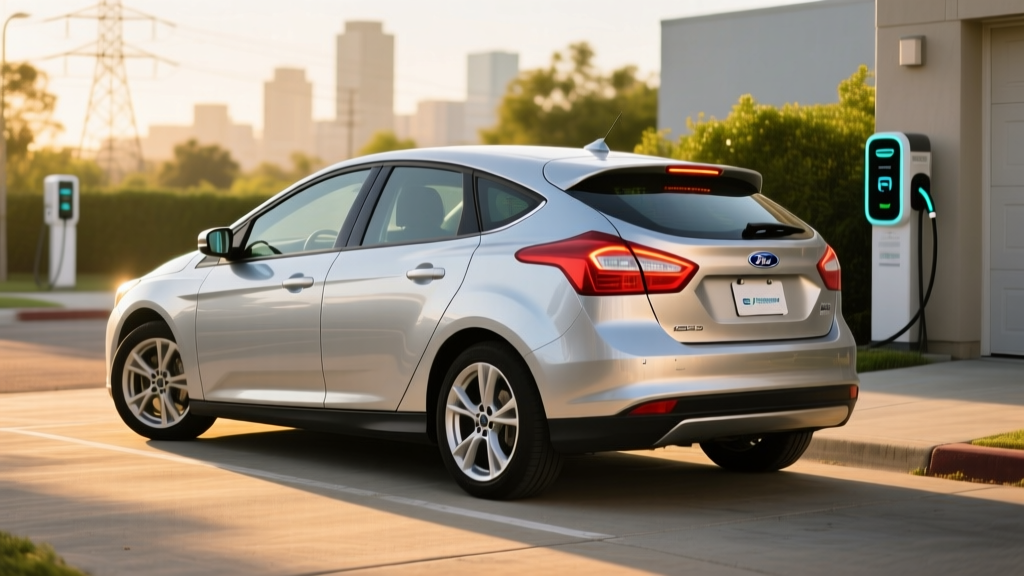
The 2017 Ford Focus Electric delivers an EPA-rated 115 miles of range from a 33.5 kWh lithium-ion battery, peaks at roughly 100 kW DC fast charging (CHAdeMO), and costs between $7,500 and $12,000 on the used market in 2026. It qualifies for the up-to-$4,000 federal used-EV tax credit (§25E) if you meet income and price caps. It's a solid budget commuter for drivers with home charging and daily round trips under 80 miles — but its CHAdeMO connector, limited cargo space, and cold-weather range drop to ~80 miles are real limitations you need to accept.
Specs That Matter: 2017 Ford Focus Electric at a Glance
| Specification | 2017 Ford Focus Electric |
|---|---|
| EPA Range | 115 miles |
| Battery (usable) | 33.5 kWh (liquid-cooled, LG Chem NMC) |
| Motor Output | 143 hp / 184 lb-ft torque |
| 0–60 mph | ~9.3 seconds |
| EPA Efficiency | 107 MPGe combined (31 kWh/100 mi) |
| DC Fast Charge (peak) | ~100 kW (CHAdeMO) |
| Level 2 Charge Rate | 6.6 kW (J1772) |
| Level 2 Time (0–100%) | ~5.5 hours |
| DC Fast 10–80% | ~30 minutes (under ideal conditions) |
| Cargo Volume | 14.5 cu ft (reduced by battery packaging) |
| Original MSRP | $29,120 (before incentives) |
| 2026 Used Price Range | $7,500–$12,000 |
| Powertrain Warranty (original) | 8 yr / 100,000 mi battery & electric components |
Real-World Range: What 115 EPA Miles Actually Means
EPA Sticker: 115 miles
Real-World Highway (65–75 mph): ~90–100 miles
Cold Weather (below 32°F): ~75–85 miles
Ideal City Commute (moderate climate): ~110–120 miles
The 2017 Focus Electric uses a liquid-cooled battery, which is a significant advantage over the passively cooled Nissan Leaf of the same era. Liquid cooling helps sustain charging speeds and reduces long-term degradation. However, 33.5 kWh is a small battery by 2026 standards. The Focus Electric lacks a heat pump, so winter cabin heating draws directly from the traction battery, eating into range significantly. If your daily commute is 40 miles each way, you'll want to charge every night without exception in winter.
The DC fast-charging curve on the CHAdeMO connector peaks near 100 kW at low state of charge but tapers sharply above 60% SoC. Expect the 10–80% charge to take roughly 30 minutes at a functioning 100+ kW CHAdeMO station — but finding CHAdeMO stalls in 2026 is increasingly difficult as the industry has standardized on NACS (Tesla's connector) and CCS. Electrify America stations often have only one CHAdeMO plug, and it's not always operational.
Used EV Tax Credit: Can You Get $4,000 Off?
The 2017 Focus Electric was never eligible for the full $7,500 new-vehicle credit (§30D) because its battery components and critical minerals didn't meet later sourcing requirements. However, as a used purchase in 2026, it can qualify for the §25E used clean vehicle credit — up to $4,000 or 30% of the sale price, whichever is lower.
§25E Used EV Credit Requirements (2026):
- Vehicle sale price: Must be $25,000 or less (easily met — these sell for $7,500–$12,000)
- Vehicle age: Must be at least 2 model years old (2017 qualifies)
- Buyer income cap: AGI ≤ $75,000 single / $112,500 head of household / $150,000 joint
- Dealer requirement: Must purchase from a licensed dealer (private-party sales don't qualify)
- Transfer option: Credit can be transferred to the dealer at point of sale as a price reduction
- Frequency limit: One used-EV credit per taxpayer every 3 years
At a $10,000 purchase price, 30% equals $3,000 — that's your credit, not the full $4,000. Still, a $3,000 reduction brings effective cost to around $7,000, making this one of the cheapest ways into a liquid-cooled EV on the market.
Cost of Ownership: Focus Electric vs. Gas Compact
Let's compare a 2017 Focus Electric against a typical 2017 gas compact (like the Focus SE with the 2.0L engine, rated at 30 MPG combined) over 5 years and 60,000 miles.
| Cost Category | 2017 Focus Electric | 2017 Gas Compact (30 MPG) |
|---|---|---|
| Purchase Price (2026) | $10,000 | $9,000 |
| Federal Tax Credit | −$3,000 (§25E) | $0 |
| Effective Purchase | $7,000 | $9,000 |
| Fuel/Energy (60k mi) | $2,790 (home charging @ $0.15/kWh) | $7,000 (@ $3.50/gal) |
| Maintenance (5 yr) | $600 (tires, cabin filter, wipers) | $2,800 (oil, filters, brakes, spark plugs) |
| Insurance (5 yr avg) | $6,500 | $5,800 |
| 5-Year Total | $16,890 | $24,600 |
| Cost per Mile | $0.28/mi | $0.41/mi |
The Focus Electric saves roughly $7,700 over 5 years despite a slightly higher insurance cost. The savings come primarily from fuel (electricity at $0.15/kWh vs. $3.50/gallon gas) and dramatically lower maintenance — no oil changes, no transmission fluid, and regenerative braking extends pad life to 80,000+ miles in typical driving.
Energy cost math: 31 kWh/100 mi × $0.15/kWh = $0.047 per mile on home Level 2 charging. Compare that to $3.50/gal ÷ 30 MPG = $0.117 per mile on gas. If you rely exclusively on public DC fast charging at $0.40/kWh, your cost jumps to $0.124/mile — actually more expensive than gas. Home charging access is essential for this vehicle to make financial sense.
Charging at Home: What You Need
The 2017 Focus Electric charges at 6.6 kW on Level 2 via a J1772 connector. Here's what a typical home installation looks like:
| Item | Estimated Cost |
|---|---|
| Level 2 EVSE (240V, 32A, J1772) | $300–$600 |
| Electrician labor (50-ft run, 240V/40A circuit) | $800–$1,500 |
| Permit & inspection | $100–$300 |
| Panel upgrade (if needed, 100A → 200A) | $1,500–$3,000 |
| Total (no panel upgrade) | $1,200–$2,400 |
| Total (with panel upgrade) | $2,700–$5,400 |
At 6.6 kW, a full 0–100% charge takes roughly 5.5 hours — easily accomplished overnight. This means even if you drain the battery to 20% during the day, you'll wake up fully charged. Most Focus Electric owners never use public chargers except for rare road trips, which is practical given the 115-mile range.
Important caveat: If you live in an apartment or condo without dedicated parking and charging access, this vehicle becomes impractical. Public CHAdeMO infrastructure is shrinking in 2026, and relying solely on public charging negates both the cost savings and the convenience.
Common Misconceptions About the 2017 Focus Electric
| Myth | Fact |
|---|---|
| "The battery will need a $15,000 replacement soon." | The liquid-cooled LG Chem pack degrades slowly. Most 2017 examples retain 85–92% of original capacity (~97–106 miles of range) in 2026. The 8-year/100,000-mile battery warranty may still apply if under threshold. |
| "It can't handle highway speeds." | It holds 70–75 mph comfortably, but efficiency drops sharply above 65 mph. Expect ~90 miles of range at sustained highway speed. |
| "CHAdeMO is dead, so I can never fast-charge." | CHAdeMO still exists at many Electrify America and EVgo stations, though availability is declining. Adapters (CHAdeMO-to-NACS) are emerging but cost $300–$500 and may limit charge speed. |
| "Used EVs aren't eligible for tax credits." | The §25E credit offers up to $4,000 (or 30% of sale price) for qualifying used EVs purchased from dealers, with income caps. |
| "I need to worry about oil changes and emissions tests." | Zero engine maintenance. No oil, no spark plugs, no catalytic converter, no emissions testing. Just tires, wipers, cabin air filter, and brake fluid. |
Who Should Buy a 2017 Ford Focus Electric?
Buy the 2017 Focus Electric if:
- You have access to home Level 2 charging (garage, driveway, or dedicated spot)
- Your daily round-trip commute is under 80 miles (leaving a 35-mile buffer for detours and winter)
- You want the cheapest possible entry into EV ownership ($7,000 effective after tax credit)
- You primarily drive in a city or suburban environment where regenerative braking maximizes efficiency
- You already have a second vehicle for longer road trips
Look elsewhere if:
- You live in an apartment without charging access
- Your daily commute exceeds 50 miles one way
- You regularly drive in sub-freezing temperatures and need full 115-mile range
- You need cargo space — the battery hump cuts the trunk to 14.5 cu ft (a gas Focus has 23.3 cu ft)
- You rely on road trips — CHAdeMO fast-charging infrastructure is unreliable in many regions
Compared to a 2017 Nissan Leaf (30 kWh), the Focus Electric has a slight range advantage (115 vs. 107 miles) and the critical benefit of liquid cooling, which preserves battery health in hot climates and sustains charge speeds. Compared to a 2018+ Leaf (40 kWh, 151-mile range), the Focus Electric falls behind on range but wins on thermal management — the Leaf's passive cooling leads to faster degradation and charge-speed throttling in heat.
Frequently Asked Questions
What is the real-world range of the 2017 Ford Focus Electric?
The EPA rates it at 115 miles. In real-world mixed driving at moderate temperatures, expect 100–110 miles. Sustained highway driving at 70+ mph drops this to 85–95 miles, and winter conditions (below 32°F) can reduce range to 75–85 miles due to resistive cabin heating drawing from the 33.5 kWh battery.
Does the 2017 Focus Electric qualify for any tax credits in 2026?
Not the new-vehicle §30D credit, but it can qualify for the §25E used clean vehicle credit — up to $4,000 or 30% of the sale price (whichever is lower). You must buy from a licensed dealer, meet income caps ($75K single / $150K joint), and not have claimed a used-EV credit in the past 3 years. See IRS guidelines.
How long does the battery last?
The liquid-cooled LG Chem NMC battery in the 2017 Focus Electric has proven durable. Most examples in 2026 show 85–92% state of health (SoH) at 60,000–90,000 miles. Ford's original 8-year/100,000-mile battery warranty covers capacity below 60% of original — a very low threshold that few vehicles hit. A full replacement, if needed, runs $5,000–$8,000 at an independent EV shop, though this is rare.
Can I fast-charge the Focus Electric on a road trip?
Yes, but with caveats. It uses the CHAdeMO connector, which is still available at many Electrify America and EVgo stations but is being phased out in favor of NACS and CCS. Plan routes carefully using PlugShare or A Better Routeplanner, and always have a backup charging option. Peak DC charge rate is ~100 kW, giving a 10–80% charge in roughly 30 minutes under ideal conditions.
How does the Focus Electric compare to a gas Focus in cost?
Over 5 years and 60,000 miles, the Focus Electric saves approximately $7,700 in total cost of ownership when charged primarily at home, driven by lower energy costs ($0.047/mi vs. $0.117/mi) and minimal maintenance. The break-even point vs. a comparable gas compact is typically within 2 years of ownership. Data sourced from fueleconomy.gov.
What should I check before buying a used 2017 Focus Electric?
Request a battery health report (state of health percentage) from the dealer or use an OBD-II EV scanner. Check for any outstanding recalls via NHTSA. Inspect the CHAdeMO charge port for corrosion or damage. Verify the original 8-year battery warranty start date (based on original in-service date). Test the regenerative braking feel and confirm the onboard charger accepts 6.6 kW on a Level 2 station.