Why the 2017 Ford F-150 Bolt Pattern Matters for EV Builders
If you're researching the 2017 Ford F-150 bolt pattern, you're likely either replacing wheels, upgrading brakes, or exploring one of the more ambitious garage projects of the decade: converting a gas F-150 into an electric truck. The 2017 F-150 uses a 6-lug, 135mm bolt circle (6×135mm) — a pattern Ford has stuck with on full-size trucks for years. That spec determines which wheels fit, which hub-centric rings you need, and whether aftermarket EV-conversion brake kits will clear your rotors.
But bolt patterns are only the start. With the Ford F-150 Lightning proving that electric pickups can tow, haul, and commute without compromise, a growing community of builders is pulling ICE powertrains from 2015–2020 F-150s and dropping in salvaged Tesla, Nissan, or Chevrolet EV drivetrains. This guide covers the bolt pattern specifics you need, then goes deep on what a real EV conversion looks like in 2026 — range, charging, cost, and whether it's worth it versus buying a Lightning outright.
2017 Ford F-150 Bolt Pattern: The Exact Specs
Here's the wheel-mounting data for the 2017 F-150, regardless of trim (XL, XLT, Lariat, King Ranch, Platinum, Limited) or drivetrain (4×2 or 4×4):
| Specification | Value |
|---|---|
| Bolt Pattern | 6 × 135 mm (6-lug) |
| Center Bore | 87.1 mm (hub-centric) |
| Lug Nut Thread Size | M14 × 1.5 |
| Lug Nut Torque Spec | 150 lb-ft (203 Nm) |
| Stock Wheel Sizes | 17", 18", 20" depending on trim |
| Typical Offset Range | +40 to +44 mm (stock) |
The 6×135mm pattern is shared across most Ford F-150 model years from 2004 onward, as well as the Ford Expedition and Lincoln Navigator. This means aftermarket wheel options are plentiful, but you must match the 87.1mm center bore — or use hub-centric rings — to avoid vibration at highway speeds. For EV conversions, this matters doubly: electric motors deliver instant torque to the wheels, and any imbalance in the hub-to-wheel interface becomes immediately obvious under hard acceleration.
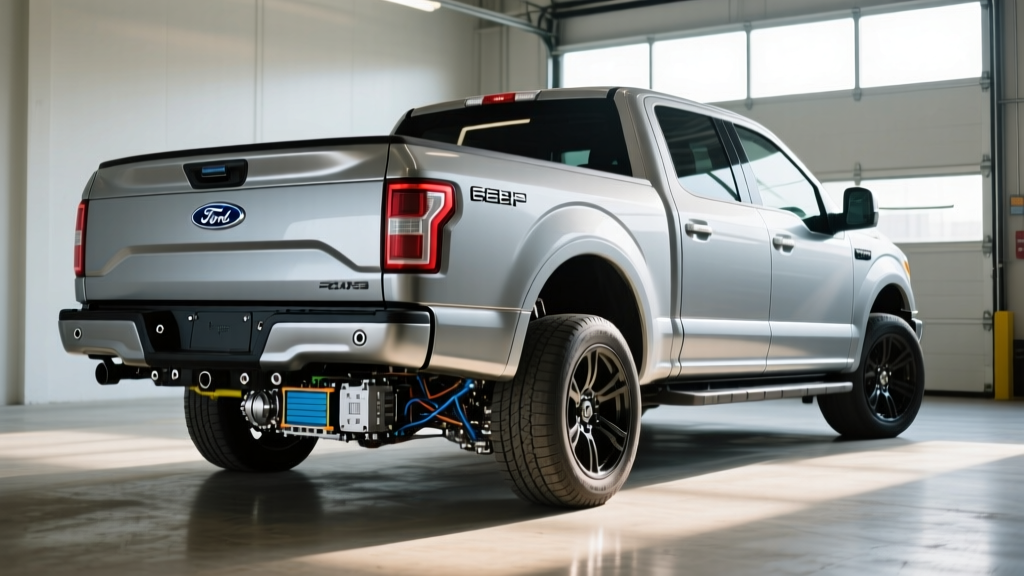
EV Conversion Basics: Dropping an Electric Drivetrain Into a 2017 F-150
Converting a 2017 F-150 from gas to electric isn't a weekend project, but it's increasingly feasible thanks to a maturing ecosystem of salvaged drivetrains, adapter plates, and open-source battery management systems. Most conversions in 2026 fall into three categories:
- Tesla Large Drive Unit (LDU) swap: Using a salvaged Model S or Model X rear motor, paired with a standalone inverter (e.g., from EV West or Open Inverter). Popular for RWD conversions.
- Nissan Leaf stack: Motor + inverter + battery modules from a wrecked Leaf. Lower power (~110 kW / 147 hp) but simpler integration and widely available.
- Full crate EV drivetrain: Companies like EV West and Cascadia Motion sell complete motor-inverter-gearbox assemblies rated for 200+ kW, designed for custom builds.
The 2017 F-150's 3.5L EcoBoost V6 or 5.0L Coyote V8 weighs 450–550 lbs. A typical EV swap adds a motor (80–150 lbs), inverter (30–50 lbs), and battery pack (600–1,200 lbs depending on capacity). Net weight change depends on battery size, but most conversions end up 300–800 lbs heavier than stock — which affects suspension, braking, and the wheel bearings behind that 6×135mm bolt pattern.
Real-World Range and Battery Capacity of a Converted F-150
For comparison, the 2026 Ford F-150 Lightning with the Extended Range battery delivers an EPA-estimated 320 miles from a 131 kWh usable pack. The gap is enormous, and it comes down to battery size, aerodynamics, and thermal management. Most garage conversions lack liquid cooling for the battery, which limits both range and fast-charging capability.
| Vehicle | Battery (kWh usable) | EPA Range | Real-World Highway | Cold Weather Est. |
|---|---|---|---|---|
| 2017 F-150 EV Conversion (60 kWh) | 60 | N/A (not EPA-certified) | 90–110 mi | 70–95 mi |
| 2017 F-150 EV Conversion (100 kWh) | 100 | N/A | 150–180 mi | 110–140 mi |
| 2026 F-150 Lightning Ext. Range | 131 | 320 mi | 250–280 mi | 200–230 mi |
| 2026 Rivian R1T Dual-Motor Max | 141 | 352 mi | 280–310 mi | 220–260 mi |
Charging Speed: DC Fast Charge and Home Level 2
This is where most conversions hit a hard ceiling. A production F-150 Lightning can accept up to 150 kW on DC fast charging, reaching 10–80% in about 41 minutes at a 350 kW-capable station (the truck caps at 150 kW). A converted 2017 F-150 typically relies on:
| Charging Level | Converted F-150 (typical) | 2026 F-150 Lightning |
|---|---|---|
| Level 1 (120V, 12A) | 1.4 kW (~3–4 mi/hr) | 1.4 kW (~3 mi/hr) |
| Level 2 (240V, 32A) | 7.7 kW (~18–22 mi/hr) | 11.5 kW (~27 mi/hr) or 19.2 kW (~44 mi/hr) w/ 80A charger |
| DC Fast Charge (CCS) | 20–50 kW (if equipped)* | 150 kW peak, 10–80% in ~41 min |
*Many conversions omit DC fast charging entirely, relying on Level 2 only. Adding a CCS-capable onboard charger (e.g., a salvaged Chevy Bolt or Tesla Gen 2 charger) adds $2,000–$5,000 and requires CAN-bus integration. Without liquid-cooled batteries, sustained DC charging above 50 kW risks overheating cells and accelerating degradation.
At home on a 7.7 kW Level 2 circuit, a 60 kWh conversion pack takes roughly 8 hours to charge from 10% to full — feasible for overnight charging but impractical for road trips. This is the single biggest functional gap between a conversion and a production EV.
Performance: 0-60, Horsepower, and Drivetrain
Electric motors deliver peak torque at 0 RPM, which transforms a heavy truck's acceleration. A typical Tesla LDU swap produces 200–270 hp at the wheels (after gear reduction losses) and 300–400 lb-ft of torque. In a 2017 F-150 weighing approximately 5,200–5,600 lbs post-conversion:
- 0–60 mph: 6.5–8.5 seconds (depending on motor and battery C-rate)
- Top speed: Often electronically limited to 85–100 mph by the inverter
- Drivetrain: Most conversions are RWD only, using a single rear motor. AWD requires a second front motor and significant fabrication.
For context, the 2026 F-150 Lightning with the dual-motor Extended Range setup produces 580 hp and 775 lb-ft, hitting 0–60 in approximately 3.8 seconds. A garage conversion won't match that, but it will feel dramatically quicker off the line than the stock 3.5L EcoBoost (0–60 in ~5.8 seconds) thanks to instant electric torque.
Cost Breakdown: Conversion vs. Buying a Lightning
Here's the financial picture that determines whether a conversion makes sense:
| Item | Conversion (60 kWh) | Conversion (100 kWh) | 2026 Lightning XLT |
|---|---|---|---|
| Donor truck (used 2017 F-150) | $12,000–$18,000 | $12,000–$18,000 | — |
| Motor + inverter + gearbox | $3,500–$8,000 | $5,000–$12,000 | — |
| Battery pack (salvaged modules) | $6,000–$12,000 | $12,000–$22,000 | — |
| BMS, wiring, cooling, fabrication | $3,000–$6,000 | $5,000–$10,000 | — |
| Charger + CCS integration | $1,500–$4,000 | $2,000–$5,000 | — |
| Labor (professional, if not DIY) | $8,000–$20,000 | $12,000–$30,000 | — |
| Total estimated cost | $34,000–$68,000 | $48,000–$97,000 | ~$55,000 MSRP |
A 2026 F-150 Lightning XLT starts around $55,000 MSRP (before any incentives) and comes with a factory warranty, EPA-certified range, 150 kW DC fast charging, Pro Power Onboard, and Ford's BlueCruise Level 2 driver-assist system. The Lightning also qualifies for evaluation under the IRS §30D federal tax credit, though eligibility depends on battery component sourcing, buyer income caps ($150K single / $300K joint), and the $80,000 MSRP cap for trucks.
A DIY conversion with salvaged parts and your own labor can come in under $35,000 total — but you're building a vehicle with no warranty, no EPA certification, no crash-testing of the modified drivetrain, and potentially no path to passing state inspection in jurisdictions that require OBD-II emissions compliance. For most buyers, the Lightning is the rational choice. For builders who value the process and customization, the conversion is a passion project with real trade-offs.
Who Should Consider an EV Conversion (And Who Shouldn't)
- You have fabrication, electrical, and CAN-bus programming skills (or a trusted shop that does)
- You want a unique, one-of-one truck and value the build process
- Your daily driving is under 80 miles round-trip with home charging
- You have a specific 2017 F-150 (e.g., a sentimental truck, a rare trim) you want to preserve and modernize
- You need reliable 250+ mile range and DC fast charging for road trips
- You want a warranty, insurance compatibility, and state inspection compliance
- You plan to tow (the Lightning is rated for 7,700–10,000 lbs; conversions are rarely tow-rated)
- Your time is better spent earning money than fabricating motor mounts
Frequently Asked Questions
What is the bolt pattern on a 2017 Ford F-150?
The 2017 F-150 uses a 6×135mm bolt pattern (6 lugs on a 135mm bolt circle diameter) with an 87.1mm center bore and M14×1.5 lug nuts torqued to 150 lb-ft.
Can I put F-150 Lightning wheels on a 2017 F-150?
Yes — the 2022–2026 F-150 Lightning uses the same 6×135mm bolt pattern and 87.1mm center bore as the 2017 model. Wheels are directly interchangeable, though you should verify offset and brake clearance.
How much does it cost to convert a 2017 F-150 to electric?
A DIY conversion with a 60 kWh salvaged battery pack typically costs $34,000–$68,000 including the donor truck. Professional builds with 100+ kWh packs can exceed $90,000. For comparison, a 2026 F-150 Lightning starts around $55,000.
Does an EV-converted F-150 qualify for the federal tax credit?
No. The IRS §30D credit applies only to new qualified plug-in electric vehicles purchased from a manufacturer. A garage conversion of a used truck does not qualify. Some states offer separate incentives for EV conversions — check your local energy office.
What's the real-world range of a converted F-150?
With a 60 kWh pack, expect 90–110 miles on the highway and 120–150 miles in mixed driving. Cold weather (below freezing) reduces this by 20–30%. A 100 kWh pack extends highway range to roughly 150–180 miles.
Is an EV conversion worth it versus buying a Lightning?
For most buyers, no — the Lightning offers more range, faster charging, a warranty, and a lower total cost. For builders who want a custom project and accept the limitations, a conversion is a rewarding but expensive hobby that produces a unique vehicle.