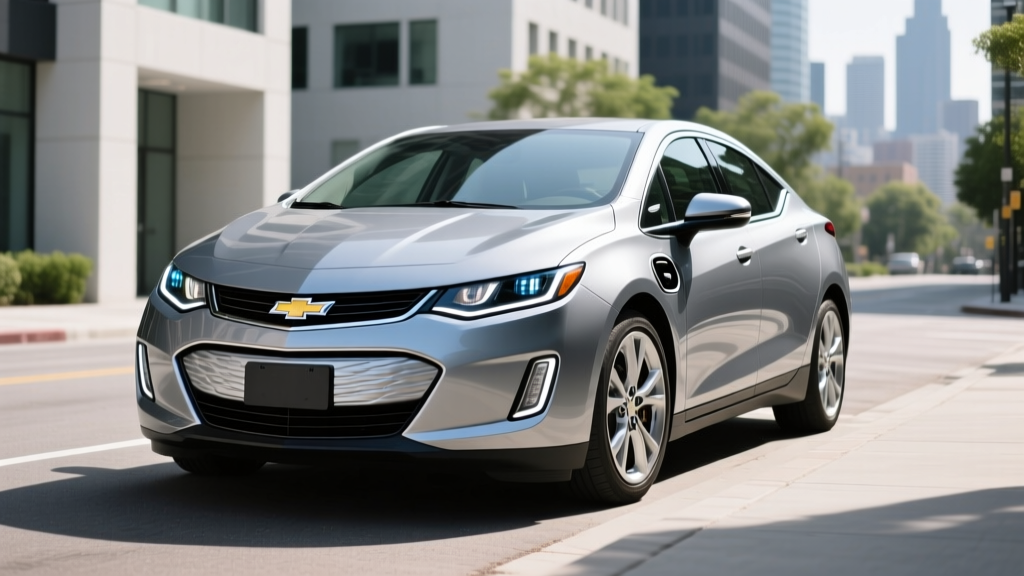
Quick Answer: Is the 2017 Chevy Volt a Good Used Buy in 2026?
The 2017 Chevy Volt is a plug-in hybrid (PHEV), not a pure EV. It delivers 53 miles of EPA-rated electric range from its 18.4 kWh lithium-ion battery, then switches to a 1.5L gas engine acting as a generator for an additional ~340 miles. On the used market in 2026, expect to pay $12,000–$18,000 depending on mileage and condition. It's an excellent commuter car if you can charge at home and your daily round trip stays under 50 miles — you'll burn almost no gas on weekdays while keeping total road-trip freedom. It is not a fit if you need DC fast charging, modern ADAS features, or pure-electric highway driving.
What Exactly Is the 2017 Chevy Volt?
The second-generation Volt (2016–2019) is an extended-range electric vehicle (EREV), a subtype of PHEV. Unlike a conventional hybrid such as the Toyota Prius, the Volt's gasoline engine never directly drives the wheels. Instead, the 1.5L four-cylinder acts solely as an onboard generator to recharge the battery once the electric range is depleted. The two electric motors (combined 149 hp, 294 lb-ft of torque) provide 100% of the propulsion at all times.
This architecture gives the Volt a driving feel much closer to a pure EV than a traditional hybrid. Acceleration is smooth and immediate, and the gas engine is often inaudible when it kicks in at highway speeds.
| Spec | Value |
|---|---|
| Electric Range (EPA) | 53 miles |
| Total Range (EV + Gas) | ~420 miles |
| Battery Capacity | 18.4 kWh (gross) / ~14 kWh usable |
| Battery Chemistry | LG Chem NMC (nickel-manganese-cobalt) |
| EV Efficiency | 106 MPGe combined (31 kWh/100 mi) |
| Gas Mode Efficiency | 42 MPG combined |
| Level 1 Charging (120V) | ~13 hours (0–100%) |
| Level 2 Charging (240V, 3.6 kW) | ~4.5 hours (0–100%) |
| DC Fast Charging | Not available |
| 0–60 mph | 7.5 seconds |
| Combined Output | 149 hp / 294 lb-ft |
| Cargo Volume | 10.6 cu ft |
| Battery Warranty (original) | 8 years / 100,000 miles (≥60% capacity) |
Source: fueleconomy.gov — 2017 Chevrolet Volt
Real-World Range: What to Actually Expect
The EPA's 53-mile electric range figure is achievable under moderate conditions — roughly 65–70°F, mixed city/suburban driving at 35–55 mph, with minimal climate control. Real-world results vary significantly:
2017 Volt Electric Range — Real-World Scenarios
- Ideal conditions (spring/fall, city driving): 50–58 miles
- Highway driving (70+ mph): 38–45 miles
- Cold weather (below 32°F, heat on): 30–40 miles
- Cold weather + highway: 25–35 miles
The Volt uses a resistive heater rather than a heat pump, which draws substantial energy from the battery in winter. Once the battery depletes, the gas generator kicks in seamlessly — you won't be stranded, but your fuel cost jumps from pennies-per-mile to roughly 42 MPG.
Charging the 2017 Volt: What You Need to Know
The Volt uses the SAE J1772 connector standard for AC charging, which is compatible with every Level 2 home charger and public AC station in North America. However, it has no DC fast charging capability — a significant limitation compared to modern BEVs.
| Level | Power | Time (0–100%) | Cost to Install/Use |
|---|---|---|---|
| Level 1 (120V, 12A) | 1.4 kW | ~13 hours | $0 (included cord) |
| Level 2 (240V, 16A) | 3.6 kW | ~4.5 hours | $500–$1,500 home install |
| DC Fast Charge | N/A | N/A | Not supported |
Practical reality: The Volt's 3.6 kW onboard charger is slow by 2026 standards. Even on a Level 2 home charger, a full recharge takes 4.5 hours. For most owners this means plugging in overnight — if you drive 40 miles round-trip, you'll need about 2.5 hours on Level 2 to fully replenish. Level 1 (standard 120V outlet) can work if your daily driving is under 25 miles, recovering roughly 4 miles of range per hour.
Home charging installation: A dedicated 240V/20A circuit with a Level 2 EVSE (such as a ChargePoint Home Flex or Emporia Vue) typically costs $500–$1,500 for equipment and electrician labor, assuming your electrical panel has spare capacity. A panel upgrade (from 100A to 200A) can add $1,500–$3,000.
Cost of Ownership: Volt vs. Gas vs. Pure EV
The 2017 Volt occupies a unique economic position. It costs less to fuel than a gas car but more than a modern long-range BEV — and it carries maintenance costs that pure EVs avoid.
| Cost Category | 2017 Volt (PHEV) | 2017 Honda Civic (Gas) | 2024 Tesla Model 3 RWD (BEV) |
|---|---|---|---|
| Purchase Price (avg.) | $14,500 (used) | $13,000 (used) | $28,000 (used) |
| Fuel/Energy (annual) | $420* | $1,650** | $540*** |
| Maintenance (annual) | $450 | $600 | $200 |
| Insurance (annual) | $1,500 | $1,350 | $1,800 |
| Estimated 5-Year Total | $26,350 | $26,750 | $43,000 |
*Assumes 70% electric driving at $0.14/kWh home rate, 30% gas at $3.40/gal at 42 MPG.
**At 32 MPG combined, $3.40/gal.
***At 26 kWh/100 mi, $0.14/kWh home rate. Public DC charging would increase this.
The Volt's economic sweet spot is clear: if you can do most weekday driving on electricity and take occasional gas-powered road trips, you'll spend roughly $35/month on electricity for a 40-mile daily commute. A comparable gas car would cost $130+/month in fuel.
Battery Health: What to Check Before Buying
The 2017 Volt's 18.4 kWh LG Chem NMC battery is now 8–9 years old. GM's original battery warranty covers 8 years/100,000 miles with a minimum 60% capacity retention — meaning most 2017 models are approaching or have exited warranty coverage depending on their in-service date.
Degradation expectations: Based on owner-reported data and fleet studies, a 2017 Volt with 80,000–120,000 miles typically retains 80–90% of its original capacity, translating to roughly 42–48 miles of real electric range instead of the original 53. The Volt's conservative battery management — it uses only about 76% of the pack's gross capacity (the "buffer") — has helped it age more gracefully than early Nissan Leafs.
What to check:
- Use the Volt's built-in "Energy Detail" screen to view lifetime kWh used and compare against expected values
- Request a battery health diagnostic from a Chevy dealer (they can read State of Health via GDS2 scan tool)
- Look for full electric range display of 45+ miles on a full charge at moderate temperatures
- Check for any stored DTC (diagnostic trouble codes) related to the hybrid/EV system
Battery replacement cost: A refurbished Volt Gen 2 battery pack currently runs $3,500–$5,500 installed. While not cheap, it's far less than many modern BEV pack replacements and the Volt's smaller pack size keeps costs manageable.
Common Misconceptions About the Volt
| Myth | Fact |
|---|---|
| "The Volt is a pure EV." | It's a PHEV/EREV. It has a gas engine and requires oil changes, though less frequently than a gas-only car. |
| "You'll get stranded when the battery dies." | The gas generator kicks in automatically. Total range is ~420 miles on a full tank + full battery. |
| "It qualifies for the $7,500 federal tax credit." | Not on a used purchase from a dealer in 2026. The IRS §30D credit applies to new vehicles only. However, the used clean vehicle credit (§25E) may provide up to $4,000 (30% of sale price, capped) if purchased from a dealer and you meet income limits. |
| "The Volt can fast-charge on road trips." | No DC fast charging. Level 2 at 3.6 kW is the maximum. Road-trip refueling is gas-only. |
| "Maintenance is the same as a gas car." | Less brake wear (regen braking), no transmission fluid changes, but you still need oil changes every ~2 years or when the engine runs enough to trigger the maintenance reminder. |
Who Should Buy the 2017 Volt — and Who Shouldn't
Decision Framework
Buy the 2017 Volt if:
- Your daily commute is 25–50 miles round-trip and you can charge at home (Level 1 or Level 2)
- You want EV-like daily driving but take road trips 3+ times per year and don't want to plan around charging stations
- You live in a region with sparse DC fast-charging infrastructure
- Your budget is $12,000–$18,000 and you want the lowest possible fuel cost in that range
- You want a proven, well-built PHEV with strong parts availability through GM's dealer network
Look elsewhere if:
- You cannot charge at home (apartment, street parking) — the Volt's value proposition collapses without regular plug-in
- Your daily commute exceeds 60 miles — you'll spend most of your driving on gas, negating the PHEV advantage
- You want a pure EV with zero gas-engine maintenance — consider a used Chevy Bolt EV (238-mile range, $10,000–$15,000 used)
- You need DC fast charging for frequent long-distance travel
- You want modern ADAS features — the 2017 Volt has basic lane-keep and forward-collision alert but nothing comparable to today's Level 2 systems
What a First-Time PHEV Buyer Should Know
If the 2017 Volt is your entry into electrified driving, understand these practical realities:
1. Charging is a habit, not an event. Unlike a gas car where you refuel weekly, plug in every night. Even Level 1 (120V) recovers enough range overnight for most commutes. Make it as routine as plugging in your phone.
2. The "Hold Mode" and "Mountain Mode" matter. Hold Mode preserves battery for later (useful if your commute ends in city traffic). Mountain Mode pre-charges the battery to ensure adequate power for steep grades — engage it 20 minutes before a mountain pass.
3. Oil changes still happen — just less often. The Volt tracks engine run-time and will prompt for an oil change based on actual generator use. If you drive 95% electric, you might go 2+ years between changes. But don't skip them — the engine still needs fresh oil when it does run.
4. Winter range loss is real and significant. Expect 25–40% less electric range in freezing temperatures. The resistive cabin heater is the primary culprit. Preconditioning the cabin while still plugged in (via the myChevrolet app) helps preserve range.
5. Tires matter more than you think. The Volt's instant torque wears front tires faster than a comparable gas car. Budget for replacement every 30,000–40,000 miles and choose low-rolling-resistance tires to preserve electric range.
Frequently Asked Questions
How does the 2017 Volt compare to the 2017 Toyota Prius Prime?
The Volt offers significantly more electric range (53 miles vs. the Prius Prime's 25 miles) and stronger electric acceleration. The Prius Prime has slightly better gas-mode efficiency (54 MPG vs. 42 MPG) and a more practical hatchback cargo area. If your commute is under 25 miles, either works. If it's 30–50 miles, the Volt keeps you in electric mode far more often.
Can I install a Level 2 charger myself?
The physical EVSE unit is plug-and-play if you already have a 240V outlet (like a dryer outlet). However, installing a new dedicated 240V circuit requires a licensed electrician and typically a permit. Never use extension cords or adapter workarounds — the sustained 16A draw over hours demands proper wiring and breaker sizing.
Is the 2017 Volt's battery warranty still valid?
The 8-year/100,000-mile battery warranty started from the vehicle's original in-service date. For a 2017 model, coverage expired between 2025 and early 2026 depending on when it was first sold. Some vehicles sold late in the model year may still have a few months of coverage. Verify with a GM dealer using the VIN.
What's the difference between kW and kWh on the Volt?
kW (kilowatts) measures power — the rate of energy flow. The Volt charges at a maximum of 3.6 kW. kWh (kilowatt-hours) measures energy capacity — the Volt's battery holds 18.4 kWh total. Think of kW as the "speed" of charging and kWh as the "size of the tank."
Does the 2017 Volt qualify for any tax credits in 2026?
The original $7,500 new-vehicle federal credit is long expired for this car. However, under the IRS §25E used clean vehicle credit, you may qualify for up to $4,000 (30% of the sale price, capped at $4,000) if you buy from a licensed dealer, your income is under $75,000 (single) / $150,000 (joint), and the vehicle's sale price is $25,000 or less. The Volt easily meets the price cap. Confirm eligibility with a tax professional, as rules are subject to change.
How reliable is the 2017 Volt?
The second-generation Volt has above-average reliability ratings. The electric drivetrain is simple and durable. The 1.5L generator engine is a proven GM design. Common issues include 12V battery drain (the auxiliary battery, not the traction pack), occasional infotainment glitches, and door-handle latch failures. The NHTSA gave the Volt a 5-star overall safety rating.
Sources: EPA fueleconomy.gov, IRS §25E Used Clean Vehicle Credit, NHTSA 2017 Volt Safety Ratings