Quick Verdict: The Original Affordable Long-Range EV
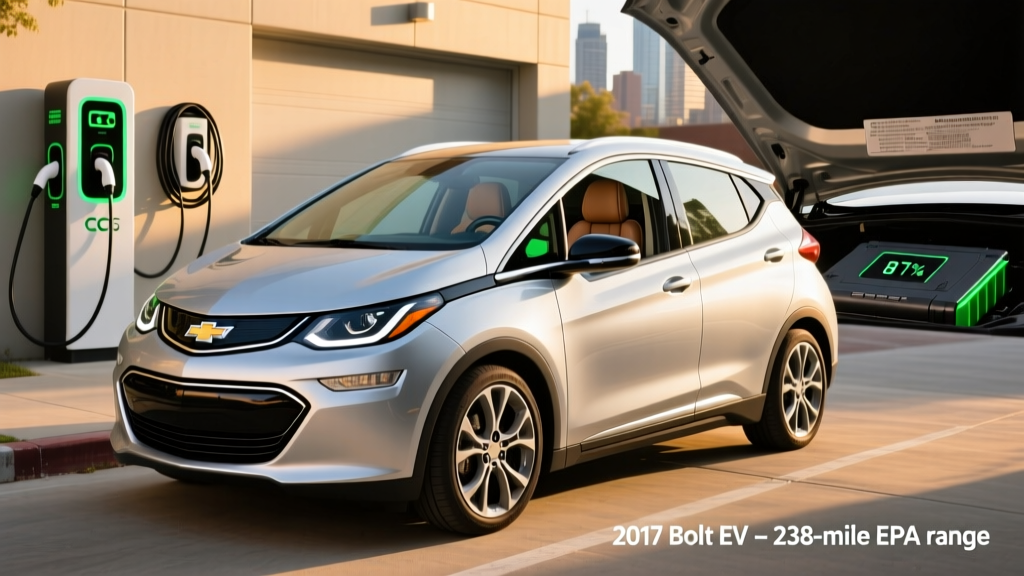
When the 2017 Chevrolet Bolt EV launched, it was the first mass-market electric vehicle to break the 200-mile EPA range barrier at a sub-$40,000 price. Nearly a decade later, it remains one of the most practical used EVs on the market — provided you understand its charging limitations, battery recall history, and what ownership looks like in 2026.
The Bolt EV's 238-mile EPA range still holds up for daily commuting and moderate road trips. Its 200 hp and 266 lb-ft of torque make it surprisingly quick off the line. But its 55 kW DC fast-charging ceiling and CCS connector (in an increasingly NACS-dominated landscape) require planning on longer drives.
If you're shopping the used EV market in 2026 and want maximum range per dollar, the 2017 Bolt EV deserves serious attention — with caveats we'll detail below.
Range and Efficiency: 238 Miles EPA, but Expect Less
Real-World Expectation: 190–220 miles highway driving at 70 mph; 160–190 miles in freezing temperatures with cabin heat. City and suburban driving with regenerative braking can match or slightly exceed the EPA figure.
The 2017 Bolt EV's combined energy consumption is rated at 28 kWh per 100 miles, which translates to 119 MPGe combined (118 city / 110 highway) per fueleconomy.gov. That efficiency figure was class-leading in 2017 and remains competitive today.
Real-world range depends heavily on driving style, terrain, and temperature. The Bolt EV uses resistive cabin heating rather than a heat pump, which draws significant energy in cold weather. Owners in northern climates consistently report 25–35% range loss when temperatures drop below 30°F. Highway driving at sustained speeds above 65 mph also reduces range more sharply than in larger, more aerodynamic EVs like the Tesla Model 3.
On the positive side, the Bolt's regenerative braking system — with its one-pedal driving mode and steering-wheel paddle for on-demand regen — is one of the best in the business. In stop-and-go traffic, you can recapture substantial energy and extend your effective range.
Battery: 60 kWh NMC Chemistry and the Recall Factor
The 2017 Bolt EV uses a 60 kWh lithium-ion battery pack (approximately 57 kWh usable) built by LG Chem. The chemistry is NMC (nickel manganese cobalt), which offers higher energy density than LFP but is more sensitive to sustained high-state-of-charge storage and extreme heat.
Critical context for any used 2017 Bolt buyer: GM issued a major battery recall for 2017–2019 Bolt EVs due to a manufacturing defect that could cause cell short circuits and, in rare cases, fires. The recall involved replacing defective battery modules — and in many cases, the entire pack — with updated units. Before purchasing any 2017 Bolt, verify via the VIN on NHTSA's recall lookup that all recall work has been completed. A Bolt with a replacement pack may actually have better long-term battery health than one that narrowly avoided the issue.
GM's battery warranty covers 8 years / 100,000 miles with a capacity retention threshold of 60% — meaning if the pack drops below 60% of original capacity within that window, GM replaces it. For a 2017 model, that warranty window closes in 2025 by year or at 100,000 miles, whichever comes first. In 2026, most 2017 Bolts are out of battery warranty unless they received a replacement pack under the recall (which restarts or extends coverage in some cases — confirm with a GM dealer).
| Spec | Value |
|---|---|
| EPA Range | 238 miles |
| Battery Capacity | 60 kWh total / ~57 kWh usable |
| Battery Chemistry | NMC (LG Chem) |
| Efficiency | 28 kWh/100 mi (119 MPGe combined) |
| Motor | Single front-mounted permanent magnet |
| Horsepower | 200 hp |
| Torque | 266 lb-ft |
| 0–60 mph | 6.5 seconds |
| Drivetrain | FWD |
| DC Fast Charge (max) | 55 kW (CCS) |
| Level 2 Charge Rate | 7.2 kW (25 miles/hr) |
| Cargo Volume | 16.9 cu ft (rear seats up) / 56.6 cu ft (folded) |
| Rear Legroom | 36.5 inches |
| Battery Warranty (original) | 8 yr / 100,000 mi (60% retention) |
| Original MSRP | $37,495 (LT) / $43,995 (Premier) |
Charging Speeds: The Bolt's Biggest Limitation
The 2017 Bolt EV charges via a CCS1 connector for DC fast charging and a J1772 inlet for Level 1 and Level 2 AC charging. Here's what to expect at each level:
| Level | Power | Rate | Time |
|---|---|---|---|
| Level 1 (120V) | ~1.4 kW | ~4 miles/hr | ~55 hours (0–100%) |
| Level 2 (240V, 32A) | 7.2 kW | ~25 miles/hr | ~9.5 hours (0–100%) |
| DC Fast Charge | 55 kW peak | ~160 miles/hr (peak) | ~50 min (10–80%) |
The 55 kW DC fast-charging cap is the 2017 Bolt's most significant drawback for road-trippers. At a modern 150–350 kW DC station, the Bolt will only pull up to 55 kW — and that peak is sustained only between roughly 10% and 40% state of charge. Above 60%, the charge curve tapers significantly, dropping to 30 kW and eventually to under 15 kW near 90%.
A 10–80% charge takes approximately 50 minutes at a compatible DC fast charger. For comparison, a Hyundai Ioniq 5 from the same era can complete that same window in roughly 18 minutes. If your driving is mostly local with occasional 200-mile trips, the Bolt's charging speed is manageable. For frequent road trippers, it's a frustration.
One additional 2026 consideration: the industry is rapidly shifting to the NACS (Tesla) connector standard. The Bolt's CCS1 connector means you'll need a CCS-to-NACS adapter (GM has provided these to Bolt owners for Supercharger access) to use Tesla's Supercharger network, which remains the most reliable DC fast-charging infrastructure in the US. Verify adapter compatibility and Supercharger access before relying on it for a trip.
Performance and Driving Impressions
The 2017 Bolt EV's 200 hp electric motor delivers instant torque to the front wheels, producing a 0–60 mph time of approximately 6.5 seconds. That's quick for a compact hatchback and makes merging and passing effortless. The single-speed transmission means smooth, uninterrupted acceleration with no gear hunting.
Handling is competent but not sporty. The 60 kWh battery pack sits low in the chassis, giving the Bolt a planted feel and minimal body roll. However, the eco-focused tires prioritize low rolling resistance over grip, and the steering is numb by enthusiast standards. This is a commuter car that happens to be quick, not a sports sedan.
Ride quality is firm but acceptable for the segment. Road noise is well-suppressed at city speeds but becomes noticeable above 65 mph — a common trait among compact EVs from this era. The cabin is surprisingly spacious for a hatchback, with 36.5 inches of rear legroom and a flat floor that makes the back seat comfortable for two adults.
Interior, Tech, and Driver Assistance
The 2017 Bolt EV came in two trims: LT ($37,495) and Premier ($43,995). Both feature a 10.2-inch touchscreen infotainment system with Apple CarPlay and Android Auto — which still holds up well in 2026. The system is responsive and the interface is straightforward, though it lacks wireless CarPlay/Android Auto (wired connection required).
The 8-inch driver information cluster displays real-time energy flow, range estimation, and charge status. The Bolt also includes a Teen Driver feature that lets owners set speed and audio volume limits — an unusual but practical feature for families.
Driver-assistance technology was modest by 2026 standards. The Premier trim includes:
- Forward Collision Alert with automatic emergency braking
- Lane Keep Assist with lane departure warning
- Blind Spot Monitoring (Premier only)
- Rear Cross Traffic Alert (Premier only)
- Surround Vision 360° camera (Premier only)
Notably absent: adaptive cruise control and any form of hands-free driving assist (GM's Super Cruise was not available on the Bolt). This is strictly SAE Level 1 driver assistance — the driver must remain fully engaged at all times.
Used Pricing and Tax Credit Eligibility in 2026
As of early 2026, the 2017 Chevy Bolt EV trades on the used market between approximately $12,000 and $18,000 depending on mileage, condition, trim, and battery health. Premier trims with under 50,000 miles and documented recall completion command the top of that range. LT models with higher mileage or unknown battery status sit at the lower end.
The federal Used Clean Vehicle Credit (§25E) — not §30D, which applies to new vehicles — may apply to a 2017 Bolt purchase. Under current IRS rules, qualified used EVs can receive a credit equal to 30% of the sale price, up to a maximum of $4,000, provided:
- The vehicle is at least two model years old (2017 qualifies)
- The sale price is $25,000 or less (most 2017 Bolts qualify)
- The buyer's modified adjusted gross income does not exceed $75,000 (single) / $112,500 (head of household) / $150,000 (joint) — per IRS §25E guidelines
- The vehicle is purchased through a licensed dealer
- The buyer has not claimed another used clean vehicle credit in the prior 3 years
At a $15,000 purchase price, the 30% credit would yield $4,000 — bringing your effective cost to $11,000. That's extraordinary value for a 238-mile EV. However, income caps and the prior-credit restriction eliminate some buyers. Always confirm eligibility with a tax professional before relying on the credit.
| Scenario | Sale Price | §25E Credit | Effective Cost |
|---|---|---|---|
| LT, 80k miles | $12,500 | $3,750 | $8,750 |
| LT, 55k miles | $14,500 | $4,000 | $10,500 |
| Premier, 40k miles | $17,500 | $4,000 | $13,500 |
Pros and Cons
Pros
- 238-mile EPA range still competitive in 2026 used market
- Excellent value after §25E used-EV tax credit
- Spacious hatchback with 56.6 cu ft cargo capacity
- Quick 6.5-second 0–60 mph acceleration
- Strong regenerative braking with one-pedal driving
- Apple CarPlay / Android Auto standard
- Recall-compliant units may have newer battery packs
Cons
- 55 kW DC fast charging is slow by 2026 standards
- CCS connector requires adapter for Tesla Superchargers
- No heat pump — significant cold-weather range loss
- No adaptive cruise control or hands-free driving
- Original battery warranty has expired for most 2017 units
- Battery recall history requires careful VIN verification
- Eco tires compromise wet-weather grip
Who Should Buy the 2017 Bolt EV?
Best for: Budget-conscious commuters who drive under 150 miles round-trip daily, have access to Level 2 home charging, and want maximum EV value. The Bolt is an outstanding second car, college-student daily driver, or urban runabout. Its hatchback practicality makes it viable for small families who don't need an SUV.
Look elsewhere if: You regularly road-trip more than 250 miles between stops, live in an area with sparse CCS charging infrastructure, or need all-wheel drive for snow-belt winters. The Bolt's 55 kW charging speed adds significant time to long-distance travel, and its FWD-only layout with eco tires is a liability on unplowed roads.
Key competitors to cross-shop in the used market: the Nissan Leaf (cheaper but shorter range unless you find a 60 kWh model, and CHAdeMO charging is increasingly unsupported), the VW e-Golf (refined but only 125-mile range), and the Hyundai Kona Electric (2019+, similar range, faster charging, but higher used prices). The Bolt wins on range-per-dollar; the Kona wins on charging speed and modern feel.
Frequently Asked Questions
What is the real-world range of the 2017 Chevy Bolt EV?
Expect 190–220 miles in mixed highway driving and 160–190 miles in freezing weather. City driving with regenerative braking can match or exceed the 238-mile EPA estimate. Battery degradation on recall-completed units is typically 5–10% at 60,000–80,000 miles.
How fast does the 2017 Bolt charge?
On a Level 2 home charger (240V, 32A), the Bolt adds about 25 miles of range per hour, fully charging overnight in ~9.5 hours. On DC fast charge, it peaks at 55 kW — a 10–80% charge takes approximately 50 minutes. This is the Bolt's main weakness for road trips.
Does the 2017 Bolt EV qualify for any federal tax credit?
Not the new-vehicle §30D credit, but it may qualify for the Used Clean Vehicle Credit (§25E) — up to $4,000 (30% of sale price) if you meet income caps ($75K single / $150K joint), buy from a dealer, and haven't claimed a used-EV credit in the past 3 years. Confirm with a tax professional.
Is the 2017 Bolt's battery safe after the recall?
Units that have completed GM's recall repair — receiving replacement battery modules or a full new pack — are considered safe by NHTSA. Always verify recall status by entering the VIN at nhtsa.gov/recalls before purchasing. Avoid any 2017 Bolt with an open recall.
Can I use Tesla Superchargers with a 2017 Bolt?
Yes, but only with a CCS-to-NACS adapter. GM has offered these adapters to Bolt owners, and many CCS-equipped EVs now have Supercharger access through the NACS adapter program. Confirm adapter availability and your specific vehicle's compatibility before planning a Supercharger-dependent road trip.
How does the 2017 Bolt compare to a new EV in 2026?
A new 2026 Bolt EV (redesigned on the Ultium platform) starts around $28,000 and offers ~260 miles of range with faster charging. But after the $4,000 used credit, a 2017 Bolt at ~$11,000–$13,500 effective cost is roughly half the price — making it the value king for buyers who don't need the latest tech or fastest charging.