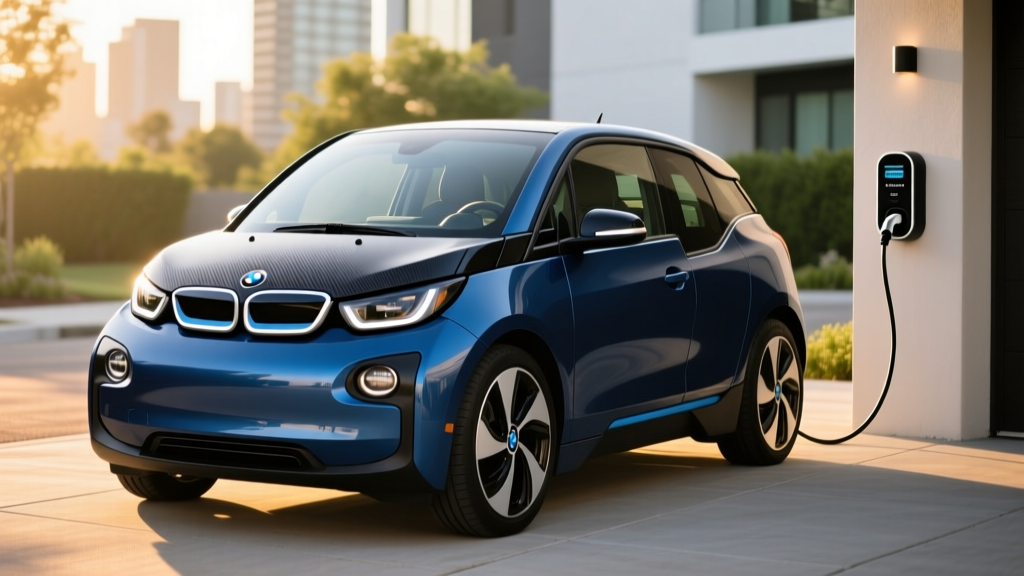
If you're searching for a "2017 BMW electric" car, you're almost certainly looking at the BMW i3 (model year 2017). Here's the direct answer: the 2017 i3 is a quirky, fun-to-drive city commuter with an EPA-estimated 114 miles of range from its 33.2 kWh (27.2 kWh usable) battery. In 2026, used examples typically sell for $9,000–$14,000 depending on mileage and condition. It works well as a second car or urban runabout if you have reliable home charging — but its limited DC fast-charging speed (50 kW peak) and short range make it a poor choice for road trips or cold-climate commuters without a backup vehicle.
Quick Verdict: 2017 BMW i3 in 2026
Buy it if: You need an affordable, fun city EV with home Level 2 charging and drive under 70 miles round-trip daily.
Skip it if: You need highway range, DC fast charging for road trips, or live in a cold climate without a second car.
2017 BMW i3: Range, Battery, and Charging Specs
The 2017 model year was significant for the i3: BMW upgraded from the original 22 kWh pack to a 33.2 kWh battery (Samsung SDI NMC cells, ~27.2 kWh usable after buffer). This nearly doubled the range over the 2014–2016 models. Here are the hard numbers:
| Spec | 2017 BMW i3 (BEV) | 2017 BMW i3 REx |
|---|---|---|
| EPA Range (electric) | 114 miles | 97 miles electric + ~80 mi gas |
| Battery Capacity | 33.2 kWh total / 27.2 kWh usable | 33.2 kWh total / 27.2 kWh usable |
| Battery Chemistry | NMC (Samsung SDI) | NMC (Samsung SDI) |
| Motor Output | 170 hp / 184 lb-ft | 170 hp / 184 lb-ft (electric) |
| 0–60 mph | 7.2 seconds | 8.0 seconds |
| EPA Efficiency | 111 MPGe combined | 111 MPGe (electric) / 31 MPG (gas) |
| Level 1 Charging (120V) | ~2.5 kW / ~8 mi/hr | ~2.5 kW / ~8 mi/hr |
| Level 2 Charging (240V) | 7.4 kW / ~25 mi/hr | 7.4 kW / ~25 mi/hr |
| DC Fast Charge (CCS) | 50 kW peak / ~25 min 10–80% | 50 kW peak / ~25 min 10–80% |
| Connector | CCS1 (Combo) | CCS1 (Combo) |
| Battery Warranty (original) | 8 yr / 100,000 mi | 8 yr / 100,000 mi |
Real-World Range vs. EPA Sticker
The EPA rates the 2017 i3 BEV at 114 miles. In practice, expect 90–105 miles on the highway at 70+ mph, and as low as 70–85 miles in freezing temperatures (the i3 lacks a heat pump, relying on resistive cabin heating). City driving with regenerative braking can push 110–120 miles in mild weather. According to fueleconomy.gov, the combined rating is 111 MPGe (30 kWh/100mi).
Used Pricing and Value in 2026
Nine years after production, the 2017 i3 has depreciated steeply — which is great news for budget-minded EV buyers. Current used-market pricing (early 2026):
- BEV, 50k–70k miles: $9,000–$11,500
- BEV, under 40k miles: $11,000–$14,000
- REx (range extender), average miles: $10,000–$13,000
For context, the original MSRP was $43,595 (BEV) and $47,445 (REx) before incentives. That's roughly 70–75% depreciation — steeper than most EVs, driven by the i3's short range relative to modern competitors and BMW's exit from the i3 program in 2022.
Federal tax credit note: The §30D new-vehicle credit does not apply to used 2017 i3 purchases. However, the used clean vehicle credit (up to $4,000 or 30% of sale price, whichever is less) may apply if you buy from a licensed dealer, the sale price is $25,000 or less, and you meet IRS income limits ($75k single / $150k joint). At a $12,000 purchase price, the credit would be $3,600 (30% of sale price) — effectively dropping your net cost to around $8,400.
How the 2017 i3 Compares to Gas, Hybrid, and Modern EVs
The i3 doesn't exist in a vacuum. Here's how it stacks up against the alternatives a 2026 buyer might cross-shop:
| Metric | 2017 BMW i3 (BEV) | 2017 Toyota Prius (gas hybrid) | 2025 Chevy Bolt EV (used) | 2025 Hyundai Kona Electric |
|---|---|---|---|---|
| Used Price (2026) | $9k–$14k | $14k–$18k | $16k–$21k | $22k–$28k (new) |
| EPA Range / MPG | 114 mi / 111 MPGe | 56 MPG combined | 259 mi / 120 MPGe | 261 mi / 129 MPGe |
| Energy/Fuel Cost per Mile | ~$0.04 (home L2) | ~$0.06 (gas) | ~$0.04 (home L2) | ~$0.04 (home L2) |
| DC Fast Charge | 50 kW (CCS) | N/A | 55 kW (CCS) | 100+ kW (NACS) |
| Annual Maintenance | ~$300–$400 | ~$600–$800 | ~$300–$400 | ~$300–$400 |
Key takeaway: The i3 wins on lowest entry price for an EV, but loses badly on range. If your daily commute is under 50 miles round-trip, the 114-mile range is adequate. If you regularly drive 80+ miles or take highway trips, the Bolt EV's 259 miles of range justifies its higher used price.
Real Costs of Ownership: 5-Year Breakdown
Let's run the numbers assuming a $12,000 purchase, 10,000 miles/year, and home Level 2 charging at $0.14/kWh (national average):
| Cost Category | 2017 BMW i3 (5 Years) | 2017 Gas Compact (e.g., Civic, 30 MPG) |
|---|---|---|
| Purchase Price | $12,000 | $14,000 |
| Federal Used EV Credit | –$3,600 | $0 |
| Net Purchase | $8,400 | $14,000 |
| Energy/Fuel (50k miles) | $2,800 (electricity) | $5,250 (gas @ $3.15/gal) |
| Maintenance (5 years) | $1,750 | $3,500 |
| Insurance (5 years) | $5,500 | $4,750 |
| Estimated Battery Replacement Risk | $0–$2,000 (reserve) | $0 |
| Total 5-Year Cost | $18,450–$20,450 | $27,500 |
The i3 saves roughly $7,000–$9,000 over five years compared to an equivalent used gas compact, primarily from lower fuel and maintenance costs plus the used EV tax credit. Insurance runs slightly higher for the i3 due to BMW parts pricing and carbon-fiber body repair costs.
Battery Health: What to Check Before Buying
The 2017 i3's battery is now 8–9 years old. While BMW's original 8-year/100,000-mile battery warranty has expired or is expiring for most examples, NMC packs in the i3 have proven reasonably durable. Most owner reports and fleet data show 85–92% state of health (SoH) at 60,000–80,000 miles.
Before purchasing, insist on:
- A battery health report from a BMW dealer or via an OBD-II app (e.g., BimmerCode or ENET cable with BMW-specific software) showing current SoH percentage
- Verification that the car has not sat at 100% SoC for extended periods (storage abuse accelerates degradation)
- Check for any NHTSA recalls — the i3 had recalls related to the REx fuel tank vent and seat belt tensioners
A replacement battery pack for the 33 kWh i3 runs approximately $8,000–$12,000 installed at a dealer, though third-party refurbishment options are emerging at $5,000–$7,000. Given the car's $10k–$14k value, a battery failure is a significant financial event — factor this risk into your purchase decision.
Common Misconceptions About the 2017 BMW i3
| Myth | Fact |
|---|---|
| "114 miles of range is unusable" | The average US commute is ~16 miles one-way (Census Bureau). For 80% of daily driving, 114 miles is adequate with home charging. |
| "The i3 can't DC fast charge" | It can, at 50 kW via CCS — adding ~80 miles in 25 minutes. It's slow by 2026 standards but functional for occasional road trips. |
| "Carbon fiber body = unrepairable" | BMW certified a network of i3 body shops. Repairs cost more than steel, but insurance typically covers collision damage. |
| "The REx makes it a true hybrid" | The REx is a 650cc two-cylinder motorcycle engine that acts as a generator. It maintains charge but doesn't drive the wheels. Think EREV (extended-range EV), not a parallel hybrid like a Prius. |
| "It qualifies for the $7,500 tax credit" | Only the used clean vehicle credit (up to $4,000) applies, and only if you meet IRS income caps and buy from a dealer. The new-vehicle §30D credit is long expired for this model. |
Decision Framework: Should You Buy the 2017 BMW i3?
If-Then Buyer Guide
- If you have Level 2 home charging AND drive under 70 miles/day → The i3 is an excellent, fun, affordable EV entry point. Buy it.
- If you need a single vehicle for all driving, including road trips → Skip the i3. Look at a used 2020+ Bolt EV, Model 3, or Kona Electric with 200+ mile range.
- If you live in a cold climate (regular sub-30°F winters) → The i3's resistive heater and small battery mean real range drops to 70–85 miles. Consider the REx variant for a gas backup, or choose a different EV with a heat pump.
- If you want the cheapest possible EV and mostly drive in the city → The i3 at ~$10k (before used EV credit) is one of the lowest-cost ways into EV ownership in 2026.
- If you need rear-seat space or cargo room for family duty → The i3's rear-hinged "coach doors" and tight back seat are impractical for car seats or frequent passengers. Look at a used Model Y or Ioniq 5 instead.
Frequently Asked Questions
Does the 2017 BMW i3 support Tesla Superchargers?
No. The 2017 i3 uses a CCS1 connector and cannot natively access Tesla's NACS Supercharger network. CCS-to-NACS adapters are available for some newer EVs, but as of 2026, no reliable adapter exists for the i3's specific CCS implementation. You'll rely on Electrify America, EVgo, ChargePoint, and other CCS-compatible networks for DC fast charging.
How long does a full Level 2 charge take?
From near-empty to 100% on a 240V Level 2 charger at 7.4 kW, expect approximately 4 hours. This is practical for overnight home charging — plug in when you get home, wake up to a full battery.
What's the maintenance like compared to a gas BMW?
Dramatically cheaper. No oil changes, no spark plugs, no transmission fluid. You'll replace cabin air filters, brake fluid (every 2 years), tires (the i3 uses narrow 155/70R19 tires that cost ~$150–$200 each and may be harder to source), and wiper blades. Budget $300–$400/year for routine maintenance.
Is the i3 REx (range extender) worth the premium?
Only if you lack reliable charging or take occasional longer trips. The REx adds ~80 miles of gas-powered range via a small onboard generator, but it's loud, adds weight, and requires gas-engine maintenance (oil changes, fuel system). For pure city commuters with home charging, the lighter, simpler BEV is the better pick.
What should a first-time EV buyer know about the i3?
Three things: (1) Install a Level 2 home charger before the car arrives — a 240V/32A circuit with a J1772/CCS connector costs $500–$1,500 installed depending on your electrical panel. (2) Download apps like PlugShare and A Better Routeplanner to locate public chargers. (3) Learn to precondition the battery (via the i3's connected app or climate control timer) before DC fast charging — a warm battery charges faster and the i3's thermal management is basic compared to modern EVs.