Quick Verdict: The 2017 BMW i3 REx in 2026
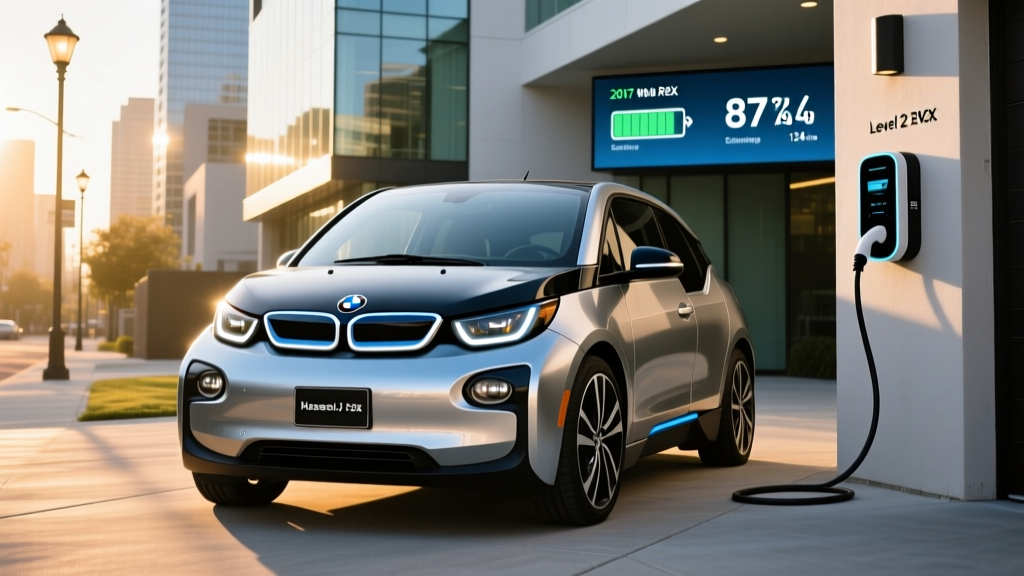
The 2017 BMW i3 REx (Range Extender) remains one of the most distinctive used EVs on the market nearly a decade after its debut. With its carbon-fiber-reinforced plastic (CFRP) passenger cell, rear-hinged "coach doors," and a tiny two-cylinder gasoline generator borrowed from a scooter, it was never a conventional car — and it still isn't one in 2026. For urban commuters who need a safety net beyond the battery, the REx variant offers a practical bridge between pure EV driving and gas-car flexibility.
But buying a 2017 i3 REx today means accepting real compromises: modest DC fast-charging speeds, a small battery by modern standards, limited cargo space, and zero eligibility for the new-vehicle federal tax credit (it's been discontinued since 2022). This review breaks down the exact numbers you need to evaluate one on the used market.
| Spec | Value |
|---|---|
| EPA Electric Range | 97 miles |
| Total Range (electric + gas) | ~180 miles |
| Battery Capacity (usable) | 27.2 kWh (33 kWh gross) |
| Battery Chemistry | NMC (Samsung SDI cells) |
| Electric Motor Output | 170 hp / 184 lb-ft torque |
| Range Extender Engine | 647 cc 2-cylinder gasoline (34 hp generator) |
| Fuel Tank | 2.4 gallons |
| 0–60 mph | 6.9 seconds |
| Drivetrain | Rear-wheel drive (single motor) |
| EPA Efficiency (EV mode) | 111 MPGe combined |
| EPA Efficiency (gas mode) | 31 MPG combined |
| Energy Consumption | 30 kWh/100 mi (EV mode) |
| Cargo Volume (rear seats up) | 15.1 cu ft |
| Cargo Volume (rear seats folded) | 36.9 cu ft |
| Curb Weight | ~3,230 lbs |
| Original Base MSRP | $45,545 (before incentives) |
| Federal Tax Credit (new, 2017) | $7,500 (expired for new purchases) |
| Used EV Tax Credit (§25E, 2026) | Up to $4,000 if eligible |
| Battery Warranty (original) | 8 years / 100,000 miles |
Range and Efficiency: What the EPA Says vs. Real-World Driving
The 2017 model year was significant for the i3 because BMW upgraded the battery from the original 22 kWh (60 Ah) pack to a 33 kWh (94 Ah) pack. This lifted the EPA-rated all-electric range from 81 miles to 97 miles. The range extender's 2.4-gallon fuel tank adds roughly 80–85 miles of gas-assisted driving, yielding a combined range of approximately 180 miles.
Real-World Range Reality: The EPA's 97-mile electric estimate assumes mixed city/highway driving at moderate temperatures. In practice:
- City commuting (mild weather): 95–110 miles — regenerative braking in stop-and-go traffic maximizes efficiency.
- Highway driving (70 mph, mild): 75–85 miles — the i3's tall, narrow profile and 155-section tires create more aero drag than EPA city cycles suggest.
- Cold weather (below 32°F / 0°C): 60–75 miles — the 2017 i3 lacks a heat pump (it uses resistive cabin heating), which draws heavily from the 27.2 kWh usable pack. Battery preconditioning is limited compared to modern EVs.
- REx mode combined: Expect roughly 150–170 miles total in mixed conditions before needing both a plug and a gas station.
Efficiency in electric mode is rated at 111 MPGe combined (30 kWh per 100 miles), which was excellent for 2017 and remains competitive today for a city-focused vehicle. When the range extender kicks in, the EPA rates it at 31 MPG combined — respectable but not class-leading against modern PHEVs like the Toyota RAV4 Prime (38 MPG gas-only).
Charging: Speeds, Connectors, and Home Setup
The 2017 i3 REx uses a CCS1 (Combined Charging System) connector for DC fast charging and a standard J1772 inlet for Level 1 and Level 2 AC charging. Here's what to expect at each level:
| Charging Level | Power / Voltage | Charge Time (0–100% or 10–80%) | Miles of Range Added |
|---|---|---|---|
| Level 1 (120V household) | ~1.4 kW | ~22 hours (full charge) | ~3–4 mi/hr |
| Level 2 (240V, 32A) | 7.4 kW (onboard charger max) | ~4.5 hours (full charge) | ~22 mi/hr |
| DC Fast Charge (CCS) | 50 kW peak | ~30 min (10–80%) | ~65 miles in 30 min |
Charging curve reality: The i3's 50 kW DC fast-charging peak is modest by 2026 standards, where many EVs pull 150–350 kW. The i3 sustains roughly 40–47 kW from 10% to about 60% State of Charge (SoC), then tapers to ~25 kW above 80%. A 10–80% session takes approximately 30 minutes at a functioning 50 kW CCS station. If you encounter a 150 kW or 350 kW charger, the i3 will still only pull its 50 kW maximum — the bottleneck is the car's onboard charge hardware, not the station.
Home charging: The 7.4 kW onboard AC charger is the practical sweet spot. A Level 2 home charger (like a ChargePoint Home Flex or Emporia Level 2) on a 40-amp circuit will fully replenish the i3's 27.2 kWh usable battery in about 4–4.5 hours. For a daily commuter who plugs in overnight, this is more than adequate — you'll wake up to a full 97-mile electric buffer every morning.
kW vs. kWh reminder: The i3's battery stores 27.2 kWh of usable energy (kilowatt-hours — think of this as the "fuel tank size"). It charges at up to 50 kW on DC or 7.4 kW on AC (kilowatts — the "flow rate"). These units are not interchangeable.
Performance and Driving Dynamics
The i3 REx's electric motor produces 170 horsepower and 184 lb-ft of torque, delivered to the rear wheels through a single-speed transmission. BMW quotes a 0–60 mph time of 6.9 seconds for the REx variant (the pure-electric i3 does it in 7.2 seconds due to slightly different tuning, though the REx carries ~265 lbs of additional weight from the generator and fuel tank).
The instant torque delivery makes the i3 feel quicker than its 0–60 number suggests in urban driving. Off the line, it will surprise drivers of larger, heavier vehicles. The 155/70R19 narrow tires are designed for low rolling resistance, not grip — you'll notice traction control intervention under hard acceleration on wet surfaces.
The range extender is a 647 cc twin-cylinder engine originally developed by Kymco for scooters. It does not drive the wheels directly; it acts solely as a generator to maintain battery charge. When it activates (typically around 5–7% SoC, or earlier if you select "Hold" mode), you'll hear a distinctive buzzy drone. It's not refined by automotive standards, but it's effective — it sustains highway speeds and prevents stranding.
Handling: The i3's carbon-fiber passenger cell and low center of gravity (battery pack under the floor) give it surprisingly composed handling for its tall hatchback proportions. The turning circle of 32.3 feet makes it exceptional for tight urban parking. However, the thin tires and light weight mean crosswinds on the highway require more steering correction than in a heavier EV.
Interior, Cargo, and Technology
The i3's interior was radical in 2014 and still looks futuristic in 2026. BMW used sustainable materials extensively: eucalyptus wood trim, recycled-plastic dash panels, and wool-blend upholstery on higher trims. The cabin seats four adults, though rear-seat access requires opening the rear-hinged coach doors — which means you can't open the rear doors without first opening the fronts.
Cargo space: With rear seats upright, you get 15.1 cubic feet — adequate for groceries and a couple of carry-on bags. Fold the rear seats (50/50 split) and capacity expands to 36.9 cubic feet. There is no front trunk (frunk); the space under the hood houses the electric motor and, in the REx, the range-extender engine.
Rear-seat dimensions: Rear legroom measures 31.9 inches — tight for adults over 6 feet tall on longer trips. Headroom is generous thanks to the tall roofline. The rear seats are best suited for children or occasional adult passengers on short rides.
Infotainment: The 2017 i3 features BMW's iDrive 5.0 system with a 6.5-inch display (10.25-inch with the optional Technology + Driving Assistance package). Apple CarPlay was available as a dealer-installed option on some 2017 models but was not factory-standard. Android Auto was not offered. Bluetooth, USB, and satellite radio are standard.
Driver assistance: The 2017 i3 offers basic features by modern standards: cruise control, parking sensors, and a rear-view camera. The optional Driving Assistance Plus package added adaptive cruise control, lane-departure warning, and forward-collision warning with city-braking — but no lane-centering or hands-free capability. This is SAE Level 1 driver assistance at best; there is no Level 2 hands-free system like BMW's later Highway Assistant.
Pricing, Tax Credits, and Used Market Value
The 2017 BMW i3 REx originally carried a base MSRP of $45,545 (including destination). With the $7,500 federal tax credit available at the time (plus state incentives like California's $2,500 CVRP), effective prices could drop below $36,000 for qualified buyers.
BMW discontinued the i3 in the U.S. market after the 2021 model year, so every 2017 i3 REx is now a used vehicle. As of early 2026, used-market pricing typically falls in these ranges:
| Condition / Mileage | Typical Price Range | Federal Used EV Credit (§25E) | Effective Cost |
|---|---|---|---|
| Excellent (under 40k mi) | $14,000 – $18,000 | Up to $4,000 (30% of sale price, max $4,000) | $10,000 – $14,000 |
| Good (40k–70k mi) | $10,000 – $14,000 | Up to $4,000 | $7,000 – $10,000 |
| Fair (70k–100k mi) | $7,000 – $10,000 | Up to $3,000 (30% cap) | $4,900 – $7,000 |
Used EV tax credit (§25E) eligibility rules for 2026:
- The vehicle must be at least two model years old (2017 qualifies).
- Sale price must be $25,000 or less (most 2017 i3 REx examples qualify).
- Credit equals 30% of the sale price, capped at $4,000 maximum.
- Buyer income caps: Modified adjusted gross income must not exceed $75,000 (single), $112,500 (head of household), or $150,000 (married filing jointly).
- The vehicle must be purchased from a licensed dealer (private-party sales do not qualify).
- The credit can be transferred to the dealer at point of sale as a price reduction.
- The same vehicle can only receive the used credit once every three years.
Verify current eligibility rules at IRS.gov — Used Clean Vehicle Credit. Consult a tax professional for your specific situation.
Note: The new-vehicle §30D federal tax credit ($7,500) does not apply to any used purchase, regardless of the vehicle's original eligibility. The i3 is only relevant under the §25E used-vehicle credit program.
Battery Health, Warranty, and Longevity
The 2017 i3 REx uses a 33 kWh (gross) / 27.2 kWh (usable) lithium-ion battery pack with NMC (nickel-manganese-cobalt) chemistry supplied by Samsung SDI. BMW engineered a conservative buffer — approximately 5.8 kWh is reserved above and below the usable window to protect against deep-discharge and overcharge degradation.
Original battery warranty: BMW warranted the i3's high-voltage battery for 8 years or 100,000 miles (whichever comes first) against defects and capacity loss below 70% of original capacity. For a 2017 model, this warranty expired in 2025 at the latest (8 years from the original in-service date). Any 2017 i3 you buy in 2026 is out of factory battery warranty unless an extended warranty was purchased separately.
Degradation data: Real-world owner reports and fleet data suggest the 94 Ah (33 kWh) i3 battery retains approximately 85–92% of original capacity after 7–8 years under typical use. The conservative buffer and active liquid thermal management system have held up well. However, vehicles regularly DC fast-charged in hot climates (Arizona, Texas) or frequently drained below 10% SoC may show higher degradation.
Battery replacement cost: If the pack does fail out of warranty, a replacement from BMW runs approximately $12,000–$16,000 (parts and labor). Third-party refurbishment services and used-pack swaps are emerging at lower costs ($6,000–$10,000), but availability varies. Factor this risk into your purchase decision, especially for high-mileage examples.
Range-extender maintenance: The 647 cc gas engine requires periodic oil changes (BMW recommends every 2 years or ~12,000 miles for the REx engine, regardless of how often it runs). The fuel system can develop issues if the gas sits for extended periods — if you rarely trigger the REx, run through a tank every few months to keep the fuel fresh.
Pros, Cons, and Who Should Buy
Pros
- Unique, lightweight carbon-fiber construction — still feels futuristic
- Excellent city efficiency (111 MPGe) and tight turning circle
- Range extender eliminates range anxiety for occasional longer trips
- Strong regenerative braking enables one-pedal driving in traffic
- Quality interior materials and distinctive design
- Low used-market pricing with potential $4,000 federal credit
- Reliable Samsung SDI battery with conservative thermal management
Cons
- 97-mile EPA electric range is short by 2026 standards
- 50 kW DC fast charging is slow — 30 min for 10–80%
- No heat pump — significant range loss in cold weather
- Coach-door design limits rear-seat access in tight parking spots
- Rear seats are tight for adults (31.9" legroom)
- No Apple CarPlay / Android Auto as standard
- Out of factory battery warranty (8-yr/100k expired by 2025)
- Range-extender engine is noisy and adds maintenance complexity
- Narrow 155-section tires limit wet-weather grip
Who the 2017 BMW i3 REx suits best:
Ideal buyer: A single person or couple with home Level 2 charging who commutes 30–60 miles round-trip in a city or suburb, wants a fun and distinctive daily driver, and values the range-extender safety net for occasional weekend trips beyond 97 miles. The i3 REx works well as a second car in a two-vehicle household.
Wrong buyer: Families needing rear-seat space for car seats or teenagers, anyone without access to reliable home or workplace charging, highway-heavy commuters in cold climates, or buyers who want modern infotainment with wireless CarPlay. If you regularly drive more than 80 miles one-way, a used Chevrolet Bolt EV (259-mile range) or a 2019+ Nissan Leaf Plus (226 miles) offers far more electric range for similar money.
2017 BMW i3 REx vs. Used Alternatives
Shopping a 2017 i3 REx means cross-shopping other used EVs and PHEVs in the $8,000–$18,000 range. Here's how it stacks up:
| Vehicle | Electric Range | Total Range | DC Fast Charge | Used Price (2026) |
|---|---|---|---|---|
| 2017 BMW i3 REx | 97 mi | ~180 mi | 50 kW (CCS) | $10k–$18k |
| 2017 Chevrolet Bolt EV | 238 mi | 238 mi | 55 kW (CCS) | $10k–$15k |
| 2017 Toyota Prius Prime | 25 mi | ~640 mi | N/A (no DCFC) | $12k–$17k |
| 2018 Nissan Leaf (40 kWh) | 151 mi | 151 mi | 50 kW (CHAdeMO) | $9k–$14k |
| 2017 Volkswagen e-Golf | 125 mi | 125 mi | 50 kW (CCS) | $10k–$15k |
The Bolt EV's 238-mile range makes it the practical winner for anyone prioritizing electric-only distance. The Prius Prime is the choice for maximum total range without charging infrastructure. The i3 REx's advantage is its driving character, build quality, and the psychological comfort of a gas backup — but on paper, it's the shortest-range option in this group.
Frequently Asked Questions
What is the real-world range of the 2017 BMW i3 REx?
In electric-only mode, expect 75–95 miles in mild weather depending on driving style (city vs. highway). In cold weather below freezing, plan for 60–75 miles. The range extender adds roughly 80 miles on its 2.4-gallon tank, for a total real-world range of 150–170 miles in mixed conditions.
How fast does the 2017 i3 REx charge?
On a DC fast charger, it peaks at 50 kW and takes about 30 minutes from 10–80% SoC. On a Level 2 home charger (240V, 32A), the 7.4 kW onboard charger delivers a full charge in roughly 4.5 hours. Level 1 (120V) trickle charging takes about 22 hours for a full charge.
Does the 2017 BMW i3 REx qualify for any federal tax credit in 2026?
Not the new-vehicle §30D credit ($7,500) — that applies only to new EV purchases meeting current battery-sourcing and MSRP rules. However, it may qualify for the §25E Used Clean Vehicle Credit: up to $4,000 (30% of sale price) if purchased from a dealer for $25,000 or less, and the buyer's income is under $75,000 (single) or $150,000 (married filing jointly). See IRS.gov for current rules.
Is the 2017 i3 REx worth buying vs. a Chevrolet Bolt EV?
If range is your priority, the Bolt's 238 EPA miles crushes the i3's 97 miles for similar used pricing. Choose the i3 REx if you value its unique design, premium interior, one-pedal driving feel, and the gas-engine backup for occasional longer trips. Choose the Bolt if you want maximum electric range and lower per-mile charging costs.
What are the biggest maintenance concerns for a used 2017 i3 REx?
Key items: (1) Battery health — request a State of Health (SoH) readout from a BMW dealer or use an OBD-II app like BimmerCode to check capacity retention. (2) Range-extender engine — ensure oil changes were performed even if the engine ran rarely; stale fuel can clog injectors. (3) The 155/70R19 tires are a specialty size — expect to pay $180–$250 per tire for replacements (Bridgestone Ecopia or similar). (4) Cabin heating uses resistive elements, not a heat pump — winter range will drop noticeably.
Can I take the 2017 i3 REx on road trips?
Yes, but with planning. The REx eliminates range anxiety by switching to gas, but the 2.4-gallon tank means fuel stops every 70–85 miles in gas mode, and the engine is noisy at sustained highway speeds. It's adequate for occasional 200–300 mile trips but not ideal as a primary road-trip vehicle. DC fast charging at 50 kW also means longer stops if you want to recharge the battery en route.