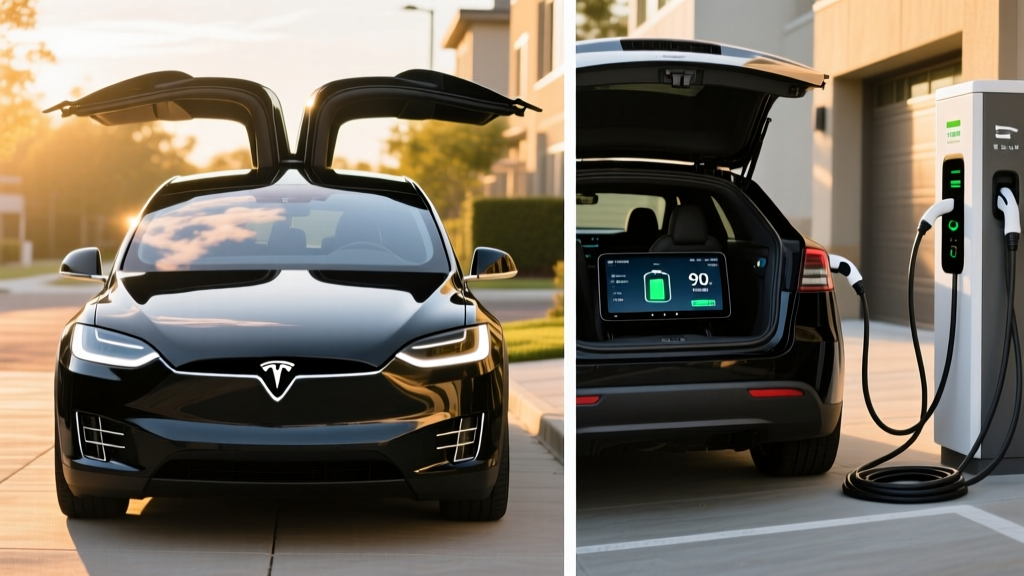
The 2016 Tesla Model X P90D was, in its day, a halo vehicle — a 2,400-pound electric SUV with falcon-wing doors, a 90 kWh battery, and a Ludicrous Mode 0-60 time that embarrassed sports cars. A decade later, it lands squarely in the used EV market, where depreciated luxury meets aging lithium-ion chemistry. If you're considering a pre-owned P90D in 2026, the math is different from buying new: you're evaluating battery State of Health (SoH), out-of-warranty risk, and whether a 10-year-old flagship still delivers on the Tesla promise.
This review breaks down the exact numbers — EPA range, charging speeds, battery degradation, and ownership costs — so you can decide whether a used P90D is a bargain or a money pit.
Quick Verdict: A Used Luxury EV With Caveats
The 2016 Tesla X P90D remains a compelling used EV if you find one with strong battery health and a clean service history. Its 250-mile EPA range, dual-motor AWD, and Supercharger access still hold up, but buyers must budget for potential battery replacement ($12,000–$20,000 out of warranty) and accept that its 400-volt architecture can't match the 15-minute fast-charging of modern 800V platforms. Best suited as a family commuter with access to reliable home charging.
Range & Efficiency: EPA Sticker vs. Real-World Miles
Real-World Expectation in 2026: 180–220 miles depending on battery degradation, driving style, and climate. Highway driving at 75 mph typically yields 190–210 miles; cold-weather (below 32°F) can drop range to 150–175 miles.
When new, the P90D's 90 kWh battery pack (approximately 85 kWh usable) delivered an EPA-rated 250 miles and an efficiency of 89 MPGe combined (38 kWh/100mi). That was competitive in 2016, but today's EVs like the Hyundai Ioniq 5 or Tesla Model Y achieve 120–130 MPGe thanks to improved aerodynamics, heat pumps, and silicon-carbide inverters.
The critical variable for a 2016 P90D in 2026 is battery degradation. Tesla's NMC (nickel-manganese-cobalt) chemistry from this era typically retains 80–88% of original capacity after 8–10 years and 100,000–150,000 miles, assuming the previous owner avoided chronic 100% charges and frequent Supercharging. A P90D with 85% SoH effectively has a ~212-mile range when new-equivalent, but real-world highway and cold-weather losses compound from that reduced baseline.
What to check before buying: Pull up the battery health screen (or use TeslaFi/app data from the seller) to see rated range at 100% SoC. If it shows below 200 miles at full charge, the pack has degraded beyond 20% and you should negotiate the price accordingly or budget for a replacement.
Battery Specs & Chemistry: What Powers the P90D
| Attribute | 2016 Tesla Model X P90D |
|---|---|
| Battery Capacity (Total) | 90 kWh |
| Usable Capacity | ~85 kWh |
| Chemistry | NMC (Nickel-Manganese-Cobalt) |
| Thermal Management | Active liquid cooling/heating |
| Battery Warranty (Original) | 8 years / unlimited miles |
| Warranty Capacity Threshold | 70% retention |
| Out-of-Warranty Replacement Cost | $12,000–$20,000 (remanufactured pack) |
The P90D uses Tesla's third-generation NMC pack, which prioritized energy density over cycle life. Compared to the LFP (lithium iron phosphate) batteries in today's base Model 3/Y, NMC degrades faster when held at high SoC and is more sensitive to heat. However, Tesla's active thermal management was class-leading in 2016 and helps mitigate calendar degradation if the vehicle was garaged.
The 8-year/unlimited-mile battery warranty expired in 2024 for all 2016 models. Any battery failure or degradation below 70% is now an out-of-pocket expense. Tesla Service Centers typically install remanufactured packs rather than new ones, and third-party EV shops like Electrified Garage offer competitive pricing.
Charging Speeds: Supercharger Access Meets 2016 Architecture
| Charging Level | Power / Rate | Time / Range Added |
|---|---|---|
| Level 1 (120V household) | ~1.4 kW | ~3–4 miles per hour |
| Level 2 (240V home, 48A) | ~11.5 kW | ~29 miles per hour; full charge in ~8 hours |
| DC Fast Charge (Supercharger V2) | Peak ~120 kW | 10–80% in ~40 minutes |
| DC Fast Charge (Supercharger V3/V4) | Capped at ~120 kW | 10–80% in ~40 minutes (vehicle-limited) |
The P90D's 400-volt architecture peaks at approximately 120 kW on DC fast chargers — respectable in 2016 but slow by 2026 standards, where 250–350 kW peaks are common. On a V3 Supercharger rated at 250 kW, the P90D will still max out around 120 kW because the bottleneck is the car's onboard charger and battery management system, not the station.
The charge curve tapers significantly above 80% SoC. Expect 10–80% in roughly 40 minutes, but 80–100% can add another 30+ minutes. For road trips, plan stops around the 150–180 mile mark (accounting for degradation) and charge to 80% to minimize time at the stall.
Home charging: The P90D accepts up to 48 amps on Level 2 (dual onboard chargers were standard on early 2016 builds, later became optional). At 48A/240V, you'll add roughly 29 miles of range per hour — enough to fully replenish overnight on a NEMA 14-50 outlet or Wall Connector. A 200-amp electrical panel is typically sufficient, but older homes may need a panel upgrade ($1,500–$3,000) to support a dedicated 60A circuit.
Performance & Drivetrain: Ludicrous Legacy
| Attribute | Specification |
|---|---|
| Drivetrain | Dual-motor AWD |
| Horsepower | ~532 hp (combined) |
| Torque | ~713 lb-ft |
| 0–60 mph | 3.8 seconds (Ludicrous Mode: 3.2 sec) |
| Top Speed | 155 mph |
| Towing Capacity | 5,000 lbs (with tow package) |
The P90D's dual-motor setup — a 259 hp front motor and a 503 hp rear motor — delivers brutal acceleration that still impresses in 2026. Ludicrous Mode, enabled by a $10,000 option when new, drops the 0-60 time to 3.2 seconds, making it quicker than a Porsche Cayenne Turbo of the same era. The instant torque and low center of gravity (battery pack under the floor) give it planted handling for a 5,400-lb SUV, though the steering feels numb compared to modern performance EVs.
Regenerative braking is aggressive and enables near one-pedal driving in "Standard" regen mode. The friction brakes (vented discs all around) rarely see heavy use, so rotors and pads often last well beyond 100,000 miles — but check for surface rust on low-mileage examples that were garaged and rarely brake-applied.
Interior, Cargo & Practicality
The 2016 Model X seats up to seven in a 2-3-2 configuration (optional six-seat layout with second-row captains chairs). The cabin shows its age compared to the refreshed Model X (2021+) — the 17-inch touchscreen runs older MCU1 hardware that's sluggish by today's standards, and the minimalist interior uses materials that haven't aged as well as competitors like the Audi e-tron or BMW iX.
| Dimension | Measurement |
|---|---|
| Cargo Volume (behind 3rd row) | 26.6 cu ft |
| Cargo Volume (2nd row folded) | 57.3 cu ft |
| Cargo Volume (all rows folded) | 81.4 cu ft |
| Front Legroom | 41.2 inches |
| 2nd-Row Legroom | 38.4 inches |
| 3rd-Row Legroom | 32.7 inches |
| Frunk (Front Trunk) | 6.6 cu ft |
The signature falcon-wing rear doors are a love-or-hate feature. They open upward in tight parking spaces (requiring only ~12 inches of side clearance) and make loading child seats easier, but the complex hinge and sensor system has been a reliability pain point. Early-build 2016 models had water-leak and alignment issues; check for service records showing door actuator replacements.
Driver Assistance: Autopilot, Not Self-Driving
2016 was a transitional year for Tesla hardware. Early P90Ds shipped with HW1 (Mobileye-based) Autopilot, which offers basic adaptive cruise and lane-keeping. Later 2016 builds received HW2 (Nvidia-based) with enhanced capabilities, though the camera suite is less capable than the HW3/HW4 in modern Teslas. Full Self-Driving (FSD) capability was sold as an option, but FSD Supervised on HW2 hardware performs noticeably below HW3+ vehicles in 2026.
Key limitation: HW1 vehicles cannot receive FSD updates and are stuck with basic Autopilot. HW2 vehicles may support FSD but with slower processing and lower-resolution cameras. If advanced driver assistance matters, prioritize a late-2016 HW2 build or look at a newer Model X.
Pricing, Tax Credits & Used EV Economics
| Cost Factor | Amount |
|---|---|
| Original MSRP (2016, P90D base) | $115,700 |
| Original As-Tested (w/ Ludicrous, PPS, etc.) | $130,000–$145,000 |
| 2026 Used Market Price (typical) | $28,000–$42,000 |
| Federal Used EV Tax Credit (§25E) | Up to $4,000 (30% of sale price, max $4,000) |
| Credit-Adjusted Price (best case) | $24,000–$38,000 |
| Federal New EV Credit (§30D) | Not applicable — used vehicle |
The 2016 P90D does not qualify for the $7,500 new EV tax credit (§30D) — that applies only to new vehicle purchases. However, it may qualify for the Used Clean Vehicle Credit (§25E), which provides 30% of the sale price up to $4,000 for eligible used EVs sold by a licensed dealer for $25,000 or more.
§25E eligibility requirements:
- Vehicle must be at least 2 model years old (2016 qualifies)
- Sale price must be $25,000 or more
- Must be purchased from a licensed dealer (private-party sales excluded)
- Buyer income caps: $75,000 single / $112,500 head of household / $150,000 joint
- Credit is non-refundable (you must owe at least that much in federal tax)
- Vehicle must be for personal use, primarily in the United States
A P90D priced at $32,000 from a dealer would yield a $4,000 credit (30% of $32,000 = $9,600, capped at $4,000), bringing the effective cost to $28,000. Verify eligibility with a tax professional, as IRS rules are subject to change.
Total cost of ownership considerations: Insurance for a used Model X runs $2,400–$3,600 annually (higher than average due to repair costs). Electricity costs roughly $0.04–$0.06 per mile at home (varies by utility rate), versus $0.12–$0.16 per mile for a comparable gas SUV at 2026 fuel prices. Budget $1,500–$3,000 annually for maintenance (tires, cabin air filter, brake fluid, coolant) and set aside a $5,000–$10,000 reserve for potential battery or drive-unit replacement.
Pros, Cons & Who Should Buy
Pros
- Brutal acceleration (3.2s 0-60 in Ludicrous) still competitive with modern performance SUVs
- Tesla Supercharger network access — the most reliable DC fast-charging ecosystem in North America
- Standard dual-motor AWD with competent snow/rain traction
- Over-the-air software updates still supported (though feature additions are limited on HW1/HW2)
- Spacious cargo area with frunk; falcon-wing doors useful in tight parking
- Up to $4,000 federal used EV tax credit
Cons
- Battery degradation reduces real-world range to 180–220 miles; out-of-warranty replacement costs $12K–$20K
- DC fast charging capped at ~120 kW — 40+ minutes for 10-80%, slow vs. modern 800V EVs
- Falcon-wing doors are a known reliability concern (actuators, seals, alignment)
- MCU1 infotainment hardware is sluggish; no wireless CarPlay/Android Auto
- HW1 Autopilot is obsolete; HW2 FSD lags behind current Tesla hardware
- High insurance premiums and expensive collision repair (aluminum body)
- Third-row seat is cramped (32.7" legroom) — best for children only
Who Should Buy the 2016 Tesla X P90D?
Buy it if: You want a fast, spacious family EV with Supercharger access for under $40K, have reliable Level 2 home charging, commute under 100 miles round-trip, and can budget for potential battery/drive-unit repairs.
Skip it if: You need 300+ miles of real-world range, want the latest driver-assist tech, lack home charging access, drive frequently in extreme cold, or want a warranty-backed ownership experience. Consider a certified pre-owned Model Y, Hyundai Ioniq 5, or BMW iX instead.
Frequently Asked Questions
What is the real-world range of a 2016 Tesla X P90D in 2026?
With typical battery degradation (80–88% SoH), expect 180–220 miles in mixed driving. Highway driving at 75 mph yields 190–210 miles; cold weather (below freezing) can drop range to 150–175 miles. Always check the vehicle's rated range at 100% SoC before purchasing.
How fast does the P90D charge at home and on road trips?
At home on Level 2 (240V/48A), it charges at ~11.5 kW, adding about 29 miles per hour — a full charge takes roughly 8 hours. On DC fast chargers, it peaks at ~120 kW, reaching 10–80% in approximately 40 minutes. It cannot take advantage of 250+ kW chargers due to its 400V architecture.
Does the 2016 Tesla X P90D qualify for any federal tax credit?
Not the $7,500 new EV credit (§30D). It may qualify for the Used Clean Vehicle Credit (§25E) — up to $4,000 if purchased from a licensed dealer for $25,000+ and your income falls below IRS caps ($75K single / $150K joint). Consult a tax professional to confirm eligibility.
Is the 2016 P90D worth buying vs. newer used EVs?
It depends on priorities. The P90D offers unmatched performance-per-dollar in the used EV market and Supercharger access. But a 2020+ Model Y, Ford Mustang Mach-E, or Hyundai Ioniq 5 offers better range, faster charging, modern infotainment, and remaining factory warranty — often for similar money. If performance and falcon-wing doors aren't essential, a newer used EV is the safer bet.
What are the biggest risks of buying a 2016 Model X?
Battery degradation and out-of-warranty replacement cost ($12K–$20K) is the primary financial risk. Falcon-wing door actuator failures, MCU1 screen delamination, and drive-unit whine are secondary concerns. Always get a pre-purchase inspection from a Tesla-certified shop and review service history for battery/coolant maintenance.
Can the 2016 P90D tow a trailer?
Yes — with the factory tow package, it's rated for 5,000 lbs. Towing reduces range significantly (expect 40–50% reduction), so plan for 100–120 mile range when towing near max capacity.
Sources: fueleconomy.gov, IRS §25E Used Clean Vehicle Credit, Tesla owner's manual and press archives.