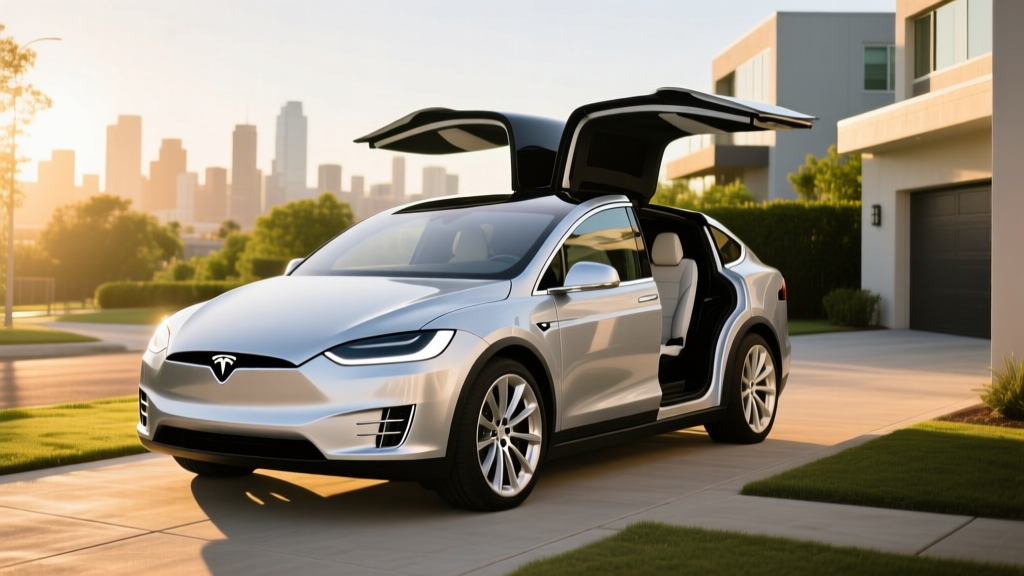
The 2016 Tesla Model X holds a unique place in electric vehicle history. As Tesla's first SUV and the debut of the now-iconic (and sometimes troublesome) Falcon Wing rear doors, it brought supercar-rivaling acceleration to a three-row family hauler. A decade later, it remains a head-turner on the used market — but buying a 10-year-old luxury EV requires careful scrutiny of battery health, charging infrastructure compatibility, and maintenance realities. This review covers everything a 2026 used-EV shopper needs to know before signing the paperwork on a 2016 Model X.
Quick Verdict: Who Should Consider a 2016 Model X Today?
The 2016 Model X makes sense for a specific buyer: someone who wants Tesla's Supercharger network access, needs three rows of seating, craves absurd acceleration, and is comfortable absorbing higher maintenance risk on a complex, aging luxury vehicle. It is not the right pick for buyers prioritizing reliability, low running costs, or a trouble-free ownership experience. If you're cross-shopping used luxury EVs, the Model X's Falcon Wing doors, air suspension, and early-production build quality demand a thorough pre-purchase inspection and a realistic maintenance budget.
Range, Battery, and Efficiency: What to Expect from a 10-Year-Old Pack
EPA Range (Original): 250 miles (90D) / 289 miles (P90D with Ludicrous) — when new.
Real-World Range in 2026: Expect 180–220 miles (90D) and 210–250 miles (P90D) depending on battery degradation, driving style, and climate. Highway driving at 75+ mph reduces range by 10–15%. Cold-weather operation (below 32°F) can cut range an additional 20–30% without preconditioning.
The 2016 Model X was offered primarily in two battery configurations:
- 90D: ~90 kWh battery pack (NMC chemistry — nickel manganese cobalt), dual-motor all-wheel drive, 250 miles EPA when new.
- P90D: ~90 kWh pack with performance rear motor, 250 miles EPA standard or up to 289 miles with the optional Ludicrous Speed upgrade.
A smaller 60 kWh and 75 kWh variant were also available at various points, offering roughly 200 and 238 miles EPA respectively. These are rarer on the used market.
Battery degradation is the critical variable. NMC packs from this era typically lose 10–18% of original capacity over 8–10 years, depending on charging habits and climate exposure. A 2016 Model X that was regularly charged to 100% and DC fast-charged frequently will sit at the higher end of that degradation range. Tesla's battery management system includes a buffer (roughly 2–4 kWh unusable by the driver) that masks early degradation, but by year 10, the loss becomes noticeable in daily driving.
Efficiency: The 2016 Model X 90D rates at approximately 92 MPGe combined (36 kWh/100 mi) per fueleconomy.gov. The heavier P90D drops to roughly 89 MPGe combined. For context, a 2025 Tesla Model Y achieves 122 MPGe — reflecting a decade of drivetrain and aerodynamic improvements.
| Spec | 90D | P90D |
|---|---|---|
| Battery (usable, approx.) | ~83.5 kWh (NMC) | ~83.5 kWh (NMC) |
| EPA Range (new) | 250 mi | 250 mi (289 mi w/ Ludicrous) |
| Est. Range in 2026 | 180–220 mi | 210–250 mi |
| Efficiency | 92 MPGe / 36 kWh/100mi | 89 MPGe / 38 kWh/100mi |
| 0–60 mph | 4.8 sec | 3.2 sec (Ludicrous) |
| Horsepower | ~518 hp (combined) | ~762 hp (combined) |
| Drivetrain | Dual-motor AWD | Dual-motor AWD |
| Max DC Fast Charge | ~120 kW (Supercharger V2) | ~120 kW (Supercharger V2) |
| Level 2 Charge Rate | ~10.5 kW (40A onboard charger std; 72A optional) | ~10.5 kW (40A std; 72A optional) |
Charging Speeds: Supercharger Access Is the Model X's Biggest Advantage
The 2016 Model X charges via Tesla's proprietary connector (now transitioning to NACS industry-wide). It supports DC fast charging on Tesla Superchargers — the most reliable and expansive fast-charging network in North America. This remains a significant ownership advantage over competing used EVs reliant on third-party networks.
| Charging Level | Power / Connector | Speed (approx.) | Notes |
|---|---|---|---|
| Level 1 (120V) | 1.4 kW / NEMA 5-15 | ~3–4 mi/hr | Emergency/top-up only |
| Level 2 (240V, 40A) | 10.5 kW / HPWC or J1772 adapter | ~28–30 mi/hr | Standard onboard charger |
| Level 2 (240V, 72A) | 17.3 kW / HPWC | ~46–50 mi/hr | Optional dual-charger upgrade |
| DC Fast (Supercharger V2) | ~120 kW peak | 10–80% in ~45–55 min | Tapers significantly above 80% |
| DC Fast (Supercharger V3) | ~120 kW (vehicle-limited) | 10–80% in ~45–55 min | V3 stations cap at vehicle's max |
Charging curve reality: The 2016 Model X peaks at roughly 120 kW on V2 Superchargers, but this peak is only sustained from roughly 10–40% State of Charge (SoC). Above 50%, the curve tapers progressively. By 80%, charge speed drops to roughly 30–40 kW. Plan road-trip stops around 20–30 minute sessions for 10–70% charges to stay in the fastest part of the curve.
Home charging: Most 2016 Model X examples came with the standard 40-amp onboard charger (10.5 kW), adding roughly 28–30 miles of range per hour. The optional 72-amp High Power Wall Connector setup (17.3 kW) was a $2,500 option when new and is relatively rare. Verify which onboard charger a specific used vehicle has before assuming faster Level 2 speeds.
CCS compatibility: The 2016 Model X uses Tesla's proprietary connector. Tesla provides a CCS adapter for non-Tesla DC fast chargers, though charging on Electrify America or EVgo stations will be limited by the vehicle's ~120 kW peak. For most owners, Tesla Superchargers handle the vast majority of DC fast-charging needs.
Performance: Supercar Acceleration in a 5,000-lb SUV
Performance was never the 2016 Model X's weakness. The dual-motor AWD layout delivers instant torque to all four wheels with traction control that feels almost telepathic.
- 90D: 0–60 mph in 4.8 seconds, ~518 combined horsepower. Quick by any standard, and effortless for highway merging and passing.
- P90D (Ludicrous): 0–60 mph in 3.2 seconds, ~762 combined horsepower. This was genuinely supercar territory in 2016 and still startling today. The "Ludicrous" launch mode requires the battery to be warm (preconditioned) and above ~90% SoC for maximum effect.
The air suspension provides adjustable ride height — useful for steep driveways, rough roads, or loading cargo. However, air suspension failures are a known issue on 2016-era Model X vehicles and are expensive to repair ($2,000–$4,000 per corner). Budget for this.
Interior, Cargo, and Technology
The 2016 Model X seats up to seven passengers in a three-row configuration (2+3+2) or six with optional second-row captain's chairs (2+2+2). Interior quality was a common criticism at launch — panel gaps, creaks, and material choices lagged behind similarly priced German luxury SUVs.
Cargo volume:
- Behind third row: ~21.8 cu ft
- Behind second row (third row folded): ~56.8 cu ft
- All rear rows folded: ~88.1 cu ft
- Front trunk (frunk): ~6.6 cu ft
Falcon Wing doors: The double-hinged rear doors open upward and outward, dramatically improving access to the second and third rows in tight parking spaces. They're undeniably cool. They're also the Model X's most common source of mechanical complaints — sensor malfunctions, hinge motor failures, and water leaks have plagued early-production examples. Tesla issued multiple software updates and hardware revisions, but a 2016 model should have its door operation thoroughly tested in all conditions before purchase.
Infotainment: The 17-inch center touchscreen was class-leading in 2016 and still impresses. Over-the-air (OTA) updates have kept the software current, adding features like theater mode, improved navigation, and updated Autopilot visualization over the years. The 2016 Model X received Tesla's MCU1 (Media Control Unit) hardware, which is noticeably slower than the MCU2 (Intel Atom) introduced in 2018. Some 2016 vehicles have been retrofitted with MCU2 — ask the seller. MCU1 does not support Netflix/YouTube streaming or the latest visualization features.
Autopilot: The 2016 Model X shipped with Hardware 1 (HW1) Autopilot. Tesla later offered a paid upgrade to Hardware 2.5 or Hardware 3 (the "Full Self-Driving Computer") for vehicles that originally had HW1. A HW3-equipped 2016 Model X can run Tesla's current FSD (Supervised) software — but this is SAE Level 2 driver assistance, not autonomous driving. The driver must remain fully attentive at all times.
ADAS Limitations: Tesla Autopilot and FSD (Supervised) are SAE Level 2 driver-assist systems. They require continuous driver supervision and do not make the vehicle self-driving. FSD (Supervised) can navigate highway interchanges and some city streets, but it makes errors — running stop signs, misjudging merges, and occasionally making unexpected steering inputs. Keep your hands on the wheel and eyes on the road.
Pricing, Tax Credits, and Used-EV Economics
Original MSRP (2016):
- Model X 60D: ~$74,000
- Model X 75D: ~$79,500
- Model X 90D: ~$88,500
- Model X P90D: ~$108,000 (with Ludicrous: ~$118,000+)
Used market pricing in 2026: Expect to pay roughly $25,000–$38,000 for a 2016 Model X 90D and $30,000–$45,000 for a P90D, depending on mileage, condition, battery health, and Autopilot hardware version. High-mileage examples (100,000+ miles) can dip below $25,000, but these carry elevated battery-replacement risk.
| Trim | Est. Used Price (2026) | Federal Used-EV Credit (§25E) | Effective Cost |
|---|---|---|---|
| 90D (avg. condition) | $28,000–$35,000 | Up to $4,000* | $24,000–$31,000 |
| P90D (avg. condition) | $33,000–$42,000 | Up to $4,000* | $29,000–$38,000 |
*§25E Used Clean Vehicle Credit rules (2026): The federal used-EV tax credit provides up to $4,000 (30% of the sale price, capped at $4,000) for qualified used electric vehicles. Key eligibility requirements per IRS guidelines:
- Vehicle price cap: Sale price must be $25,000 or less to qualify. Many 2016 Model X examples exceed this threshold, making them ineligible. A lower-mileage or higher-degradation example priced at or below $25,000 may qualify.
- Buyer income limits: Adjusted gross income must not exceed $75,000 (single), $112,500 (head of household), or $150,000 (joint filers).
- Vehicle age: Must be at least 2 model years old (2016 qualifies).
- Dealer sale: Must be purchased from a licensed dealer (private-party sales do not qualify).
- First transfer: The credit applies only on the first qualified resale after August 16, 2022. If the vehicle was previously sold as a used EV with the credit claimed, it may not qualify again — verify with your dealer and a tax professional.
The §30D new-vehicle credit does not apply to used purchases. Consult a tax professional to confirm eligibility before relying on the credit in your budget.
Warranty, Battery Health, and Long-Term Costs
The 2016 Model X came with Tesla's battery and drive unit warranty:
- Battery: 8 years / 150,000 miles (whichever comes first), with a capacity retention threshold of 70%. This warranty has expired or is expiring for most 2016 examples by 2024–2026.
- Drive unit: 8 years / 150,000 miles.
- Basic vehicle: 4 years / 50,000 miles (long expired).
Battery replacement cost: A remanufactured 90 kWh pack from Tesla currently costs roughly $14,000–$18,000 installed. Third-party shops may offer repairs for $10,000–$14,000 using refurbished modules. This is the single largest financial risk of owning a 2016 Model X — if the battery fails outside warranty, it can total the vehicle's value.
Pre-purchase battery check: Before buying, access the vehicle's Service Mode (or have a Tesla-certified inspector do so) to read the battery's State of Health (SoH). An SoH reading below 82% on a 2016 pack is common and means you're working with roughly 180–200 miles of usable range. Below 75%, start budgeting for a replacement.
Other common repair costs (2016 Model X):
- Falcon Wing door motor/sensor repair: $800–$2,500 per door
- Air suspension strut replacement: $2,000–$4,000 per corner
- Windshield replacement (panoramic): $1,500–$2,500
- MCU1 to MCU2 upgrade: ~$1,500–$2,000 (if not already done)
- Drive unit replacement: $5,000–$8,000 (rare but documented)
2016 Model X vs. Key Used-EV Competitors
| Attribute | 2016 Tesla Model X 90D | 2017 Jaguar I-PACE | 2018 Audi e-tron |
|---|---|---|---|
| Est. Used Price | $28,000–$35,000 | $22,000–$30,000 | $25,000–$33,000 |
| Real-World Range (2026) | 180–220 mi | 180–210 mi | 180–210 mi |
| DC Fast Charge (peak) | ~120 kW | ~100 kW | ~150 kW |
| Seating | 5–7 passengers | 5 passengers | 5 passengers |
| 0–60 mph | 4.8 sec | 4.5 sec | 5.5 sec |
| Charging Network | Tesla Supercharger | CCS (third-party) | CCS (third-party) |
| OTA Updates | Yes (ongoing) | Limited | Limited |
The Model X's key advantages over used competitors are three-row seating, Supercharger network access, and ongoing OTA software updates. Its disadvantages include higher complexity (Falcon Wing doors, air suspension), higher repair costs, and more variable build quality. The Jaguar I-PACE and Audi e-tron offer more conventional SUV practicality and often better interior quality, but rely on less reliable public charging networks.
Pros
- Tesla Supercharger network — the most reliable DC fast-charging infrastructure in North America
- Supercar-level acceleration, especially P90D with Ludicrous
- Three-row seating (up to 7 passengers) — rare in the used-EV market
- Ongoing OTA updates keep software features current
- Frunk + rear cargo offers versatile storage
- Falcon Wing doors are dramatic and genuinely improve rear-seat access in tight spaces
Cons
- Falcon Wing door mechanisms are a known reliability liability
- Air suspension failures are common and costly
- MCU1 infotainment hardware is dated and sluggish
- Battery degradation reduces real-world range to 180–220 mi
- Expensive out-of-warranty repairs (battery: $14K–$18K; drive unit: $5K–$8K)
- Interior build quality and materials lag behind German luxury competitors
- Most examples exceed the $25,000 used-EV tax credit price cap
Frequently Asked Questions
What is the real-world range of a 2016 Tesla Model X in 2026?
Expect 180–220 miles for a 90D and 210–250 miles for a P90D, depending on battery State of Health. Highway driving at sustained speeds above 70 mph reduces range by roughly 10–15% compared to city driving. Cold weather (below 32°F) without battery preconditioning can cut range by 20–30%. Always test-drive a specific vehicle and check its projected range at various SoC levels before purchasing.
How fast does the 2016 Model X charge at home and on the road?
At home on a 240V Level 2 charger with the standard 40A onboard charger, the 2016 Model X adds roughly 28–30 miles of range per hour (10.5 kW). A full charge from 10% takes about 8–9 hours. On Tesla Superchargers (V2 or V3), the vehicle peaks at roughly 120 kW, achieving a 10–80% charge in approximately 45–55 minutes. Charging slows significantly above 80% SoC due to the battery management system tapering current to protect cell longevity.
Does a used 2016 Tesla Model X qualify for any federal tax credit?
It may qualify for the §25E Used Clean Vehicle Credit (up to $4,000), but only if the sale price is $25,000 or less, the buyer's income falls within IRS limits ($75K single / $150K joint), and the vehicle is purchased from a licensed dealer. Many 2016 Model X examples are priced above $25,000, making them ineligible. The §30D new-vehicle credit does not apply to used purchases. Always consult IRS guidelines and a tax professional before relying on the credit.
Is the 2016 Model X worth buying vs. a newer used EV?
It depends on your priorities. If you need three rows, Supercharger access, and dramatic performance at a sub-$40K price, the 2016 Model X has no direct rival. However, if reliability and low running costs matter more, a newer (2020+) used Tesla Model Y, Hyundai Ioniq 5, or Kia EV6 will offer better range, faster charging, fewer mechanical concerns, and potentially lower total cost of ownership despite a higher purchase price. Budget at least $3,000–$5,000 annually for out-of-warranty maintenance on a 2016 Model X.
What should I check before buying a used 2016 Model X?
Prioritize these inspections: (1) Battery State of Health via Service Mode — anything below 78% is a negotiation point or walk-away. (2) Falcon Wing door operation — test open/close cycles 20+ times, including in rain or cold if possible. (3) Air suspension — cycle through all ride heights and listen for compressor strain. (4) Autopilot hardware version — HW3 is strongly preferred over HW1. (5) Service history — verify whether the MCU upgrade, drive unit replacements, or battery service have been performed. A pre-purchase inspection at a Tesla Service Center ($200–$300) is highly recommended.
Can the 2016 Model X use non-Tesla charging networks?
Yes. Tesla provides a CCS adapter that allows the 2016 Model X to charge at Electrify America, EVgo, and other CCS-equipped public stations. Level 2 public charging works with the included J1772 adapter. However, the vehicle's ~120 kW peak DC charge rate means you won't fully utilize newer 350 kW chargers. For most owners, Tesla Superchargers remain the most reliable option.