The 2016 Tesla Model X was the first year Tesla's flagship SUV reached customers in meaningful volume, and it remains one of the most distinctive used EVs on the market. With its falcon-wing rear doors, available third row, and dual-motor all-wheel drive, it carved out a segment of its own. But as a nearly decade-old electric vehicle in 2026, the 2016 Model X demands a careful, data-driven look before you sign any paperwork. Battery degradation, outdated Supercharging hardware, and the well-documented build-quality issues of early production all factor heavily into the ownership equation.
This review covers every number a used-EV buyer needs — EPA range by trim, real-world highway and cold-weather expectations, battery chemistry and degradation data, DC fast-charge speeds, home charging rates, performance figures, and the critical question of federal used-EV tax credit eligibility. If you are shopping for a 2016 Model X, this is the spec sheet and reality check you need.
2016 Model X Range, Battery & Efficiency by Trim
Tesla offered the 2016 Model X in several battery configurations. The most common on the used market today are the 60D, 75D, 90D, and P90D. The 60D was software-limited to 60 kWh from a 75 kWh physical pack (owners could purchase an unlock). The 75D, 90D, and P90D represent the bulk of surviving examples.
| Trim | Battery (usable, kWh) | Chemistry | EPA Range (mi) | MPGe (combined) | 0-60 mph (sec) | HP (approx.) | Drivetrain |
|---|---|---|---|---|---|---|---|
| 60D | ~60 (sw-limited 75) | NMC | 200 | 92 | 6.0 | 328 | AWD Dual-Motor |
| 75D | ~72.5 | NMC | 237 | 92 | 6.0 | 328 | AWD Dual-Motor |
| 90D | ~83.5 | NMC | 257 | 92 | 4.8 | 417 | AWD Dual-Motor |
| P90D (Ludicrous) | ~83.5 | NMC | 250 | 89 | 3.2 | 532 | AWD Dual-Motor |
All 2016 Model X variants use NMC (nickel-manganese-cobalt) lithium-ion cells supplied by Panasonic. There are no LFP (lithium iron phosphate) packs in this model year — LFP chemistry did not appear in Tesla vehicles until the 2021+ Standard Range models.
Real-World Range Expectations
EPA sticker: 237 mi (75D) / 257 mi (90D)
Real-world highway (70 mph, 72°F): Expect 195–220 mi (75D) and 215–240 mi (90D). The Model X's 5,000+ lb curb weight and 0.25 Cd drag area cut highway efficiency hard.
Cold weather (30°F or below): Plan for 25–35% range loss, bringing a 75D down to roughly 150–175 mi and a 90D to 165–190 mi. Battery preconditioning helps, but the 2016 Model X lacks the heat pump found in later Tesla models — it uses resistive cabin heating, which draws heavily from the pack.
After 8–10 years of degradation: Most 2016 packs have lost 10–18% of original capacity depending on charging habits and mileage. A 90D that originally delivered 257 EPA miles may now show 210–230 mi at 100% SoC, assuming the pack has not been replaced.
Efficiency figures hover around 36–38 kWh/100 mi in mixed driving, according to fueleconomy.gov. That translates to roughly 2.6–2.8 mi/kWh — respectable for a 5,300-lb three-row SUV, but noticeably less efficient than a modern Model Y or Hyundai Ioniq 5.
Charging Speeds: DC Fast Charge, Supercharging & Home Level 2
This is where the 2016 Model X shows its age most clearly. Tesla's Supercharger network was still maturing in 2016, and the Model X's on-board charge hardware limits how fast it can accept power.
| Charging Method | Peak Power (kW) | 10–80% Time | Rate (mi/hr of charge) | Notes |
|---|---|---|---|---|
| DC Fast Charge (Supercharger V2) | ~120 kW peak | ~40–45 min | ~250 mi/hr at peak | Peak only at low SoC; tapers sharply above 60%. V3 Superchargers (250 kW) are limited to ~120 kW on this hardware. |
| DC Fast Charge (CHAdeMO adapter via Tesla) | ~50 kW | ~80–90 min | ~120 mi/hr at peak | Requires legacy CHAdeMO adapter; very slow by 2026 standards. |
| Level 2 Home (48A / 11.5 kW) | 11.5 kW | ~7–8 hr (0–100%) | ~29 mi/hr | Requires NEMA 14-50 or hardwired Wall Connector on 60A circuit. |
| Level 2 Home (32A / 7.7 kW) | 7.7 kW | ~10–11 hr (0–100%) | ~19 mi/hr | Mobile Connector on NEMA 14-50 outlet. |
| Level 1 (120V / 12A) | ~1.4 kW | 50+ hr | ~3–4 mi/hr | Emergency/trickle only. |
Charge curve reality: The 2016 Model X peaks near 120 kW only when the battery is warm (preconditioned) and below ~30% SoC. Above 50% SoC, the rate drops to 60–80 kW, and above 80% it falls below 30 kW. On a road trip, plan your stops around 10–80% increments — charging from 80–100% takes nearly as long as 10–80%.
The 2016 Model X uses Tesla's proprietary connector (now called NACS). With Tesla opening the Supercharger network to NACS-equipped non-Tesla vehicles, this connector is an advantage in 2026 — the Model X accesses the most reliable DC fast-charging network in North America without an adapter. However, for CCS-based public chargers (Electrify America, EVgo CCS stalls), you would need a NACS-to-CCS adapter, which Tesla sells but which limits charge rates on this older hardware anyway.
Performance & Driving Dynamics
Even in 2026, a 2016 Model X P90D with Ludicrous Mode feels brutally quick. The 3.2-second 0–60 mph time was supercar territory when new and still impresses. The 90D's 4.8-second run is more than adequate for highway merging, and even the base 75D's 6.0 seconds beats most gas-powered midsize SUVs.
All trims feature dual-motor AWD with independent front and rear motors — there is no mechanical linkage. Torque vectoring is handled electronically, giving confident traction in rain and light snow. The air suspension (standard on all 2016 Model X trims) provides adjustable ride height, useful for steep driveways or light off-pavement use.
However, the 2016 Model X is a heavy vehicle. At 5,200–5,400 lbs curb weight, you feel it through corners. Body roll is noticeable, and the regenerative braking — while strong — does not offer true one-pedal driving to a complete stop the way newer Teslas do after firmware updates. The brake feel can be vague as the system blends regen and friction braking.
Interior, Cargo, Tech & Standout Features
The 2016 Model X seats five standard, with an optional third row bringing capacity to seven (or six with optional second-row captain's chairs). Cargo volume is generous:
- Behind third row: ~21.8 cu ft
- Behind second row (third row folded): ~57.2 cu ft
- Behind front seats (all rear rows folded): ~81.7 cu ft
- Front trunk (frunk): ~6.6 cu ft
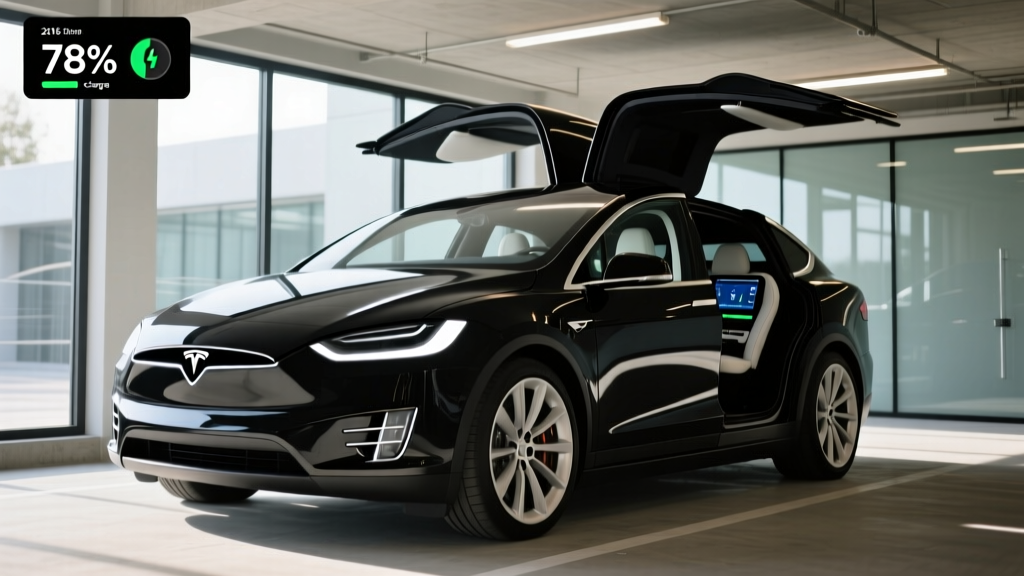
The falcon-wing rear doors are the Model X's signature feature. They articulate upward with dual-hinged panels, making child-seat installation and third-row access easier in tight parking spaces. However, they are also the vehicle's most common source of complaints — water leaks, sensor malfunctions, and slow open/close cycles are well-documented across owner forums and NHTSA records.
Infotainment: The 2016 Model X runs on Tesla's 17-inch portrait touchscreen. In 2016, this was class-leading. In 2026, it still works well for navigation, media, and vehicle controls, but the processor (an older Intel Atom) feels sluggish compared to current Tesla hardware. Over-the-air updates have kept the software functional, but Tesla has discontinued major feature updates for MCU1 (Media Control Unit 1) vehicles. Some owners have paid ~$1,500–$2,500 for the MCU2 upgrade to gain faster performance and modern streaming apps.
Driver assistance: 2016 Model X vehicles came with either Autopilot Hardware 1 (HW1, Mobileye-based) or Hardware 2 (HW2, Tesla's custom suite, introduced late 2016). HW1 vehicles received basic Autopilot (lane centering + adaptive cruise) but are not eligible for Full Self-Driving (Supervised). HW2 vehicles may have received FSD capability, but the neural-net processing power of HW2 is limited — Tesla has stated HW2 may not support future FSD versions without a hardware retrofit.
Used Pricing & Federal Tax Credit Eligibility
The 2016 Model X originally carried a base MSRP of approximately $74,000 (60D) to $115,000+ (P90D with options). In the 2026 used market, prices vary significantly based on mileage, battery health, and trim:
| Trim | Original MSRP | Used Price Range (2026) | Potential Used EV Credit (§25E) | Effective Price After Credit |
|---|---|---|---|---|
| 60D | ~$74,000 | $14,000–$19,000 | Up to $4,000 | $10,000–$15,000 |
| 75D | ~$82,500 | $17,000–$24,000 | Up to $4,000 | $13,000–$20,000 |
| 90D | ~$93,500 | $20,000–$28,000 | Up to $4,000 | $16,000–$24,000 |
| P90D | ~$115,000+ | $22,000–$32,000 | Up to $4,000 | $18,000–$28,000 |
Federal used-EV tax credit (IRS §25E): The 2016 Model X may qualify for the federal used clean vehicle credit of up to $4,000 (30% of the sale price, capped at $4,000). However, several rules apply:
- Sale price cap: The used vehicle must sell for $25,000 or less to qualify.
- Buyer income limits: Adjusted gross income must not exceed $75,000 (single), $112,500 (head of household), or $150,000 (joint filers).
- Dealer requirement: The sale must be through a licensed dealer; private-party sales do not qualify.
- Vehicle age: Must be at least 2 model years old (easily satisfied by a 2016 model).
- One-time use per buyer: You can only claim this credit once every 3 years.
Many 2016 Model X listings now fall below the $25,000 threshold, making the §25E credit accessible — but verify the dealer participates and your income qualifies. Consult IRS.gov §25E guidance or a tax professional before relying on the credit. Note: the §30D new-vehicle credit does not apply to used purchases.
Battery Health, Warranty & Long-Term Ownership Costs
The 2016 Model X originally came with an 8-year/unlimited-mile battery and drive unit warranty for the 60D and 75D, and an 8-year/unlimited-mile warranty for the 90D and P90D. As of 2026, every 2016 Model X has aged out of its original factory battery warranty unless an extended service agreement was purchased.
Battery degradation data: Analysis of fleet data and owner reports (cited by sources such as Tesla's Impact Report and independent EV analytics) shows that 2016-era NMC packs typically lose 10–15% capacity in the first 100,000 miles, with the curve flattening afterward. Vehicles with 120,000–150,000 miles may show 12–18% total degradation. Frequent DC fast charging and habitual 100% SoC storage accelerate this loss.
Battery replacement cost: If the pack fails outside warranty, a remanufactured 90 kWh replacement from Tesla typically costs $12,000–$16,000 including labor. Third-party EV shops sometimes offer replacements for $8,000–$12,000 using refurbished modules. This is a critical cost to budget for when buying any 2016 Model X with high mileage.
Other ownership costs to anticipate:
- Air suspension: Front and rear air struts are known failure points. Replacement runs $1,500–$2,500 per corner.
- Falcon-wing door mechanisms: Hydraulic struts and sensors may require service — budget $500–$1,500 per incident.
- MCU upgrade: If the vehicle still has MCU1, the upgrade to MCU2 costs ~$1,500–$2,500 at a Tesla Service Center.
- Tires: The Model X's weight and torque chew through tires. Expect 20,000–30,000 miles per set; 20-inch or 22-inch tires cost $250–$450 each.
- Insurance: Model X insurance premiums remain elevated due to repair costs — get quotes before purchasing.
Pros & Cons: The Honest Assessment
Pros
- Supercharger network access (NACS) — best DC charging reliability in North America
- Spacious three-row SUV with frunk — genuine family hauler
- Strong performance even in base 75D trim
- Over-the-air updates still provide security and minor feature patches
- Used prices have dropped to genuinely affordable territory
- Potential $4,000 federal used-EV tax credit (§25E)
- Standard AWD with capable traction in snow and rain
Cons
- Battery warranty has expired — replacement is a $12K+ risk
- DC fast-charge speed maxes at ~120 kW — slow by 2026 standards
- Falcon-wing doors: chronic leak, sensor, and actuator issues
- Air suspension failures are common and expensive
- MCU1 hardware is obsolete; upgrade costs extra
- No heat pump — cold-weather range loss is significant (25–35%)
- HW1 Autopilot vehicles cannot receive FSD updates
- Insurance premiums remain high relative to vehicle value
Who Should Buy the 2016 Model X — And Who Shouldn't
Choose the 2016 Model X if:
- You need a three-row electric SUV on a tight budget (under $25K before credit)
- You have reliable home Level 2 charging and mostly drive under 150 miles/day
- You value Supercharger access for occasional road trips
- You can budget $3,000–$5,000 for potential suspension or door repairs in year one
- You are buying from a dealer and qualify for the §25E used-EV credit
Look elsewhere if:
- You need fast DC charging for frequent long-distance travel (consider a 2021+ Model Y or Hyundai Ioniq 5)
- You live in a cold climate where the 25–35% winter range loss will be painful
- You want modern ADAS — HW1/HW2 Autopilot is outdated compared to current systems
- You cannot absorb a potential $12,000+ battery replacement cost
- You want current-model infotainment responsiveness without paying for an MCU upgrade
2016 Model X vs. Key Used EV Competitors
In the $15,000–$30,000 used EV SUV market of 2026, the 2016 Model X competes with the 2019–2020 Tesla Model Y (early examples), the 2018–2020 Jaguar I-PACE, and the 2019 Audi e-tron. Here is how they compare on the metrics that matter:
| Attribute | 2016 Tesla Model X 90D | 2019 Tesla Model 3 LR AWD | 2019 Jaguar I-PACE | 2019 Audi e-tron |
|---|---|---|---|---|
| Used Price Range | $20K–$28K | $18K–$24K | $18K–$25K | $20K–$27K |
| EPA Range | 257 mi | 310 mi | 234 mi | 204 mi |
| DC Fast Charge (peak kW) | ~120 kW | ~150 kW | ~105 kW | ~150 kW |
| Seating | 5–7 | 5 | 5 | 5 |
| Cargo (max, cu ft) | 81.7 | 64.9 | 51.0 | 57.0 |
| Battery Warranty Remaining | Expired | ~1–2 yr remaining | Expired | Expired |
| Supercharger Access | Yes (NACS native) | Yes (NACS native) | No (CCS; adapter needed) | No (CCS; adapter needed) |
The Model X wins on cargo space and seating capacity. The Model 3 LR AWD wins on range, charging speed, and remaining warranty. The I-PACE and e-tron offer more conventional SUV styling and build quality but sacrifice range and charging infrastructure access. Your choice depends on whether third-row seating and maximum cargo volume are non-negotiable.
Frequently Asked Questions
What is the real-world range of a 2016 Tesla Model X in 2026?
With 8–10 years of battery degradation, expect a 75D to deliver 175–210 real-world miles and a 90D to deliver 195–230 miles in moderate temperatures and mixed driving. Highway driving at 70+ mph reduces these figures by 10–15%, and cold weather (below 30°F) can cut range by an additional 25–35%. Always check the vehicle's current range display at 100% SoC before purchasing — it is the best indicator of remaining battery health.
How fast does the 2016 Model X charge at home and on the road?
On a DC fast charger (Tesla Supercharger V2), it peaks at approximately 120 kW and takes about 40–45 minutes for a 10–80% charge. On newer V3 Superchargers (250 kW), the 2016 Model X is still limited to ~120 kW by its onboard charge hardware. At home on a 48A Level 2 charger (11.5 kW), a full charge takes 7–8 hours. On a standard 32A Level 2 setup (7.7 kW), expect 10–11 hours. Level 1 (120V) is impractical for daily use at only 3–4 miles per hour of charge.
Does the 2016 Model X qualify for the federal EV tax credit?
Not the new-vehicle §30D credit — that applies only to new purchases. However, it may qualify for the §25E used clean vehicle credit of up to $4,000, provided: the sale price is $25,000 or less, the buyer's income falls within IRS limits ($75K single / $150K joint), and the sale is through a licensed dealer. Verify eligibility at IRS.gov before relying on the credit.
Is the 2016 Model X worth buying vs. a newer used EV?
It depends on your priorities. If you need three-row seating, maximum cargo space, and Supercharger access for under $25,000, the 2016 Model X is one of the few options. If you prioritize range, fast charging, modern tech, and lower repair risk, a 2019–2020 Model 3 Long Range or a 2021 Hyundai Ioniq 5 is a better financial bet. Budget at least $3,000–$5,000 for repairs in the first year of 2016 Model X ownership.
What are the most common problems with the 2016 Model X?
The top issues reported by owners and tracked by NHTSA include: falcon-wing door malfunctions (sensors, actuators, water leaks), air suspension failures, MCU1 screen delamination or freezing, and windshield cracking (the Model X's expansive panoramic windshield is expensive to replace at $1,200–$1,800). Battery and drive unit failures are less common but catastrophic in cost if out of warranty.
Can I still get software updates on a 2016 Model X?
Yes, but they are limited. Tesla continues to push security patches and minor feature updates to MCU1-equipped vehicles, but major new features (theater mode, advanced navigation, streaming apps) require the MCU2 hardware upgrade. If infotainment performance matters to you, confirm whether the vehicle has been upgraded before purchasing, or budget for the $1,500–$2,500 retrofit.