Quick Verdict: A Used Flagship With Falcon-Wing Drama and Real Compromises
The 2016 Tesla Model X P90D was Tesla's first SUV, and nearly a decade later it remains one of the most talked-about used EVs on the market. With Ludicrous Mode delivering a 3.2-second 0-60 mph time, falcon-wing rear doors, and an EPA-estimated 250 miles of range from its 90 kWh battery, the P90D still turns heads. But as a used purchase in 2026, it demands careful scrutiny. Battery degradation, aging drive units, and the complex rear door mechanisms make pre-purchase diligence non-negotiable. This review breaks down the real-world numbers you need before signing a check.
| Spec | Value |
|---|---|
| EPA Range | 250 miles (19" wheels) |
| Battery (Usable) | ~83.5 kWh usable / 90 kWh gross, NMC (nickel-manganese-cobalt) |
| Drivetrain | Dual-motor AWD |
| Horsepower | ~532 hp (combined, Ludicrous Mode) |
| 0-60 mph | 3.2 seconds (with Ludicrous) |
| Max DC Fast Charge | ~120 kW peak (Supercharger V2) |
| 10-80% DC Charge Time | ~45-50 minutes |
| Level 2 Charge Rate | Up to 17.2 kW (dual onboard chargers, 48A) |
| Efficiency | 89 MPGe combined / 38 kWh/100mi |
| Cargo (behind 3rd row / max) | 21.8 cu ft / 83.1 cu ft |
| Seating | 5, 6, or 7 passengers |
| Original MSRP | ~$132,000 (base P90D, before options) |
| Used Price Range (2026) | $28,000 - $42,000 |
| Battery Warranty (Original) | 8 years / unlimited miles |
Real-World Range: What 250 EPA Miles Actually Means Today
EPA Sticker: 250 miles (P90D with 19" wheels; 20" wheels reduced to ~242 miles)
Real-World Expectation in 2026: 190-225 miles depending on battery health, driving style, and temperature. Highway driving at 70+ mph typically yields 200-215 miles in moderate weather. Cold-weather highway range can drop to 165-185 miles.
The 2016 Model X P90D shipped with a 90 kWh (gross) NMC lithium-ion battery pack. Usable capacity was approximately 83.5 kWh — Tesla maintains a top and bottom buffer to protect cell longevity. According to fueleconomy.gov, the P90D with 19-inch wheels earned a 250-mile EPA estimate, though opting for the 20-inch turbine-style wheels knocked that down to around 242 miles.
For a 2026 used buyer, the critical variable is battery degradation. Tesla's NMC chemistry in this era typically shows 8-14% capacity loss after 80,000-120,000 miles, depending on charging habits and climate. A P90D that was frequently DC fast-charged or regularly held at 100% state of charge will be closer to the higher end of that range. That means a 100,000-mile example might deliver only 210-220 miles of usable range in ideal conditions.
The Model X's large frontal area and heavy curb weight (~5,271 lbs) hurt highway efficiency. Expect consumption around 38-42 kWh/100mi at sustained highway speeds, which is thirsty by modern EV standards. For comparison, a 2025 Tesla Model X Long Range achieves roughly 32-34 kWh/100mi. The older pack and less efficient heat pump system also mean greater range loss in freezing temperatures — plan for 25-35% reduction in sub-30°F conditions.
Charging Speeds: Supercharger V2 and Home Charging Reality
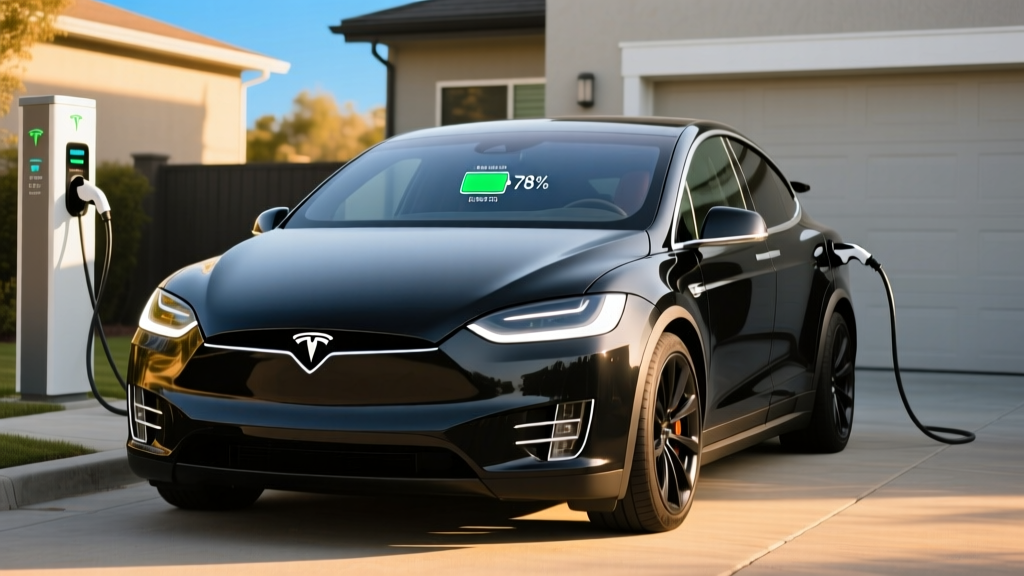
The P90D predates Tesla's V3 Supercharger architecture. Its peak DC fast-charge rate is approximately 120 kW on a V2 Supercharger stall, and the charge curve tapers significantly above 60% state of charge. Here's what that looks like in practice:
| Charging Method | Power (kW) | Miles Added per Hour | Notes |
|---|---|---|---|
| Tesla Supercharger V2 (DC) | ~120 kW peak | ~200 mi/hr (at peak) | 10-80% in ~45-50 min; tapers hard above 60% |
| Tesla Supercharger V3 (DC) | ~120 kW (capped by vehicle) | ~200 mi/hr (at peak) | V3 stalls won't deliver 250 kW — car is the bottleneck |
| Level 2 — Dual Charger (48A) | 17.2 kW | ~52 mi/hr | Requires HPWC / Tesla Wall Connector at 60A circuit |
| Level 2 — Single Charger (40A) | 10 kW | ~30 mi/hr | Some P90D units had single charger; verify before purchase |
| Level 1 (120V / 12A) | ~1.4 kW | ~4 mi/hr | Emergency/trickle only — full charge takes 60+ hours |
A critical ownership note: some 2016 Model X units shipped with a single onboard charger (10 kW) while others received the dual-charger option (17.2 kW). This was a $2,500 option at the time. If home charging speed matters to you — and with a 90 kWh pack, it should — verify which configuration the vehicle has before purchasing. A dual-charger P90D on a 48-amp Tesla Wall Connector will replenish the pack from 10-100% in roughly 5 hours, while a single-charger unit takes closer to 8.5 hours.
On the road, the 120 kW DC ceiling means longer Supercharger stops than newer EVs. A modern Hyundai Ioniq 5 or Tesla Model Y on a V3 stall can add 200 miles in 15-20 minutes. The P90D will need 45-50 minutes for a similar 10-80% session. Road-trippers should factor this into route planning, especially on corridors with limited Supercharger density.
One advantage: the P90D uses Tesla's proprietary connector, which in 2026 still grants access to the full Supercharger network without adapters. Tesla has opened some stalls to NACS-equipped non-Tesla EVs, but Tesla owners retain the most seamless plug-and-charge experience.
Performance: Ludicrous Mode Still Delivers Supercar Humiliation
The P90D's dual-motor all-wheel-drive powertrain produces approximately 532 combined horsepower in Ludicrous Mode. The front motor handles the front axle while a larger rear motor drives the rear wheels, with torque vectoring managed by Tesla's traction control software.
The headline number is the 3.2-second 0-60 mph time — achieved with Ludicrous Mode enabled and the battery above 90% state of charge. Below roughly 50% SoC, expect 0-60 times closer to 4.5-5.0 seconds as the battery's maximum discharge rate decreases. This is physics, not a defect: lithium-ion cells deliver peak power at high state of charge.
Even without Ludicrous, the P90D's Sport mode delivers immediate, linear torque that makes highway merging effortless. The air suspension adjusts ride height automatically, dropping at speed for aerodynamics and raising for rough roads or steep driveways. Steering is precise if somewhat numb, and the low center of gravity (battery pack under the floor) keeps body roll surprisingly controlled for a 5,200-pound SUV.
The P90D was also rated to tow up to 5,000 pounds when equipped with the optional tow package. Real-world towing range drops dramatically — expect 130-160 miles at highway speeds with a loaded trailer. For comparison, the newer Model X Plaid tows the same 5,000 lbs but with more range in reserve.
Interior, Tech, and the Falcon-Wing Reality Check
The 2016 Model X interior is dominated by a 17-inch portrait touchscreen that controls nearly every vehicle function — climate, navigation, media, suspension settings, and regenerative braking intensity. The digital instrument cluster is a small secondary screen behind the yoke-style (or round) steering wheel. In 2026, the infotainment hardware (MCU1 in early 2016 builds, MCU2 in later ones) feels dated compared to Tesla's current AMD Ryzen-based systems. MCU1 units are particularly slow and prone to the infamous "yellow border" screen delamination issue. Tesla offered a paid MCU2 upgrade (~$2,250) that many owners pursued; check whether the vehicle you're evaluating has been upgraded.
The falcon-wing rear doors are the Model X's defining feature — and its most divisive. They open upward on double hinges, requiring less side clearance than conventional doors (Tesla claims just 12 inches). In practice, they're genuinely useful for loading child seats in tight parking spots. However, they're also the Model X's most common source of service complaints. The hydraulic struts, sensors, and alignment mechanisms have generated thousands of warranty claims. Pre-2017 builds are especially prone to misalignment, water leaks, and sensor errors. If the doors don't open and close smoothly and symmetrically during a test drive, walk away or budget for a $1,500-$3,000 repair.
Cargo space is generous: 21.8 cubic feet behind the third row and 83.1 cubic feet with both rear rows folded. The front trunk (frunk) adds approximately 6.5 cubic feet — enough for a carry-on bag or charging cables. Passenger space is best in five-seat configuration; the optional third row is tight for adults and best suited to small children.
Driver assistance comes via Tesla's Autopilot hardware suite. 2016 Model X units built before October 2016 have Hardware 1 (HW1); those built after have Hardware 2 (HW2). HW2 units are eligible for Tesla's Full Self-Driving (Supervised) software, though the experience on older hardware is noticeably less refined than on current HW4 vehicles. Important: Autopilot and FSD are SAE Level 2 driver-assist systems — the driver must remain fully engaged with hands on the wheel and eyes on the road at all times. These are not autonomous driving systems.
Used Pricing, Ownership Costs, and Tax Credit Eligibility
The 2016 Model X P90D originally started around $132,000 before options, with well-equipped examples exceeding $145,000. In the 2026 used market, prices have dropped substantially:
| Condition / Mileage | Typical Price Range | Notes |
|---|---|---|
| Under 60K miles, excellent | $36,000 - $42,000 | Low-degradation battery, full service records |
| 60K-100K miles, good | $30,000 - $38,000 | Average battery health, some wear items |
| 100K+ miles, fair | $24,000 - $32,000 | Higher degradation risk; budget for potential battery service |
Federal tax credit on used EVs: Under IRS §25E (the previously owned clean vehicle credit), buyers of qualifying used EVs can claim up to $4,000 or 30% of the sale price, whichever is less. The 2016 Model X P90D qualifies as a used EV, but strict rules apply:
- The sale price must be $25,000 or less to qualify for the full $4,000 credit
- Buyer income caps apply: $75,000 single / $112,500 head of household / $150,000 married filing jointly (modified AGI)
- The vehicle must be purchased from a licensed dealer (private-party sales do not qualify)
- The credit can be transferred to the dealer as a point-of-sale discount
- The vehicle must be at least two model years old (2016 qualifies)
In practice, this means a P90D priced at $25,000 from a dealer could net a $4,000 credit, bringing effective cost to $21,000 — but most well-maintained P90Ds sell above the $25,000 cap. Always verify current eligibility rules at irs.gov and consult a tax professional.
Insurance for a used Model X P90D typically runs $2,200-$3,200 annually, reflecting the vehicle's high repair costs and aluminum body construction. Get quotes before committing.
Battery Warranty, Degradation, and Replacement Costs
Tesla's original battery and drive unit warranty for the 2016 Model X P90D was 8 years with unlimited miles, covering the battery pack against defects and excessive capacity loss (below 70% retention). For a 2016 model year vehicle, this warranty expired in 2024 regardless of mileage. Any battery failure in 2026 is an out-of-pocket expense.
Tesla's NMC 90 kWh packs from this generation have shown variable longevity. Data aggregated from owner communities and third-party studies (including Tesla's own Impact Report) suggest:
- Average degradation: ~10-12% at 100,000 miles
- Worst cases: 18-22% loss in vehicles frequently fast-charged or exposed to extreme heat
- Best cases: 6-8% loss with consistent home Level 2 charging and 80% daily charge limits
If the battery does fail or degrade below usable capacity, a Tesla Service Center replacement runs $14,000-$18,000 for a refurbished 90 kWh pack. Third-party EV battery shops have begun offering cell-level repairs for $5,000-$9,000, though availability varies by region. This is the single largest financial risk of owning a 2016 P90D — budget accordingly.
The drive units (front and rear motors) have also been a known failure point on 2016-era Model X vehicles. Tesla revised the rear drive unit multiple times; earlier versions were prone to bearing wear and coolant leaks. Replacement runs $3,000-$5,000 per unit out of warranty.
Who Should Buy the 2016 Model X P90D — and Who Shouldn't
Pros
- Supercar-level acceleration (3.2s 0-60) in a 7-seat SUV
- Full Supercharger network access with no adapter needed
- Falcon-wing doors are genuinely useful for car-seat loading
- Air suspension provides adjustable ride height and comfort
- Strong cargo capacity (83.1 cu ft max)
- Over-the-air software updates still add features
Cons
- Original battery/drive unit warranty has expired
- Falcon-wing doors are expensive to repair and prone to issues
- 120 kW DC charge ceiling means longer road-trip stops
- High insurance premiums ($2,200-$3,200/yr)
- MCU1 infotainment is slow unless upgraded to MCU2
- Efficiency (38 kWh/100mi) is poor vs. modern EVs
- No federal new-vehicle tax credit applies; used credit has $25K price cap
Best for: Performance-oriented families who want supercar acceleration with SUV practicality, have access to home Level 2 charging, and can budget $3,000-$5,000 annually for potential repairs. The P90D works as a daily commuter and weekend road-tripper if you accept the charging-speed trade-off.
Skip it if: You need maximum range efficiency, want modern 250+ kW charging speeds, prefer a bumper-to-bumper warranty, or can't absorb a potential $15,000 battery replacement. A used 2020-2022 Model X Long Range or a newer Rivian R1S may offer better long-term value despite a higher entry price.
Frequently Asked Questions
What is the real-world range of the 2016 Tesla Model X P90D?
The EPA rated the P90D at 250 miles with 19" wheels. In 2026, with typical battery degradation (10-14%), expect 190-225 miles in mixed driving. Highway driving at 75 mph yields roughly 200-215 miles in moderate weather, and cold weather can drop that to 165-185 miles. Always check the vehicle's current rated range on the touchscreen before purchasing.
How fast does the P90D charge at home and on the road?
On a Tesla V2 Supercharger, the P90D peaks at roughly 120 kW, adding about 200 miles of range per hour at peak speed. A 10-80% session takes approximately 45-50 minutes. At home on a Level 2 Tesla Wall Connector with dual onboard chargers, it charges at up to 17.2 kW (~52 miles per hour), fully replenishing the pack in about 5 hours. Single-charger units are limited to 10 kW (~30 miles per hour).
Does the 2016 Model X P90D qualify for any federal EV tax credit?
Not the new-vehicle §30D credit — that applies only to new purchases. However, the used EV credit (§25E) can provide up to $4,000 if the purchase price is $25,000 or less, you buy from a licensed dealer, and your income falls under the IRS caps ($75K single / $150K married). Most P90Ds sell above $25,000, limiting credit eligibility. Verify rules at irs.gov.
Is the 2016 Model X P90D worth buying vs. a newer used Model X or Rivian R1S?
It depends on your budget and risk tolerance. The P90D offers thrilling performance and falcon-wing novelty at a lower entry price ($28K-$42K), but carries significant out-of-warranty repair risk. A used 2021+ Model X Long Range ($55K-$70K) provides more range (348 EPA miles), faster 250 kW charging, and remaining warranty. The Rivian R1S ($50K-$65K used) offers superior off-road capability and more conventional, repairable doors. The P90D is the enthusiast's bargain — if you can stomach the maintenance uncertainty.
What are the biggest reliability concerns with the 2016 P90D?
The top three are: (1) falcon-wing door mechanism failures (hydraulic struts, sensors, alignment — $1,500-$3,000 per repair), (2) rear drive unit bearing wear and coolant leaks ($3,000-$5,000 replacement), and (3) battery degradation exceeding 15% in high-mileage or poorly maintained examples. The panoramic windshield is also prone to cracking, and replacement costs $1,500-$2,500. A pre-purchase inspection at a Tesla Service Center ($200-$300) is strongly recommended.
Can the P90D use Tesla's Full Self-Driving software?
Only if the vehicle has Hardware 2 (HW2) or later, which Tesla began installing in October 2016. Early 2016 P90Ds with HW1 are not eligible for FSD. Even with HW2, FSD (Supervised) is an SAE Level 2 driver-assist system — it does not make the vehicle autonomous. The driver must remain fully engaged at all times. FSD capability can be transferred with the vehicle if the original owner purchased it, but Tesla does not always honor transfers on used sales. Verify FSD status in the vehicle's software menu.