Quick Verdict: The 2016 Model X 75D in 2026
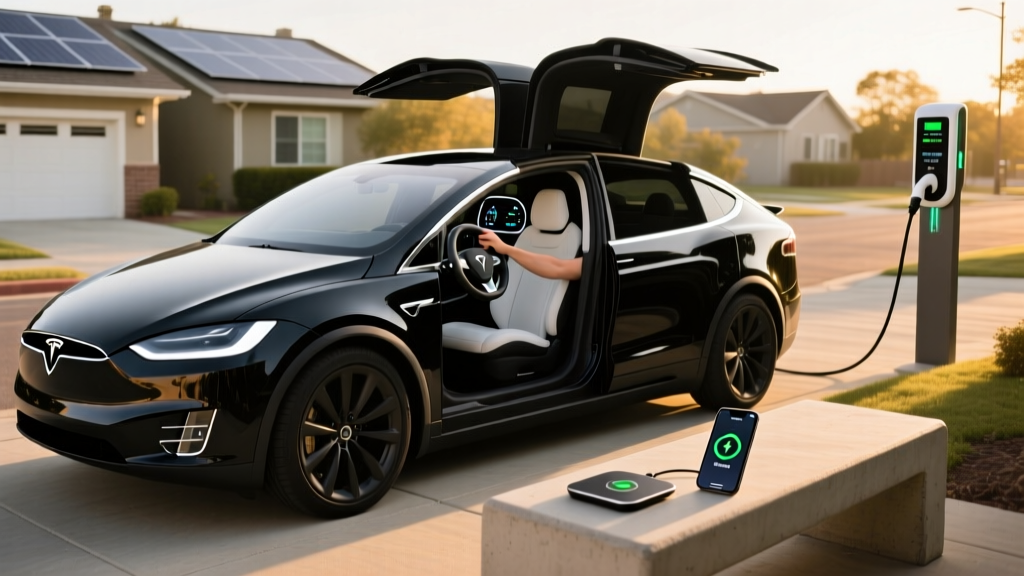
The 2016 Tesla Model X 75D occupies a specific niche in the used EV market: a three-row, all-wheel-drive electric SUV with falcon-wing doors, access to the Supercharger network, and a price that has depreciated into the $18,000–$26,000 range. For families who need six or seven seats and can charge at home, it remains compelling. But a decade-old luxury EV with complex mechanicals demands careful scrutiny — especially around battery health, drive unit condition, and the cost of out-of-warranty repairs.
This review covers everything a prospective used buyer needs: real-world range expectations, charging speeds, battery degradation patterns, ownership economics, and the specific failure points that separate a smart purchase from a money pit.
Range, Battery, and Efficiency
The 2016 Model X 75D was equipped with a 75 kWh (usable) lithium-ion battery pack using Nickel-Manganese-Cobalt (NMC) chemistry. Tesla never published the exact cell-level chemistry breakdown for this vintage, but teardown analysis and service documentation confirm NMC cathodes — the standard for Tesla's long-range packs before the company shifted to LFP for standard-range models years later.
EPA Rated: 238 miles (combined city/highway)
Real-World Highway (70 mph, 72°F): ~200–215 miles
Real-World Cold Weather (30°F, mixed driving): ~155–175 miles
City / Moderate Climate: ~220–235 miles (regen braking recovers energy in stop-and-go)
The 75D's dual-motor all-wheel-drive layout and heavy curb weight (~5,052 lbs) work against highway efficiency. The large frontal area and the aerodynamic drag of the falcon-wing door seals add incremental losses. Owners consistently report 2.8–3.2 miles per kWh on the highway and 3.3–3.6 mi/kWh in city driving.
| Attribute | Value |
|---|---|
| Battery Capacity (Usable) | 75 kWh |
| Battery Chemistry | NMC (Nickel-Manganese-Cobalt) |
| EPA Range | 238 miles |
| EPA Efficiency | 92 MPGe (combined) / 36 kWh/100 mi |
| Real-World Highway Range | ~200–215 miles |
| Real-World Cold-Weather Range | ~155–175 miles |
Degradation reality: A 2016 Model X 75D in 2026 is roughly 10 years old. NMC packs from this era typically show 10–18% capacity loss depending on charging habits, climate, and total mileage. A unit with 90,000+ miles and frequent DC fast charging may retain only 82–85% of original capacity (State of Health), translating to roughly 195–200 miles of usable EPA-equivalent range when new — and closer to 165–175 miles real-world today. Always request a battery health reading via the car's service menu or a third-party diagnostic before purchase. Source: fueleconomy.gov EV technology guide.
Charging: DC Fast, Level 2, and Supercharger Access
Charging capability is where the 2016 Model X 75D shows its age relative to modern EVs — but it retains one massive advantage: native Tesla Supercharger network access with no adapter required.
| Charging Level | Power / Rate | Time / Miles Added |
|---|---|---|
| Level 1 (120V, 12A) | ~1.4 kW | ~4–5 miles per hour |
| Level 2 (240V, 48A — Tesla Wall Connector) | ~11.5 kW | ~30–33 miles per hour; 0–100% in ~7.5 hours |
| Level 2 (240V, 40A — Mobile Connector / NEMA 14-50) | ~9.6 kW | ~25–27 miles per hour; 0–100% in ~9 hours |
| DC Fast Charge (Supercharger V2) | Peak ~120 kW | 10–80% in ~35–40 minutes |
| DC Fast Charge (Supercharger V3) | Capped at ~120 kW (vehicle-side limit) | No speed benefit over V2 for this model |
Key charging nuance: The 75 kWh pack cannot accept the full 250 kW that V3 Superchargers deliver. The vehicle's battery management system caps intake at approximately 120 kW. This means charging at a V3 stall provides no time advantage over a V2 stall. The charge curve is relatively flat from 10–50% SoC, then tapers progressively from 60% onward. Expect a 10–80% session to take 35–40 minutes at a V2 Supercharger.
Connector note: The 2016 Model X uses the Tesla proprietary connector (now being standardized as NACS). It cannot natively use CCS1 or CHAdeMO chargers. Tesla includes a J1772 adapter in the glovebox for Level 2 public chargers (ChargePoint, Blink, etc.), but DC fast charging is Supercharger-only unless you source a third-party CCS-to-NACS adapter — which is expensive and not officially supported by Tesla for older vehicles.
Performance and Drivetrain
The "D" in 75D stands for Dual Motor. The 2016 Model X 75D pairs a front AC induction motor with a rear AC induction motor for permanent all-wheel drive. Combined output is approximately 328 horsepower (245 kW).
| Attribute | Value |
|---|---|
| Drivetrain | Dual Motor AWD |
| Horsepower (combined) | ~328 hp |
| 0–60 mph | 6.0 seconds (EPA/Tesla published) |
| Top Speed | 130 mph (electronically limited) |
| Curb Weight | ~5,052 lbs |
| Towing Capacity | 5,000 lbs (with tow package) |
The 6.0-second 0–60 time is unremarkable by 2026 EV standards (the current Model X Plaid does it in 2.5 seconds), but it remains brisk for a three-row SUV of this size. The instant torque delivery makes highway merging and passing effortless. Regenerative braking is strong enough for one-pedal driving in most conditions, though the 2016 software does not offer the adjustable regen levels found in newer Teslas or competing EVs.
Interior, Cargo, and Technology
The 2016 Model X was offered in five-, six-, and seven-seat configurations. The six-seat layout with second-row captain's chairs is the most common and provides the best access to the third row.
| Attribute | Value |
|---|---|
| Seating | 5, 6, or 7 passengers |
| Front Legroom | 41.2 inches |
| Second-Row Legroom | 36.9 inches |
| Third-Row Legroom | 32.7 inches |
| Cargo (behind 3rd row) | 21.8 cu ft |
| Cargo (3rd row folded) | 56.8 cu ft |
| Cargo (all rear rows folded) | 81.4 cu ft |
| Front Trunk (Frunk) | 6.6 cu ft |
Technology highlights: The 17-inch portrait touchscreen was class-leading in 2016 and remains functional. Navigation, media, climate controls, and vehicle settings all route through this screen. Over-the-air software updates have kept the infotainment system reasonably current, though the hardware (MCU1 — Media Control Unit version 1) is slow by modern standards and was subject to a recall for eMMC memory failure. Tesla replaced many under warranty, but verify whether the MCU has been upgraded to MCU2 (Intel Atom-based) or the newer MCU3/Ryzen-based unit.
Driver assistance: The 2016 Model X shipped with Autopilot hardware suite HW1 or HW2 (depending on build date). HW2 vehicles received enhanced Autopilot and limited FSD (Supervised) capability via software updates. This is SAE Level 2 driver assistance — the driver must keep hands on the wheel and eyes on the road at all times. It is not self-driving.
The 2016 Model X's Autopilot is a Level 2 driver-assist system. It can maintain lane position, adapt cruise speed, and navigate highway interchanges under supervision. It cannot handle construction zones, unmapped roads, or adverse weather autonomously. The driver is legally and physically responsible for the vehicle at all times. Do not purchase this vehicle expecting autonomous capability.
Notable drawbacks:
- Falcon-wing doors: Complex mechanisms with multiple sensors, actuators, and seals. Prone to rattles, alignment issues, and water leaks. Repair costs are high.
- MCU1 eMMC failure: Early Media Control Units experienced flash memory wear, causing blank screens. Confirm replacement history.
- Wind noise: Frameless windows and falcon-wing door seals generate noticeable cabin noise above 65 mph.
- Third-row usability: Best suited for children; adults will find legroom tight on longer trips.
Pricing, Tax Credits, and Ownership Economics
The 2016 Model X 75D originally carried a base MSRP of approximately $82,500 (before the $7,500 federal credit available at that time). In the 2026 used market, prices have dropped substantially.
| Category | Amount |
|---|---|
| Original Base MSRP (2016) | ~$82,500 |
| Typical Used Price (2026, 80k–110k mi) | $18,000–$26,000 |
| Federal Used EV Tax Credit (§25E) | Up to $4,000 (30% of sale price, max $4,000) |
| Effective Price After Credit | ~$14,000–$22,000 |
Critical tax credit detail: The original §30D new-vehicle credit no longer applies to a 2016 model. However, the §25E Previously-Owned Clean Vehicle Credit may apply. This credit provides 30% of the sale price, up to a maximum of $4,000, for used EVs purchased from a licensed dealer. Eligibility requirements include:
- Sale price must be $25,000 or less
- Buyer income caps: $75,000 (single), $112,500 (head of household), $150,000 (joint filers) — based on modified AGI
- Vehicle must be at least 2 model years old (2016 qualifies)
- Must purchase from a licensed dealer (private-party sales do not qualify)
- Credit can be transferred to the dealer at point of sale as a price reduction
- Buyer can only claim the used-EV credit once every 3 years
Always verify current rules at IRS.gov §25E guidance before purchasing. Tax eligibility depends on your specific income, filing status, and purchase structure.
Ownership cost reality: The purchase price is only the entry fee. Budget for:
- Insurance: $1,800–$2,800/year (varies by state, driving record, coverage level)
- Home charging electricity: ~$600–$900/year at $0.14/kWh national average (12,000 miles/year)
- Tires: $1,200–$1,800 per set of four; the Model X's weight wears tires faster than lighter EVs. Expect 25,000–35,000 miles per set.
- Out-of-warranty repairs: Drive unit replacement: $4,000–$7,000. Battery replacement: $12,000–$18,000. Falcon-wing door actuator: $1,500–$3,000 per door.
Warranty Status in 2026
The original Tesla battery and drive unit warranty for the 2016 Model X 75D was 8 years / 150,000 miles (whichever comes first), with a capacity retention threshold of 70%. This means that as of 2024, the 8-year time limit has expired on all 2016 units. The mileage limit may still apply if the vehicle has fewer than 150,000 miles — but given the age, most 2016 Model X vehicles are now fully out of factory warranty.
| Coverage | Original Term | Status in 2026 |
|---|---|---|
| Battery (capacity ≥70%) | 8 yr / 150,000 mi | Expired (time limit reached 2024) |
| Drive Unit(s) | 8 yr / 150,000 mi | Expired (time limit reached 2024) |
| Basic Vehicle | 4 yr / 50,000 mi | Expired |
This is the single biggest financial risk of purchasing a 2016 Model X. A battery or drive unit failure is a five-figure repair. Before buying, invest in a pre-purchase inspection at a Tesla Service Center or qualified independent EV shop. Request the battery's State of Health (SoH) percentage and check for any open recalls or service campaigns.
2016 Model X 75D vs. Key Competitors
| Vehicle | EPA Range | Battery | Seats | Used Price Range | DC Fast Charge |
|---|---|---|---|---|---|
| 2016 Tesla Model X 75D | 238 mi | 75 kWh NMC | 5–7 | $18k–$26k | ~120 kW peak |
| 2017–2018 Tesla Model S 75D | 259 mi | 75 kWh NMC | 5 | $16k–$24k | ~120 kW peak |
| 2018 Jaguar I-PACE EV320 | 234 mi | 90 kWh NMC | 5 | $18k–$25k | ~100 kW peak |
| 2019 Audi e-tron (55) | 204 mi | 95 kWh NMC | 5 | $20k–$28k | ~150 kW peak |
The Model X 75D's primary advantage over these competitors is three-row seating and Supercharger access. The I-PACE and e-tron offer better build quality and more conventional styling, but seat only five and lack access to Tesla's charging network (though CCS fast-charging infrastructure has expanded significantly by 2026). The Model S 75D is mechanically similar but offers no third row and a lower ride height.
- You need three rows of seating and cannot afford a newer Model X or Rivian R1S
- You rely on Tesla's Supercharger network for road trips
- You can charge at home (Level 2) and your daily commute is under 150 miles round-trip
- You have a financial buffer for potential out-of-warranty repairs ($5,000–$10,000 reserve recommended)
- You need reliable DC fast charging on non-Tesla networks (CCS infrastructure is now robust)
- You want a warranty — consider a certified pre-owned 2021+ Model Y or a newer Hyundai Ioniq 5
- You drive in extreme cold regularly (range drops significantly without a heat pump, which the 2016 Model X lacks)
Pros and Cons
- Three-row seating (6 or 7 passengers) — rare in used EVs at this price
- Native Tesla Supercharger access — the most reliable DC fast-charging network
- Over-the-air updates keep software reasonably current
- Strong regenerative braking enables one-pedal driving
- 5,000-lb towing capacity with tow package
- Falcon-wing doors provide dramatic second-row access in tight parking
- Eligible for up to $4,000 used-EV tax credit (§25E) if purchased under $25k from a dealer
- Fully out of factory warranty — major repair risk is on the buyer
- Falcon-wing doors are a known reliability liability (seals, actuators, sensors)
- MCU1 hardware is slow and was subject to eMMC failure recall
- DC fast charging capped at ~120 kW — slow by 2026 standards
- No heat pump — cold-weather range loss is significant (30–35% at 30°F)
- High tire wear due to vehicle weight (~5,052 lbs)
- Wind noise and panel fit quality lag behind German competitors
- Autopilot HW1/HW2 is outdated compared to current HW4/AI systems
Frequently Asked Questions
What is the real-world range of the 2016 Tesla Model X 75D?
The EPA rated the 2016 Model X 75D at 238 miles combined. In real-world highway driving at 70 mph and moderate temperatures, expect 200–215 miles. In cold weather (below freezing), range drops to approximately 155–175 miles due to battery resistance and cabin heating demands. A 10-year-old pack with degradation may reduce these figures by an additional 10–15%.
How fast does the 2016 Model X 75D charge?
On a Tesla V2 Supercharger, the 75D peaks at approximately 120 kW and charges from 10–80% in about 35–40 minutes. On a V3 Supercharger (250 kW capable), the vehicle still caps at ~120 kW, so there is no speed advantage. At home on a 48-amp Level 2 Tesla Wall Connector (240V), the car charges at ~11.5 kW, adding roughly 30–33 miles of range per hour — a full charge takes about 7.5 hours.
Does the 2016 Model X 75D qualify for any federal tax credit?
The new-vehicle §30D credit no longer applies. However, the §25E Previously-Owned Clean Vehicle Credit may provide up to $4,000 (30% of sale price) if you buy from a licensed dealer for $25,000 or less and your income falls within IRS limits ($75k single / $150k joint). Verify details at IRS.gov before purchasing.
Is the 2016 Model X 75D worth buying in 2026?
It depends on your priorities. If you need a three-row electric SUV on a tight budget and can absorb potential repair costs, the 75D offers strong value — especially with the $4,000 used-EV credit bringing effective prices as low as $14,000–$22,000. However, the expired warranty, aging MCU1 hardware, falcon-wing door complexity, and 120 kW charging cap are real drawbacks. Buyers who want warranty coverage and faster charging should consider a newer Model Y, Hyundai Ioniq 5, or Kia EV6, even if they sacrifice the third row.
What should I check before buying a used 2016 Model X 75D?
Request a pre-purchase inspection from a Tesla Service Center. Specifically verify: (1) Battery State of Health percentage — anything below 80% is a negotiation point or walk-away. (2) Whether the MCU has been upgraded from MCU1 to MCU2 or MCU3. (3) Falcon-wing door operation — open and close every door 10 times and check for misalignment, rattles, or error messages. (4) Drive unit condition — listen for whining, clunking, or vibration under acceleration. (5) Open recall status, particularly for the eMMC and seatbelt tensioner campaigns. (6) Service history and maintenance records.
Can the 2016 Model X 75D use non-Tesla chargers?
For Level 2 (AC) charging, yes — Tesla includes a J1772 adapter, so you can use ChargePoint, Blink, and other public Level 2 stations. For DC fast charging, the 2016 Model X is limited to Tesla Superchargers. Third-party CCS-to-NACS adapters exist but are costly ($300–$500) and not officially supported by Tesla for pre-2021 vehicles. By 2026, many Supercharger stalls have been fitted with "Magic Dock" CCS connectors for non-Tesla EVs, but this does not help older Teslas charge on CCS networks.