Quick Verdict: A Flagship That Still Flexes — But at a Cost
The 2016 Tesla Model S P100D was the halo sedan of its era: a 315-mile EPA range, a Ludicrous-mode 0-60 time of 2.5 seconds, and a 100 kWh battery that dwarfed everything else on the road. In 2026, it remains one of the most compelling used EVs on the market — but it's also a high-maintenance, high-mileage luxury sedan that demands careful vetting before purchase. If you're shopping the used market, this profile gives you the exact numbers, charging realities, and ownership math you need to decide whether a P100D is a steal or a money pit.
| Spec | Value |
|---|---|
| EPA Range (19" wheels) | 315 miles |
| EPA Range (21" wheels) | 294 miles |
| Battery Capacity | 100 kWh (usable ~98 kWh) |
| Battery Chemistry | NMC (Nickel Manganese Cobalt) |
| Drivetrain | Dual-Motor AWD |
| 0-60 mph (Ludicrous) | 2.5 seconds |
| Peak Horsepower | ~762 hp (combined motors) |
| Max DC Fast Charge | ~120 kW (Supercharger V2) |
| 10-80% DC Charge Time | ~55-65 minutes |
| Level 2 Charge Rate | ~17 kW (Dual Charger option) / ~11.5 kW (single) |
| MPGe (combined) | 98 MPGe |
| Energy Consumption | 35 kWh/100 mi |
| Cargo Volume | 26.3 cu ft (rear) + 5.3 cu ft (frunk) |
| Battery Warranty (original) | 8 years / unlimited miles |
| Original Base MSRP | ~$134,500 (before incentives) |
| Used Price Range (2026) | $28,000 – $42,000 |
Real-World Range: What 315 EPA Miles Actually Means
EPA Sticker: 315 miles (19" wheels) | Real-World Highway (70 mph): ~250-270 miles | Cold Weather (below 32°F): ~200-230 miles
The P100D's 100 kWh NMC battery pack was the largest Tesla offered in the Model S lineup. On paper, 315 miles of EPA range still holds up well in 2026 — it beats many new EVs costing twice as much. But the real-world picture is more nuanced.
On highway road trips at 70-75 mph, expect to see between 250 and 270 miles of usable range in mild weather (60-80°F). The Model S's large frontal area and weight (~4,900 lbs) work against efficiency at speed. In city driving with heavy regenerative braking, you can approach or slightly exceed the EPA figure thanks to the NMC pack's strong low-speed efficiency.
Cold weather is the P100D's Achilles heel. Without a heat pump (Tesla didn't introduce one in the Model S until the 2021 refresh), the sedan relies on resistive cabin heating, which can consume 3-5 kW continuously. Combined with reduced battery chemical efficiency below freezing, plan for 200-230 miles of range in sub-32°F conditions. Preconditioning the battery while plugged in helps, but the 2016 model year lacks the sophisticated thermal management of newer EVs.
For context on EPA methodology, see the 2016 Model S data on fueleconomy.gov.
Charging Speeds: Supercharger V2 Era — Functional but Slow by 2026 Standards
| Charging Level | Power (kW) | Rate (mi/hr) | Notes |
|---|---|---|---|
| Level 1 (120V) | ~1.4 kW | ~4 mi/hr | Emergency/trickle only |
| Level 2 (240V, 48A) | ~11.5 kW | ~33 mi/hr | Standard onboard charger |
| Level 2 (240V, Dual Charger) | ~17 kW | ~50 mi/hr | Optional dual-charger upgrade |
| DC Fast (Supercharger V2) | ~120 kW peak | ~300 mi/hr (peak) | Tapers heavily above 60% SoC |
| DC Fast (CHAdeMO adapter) | ~50 kW | ~140 mi/hr | Via Tesla CHAdeMO adapter |
Charging is where the P100D shows its age most clearly. The 2016 Model S predates Tesla's V3 Superchargers (250 kW) and the 4680-cell architecture. On a V2 Supercharger, the P100D peaks around 120 kW but only briefly — typically between 10-30% State of Charge. By 50% SoC, power drops to roughly 80 kW, and above 80% it falls below 30 kW as the battery management system protects the NMC cells.
A realistic 10-80% charge on a V2 Supercharger takes 55-65 minutes. On V3 Superchargers, the P100D is hardware-limited and won't exceed its ~120 kW ceiling, so you'll see similar times. This is roughly double the 10-80% time of a 2025 Hyundai Ioniq 5 or Tesla Model 3 Long Range on a V3 stall.
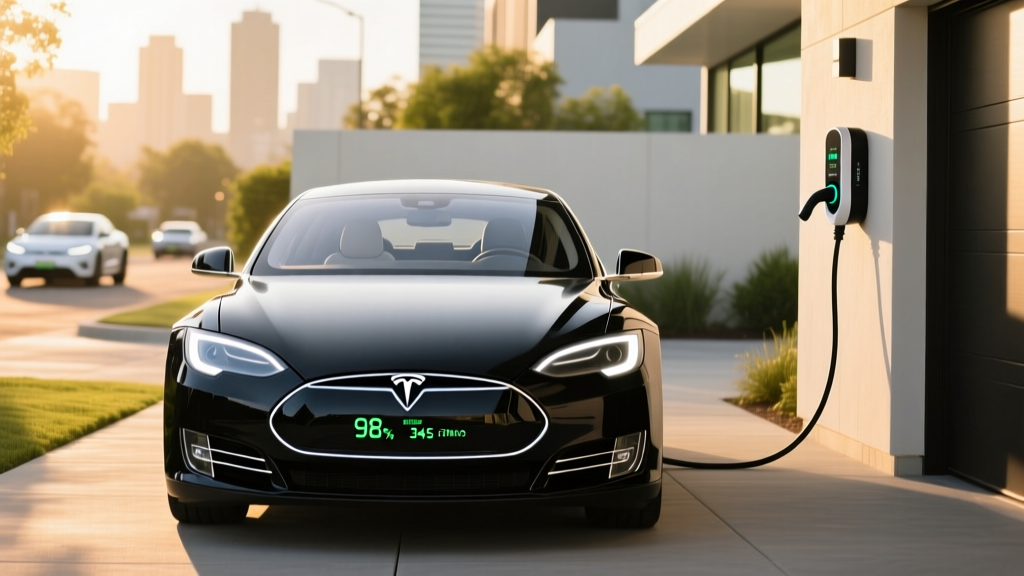
At home, the P100D benefits from a relatively generous onboard charger. With the standard single charger (11.5 kW / 48A), a full 0-100% charge takes about 9 hours on a 60A circuit. If the car has the optional Dual Charger (17 kW / 72A), that drops to roughly 6 hours — a meaningful advantage for high-mileage commuters. A full Level 2 home charger installation typically costs $800-$2,000 depending on panel capacity and run length.
The P100D uses Tesla's proprietary connector (now branded NACS). In 2026, NACS has become the dominant North American standard, so the P100D charges natively at all Superchargers and at most third-party networks via their NACS-equipped stations — no adapter needed for the majority of public chargers.
Performance & Driving Dynamics: Supercar Speed in a Luxury Sedan
Nothing about the P100D is subtle. With dual motors producing a combined ~762 hp and Ludicrous mode engaged, the 0-60 mph sprint takes just 2.5 seconds — a figure that embarrassed six-figure supercars in 2016 and still turns heads in 2026. The instant torque delivery is seamless, and the all-wheel-drive system provides confident traction in rain and light snow.
The air suspension (standard on P100D trims) offers adjustable ride height and decent compliance, though it's a known maintenance item — air struts typically need replacement between 80,000 and 120,000 miles at $1,500-$2,500 per corner. The steering is precise but light, and at 4,900 lbs, the P100D feels its mass through corners. This is a grand tourer, not a sports sedan, despite the acceleration.
Regenerative braking in the P100D is strong enough for near-one-pedal driving in most conditions, though it lacks the full one-pedal stop-and-hold feature Tesla added in later model years. Expect to use the friction brakes occasionally to come to a complete stop.
Interior, Tech & Driver Assistance
The 2016 Model S interior is a mixed bag by 2026 standards. The 17-inch center touchscreen was revolutionary at launch and remains functional, but the hardware (MCU1/Nvidia Tegra) feels sluggish compared to modern infotainment. Many P100D examples have been upgraded to MCU2 (Intel Atom) through Tesla's retrofit program (~$1,500-$2,000), which adds faster response, updated maps, and streaming media support. Verify whether a used example has this upgrade before purchasing.
Seating is comfortable for four adults, with 42.7 inches of front legroom and 35.4 inches of rear legroom. The rear middle seat is tight for adults on longer trips. Cargo capacity is generous: 26.3 cu ft in the rear hatch area and 5.3 cu ft in the front trunk (frunk), totaling 31.6 cu ft — more than most midsize luxury sedans.
On the driver-assistance front, the 2016 P100D shipped with Hardware 1 (HW1) Autopilot, which provides basic adaptive cruise control and lane-keeping. This is an SAE Level 2 system — it requires full driver attention and hands-on-wheel supervision at all times. It is not self-driving. Later in the 2016 model year, Tesla transitioned to HW2 (and eventually HW2.5 via retrofit), which supports Enhanced Autopilot features including auto lane change and Navigate on Autopilot. Confirm the hardware version on any used example.
ADAS Limitation Warning: The 2016 Model S Autopilot (HW1 or HW2) is an SAE Level 2 driver-assistance system. The driver must remain fully engaged, hands on the wheel, and eyes on the road at all times. It does not handle construction zones, unmapped roads, or adverse weather reliably. Full Self-Driving (FSD) capability was not available on HW1 vehicles and is limited on HW2 compared to HW3/HW4 systems in newer Teslas.
Pricing, Used Market Value & Tax Credit Eligibility
| Item | Amount |
|---|---|
| Original MSRP (2016) | ~$134,500 |
| Typical Used Price (2026, 60k-90k mi) | $28,000 – $42,000 |
| Federal Used EV Tax Credit (§25E) | Up to $4,000 (if eligible) |
| Estimated Net Cost (after credit) | $24,000 – $38,000 |
The P100D's depreciation has been steep — a $134,500 flagship now trades for $28,000-$42,000 depending on mileage, condition, battery health, and MCU upgrade status. This makes it one of the most performance-per-dollar EVs on the used market.
Tax credit note: The P100D does not qualify for the new-vehicle §30D federal tax credit (it's a used vehicle, and the original credit has long since been claimed or expired for Tesla). However, it may qualify for the §25E Used Clean Vehicle Credit, which provides up to $4,000 (30% of the sale price, capped at $4,000) for used EVs purchased from a dealer for $25,000 or less. Given that many P100D examples sell above $25,000, credit eligibility depends heavily on finding a qualifying example. Income caps also apply: modified AGI must not exceed $75,000 (single) / $150,000 (joint). Always verify current IRS §25E rules before relying on this credit.
Battery Health, Warranty & Long-Term Ownership Costs
The P100D's 100 kWh NMC pack was covered by Tesla's original 8-year/unlimited-mile battery warranty, which guaranteed at least 70% capacity retention. For a 2016 model year, this warranty expired in 2024. In 2026, any P100D you buy is out of factory battery warranty unless the owner purchased an extended coverage plan.
NMC battery degradation in the Model S typically follows this pattern: roughly 8-10% loss in the first 30,000 miles, then a slower linear decline of about 1-2% per year. Data from Tesla owner communities and third-party battery analytics suggest that a 2016 P100D with 80,000-100,000 miles may retain 82-88% of original capacity — translating to roughly 260-280 miles of real-world range (from the 315 EPA baseline).
Battery replacement is the P100D's biggest financial risk. A remanufactured 100 kWh pack from Tesla costs approximately $15,000-$22,000 including labor as of 2026. Third-party options exist but vary in quality and warranty coverage. Before buying, request a battery health report from Tesla (available through the service center) or use the car's energy screen to estimate State of Health (SoH).
Other common maintenance items on the 2016 Model S:
- Air suspension struts: $1,500-$2,500 per corner; common failure at 80k-120k miles
- Drive unit (motor) replacement: $4,000-$7,000; front and rear units can fail independently
- MCU1 to MCU2 upgrade: ~$1,500-$2,000 (recommended for modern functionality)
- 12V auxiliary battery: $300-$500 replacement every 3-5 years
- Touchscreen delamination (MCU1): "bubble" issue; covered under a service bulletin but may not be honored on older vehicles
Insurance premiums for the P100D remain elevated — expect $2,500-$4,000 per year depending on your profile, reflecting the vehicle's original luxury pricing and repair costs.
Pros & Cons at a Glance
Pros
- Supercar-level 2.5s 0-60 mph acceleration
- 315-mile EPA range still competitive in 2026
- Generous cargo space (31.6 cu ft total) with hatchback practicality
- NACS connector = native Supercharger access, no adapter needed
- Massive depreciation = high performance-per-dollar on used market
- Over-the-air updates still supported (HW2+ vehicles)
- Air suspension with adjustable ride height
Cons
- DC fast charging limited to ~120 kW (slow by 2026 standards)
- Battery warranty expired (8-yr/2024 for 2016 model year)
- Expensive out-of-warranty repairs (battery, air suspension, drive units)
- No heat pump — significant cold-weather range loss
- MCU1 infotainment hardware is outdated (unless upgraded)
- HW1 Autopilot vehicles cannot run FSD; limited ADAS capability
- High insurance premiums relative to current market value
- §25E used EV credit only applies if purchased at $25,000 or less
Who Should Buy the 2016 Model S P100D?
Choose the P100D if:
- You want supercar acceleration and luxury sedan comfort for under $40,000
- You have reliable home Level 2 charging and primarily commute or take moderate road trips (under 250 miles between stops)
- You're mechanically savvy or have a trusted independent EV shop for out-of-warranty repairs
- You value NACS/Supercharger network access without adapter hassle
Look elsewhere if:
- You need fast DC charging for frequent long-distance travel (300+ mile trips regularly)
- You live in a cold climate and need reliable winter range without a heat pump
- You want a worry-free warranty — consider a newer EV or certified pre-owned model
- Your budget can't absorb a potential $15,000-$22,000 battery replacement
Frequently Asked Questions
What is the real-world range of the 2016 Tesla Model S P100D?
The EPA rates the P100D at 315 miles (19" wheels). In real-world highway driving at 70 mph, expect 250-270 miles in mild weather and 200-230 miles in freezing temperatures. Actual range depends heavily on driving style, temperature, and battery health.
How fast does the P100D charge?
On DC fast charging (Supercharger V2), the P100D peaks at ~120 kW but sustains that rate only briefly. A 10-80% charge takes approximately 55-65 minutes. At home on Level 2, expect ~33 miles of range per hour (single charger) or ~50 miles per hour (dual charger option).
Does the 2016 Model S P100D qualify for any federal tax credit?
Not the new-vehicle §30D credit. It may qualify for the §25E Used Clean Vehicle Credit (up to $4,000) if purchased from a dealer for $25,000 or less, subject to buyer income caps ($75k single / $150k joint). Check current IRS rules before relying on this credit.
Is the P100D worth buying versus a newer, cheaper EV?
It depends on priorities. The P100D offers unmatched acceleration and range for its used price, but carries significant out-of-warranty repair risk. A newer Chevrolet Bolt EUV or base Tesla Model 3 will cost similarly, charge faster, and carry a warranty — but can't match the P100D's performance or luxury presence.
How long will the P100D battery last?
NMC packs in the Model S typically retain 82-88% capacity at 80,000-100,000 miles based on owner data. At that degradation level, you'd see roughly 260-280 real-world miles. Full battery replacement costs $15,000-$22,000 if needed. Request a battery health report before purchasing.
Can the P100D use non-Tesla chargers?
Yes, but with caveats. The P100D uses the NACS connector natively. For CCS stations, Tesla offers a CCS adapter (~$250), though the P100D's ~120 kW peak charge rate limits the benefit. CHAdeMO stations require Tesla's CHAdeMO adapter and are limited to ~50 kW.