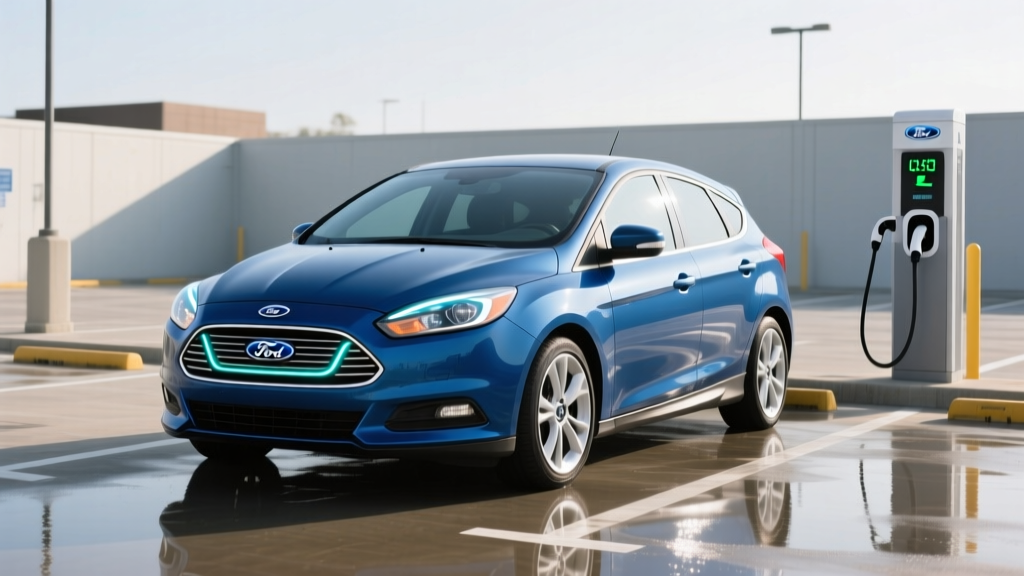
If you're researching the 2016 Ford Focus Electric hatchback as a used EV purchase in 2026, here's what you need to know immediately: this is a discontinued, compliance-era electric car with a 76-mile EPA range, a 33.5 kWh liquid-cooled battery, and CHAdeMO DC fast charging (peak ~50 kW). It's best suited as a low-cost daily commuter for drivers with home Level 2 charging and predictable sub-60-mile round trips. Expect to pay $6,000–$10,000 on the used market depending on mileage and battery health.
Quick Verdict: Is the 2016 Focus Electric Worth Buying?
Yes, if: you need an ultra-affordable second car for short commutes, have Level 2 home charging, and live in a mild climate.
No, if: you need highway range, rely on public charging, live in extreme cold, or want modern ADAS features.
Range, Battery, and Real-World Efficiency
The 2016 Focus Electric uses a 33.5 kWh lithium-ion battery (liquid-cooled, NMC chemistry) with approximately 29–30 kWh usable. The EPA rated it at 76 miles of range and 105 MPGe combined (107 city / 103 highway). For context, that's roughly 30 kWh/100 miles in energy consumption — respectable for its era but far behind modern EVs like the Chevrolet Bolt (120 MPGe) or Hyundai Ioniq 5 (114 MPGe combined on Long Range trims).
Real-World Range Expectations
EPA sticker: 76 miles
Typical real-world (mild weather, mixed driving): 65–75 miles
Highway-heavy (70+ mph): 55–65 miles
Cold weather (below 32°F): 45–55 miles (30–40% loss without preconditioning)
The liquid-cooled battery is a genuine advantage over the air-cooled Nissan Leaf of the same vintage, which suffered more severe degradation in hot climates. However, eight-year-old NMC packs will have some capacity loss. Request a State of Health (SoH) reading before purchase — expect 80–90% retention on a well-maintained example. Anything below 80% means you're working with 60 miles or less of real range.
Charging Speed and Infrastructure Compatibility
| Level | Power (kW) | Time (0–100%) | Miles Added/Hour |
|---|---|---|---|
| Level 1 (120V) | ~1.4 kW | ~24 hours | ~3–4 mi/hr |
| Level 2 (240V, 32A) | 6.6 kW | ~5 hours | ~18–20 mi/hr |
| DC Fast (CHAdeMO) | ~50 kW peak | 10–80% in ~35 min | ~90–100 mi/hr (peak) |
The 2016 Focus Electric charges via CHAdeMO for DC fast charging and J1772 for Level 1/2. This is critical context for 2026 buyers: the North American Charging Standard (NACS) has largely won the connector war, and CHAdeMO infrastructure is shrinking. Electrify America and many networks still support CHAdeMO at some stations, but new installations overwhelmingly favor NACS and CCS1. If you plan to rely on public DC fast charging, check your local network coverage carefully via apps like PlugShare or ChargePoint.
At home, the onboard 6.6 kW charger is adequate for overnight replenishment. A full Level 2 install (240V, 40A circuit) typically costs $800–$2,000 depending on panel capacity and run length. For a car with 76 miles of range, home charging is essentially mandatory — public-only ownership will be frustrating and expensive.
Cost Breakdown: Purchase, Charging, and Ownership
| Cost Category | 2016 Focus Electric | 2016 Focus Gas (SE) |
|---|---|---|
| Used Purchase Price (2026) | $6,000–$10,000 | $7,000–$11,000 |
| Fuel/Energy Cost (15,000 mi/yr) | $450–$650 (at $0.13/kWh) | $1,650–$1,950 (at $3.30/gal, 30 MPG) |
| Annual Maintenance | $300–$500 | $700–$1,100 |
| Insurance (avg) | $1,100–$1,400/yr | $1,000–$1,300/yr |
| 5-Year Total (excl. purchase) | $9,250–$12,750 | $16,750–$21,750 |
The Focus Electric's ownership economics are compelling if you drive it regularly. Annual energy savings of $1,000–$1,300 versus the gas Focus are realistic with home charging at national-average electricity rates. Maintenance savings come from no oil changes, no transmission fluid, and regenerative braking extending pad life. However, insurance can run 5–10% higher due to specialized repair requirements, and you'll want to budget for eventual battery diagnostics or replacement ($5,000–$8,000 if needed, though many packs last 150,000+ miles).
Federal tax credit note: The §30D new EV credit is irrelevant here, but the used EV credit (§25E) offers up to $4,000 or 30% of sale price (whichever is lower) for qualified purchases from dealers. Income caps apply ($75K single / $150K joint), and the vehicle must be at least two model years old with a sale price under $25,000. Verify current rules at IRS.gov.
Performance, Driving Dynamics, and Practicality
The 2016 Focus Electric produces 143 horsepower and 184 lb-ft of torque from its front-mounted AC synchronous motor. The 0–60 mph time is approximately 9.5 seconds — adequate for city merging but not quick by modern EV standards (a 2026 Tesla Model 3 RWD does it in 5.8 seconds). Top speed is electronically limited to 84 mph.
Driving dynamics are a pleasant surprise: the Focus chassis is well-regarded, and the electric powertrain's instant torque makes it feel peppier than the numbers suggest around town. Regenerative braking is moderate — not true one-pedal driving like a Bolt or Tesla, but enough to reduce brake wear significantly.
Practicality is the Focus Electric's weak point. Cargo space is 14.5 cubic feet behind the rear seats (versus 23.3 cu ft in the gas Focus) because the battery pack intrudes into the cargo area. The rear seat is tight for adults on longer trips. If you need a family hauler, this isn't it.
EV vs Gas: Which 2016 Focus Makes Sense?
| Factor | Focus Electric | Focus Gas (2.0L, Auto) |
|---|---|---|
| EPA Range / Tank Range | 76 miles | ~380 miles (12.4 gal × 30 MPG) |
| Efficiency | 105 MPGe / 30 kWh/100mi | 30 MPG combined |
| Refuel/Recharge Time | 5 hrs (L2) / 35 min (DC 10–80%) | 5 minutes |
| Cargo Space | 14.5 cu ft | 23.3 cu ft |
| Annual Fuel Cost | $450–$650 | $1,650–$1,950 |
| Best For | Short commutes, home charging | Road trips, flexible use |
The gas Focus wins on range, cargo, and flexibility. The electric Focus wins on operating cost and driving smoothness — if your use case fits within its constraints.
Common Misconceptions About the Focus Electric
| Myth | Fact |
|---|---|
| "76 miles is unusable." | U.S. average daily driving is ~37 miles (FHWA data). Most commutes fit easily with home charging. |
| "The battery will need replacement soon." | Liquid-cooled NMC packs from this era commonly retain 80%+ SoH at 100K miles. Ford's original warranty was 8 years/100,000 miles (may still apply on low-mile examples). |
| "CHAdeMO is completely dead." | It's declining but still functional at many Electrify America and EVgo stations. Adapters exist but are expensive ($300–$500). |
| "It qualifies for the $7,500 federal credit." | No — §30D applies only to new EVs. The used §25E credit (up to $4,000) may apply if bought from a dealer and you meet income caps. |
Decision Framework: Should You Buy It?
Buy the 2016 Focus Electric IF:
- Your daily round-trip commute is under 60 miles (with margin for weather)
- You have access to Level 2 home charging (garage or driveway)
- You're buying it as a second car for errands and commuting
- You live in a mild climate (limited cold-weather range loss)
- You want to minimize operating costs on a tight budget
Skip It IF:
- You need 200+ miles of range for road trips
- You'll rely primarily on public charging
- You regularly drive in sub-freezing temperatures
- You need cargo space for gear, kids, or pets
- You want modern driver-assist features (this car has basic stability control and ABS, nothing more)
Pre-Purchase Checklist for Used Focus Electric Buyers
- Battery SoH test: Use an OBD-II reader with EV-capable software (e.g., LeafSpy equivalent or dealer diagnostic) to check capacity retention
- Charging port inspection: Look for corrosion, loose pins, or burnt contacts on both J1772 and CHAdeMO inlets
- Coolant system check: The liquid cooling loop should be serviced; verify no leaks or low coolant warnings
- Tire condition: EVs are heavier and wear tires faster; budget $400–$700 for a set if needed
- 12V battery age: Like all EVs, a weak 12V can prevent the car from starting; replace if over 4 years old
- Service history: Confirm cabin air filter, brake fluid, and gearbox fluid (yes, it has a single-speed reduction gear) were maintained
Frequently Asked Questions
What's the real-world range of a 2016 Focus Electric in 2026?
Expect 65–75 miles in mild weather with mixed driving. Highway speeds above 70 mph drop this to 55–65 miles. In freezing temperatures, plan for 45–55 miles unless you can precondition while plugged in.
Can I use Tesla Superchargers with a 2016 Focus Electric?
Not directly. The Focus Electric uses CHAdeMO, and Tesla's Supercharger network uses NACS (formerly proprietary). Third-party CHAdeMO-to-NACS adapters exist but cost $300–$500 and aren't officially supported by Tesla. Rely on Electrify America, EVgo, and ChargePoint for DC fast charging.
Is the 2016 Focus Electric eligible for any tax credits?
Not the §30D new-vehicle credit. However, the §25E used clean vehicle credit may provide up to $4,000 (or 30% of the sale price) if you buy from a licensed dealer, your income is under $75K (single) or $150K (joint), and the sale price is under $25,000. Confirm eligibility at IRS.gov or with a tax professional.
How much does it cost to charge at home?
At the U.S. average residential rate of ~$0.13/kWh, a full charge (30 kWh usable) costs roughly $3.90. That's good for 65–75 real-world miles — about $0.05–$0.06 per mile, versus $0.11–$0.13/mile for a 30 MPG gas car at $3.30/gallon.
What happens if the battery fails?
Replacement costs $5,000–$8,000 for a refurbished or new pack (parts + labor). However, liquid-cooled packs from this era typically last 150,000+ miles before dropping below 70% capacity. Check remaining warranty — Ford's original 8-year/100,000-mile battery warranty may still cover 2016 models through 2024, but you'll need to verify with a dealer.
Is the Focus Electric a good first EV?
It can be, if your lifestyle matches its limitations. The low purchase price and cheap operating costs are excellent for learning EV ownership habits (plugging in nightly, monitoring range, planning around charging). But if you need flexibility for road trips or lack home charging, a longer-range used EV (2017+ Bolt, 2018+ Leaf Plus) or a PHEV may serve you better.
Sources: EPA Fuel Economy Guide – 2016 Ford Focus Electric, IRS Used Clean Vehicle Credit (§25E), manufacturer specifications.