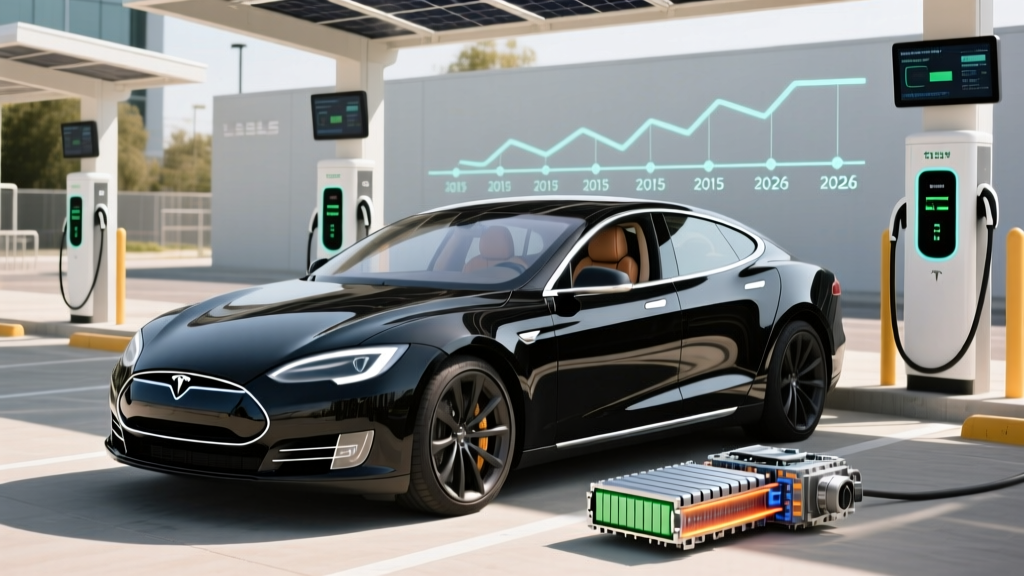
The 2015 Tesla Model S was the car that proved a premium electric sedan could outperform its gasoline rivals while offering practical daily range. More than a decade later, it remains one of the most searched used EVs on the market. For buyers in 2026 considering a pre-owned Model S, the appeal is obvious: depreciation has brought prices well below $20,000 in many cases, the Supercharger network is the most reliable in North America, and the driving dynamics still hold up. But a 2015 EV also carries real risks — battery degradation, outdated hardware, and zero federal tax-credit eligibility on the used side (the §25E used-EV credit applies only to vehicles priced at $25,000 or less sold through a dealer, and many 2015 Model S units hover near that threshold).
This review breaks down every number a used-EV shopper needs: actual range you can expect today, charging speeds on current infrastructure, battery health considerations, and whether a 2015 Model S still makes financial sense against newer, credit-eligible alternatives.
2015 Model S Lineup and Key Specs
Tesla offered the 2015 Model S in several battery and drivetrain configurations. The most common trims you will encounter on the used market are the 60, 70D, 85, and P85D. The mid-year refresh introduced the 70D (dual-motor AWD) and the high-performance P85D with Ludicrous mode. Here is a consolidated spec table based on original EPA data and Tesla's published figures:
| Trim | Battery (kWh, gross) | EPA Range (mi) | Drivetrain | 0-60 mph | Horsepower | MPGe (combined) |
|---|---|---|---|---|---|---|
| 60 (RWD) | 60 | 208 | RWD | 5.5 s | 302 | 95 |
| 70D (AWD) | 70 | 240 | Dual-motor AWD | 5.2 s | 328 | 101 |
| 85 (RWD) | 85 | 265 | RWD | 5.4 s | 362 | 89 |
| P85D (AWD) | 85 | 253 | Dual-motor AWD | 3.2 s (Ludicrous) | 691 | 93 |
All 2015 Model S variants use NMC (nickel-manganese-cobalt) lithium-ion cells in Tesla's original large-format battery pack. LFP chemistry was not introduced into the Model S lineup until much later (and only in the Standard Range RWD variant of the current generation). The 2015 pack was liquid-cooled and actively thermally managed — a significant advantage over passive-cooled competitors of that era, and a key reason many of these packs still function today.
Real-World Range: What to Expect in 2026
Original EPA range for the 85 kWh model was 265 miles. For a 2015 Model S in 2026 with typical 10-15% battery degradation, expect approximately 220–240 miles in mixed driving. Highway-only trips at 70+ mph will yield closer to 195–215 miles. In cold weather (below 32°F), plan for an additional 20-30% reduction, bringing usable range to roughly 155–185 miles for the 85 kWh variant.
Battery degradation is the defining variable for any used EV. Tesla's NMC packs from this era typically lose 8-12% of original capacity in the first 50,000 miles, then degrade more slowly — roughly 1-2% per year thereafter. A 2015 Model S with 100,000 miles and an original 85 kWh pack may show 72-76 kWh of usable capacity today. You can verify this through the car's energy graph screen or third-party tools that read the BMS (battery management system) directly.
According to fueleconomy.gov, the 2015 Model S 85 achieves 89 MPGe combined and consumes approximately 38 kWh per 100 miles. That efficiency figure remains accurate for a healthy pack, though a degraded battery will show slightly higher consumption per mile of actual range because the overhead systems (climate control, battery conditioning) draw from a smaller usable pool.
The 2015 Model S does not feature a heat pump — it uses resistive electric heating. This is a meaningful efficiency penalty in winter compared to newer EVs (including the current Model Y and Model 3) that use heat pumps to reduce cabin-heating energy draw by 30-50%.
Charging Speed: DC Fast, Level 2, and the Supercharger Network
Charging capability is where the 2015 Model S shows its age most clearly. Tesla's Supercharger network has expanded dramatically since 2015, but the car's onboard hardware limits how fast it can accept a charge.
| Charging Level | Max Rate | Typical Speed | Notes |
|---|---|---|---|
| Level 1 (120V household) | ~1.4 kW | ~3–4 mi/hr | Emergency/trickle only |
| Level 2 (240V home) | 10 kW (single charger) 20 kW (twin chargers option) | ~29 mi/hr (single) ~58 mi/hr (twin) | Most homes need a 60A circuit for twin chargers |
| DC Fast (Supercharger V2) | ~120 kW peak | 10–80% in ~40 min | Tapers significantly above 60% SoC |
| DC Fast (Supercharger V3/V4) | Capped at ~120 kW by vehicle | 10–80% in ~40 min | 250 kW stalls offer no speed benefit to 2015 hardware |
The critical detail: the 2015 Model S peaks at approximately 120 kW on DC fast charging, and that peak is sustained for only a short window (roughly 10-30% state of charge). Above 50% SoC, the charge curve tapers sharply — you will see 60-80 kW in the 50-70% range and as low as 20-30 kW approaching 90%. A 10-80% session at a V2 Supercharger takes roughly 40 minutes. At a newer V3 or V4 stall, the car cannot take advantage of the higher amperage, so the time is essentially identical.
For home charging, the 2015 Model S came standard with a single onboard charger rated at 10 kW (40A). Tesla offered a "Dual Charger" option that doubled the onboard capacity to 20 kW (80A), which requires a high-amperage wall connector and a dedicated 100A circuit — an expensive electrical upgrade most homes cannot support without a panel upgrade. Most used 2015 examples on the market have the single 10 kW charger, yielding about 29 miles of range per hour of charging — enough to replenish a full day's driving overnight on a Level 2 home setup.
The 2015 Model S uses Tesla's proprietary connector (now officially designated NACS). This remains an advantage in 2026: the NACS plug is the dominant standard in North America, with Ford, GM, Rivian, and others having adopted it. You will never need an adapter for Superchargers, and the growing number of NACS-compatible third-party chargers means compatibility is not a concern.
Performance, Drivetrain, and Driving Dynamics
Even by 2026 standards, the 2015 Model S P85D with Ludicrous mode is seriously quick. The 3.2-second 0-60 mph time was supercar territory when it launched, and it still surprises passengers today. The standard 85 RWD model hits 60 mph in 5.4 seconds — brisk for a 4,600-pound sedan. All variants deliver instant torque from a standstill with no transmission shift lag, a characteristic that makes the Model S feel quicker in stoplight-to-stoplight driving than the 0-60 numbers suggest.
The dual-motor 70D and P85D models provide genuine all-wheel-drive traction, useful in rain and light snow. However, the 2015 Model S lacks the sophisticated torque-vectoring and traction-control refinements of Tesla's current dual-motor and tri-motor systems. Ground clearance is 5.4 inches — adequate for most conditions but not for unplowed roads.
Ride quality was a common criticism of early Model S vehicles. The 2015 model uses a conventional steel-spring suspension (air suspension was optional). Cars equipped with the optional air suspension offer adjustable ride height and a more compliant ride, but air-spring failures are a known and costly repair item on vehicles of this age — budget $1,500–$2,500 per corner if an air strut fails.
Interior, Cargo, and Technology
The 2015 Model S interior was a polarizing topic at launch and remains one in 2026. The 17-inch center touchscreen was revolutionary for its time and still functions well, though the underlying hardware (MCU1 — Media Control Unit version 1) is noticeably slow by modern standards. The MCU1 uses an NVIDIA Tegra 3 processor that can lag when loading maps, streaming media, or navigating menus. Tesla offered an MCU2 upgrade program (Intel Atom-based) for approximately $2,000-$2,500; many used examples have had this upgrade performed, and it is worth seeking out.
Cargo capacity is a genuine strength. The 2015 Model S offers 26.3 cubic feet behind the rear seats and 58.1 cubic feet with the rear seats folded (60/40 split). The front trunk (frunk) adds approximately 5.3 cubic feet — enough for a carry-on bag or charging cables. Total cargo volume of roughly 63.4 cubic feet exceeds many midsize SUVs, making the Model S surprisingly practical for families and road trips.
Passenger space is generous in front (42.7 inches of legroom) but tighter in the rear (35.4 inches) compared to a current Model S or competing luxury sedans. The rear seat cushion is relatively flat and low, which taller passengers notice on longer trips.
Driver-assistance technology on the 2015 Model S depends on when the car was built. Vehicles produced after October 2014 include Hardware 1 (HW1) Autopilot, which enables basic adaptive cruise control and lane-keeping. This is a SAE Level 2 system — the driver must remain fully engaged and supervising at all times. HW1 does not support Tesla's current Full Self-Driving (Supervised) software, which requires HW3 or later. Do not expect Autosteer to handle complex interchanges, construction zones, or unmapped roads; it is a highway-assist feature, not an autonomous driving system.
Hardware 1 Autopilot provides basic lane-centering and adaptive cruise control on well-marked highways. It is SAE Level 2 driver assistance, not self-driving. It cannot navigate on-ramps, change lanes autonomously, recognize traffic lights, or handle city streets. The driver must keep hands on the wheel and eyes on the road at all times. FSD (Supervised) is not compatible with HW1.
Pricing, Tax Credits, and Total Cost of Ownership
As of early 2026, used 2015 Tesla Model S pricing varies significantly by mileage, condition, battery health, and trim:
- Model S 60 (RWD, 80k–120k miles): $11,000–$15,000
- Model S 70D (AWD, 70k–110k miles): $14,000–$18,000
- Model S 85 (RWD, 60k–100k miles): $15,000–$20,000
- Model S P85D (AWD, 50k–90k miles): $17,000–$24,000
These prices reflect private-party and dealer listings. The key question for buyers is whether a 2015 Model S qualifies for any federal tax incentives.
| Requirement (§25E Used EV Credit) | Rule | 2015 Model S Status |
|---|---|---|
| Sale price cap | ≤ $25,000 | Most examples qualify (under $25k) |
| Model year requirement | At least 2 model years older than current year | Qualifies (2015 vs. 2026) |
| Buyer income cap (AGI) | $75k single / $112.5k HOH / $150k MFJ | Varies by buyer |
| Prior credit history | Vehicle must not have been claimed for §25E after 2022 | Check VIN history |
| Sale channel | Must be through a licensed dealer | Private-party sales do NOT qualify |
| Maximum credit | $4,000 or 30% of sale price, whichever is less | Typically $3,000–$4,000 |
The §25E used-EV credit can provide up to $4,000, but only if you purchase through a licensed dealer (not a private-party sale), your income falls below the caps, and the specific vehicle has not previously been claimed under §25E after December 31, 2022. Per IRS guidelines, the dealer must report the sale to the IRS at the time of purchase. This credit is non-refundable — it can only offset tax liability you already owe.
The §30D new-vehicle credit does not apply to the 2015 Model S, as it is a used purchase. Tesla's new vehicles are subject to current §30D rules including MSRP caps, buyer income limits, and critical-mineral/battery-component sourcing requirements.
Total cost of ownership for a 2015 Model S in 2026 is favorable compared to a comparable-age gasoline luxury sedan. Electricity costs approximately $0.13–$0.16 per kWh nationally (home charging), translating to roughly 4–5 cents per mile. Supercharger pricing averages $0.25–$0.35 per kWh depending on location, or about 8–12 cents per mile. By comparison, a 2015 BMW 5 Series averaging 22 MPG at $3.40/gallon costs roughly 15 cents per mile in fuel alone. Over 12,000 miles annually, the Model S saves approximately $1,200–$1,800 in fuel costs.
Insurance is the offset: the Model S typically costs 20-35% more to insure than a comparable gasoline sedan, adding $400–$800 per year depending on your profile and state. Maintenance is minimal — no oil changes, no transmission fluid, and regenerative braking extends pad life to 80,000+ miles in many cases — but out-of-warranty repairs on a Tesla can be expensive due to proprietary parts and limited third-party service options.
Battery Warranty, Degradation, and Replacement Cost
The 2015 Model S battery and drive unit warranty was 8 years with unlimited miles for the 85 kWh variants, and 8 years/125,000 miles for the 60 and 70 kWh models. In 2026, all 2015 Model S vehicles are beyond their original battery warranty period. This is the single most important financial risk of buying a 2015 Model S today.
If the battery requires replacement out of warranty, Tesla's current pricing for a remanufactured 85 kWh pack ranges from approximately $12,000 to $16,000 including labor. Third-party EV repair shops may offer replacements for $8,000–$12,000 using salvaged or refurbished packs. Before purchasing, request a battery health reading — either from Tesla Service or from the car's own energy screen — and factor the probability of a replacement into your budget over the next 3–5 years.
The drive units (motors) are generally robust, but the front motor on dual-motor variants has been known to require replacement at higher mileages. Budget $3,000–$5,000 for a drive-unit replacement if needed.
- Access to Tesla Supercharger network — the most reliable DC fast-charging infrastructure in North America
- Strong cargo capacity (63+ cu ft) with frunk and fold-flat rear seats
- NACS connector — native compatibility with the dominant charging standard
- Over-the-air software updates still supported (though limited on HW1/MCU1)
- Low operating cost — 4–5 cents/mile on home electricity
- P85D performance remains impressive (3.2s 0-60)
- §25E used-EV credit eligible when purchased through a dealer under $25,000
- Out of battery/drive-unit warranty — replacement cost of $12,000–$16,000
- Peak DC fast charge limited to ~120 kW; 40-minute 10-80% sessions
- MCU1 infotainment hardware is slow; upgrade costs ~$2,000+
- No heat pump — significant cold-weather range loss (20-30%)
- HW1 Autopilot is basic; no FSD compatibility
- Air suspension failures are common and costly ($1,500–$2,500 per corner)
- Rear seat comfort and legroom (35.4 in) lag modern competitors
2015 Model S vs. Alternatives: What Else Should You Consider?
At the $14,000–$22,000 price point, the 2015 Model S competes with several other used EVs and newer models that may suit different buyers better:
- 2018–2020 Tesla Model 3 Long Range (used): $18,000–$25,000. Newer hardware (HW3, MCU2), heat pump (2021+), faster charging (up to 250 kW on V3 Superchargers), and potentially still within battery warranty. Less cargo space and a smaller interior, but a more modern and efficient vehicle overall.
- 2017–2019 Chevrolet Bolt EV (used): $10,000–$15,000. EPA range of 238 miles, practical hatchback shape, and a fraction of the maintenance risk. However, no DC fast charging to speak of (50 kW max, CCS connector) and no Supercharger access.
- 2023–2024 Hyundai Ioniq 5 or Kia EV6 (used): $25,000–$32,000. 800V architecture with 200+ kW charging, modern interiors, and remaining factory warranty. More expensive upfront but far less risk.
- You need maximum cargo space in a sedan form factor
- Supercharger access is a top priority for road trips
- You can budget $5,000–$10,000 for potential battery or suspension repairs
- You find a well-maintained example with documented battery health above 85%
- You want remaining factory battery warranty coverage
- Faster DC charging (150+ kW sustained) is important for your road-trip pattern
- You need modern driver-assistance features beyond basic lane-keeping
- You want a heat pump for cold-climate efficiency
Frequently Asked Questions
What is the real-world range of a 2015 Tesla Model S today?
For the most common 85 kWh variant with typical 10-15% degradation, expect 220–240 miles in mixed driving, 195–215 miles on the highway at 70+ mph, and 155–185 miles in freezing temperatures. The 60 kWh model will deliver roughly 170–185 miles mixed under similar conditions.
How fast does the 2015 Model S charge at home and on road trips?
At home on a Level 2 (240V) charger with the standard single onboard charger, the 2015 Model S adds about 29 miles of range per hour at 10 kW. A full overnight charge (8–10 hours) easily replenishes a day's driving. On DC fast chargers (Superchargers), the car peaks at approximately 120 kW, with a 10-80% session taking about 40 minutes due to significant charge-curve taper above 60% SoC.
Does a used 2015 Model S qualify for any federal tax credit?
It may qualify for the §25E used clean-vehicle credit of up to $4,000, but only if you buy through a licensed dealer (not private party), the sale price is $25,000 or less, your adjusted gross income falls below IRS limits ($75,000 single / $150,000 married filing jointly), and the vehicle has not been previously claimed under §25E after 2022. Check the IRS used vehicle credit page for current rules.
Is the 2015 Model S still worth buying in 2026?
It can be, at the right price and with the right expectations. A well-maintained 85 kWh example with documented battery health above 85%, purchased for under $18,000, offers strong value — especially given Supercharger access and cargo space. The risk is the out-of-warranty battery: a $12,000–$16,000 replacement would total many examples economically. Budget for that possibility and get a pre-purchase battery inspection.
Can I upgrade the Autopilot or infotainment on a 2015 Model S?
The MCU1 infotainment can be upgraded to MCU2 through Tesla Service for approximately $2,000–$2,500, which significantly improves responsiveness. However, the HW1 Autopilot hardware cannot be upgraded to HW3 or HW4, meaning Full Self-Driving (Supervised) is permanently unavailable on 2015 vehicles. You are limited to the basic Autopilot features the car shipped with.
What are the most common problems with the 2015 Model S?
The most frequently reported issues include: air suspension strut failures (if equipped), MCU1 screen delamination or yellowing, door handle mechanisms breaking, 12V auxiliary battery failures (the car uses a standard 12V lead-acid battery for ancillary systems), and drive-unit whine or failure on higher-mileage examples. None of these are catastrophic, but repair costs add up on an out-of-warranty vehicle.