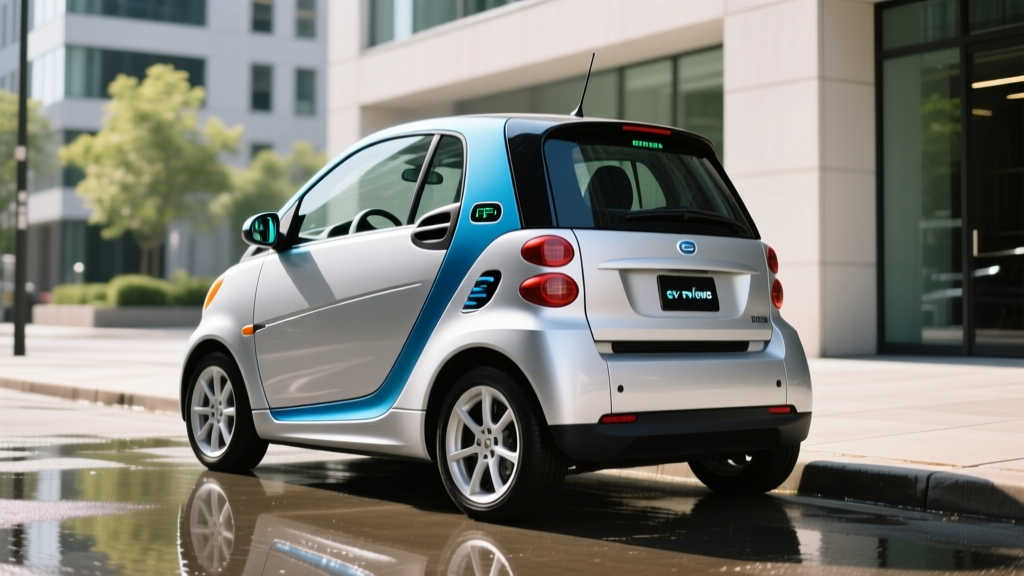
The Quick Verdict on the 2015 Smart Fortwo Passion Electric Drive
The 2015 Smart Fortwo Passion Electric Drive is a discontinued two-seat city microcar with an EPA-rated 68 miles of range from its 17.6 kWh lithium-ion battery. On the used market in 2026, expect to pay between $4,500 and $7,500 depending on mileage and battery health. It qualifies for the federal used-EV tax credit (§25E) — up to $4,000 — which can drop effective cost below $3,000 for eligible buyers. It charges at a maximum of 3.3 kW on Level 2 (no DC fast charging), meaning a full charge takes roughly 6 hours. This car works only as a dedicated urban commuter with reliable home charging. If you need highway range, back seats, or fast-charging capability, look elsewhere.
Range, Battery, and What You'll Actually Get
The 2015 Smart Fortwo ED uses a 17.6 kWh lithium-ion battery pack (NMC chemistry) mounted beneath the floor. The EPA rated it at 68 miles of combined range with an efficiency of 107 MPGe (31 kWh/100 miles), per fueleconomy.gov.
EPA Range vs. Real-World Expectation
EPA sticker: 68 miles combined
Real-world city driving (mild weather): 58–65 miles
Highway driving at 65+ mph: 45–55 miles
Cold weather (below 35°F): 38–50 miles (30–40% loss without a heat pump)
This car lacks a heat pump, relying on resistive cabin heating. In winter climates, range drops sharply. Plan your commute around 40 usable miles in cold months to avoid stranding.
The battery was manufactured by Deutsche Accumotive (a Daimler subsidiary). Smart provided an 8-year/100,000-mile battery warranty on the original purchase — which means for a 2015 model, that warranty has expired or is expiring in 2025–2026 depending on in-service date. Battery replacement on these cars is extremely rare but would cost an estimated $8,000–$12,000 if needed, often exceeding the car's value.
Charging: Speeds, Connectors, and Home Setup
This is where the 2015 Fortwo ED shows its age most clearly. The car has a J1772 connector for AC charging and no DC fast-charging capability whatsoever. Here's what to expect:
| Charging Level | Power (kW) | Connector | Full Charge Time | Miles per Hour of Charging |
|---|---|---|---|---|
| Level 1 (120V household) | ~1.4 kW | J1772 | ~12–13 hours | ~5–6 mi/hr |
| Level 2 (240V home/public) | 3.3 kW (max onboard) | J1772 | ~5.5–6 hours | ~11–12 mi/hr |
| DC Fast Charging | N/A | N/A | Not supported | N/A |
The onboard charger is limited to 3.3 kW, so even if you plug into a 7.2 kW or 11.5 kW Level 2 station, the car will only draw 3.3 kW. This is an important distinction between kW (the rate of power delivery) and kWh (the total energy stored in the 17.6 kWh battery).
Home charging reality: Most owners charge overnight on Level 1 (a standard 120V outlet), which adds roughly 60 miles overnight — sufficient for daily city driving. A Level 2 home installation (240V, 16-amp circuit) costs between $500 and $1,500 depending on your electrical panel's capacity and the run length to your parking spot. If your home has a 100-amp panel already near capacity, a panel upgrade to 200 amps can add $1,500–$3,000.
Public charging is impractical for this car. Without DC fast charging, you'd be tethered to a Level 2 public station for 5+ hours. This vehicle is a home-charge-only proposition for most owners.
Performance and Driving Experience
The electric motor produces 74 horsepower and 96 lb-ft of torque. The 0–60 mph time is approximately 11.5 seconds — leisurely by modern EV standards but adequate for city merging. Top speed is electronically limited to 78 mph.
The driving experience is best described as go-kart-like in town: the short 73.5-inch wheelbase and tight 22.8-foot turning circle make it exceptionally maneuverable in urban traffic and tight parking spots. Regenerative braking is modest — it does not offer true one-pedal driving. You'll still use the brake pedal regularly.
On the highway, the car feels its size. The narrow track, light weight (~2,000 lbs), and short wheelbase mean crosswinds and semi-truck drafts are noticeably unsettling. It is not a road-trip car, and it shouldn't be treated as one.
Cost Breakdown: Purchase, Running Costs, and Savings
Here's how the numbers stack up for buying and running a 2015 Smart Fortwo Passion Electric Drive in 2026 compared to a typical used gas-powered city car:
| Cost Category | 2015 Smart Fortwo ED (Electric) | Used Gas City Car (e.g., 2015 Honda Fit) |
|---|---|---|
| Purchase Price (used market 2026) | $4,500–$7,500 | $8,000–$12,000 |
| Federal Used EV Credit (§25E) | Up to $4,000 (if eligible) | $0 |
| Effective Net Cost | $500–$3,500 | $8,000–$12,000 |
| Fuel/Energy Cost per Year (8,000 mi) | $240–$360 (home charging at $0.12–$0.18/kWh) | $960–$1,200 (gas at $3.00–$3.75/gal, 30 MPG) |
| Annual Maintenance | $200–$400 (no oil, minimal brake wear) | $600–$1,000 (oil, filters, brakes, belts) |
| Insurance (annual avg.) | $900–$1,300 | $1,000–$1,400 |
| 5-Year Total Running Cost (fuel + maintenance) | $2,200–$3,800 | $7,800–$11,000 |
Key insight: The effective purchase price after the used-EV tax credit can be remarkably low. The IRS §25E credit provides 30% of the sale price up to $4,000 for used EVs, with income caps ($75,000 single / $150,000 joint) and a vehicle price cap of $25,000. Since these cars sell well under $25,000, most buyers who meet the income threshold can claim the full credit. This credit can be transferred to the dealer at point of sale as of 2024 onward.
The annual energy savings alone ($700–$900 per year) pay back the purchase price in just a few years, making this one of the cheapest vehicles to operate on the road.
EV vs. Gas: Head-to-Head Comparison
| Attribute | 2015 Smart Fortwo ED | 2015 Smart Fortwo Gas (Passion) |
|---|---|---|
| Powertrain | 74 hp electric motor, 17.6 kWh battery | 1.0L 3-cyl turbo, 70 hp |
| Range | 68 mi (EPA) | ~240 mi (8.7-gal tank, 34 MPG combined) |
| Efficiency | 107 MPGe / 31 kWh/100mi | 34 MPG combined |
| "Fuel" Cost per Year | $240–$360 | $750–$950 |
| 0–60 mph | ~11.5 sec | ~14.0 sec |
| Maintenance Needs | Minimal (tires, cabin filter, wipers) | Oil changes, spark plugs, belts, exhaust |
| Refuel/Recharge Time | 6 hours (Level 2), 12+ hours (Level 1) | 3 minutes at gas station |
| Cargo Volume | 7.8 cu ft | 7.8 cu ft |
The electric version is quicker off the line and dramatically cheaper to run, but the gas Fortwo offers 3.5× the range and refuels in minutes. For a city-only commuter who charges at home, the ED wins. For anyone who needs flexibility for longer trips, the gas version (or a different vehicle entirely) is the better choice.
Common Misconceptions — Myth vs. Fact
| Myth | Fact |
|---|---|
| "68 miles of range is useless" | The average US commute is ~16 miles each way (per Census data). For a city-only commuter, 68 miles covers 2–3 days of driving before charging overnight. |
| "The battery will need replacing" | NMC batteries from this era typically degrade 15–25% over 10 years. Expect ~50–55 miles of real-world range at age 10+. Full battery failure is rare. |
| "I can fast-charge it on road trips" | The car has NO DC fast charging. Road trips require planning around multi-hour Level 2 stops. This is strictly a local-use vehicle. |
| "It qualifies for the $7,500 new EV tax credit" | No. The car is discontinued. However, it may qualify for the §25E used-EV credit of up to $4,000. |
| "Smart cars are unsafe" | The 2015 Fortwo earned a 4-star NHTSA frontal crash rating. Its Tridion safety cell is robust. However, its small size means greater risk in multi-vehicle collisions with larger vehicles — physics matters. |
| "Any mechanic can service it" | Smart brand has limited US dealer support since Mercedes-Benz scaled back the brand. Independent EV-savvy mechanics or Mercedes-Benz dealers are your best options. |
Real-World Ownership: What First-Time EV Buyers Need to Know
Home Charging Is Non-Negotiable
Without DC fast charging, public infrastructure is essentially irrelevant for daily use. You must have reliable access to a 120V or 240V outlet where you park overnight. Apartment dwellers without dedicated parking and an outlet should not buy this car.
Battery Health Before Purchase
Before buying any used 2015 Fortwo ED, request a battery state-of-health (SoH) reading. A Mercedes-Benz or Smart dealer can pull this via OBD-II diagnostic. An SoH above 80% is acceptable; below 75% means noticeably reduced range and potential future expense. Independent EV shops with tools like Leaf Spy equivalents for Smart can also pull this data.
Climate Matters
In mild climates (Southern California, Florida, Texas), this car delivers close to its EPA range year-round. In cold-weather states (Minnesota, Michigan, New England), expect 30–40% range loss in winter. Preconditioning the cabin while plugged in helps preserve range, but the resistive heater draws significant power from that small 17.6 kWh pack.
Parts and Service Availability
Smart officially exited the US market after the 2019 model year. Body panels, trim pieces, and model-specific components can be difficult to source. The electric drivetrain shares engineering with other Daimler products, but unique Smart parts may require specialty importers or salvage yards. Factor in potential service delays.
Insurance
Insurance rates are generally moderate for this car due to its low value and low speeds, but some carriers may be hesitant to insure a discontinued brand with limited parts availability. Get quotes before purchasing.
Decision Framework: Should You Buy One?
Buy the 2015 Smart Fortwo Passion Electric Drive IF:
- Your daily round-trip commute is under 40 miles, primarily on surface streets
- You have dedicated home parking with access to a 120V or 240V outlet
- This will be a second or third household vehicle, not your only car
- You live in a mild climate or accept significant winter range loss
- You want to minimize purchase cost and running cost to the absolute floor
- You qualify for the §25E used-EV credit, making net cost potentially under $2,000
Do NOT Buy This Car IF:
- You need a single vehicle that handles road trips, highway commuting, or passenger/cargo hauling
- You lack reliable home charging access
- You live in a region with harsh winters and cannot tolerate 40-mile real-world range
- You want modern EV features (fast charging, over-the-air updates, advanced ADAS, Apple CarPlay)
- You're uncomfortable with limited dealer support for a discontinued brand
Frequently Asked Questions
What is the real-world range of the 2015 Smart Fortwo Passion Electric Drive?
The EPA rates it at 68 miles combined. In real-world city driving at moderate temperatures, expect 58–65 miles. Highway driving at 65+ mph drops that to 45–55 miles. In freezing weather, plan for as little as 38–50 miles.
Does the 2015 Smart Fortwo ED qualify for any tax credits in 2026?
It does not qualify for the §30D new-vehicle credit (it's discontinued). It may qualify for the IRS §25E used clean vehicle credit: 30% of the sale price, up to $4,000. Buyer income must be under $75,000 (single) or $150,000 (joint), and the dealer sale price must be under $25,000. Consult a tax professional to confirm eligibility.
How long does it take to charge?
On a standard 120V household outlet (Level 1), a full charge takes about 12–13 hours. On a 240V Level 2 charger, expect about 5.5–6 hours. The car does not support DC fast charging.
Is the battery warranty still valid on a 2015 model?
The original battery warranty was 8 years / 100,000 miles. For a 2015 model, that warranty expired between 2023 and 2025 depending on the in-service date and mileage. You are likely purchasing this car without battery warranty coverage.
Can I take this car on a road trip?
Technically yes, but practically no. With 68 miles of range and no DC fast charging, a 200-mile trip would require 2–3 multi-hour Level 2 charging stops. This car is designed exclusively for urban and suburban commuting.
What should I check before buying a used 2015 Fortwo ED?
Priority checks: (1) Battery state-of-health diagnostic reading — target above 80%. (2) Charging port and cable condition. (3) Service history for any drivetrain faults. (4) Tire condition (unique Smart tire sizes can be pricey). (5) 12V auxiliary battery age — these small batteries die every 3–5 years and strand the car if neglected.
How does this compare to buying a modern used EV like a Chevy Bolt or Nissan Leaf?
A used 2017–2022 Chevy Bolt EV offers 238–259 miles of range, DC fast charging, and a full back seat for roughly $10,000–$16,000. A used Nissan Leaf (30 kWh, 2016+) offers ~107 miles. Both are far more capable and practical. The Smart Fortwo ED only wins on absolute lowest purchase price and extreme urban maneuverability. If you can spend $10,000+, a Bolt or Leaf is a substantially better EV.