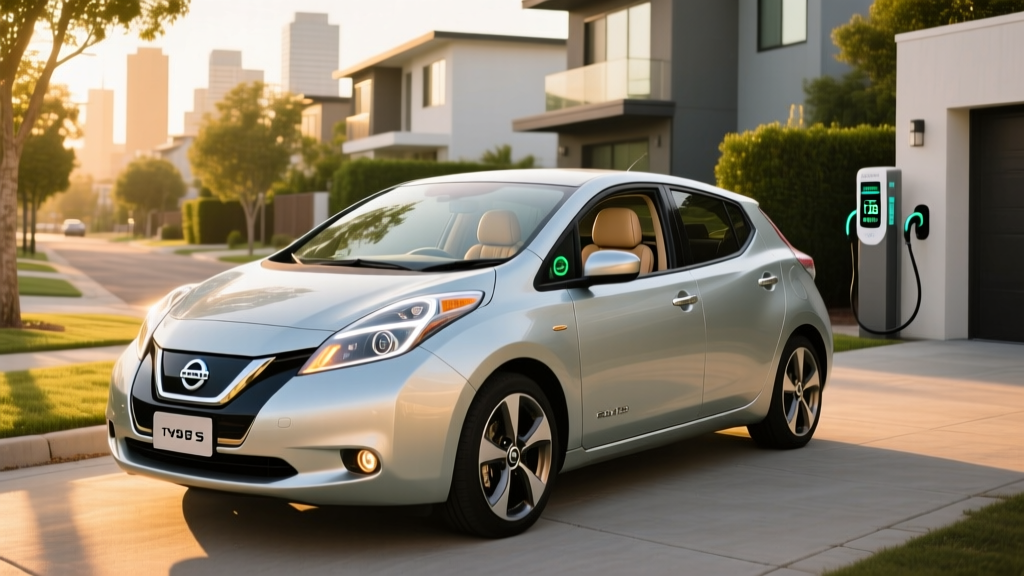
The 2015 Nissan Leaf S was one of the most affordable new electric cars on the market when it launched, offering practical city commuting with zero tailpipe emissions. More than a decade later, it remains a common sight on the used-EV market — and a frequent target for budget-conscious buyers exploring electric ownership for the first time. But with a small 24 kWh battery and aging fast-charge infrastructure support, does this first-generation Leaf still make sense in 2026?
This review covers the 2015 Leaf S specifically (the base trim), examining its real-world range, charging behavior, battery longevity concerns, and whether it qualifies for the federal used-EV tax credit. If you're cross-shopping this against newer used EVs or wondering what to expect as a current owner, this is your data-driven guide.
2015 Nissan Leaf S: Core Specifications
| Attribute | 2015 Nissan Leaf S |
|---|---|
| EPA Range | 84 miles |
| Battery Capacity (Usable) | ~21.6 kWh usable (24 kWh gross) |
| Battery Chemistry | NMC (Lithium Manganese Oxide variant, no active thermal management) |
| Motor Output | 80 kW / 107 hp, 187 lb-ft torque |
| Drivetrain | FWD (front-wheel drive, single motor) |
| 0–60 mph | ~11.5 seconds |
| EPA Efficiency | 114 MPGe combined (30 kWh/100 mi) |
| DC Fast-Charge Peak | ~50 kW (CHAdeMO) |
| Level 2 Charge Rate | 6.6 kW (onboard charger) |
| Cargo Volume | 24.0 cu ft (rear seats up), 30.0 cu ft (folded) |
| Base MSRP (2015) | $29,010 (before incentives) |
| Battery Warranty (Original) | 8 years / 100,000 miles (capacity loss coverage) |
Real-World Range: What 84 EPA Miles Actually Means
Real-World Expectation: 65–80 miles in mixed driving; as low as 50–60 miles in cold weather or sustained highway speeds above 65 mph.
The 84-mile EPA sticker was competitive in 2015, when most affordable EVs clustered around 70–90 miles. But real-world conditions shrink that figure noticeably. The Leaf's lack of an active thermal management system (it uses passive air cooling for the battery) means efficiency drops sharply in two scenarios:
- Cold weather (below 40°F): Expect 25–35% range loss. Cabin heating draws directly from the traction battery, and the cold slows lithium-ion charge acceptance. A 50-mile round-trip commute in January may require midday charging.
- Highway driving (70+ mph): The Leaf's aerodynamic profile helps at low speeds, but above 65 mph, consumption climbs steeply. Sustained interstate driving yields roughly 2.5–3.0 miles per kWh, versus the EPA-rated 3.3 mi/kWh combined.
For city commuting with regenerative braking engaged, owners regularly report achieving 80–90 miles on a full charge in mild weather. The Leaf rewards smooth, moderate-speed driving better than almost any EV on the road — but punish it with hills, heat, or highway speeds, and the small battery shows its limits fast.
According to EPA data on fueleconomy.gov, the 2015 Leaf S achieves 126 MPGe city / 101 MPGe highway, reflecting that city-regen advantage.
Charging Speed: CHAdeMO, 50 kW Peak, and the Taper Problem
| Charging Level | Power / Rate | Time / Miles Added |
|---|---|---|
| Level 1 (120V household) | ~1.2 kW | ~4–5 miles per hour of charging; full charge in ~20+ hours |
| Level 2 (240V, 6.6 kW onboard) | 6.6 kW | ~22 miles per hour; full charge in ~4 hours |
| DC Fast Charge (CHAdeMO) | Peak ~50 kW | 0–80% in ~30 minutes (under ideal conditions); tapers heavily above 80% |
The 2015 Leaf S came standard with a CHAdeMO DC fast-charge port (a significant advantage over the base 2013–2014 Leaf S, which required the Charge Package upgrade). At a 50 kW CHAdeMO station, the Leaf can accept a peak charge rate of approximately 50 kW — but only when the battery is warm, at a low state of charge (below 30%), and in moderate ambient temperatures.
Here's the critical nuance: the Leaf's passive battery cooling means that during fast charging, battery temperature rises quickly. The car's battery management system (BMS) responds by tapering charge speed aggressively. A typical fast-charge session might look like this:
- 10–40% SoC: ~40–50 kW sustained
- 40–60% SoC: ~30–35 kW
- 60–80% SoC: ~15–20 kW
- Above 80%: single-digit kW, essentially trickle-charging
This taper means the commonly cited "30-minute fast charge" only gets you to about 80%. Pushing to 100% on DC fast charge can add another 30–40 minutes and is generally not recommended for battery longevity.
CHAdeMO infrastructure note for 2026: The North American charging landscape has shifted heavily toward NACS (Tesla's connector, now the standard for most new EVs) and CCS1. CHAdeMO stations are declining in number as Electrify America, EVgo, and other networks prioritize CCS and NACS. Before buying a used Leaf, verify that CHAdeMO chargers remain accessible along your regular routes. Apps like PlugShare can help you map current availability.
Battery Health and Degradation: The Biggest Ownership Concern
The 2015 Leaf's battery is its most debated attribute. Nissan used an NMC-variant chemistry (lithium manganese oxide blend) that offered good power density but proved more susceptible to capacity loss over time — especially in hot climates. Unlike Tesla, BMW, and Chevrolet, Nissan did not equip the Leaf with active liquid thermal management. The battery relies on passive air cooling, which is adequate for mild climates and gentle use but accelerates degradation under these conditions:
- Frequent DC fast charging (heat buildup)
- Regular charging to 100% and sitting at full state of charge
- Hot-climate operation (Arizona, Texas, Southern California summers)
- High-mileage use with repeated deep discharge cycles
Nissan's original battery warranty covered capacity loss below 9 bars (out of 12) on the dashboard capacity indicator within 8 years or 100,000 miles. By 2026, nearly all 2015 Leafs are outside that warranty window. Real-world degradation data from Leaf owners and communities like My Nissan Leaf suggest:
- Mild-climate, garage-kept examples: 10–15% capacity loss over 10 years (roughly 70–75 miles of real-world range remaining)
- Hot-climate, high-use examples: 20–35% capacity loss (50–60 miles of real-world range)
- Leaf Spy app reading: Any serious used Leaf buyer should use the Leaf Spy OBD-II app to read State of Health (SoH) percentage before purchase. An SoH above 80% is considered good for a 2015 model; below 70% warrants price negotiation or battery replacement budgeting.
A replacement battery from Nissan costs approximately $6,500–$9,000 installed (24 kWh pack), though third-party refurbishers and used pack swaps may reduce that figure. Factor battery condition heavily into your purchase price.
Driving Experience, Performance, and Daily Usability
The 2015 Leaf S is not a performance EV. Its 107-horsepower motor and 11.5-second 0–60 time place it firmly in economy-car territory. But for its intended use — urban and suburban commuting — the driving experience is surprisingly pleasant:
- Instant torque: 187 lb-ft available from 0 RPM makes the Leaf feel peppy off the line, even if it runs out of breath above 50 mph.
- Regenerative braking: The "B" mode on the shift lever increases regen aggressiveness, enabling near-one-pedal driving in city traffic (though the car does not come to a complete stop on regen alone).
- Ride quality: Soft suspension tuning absorbs potholes well, though the low-rolling-resistance tires prioritize efficiency over grip.
- Visibility and maneuverability: Excellent outward visibility and a tight 34.4-foot turning circle make parking effortless.
Interior and cargo: The Leaf S seats five, though rear legroom (33.3 inches) is tight for adults on longer trips. The 24.0 cu ft cargo area behind the rear seats is generous for the hatchback class — enough for a week's groceries or two carry-on suitcases. Fold the 60/40 rear bench and you get 30.0 cu ft, competitive with compact crossovers.
Infotainment and tech: The S trim came with a 4.3-inch display, Bluetooth, USB, and a rearview camera. No Apple CarPlay or Android Auto (those arrived on later model years and higher trims). Navigation was not standard on the S — it was bundled into the SV and SL trims. For 2026 expectations, the infotainment feels dated, but aftermarket head-unit replacements are widely available.
Safety: The 2015 Leaf earned a 4-star overall rating from NHTSA and was an IIHS Top Safety Pick when equipped with optional features. Standard equipment included six airbags, stability control, and tire-pressure monitoring. No advanced driver-assist features (lane-keeping, adaptive cruise) were offered — this is a pre-ADAS-era vehicle.
Pricing, Tax Credits, and Used-EV Value in 2026
When new, the 2015 Leaf S carried an MSRP of $29,010 (before the $7,500 federal tax credit and any state incentives, which could bring the effective price below $20,000 in states like California and Georgia). In 2026, used-market pricing varies dramatically based on battery health, mileage, and region:
| Scenario | Estimated Price |
|---|---|
| Original 2015 MSRP | $29,010 |
| Used market (2026), good battery (80%+ SoH), ~80k miles | $6,500–$9,500 |
| Used market (2026), degraded battery (<70% SoH), ~100k miles | $4,000–$6,000 |
| Federal Used Clean Vehicle Credit (§25E) | Up to $4,000 (30% of sale price, max $4,000) |
| Effective price after §25E credit (eligible buyer, $7,000 sale) | ~$3,000–$4,900 |
Federal used-EV tax credit (§25E): The 2015 Leaf S can qualify for the federal Used Clean Vehicle Credit, which provides 30% of the sale price up to a maximum of $4,000. However, eligibility depends on several IRS rules (see IRS §25E guidelines):
- Sale price cap: The vehicle must sell for $25,000 or less (virtually all 2015 Leafs qualify).
- Buyer income limits: Adjusted gross income must not exceed $75,000 (single), $112,500 (head of household), or $150,000 (married filing jointly).
- Dealer requirement: The sale must be through a licensed dealer (private-party sales do not qualify).
- Model eligibility: The Leaf is on the IRS qualified used-EV list.
- One-time use: You can only claim this credit once every three years per buyer.
If eligible, a $7,000 used Leaf purchase nets a $2,100 credit (30%), bringing the effective cost to $4,900 — making this one of the cheapest paths into EV ownership in America.
Who Should Buy the 2015 Nissan Leaf S?
Choose the 2015 Leaf S if:
- You need a second car strictly for city commuting (under 40 miles round-trip)
- You have reliable home Level 2 charging and access to CHAdeMO fast chargers nearby
- You live in a mild climate (Pacific Northwest, coastal California, Southeast with garage parking)
- Your budget is under $10,000 and you qualify for the §25E used-EV credit
- You want the lowest possible operating cost (electricity at ~$0.04/mile vs. $0.12–0.15/mile for gas)
Look elsewhere if:
- You need 150+ miles of range for road trips or long commutes
- You live in a hot climate and can't garage the car
- You rely on public fast-charging and your area has transitioned to CCS/NACS
- You want modern infotainment, driver assists, or over-the-air updates
- You need to carry more than two passengers regularly
Pros and Cons at a Glance
Pros
- Extremely low purchase price on the used market (often under $8,000)
- Eligible for up to $4,000 federal used-EV tax credit
- Very low operating cost (~$0.04/mile on average electricity rates)
- Spacious hatchback cargo area (24–30 cu ft)
- Smooth, quiet city driving with strong low-end torque
- Simple mechanicals — few moving parts to maintain
- CHAdeMO fast-charge capability (when stations are available)
Cons
- 84-mile EPA range (real-world often 65–80) limits use to short commutes
- Passive battery cooling accelerates degradation, especially in heat
- CHAdeMO infrastructure is declining across North America
- No active thermal preconditioning for fast charging
- Dated infotainment (no CarPlay/Android Auto, small 4.3" screen)
- 11.5-second 0–60 — underpowered for highway merging
- Original battery warranty expired for all 2015 models
- No advanced driver-assist features (ADAS) available
Frequently Asked Questions
What is the real-world range of the 2015 Nissan Leaf S?
The EPA rates the 2015 Leaf S at 84 miles. In real-world mixed driving at moderate temperatures, expect 65–80 miles. In cold weather (below 40°F) or sustained highway driving above 65 mph, that drops to 50–65 miles. Battery degradation on a 10-year-old pack will further reduce these figures — always check State of Health via Leaf Spy before purchasing.
How fast does the 2015 Leaf S charge?
On a Level 2 (240V) home charger, the 6.6 kW onboard charger adds roughly 22 miles of range per hour, reaching a full charge in about 4 hours. On a CHAdeMO DC fast charger, it peaks at approximately 50 kW, achieving 0–80% in roughly 30 minutes under ideal conditions — but the passive cooling system causes significant tapering as the battery warms, making repeated fast charges slower and potentially degrading battery health over time.
Does the 2015 Nissan Leaf qualify for a federal tax credit in 2026?
Not the new-vehicle §30D credit (that applied at original purchase). However, the 2015 Leaf S does qualify for the federal Used Clean Vehicle Credit (§25E), which provides 30% of the sale price up to $4,000. Eligibility requires: sale price under $25,000, purchase through a licensed dealer, buyer AGI below $75K/$112.5K/$150K thresholds, and you haven't claimed the credit in the past 3 years. Check current rules at IRS.gov.
Is the 2015 Leaf S worth buying vs. a newer used EV?
It depends on your budget and use case. At $5,000–$9,000 (before the §25E credit), the Leaf S is the cheapest entry into EV ownership. But a 2018+ Leaf (40 kWh, 151-mile range) or a used Chevrolet Bolt EV (238-mile range) offers dramatically more usability for $12,000–$18,000. If your commute is under 35 miles each way, you charge at home, and budget is the top priority, the 2015 Leaf S is a rational choice. If you need flexibility for longer trips or live in a hot climate, spend more for a newer model with active thermal management.
How long will the 2015 Leaf battery last, and what does replacement cost?
Most 2015 Leafs show 10–25% battery capacity loss after 10 years, depending on climate and charging habits. The original 8-year/100,000-mile battery warranty has expired for all 2015 models. A new 24 kWh replacement battery from Nissan costs approximately $6,500–$9,000 installed. Third-party battery refurbishers offer repairs for $3,000–$5,000 in some markets. Always check battery SoH before purchase — a degraded pack can turn a $7,000 bargain into a $14,000 liability.
Can I charge the 2015 Leaf S at Tesla Superchargers?
No. The 2015 Leaf uses a CHAdeMO DC fast-charge connector and a J1772 Level 2 connector. Tesla Superchargers use the NACS connector, and no reliable CHAdeMO-to-NACS adapter exists for DC fast charging. You can use a J1772 adapter for Tesla destination chargers (Level 2), but not Superchargers. Verify CHAdeMO availability in your area before committing to this vehicle.