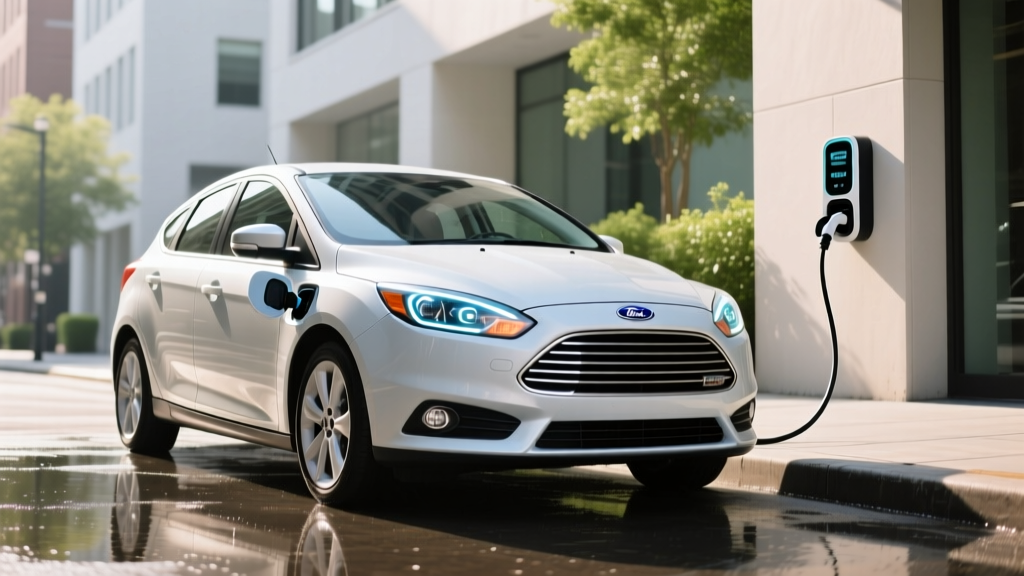
If you're researching the 2015 Ford Focus Electric as a used EV purchase in 2026, here's the quick answer: it's a budget-friendly city commuter with just 76 miles of EPA-estimated range, a 23 kWh usable battery (liquid-cooled), and Level 2 AC charging only — no DC fast charging. Expect to pay $5,000–$9,000 on the used market. It works well as a second car for short commutes if you can charge at home, but its limited range, CHAdeMO-only fast-charge absence, and aging battery make it a niche buy. Read on for the full cost breakdown, real-world range expectations, and a decision framework to see if it fits your needs.
Range, Battery, and Real-World Expectations
The 2015 Focus Electric uses a 23 kWh usable lithium-ion battery pack (out of a 23 kWh gross capacity) with an electric motor producing 143 horsepower and 184 lb-ft of torque. The EPA rated it at 76 miles of combined range and 105 MPGe combined (110 city / 99 highway), according to fueleconomy.gov.
| Spec | Value |
|---|---|
| EPA Range | 76 miles |
| Battery (Usable) | 23 kWh, lithium-ion (liquid-cooled) |
| MPGe (Combined) | 105 MPGe (110 city / 99 hwy) |
| Motor Output | 143 hp / 184 lb-ft |
| 0–60 mph | ~9.2 seconds |
| Level 2 Charge Rate | 6.6 kW (J1772 connector) |
| DC Fast Charging | Not available |
| Level 2 Charge Time (0–100%) | ~3.5 hours |
| Level 1 Charge Time (120V) | ~20+ hours |
| Original MSRP (2015) | $29,170 (before incentives) |
| Used Price Range (2026) | $5,000–$9,000 |
Charging: What You Need to Know
The 2015 Focus Electric supports Level 2 AC charging at 6.6 kW via a standard J1772 connector. This means a full charge from empty on a 240V home charger takes roughly 3.5 hours. On a standard 120V household outlet (Level 1), you'll add about 3–4 miles per hour, meaning a full charge can take over 20 hours — impractical for daily use unless your commute is very short.
Critical limitation: This vehicle has no DC fast charging capability. There is no CHAdeMO, CCS, or NACS port. You cannot use Electrify America, Tesla Superchargers, or any public DC fast charger. Your only public charging option is Level 2 AC stations (ChargePoint, Blink, etc.), which add roughly 20–25 miles of range per hour at 6.6 kW.
| Level | Power (kW) | Miles Added/Hour | Full Charge Time |
|---|---|---|---|
| Level 1 (120V) | ~1.2 kW | 3–4 mi/hr | ~20+ hours |
| Level 2 (240V) | 6.6 kW | 20–25 mi/hr | ~3.5 hours |
| DC Fast Charge | N/A | N/A | Not supported |
Home charging setup: Most owners install a Level 2 home charger (240V, 30–40A circuit). Expect $500–$1,500 for the charger unit and $500–$2,000 for electrician installation, depending on panel capacity and run length. If your electrical panel is maxed out, a panel upgrade can add $1,500–$3,000. Always consult a licensed electrician for final specs.
Cost of Ownership: Focus Electric vs. Gas Car
At a used price of $5,000–$9,000, the 2015 Focus Electric is one of the cheapest EVs you can buy in 2026. But the real savings come from fuel and maintenance. Here's how it compares to a typical gas compact:
| Cost Category | 2015 Focus Electric | Gas Compact (30 MPG avg) |
|---|---|---|
| Fuel/Energy | $360–$540/yr (home charging at $0.12–$0.18/kWh) | $1,400/yr (at $3.50/gal) |
| Maintenance | $200–$400/yr (no oil, fewer brakes) | $600–$900/yr |
| Insurance (avg) | $1,200–$1,500/yr | $1,100–$1,400/yr |
| Total Annual (fuel + maint) | $560–$940 | $2,000–$2,300 |
Annual savings: roughly $1,100–$1,400 in fuel and maintenance alone. Over 5 years, that's $5,500–$7,000 in operating savings, which can more than offset the purchase price.
Federal tax credit note: The §30D federal tax credit does not apply to used vehicles purchased from private parties. However, the used EV credit (§25E) offers up to $4,000 or 30% of the sale price (whichever is less) for qualified used EVs purchased from a dealer, subject to income caps ($75K single / $150K joint) and a sale price cap of $25,000. Since the Focus Electric typically sells for under $10,000, you could qualify for up to $3,000 (30% of price) if purchased from a participating dealer. Verify current rules at irs.gov.
Battery Health and Longevity
The biggest concern with any used EV is battery degradation. The Focus Electric's liquid-cooled battery gives it an advantage over passively cooled competitors (like the 2011–2017 Nissan Leaf), as active thermal management reduces heat-related degradation.
That said, a 2015 model is now 11 years old in 2026. Expect 10–20% capacity loss depending on climate, charging habits, and mileage. A unit that originally delivered 76 EPA miles may now deliver 60–68 miles on a full charge. Ford originally warranted the battery for 8 years / 100,000 miles, meaning most 2015 models are now out of warranty.
Before buying, insist on:
- A battery state-of-health (SoH) reading from a Ford dealer or an OBD-II scanner tool (e.g., Leaf Spy equivalent for Ford — FORScan can pull this data)
- Service records showing any battery-related warranty work
- A test drive that confirms the vehicle reaches at least 60+ miles on a full charge in moderate weather
Battery replacement cost: If the pack fails out of warranty, replacement runs $5,000–$8,000 (parts and labor), which can exceed the vehicle's value. This is a key risk factor for any used EV of this age.
Ford Focus Electric vs. Used Alternatives
How does the Focus Electric stack up against other used EVs in the same price bracket?
| Vehicle | EPA Range | DC Fast Charge | Battery Cooling | Used Price (2026) |
|---|---|---|---|---|
| 2015 Ford Focus Electric | 76 mi | No | Liquid | $5,000–$9,000 |
| 2015 Nissan Leaf | 84 mi | Yes (CHAdeMO) | Passive (air) | $5,000–$9,000 |
| 2016 BMW i3 (BEV) | 81 mi | Yes (CCS) | Liquid | $8,000–$13,000 |
| 2017 VW e-Golf | 125 mi | Yes (CCS) | Liquid | $10,000–$15,000 |
The Focus Electric's advantage is its liquid-cooled battery at a very low price. Its disadvantage is the complete lack of DC fast charging, which the Leaf, i3, and e-Golf all offer. If you ever need to drive beyond your daily commute, the Leaf or e-Golf gives you more flexibility.
Myths vs. Facts
| Myth | Fact |
|---|---|
| "The battery will need replacing soon" | Liquid-cooled packs degrade slower. Expect 80–90% SoH at 11 years if well maintained. Always verify before buying. |
| "I can use any public charger" | Only Level 2 (J1772). No DC fast charging. You cannot use Superchargers, Electrify America DC stalls, or any CCS/CHAdeMO/NACS fast charger. |
| "It qualifies for the $7,500 federal tax credit" | The §30D credit applies only to new EVs. Used purchases may qualify for the §25E used-EV credit (up to $4,000) from a dealer, subject to income and price caps. |
| "76 miles is enough for anyone" | Real-world highway and cold-weather range can drop to 45–60 miles. It works for short city commutes but not for flexible daily driving. |
| "EVs cost more to insure" | At this price point, insurance is comparable to a gas compact — $1,200–$1,500/year on average. Always get a quote before buying. |
Decision Framework: Is the 2015 Focus Electric Right for You?
Buy the 2015 Ford Focus Electric if:
- Your daily round-trip commute is under 40 miles
- You have home charging access (garage, driveway, or dedicated 240V outlet)
- You want the cheapest possible EV as a second car or city runabout
- You live in a mild climate (less cold-weather range loss)
- You can verify battery SoH above 80% before purchase
Look elsewhere if:
- Your commute exceeds 50 miles round-trip
- You rely on apartment or street parking with no charging access
- You need DC fast charging for occasional road trips
- You live in a cold climate where winter range could drop below 50 miles
- You want a vehicle with modern safety tech (the 2015 Focus lacks automatic emergency braking, lane-keep assist, and other ADAS features now standard on newer EVs)
Frequently Asked Questions
Can I install a home charger for the Focus Electric?
Yes. The car uses a standard J1772 connector compatible with any Level 2 home charger (ChargePoint Home Flex, Emporia Level 2, Grizzl-E, etc.). You'll need a 240V circuit (NEMA 14-50 or hardwired) installed by a licensed electrician. Budget $1,000–$3,500 total for equipment and installation depending on your panel capacity and wiring distance.
How long will the battery last?
Liquid-cooled lithium-ion packs from this era typically retain 80–90% capacity after 10–12 years. The key variable is how the previous owner charged it — frequent Level 1 (120V) charging and consistent 100% SoC storage accelerate degradation. Use FORScan or a Ford dealer diagnostic to check SoH before purchasing.
Is the 2015 Focus Electric safe?
The 2015 Ford Focus received a Good rating in most IIHS crash tests, but it lacks modern driver-assistance features. There is no automatic emergency braking, blind-spot monitoring, or lane-keeping assist. Check IIHS ratings for the full breakdown.
What's the maintenance like?
Minimal. No oil changes, no spark plugs, no transmission fluid. You'll need cabin air filter replacement ($20–$40), brake fluid flushes every 2–3 years, tire rotations, and wiper blades. Regenerative braking extends brake pad life significantly — many EV owners report original brake pads lasting 80,000+ miles.
Can I take it on a road trip?
Realistically, no. With no DC fast charging and only 76 miles of range, any trip beyond your local area requires meticulous planning around Level 2 public chargers (which take 3+ hours for a full charge). This is strictly a commuter and city-errand vehicle.