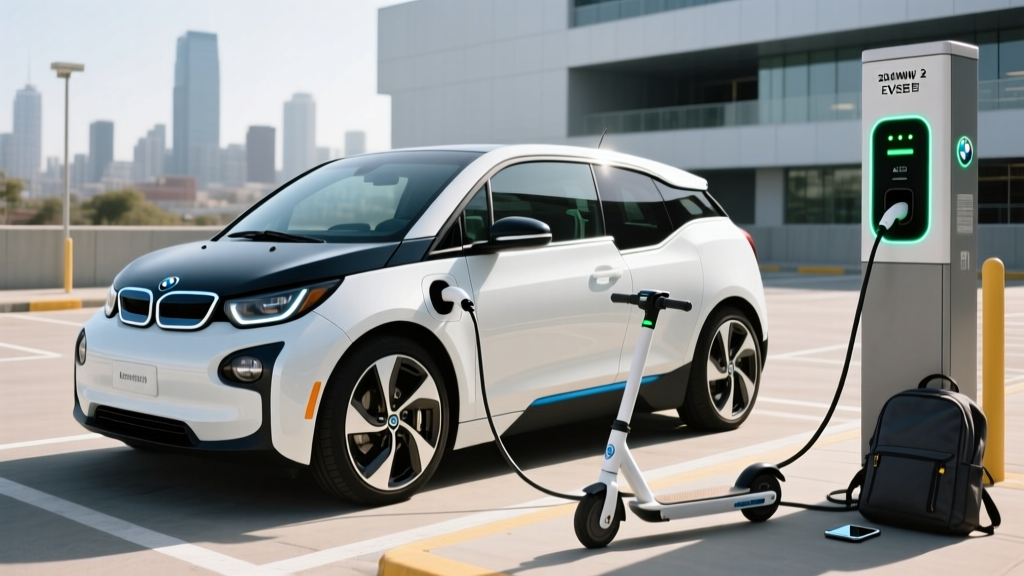
The 2015 BMW i3 hatchback was one of the most forward-thinking electric vehicles of its era. Built on a carbon-fiber-reinforced plastic (CFRP) passenger cell with an aluminum chassis, it weighed under 2,800 pounds and offered a driving experience no other subcompact EV could match. More than a decade later, it remains a popular entry point into EV ownership on the used market, with well-maintained examples trading between $8,000 and $14,000 depending on battery health and mileage.
But the i3's pioneering design comes with trade-offs that modern EV buyers should weigh carefully. Its small battery, limited DC fast-charging speed, and quirky rear-hinged half-doors define a very specific use case. This review breaks down the exact numbers — range, charging speeds, efficiency, and ownership costs — so you can decide whether the 2015 i3 fits your daily driving needs in 2026.
2015 BMW i3 Specifications at a Glance
| Specification | 2015 BMW i3 BEV | 2015 BMW i3 REx (Range Extender) |
|---|---|---|
| EPA Electric Range | 81 miles | 72 miles (electric-only) |
| Total Range (REx) | N/A | ~150 miles (combined electric + gas) |
| Battery Capacity (gross / usable) | 22 kWh / ~18.8 kWh | 22 kWh / ~18.8 kWh |
| Battery Chemistry | NMC (Samsung SDI cells) | NMC (Samsung SDI cells) |
| Motor Output | 170 hp / 184 lb-ft torque | 170 hp / 184 lb-ft torque |
| Drivetrain | Rear-wheel drive (RWD) | Rear-wheel drive (RWD) |
| 0–60 mph | 7.0 seconds | 7.7 seconds |
| EPA Efficiency | 124 MPGe (27 kWh/100 mi) | 117 MPGe (electric mode) |
| Max DC Fast Charge Rate | 50 kW (CCS Combo 2) | 50 kW (CCS Combo 2) |
| Level 2 Charge Rate | 7.4 kW (240V, 30A) | 7.4 kW (240V, 30A) |
| Cargo Volume (rear seats up / down) | 15.1 / 36.9 cu ft | 15.1 / 36.9 cu ft |
| Curb Weight | 2,799 lbs | 3,130 lbs |
| Original Base MSRP | $42,275 | $46,125 |
Range and Real-World Efficiency
The i3's efficiency is genuinely impressive by any standard. At 124 MPGe combined (27 kWh per 100 miles), it was the most efficient EV sold in the U.S. in 2015, and it remains competitive even against 2026 models. Its featherweight CFRP construction is the reason: moving 2,799 pounds requires far less energy than a 4,500-pound electric crossover.
For city commuters covering 20–40 miles round trip, the i3's range is perfectly adequate. You'll charge at home overnight and rarely think about it. But if your commute exceeds 50 miles one way, or if you regularly drive in cold climates without access to workplace charging, the 22 kWh battery becomes a genuine limitation.
The Range Extender (REx) variant pairs the electric motor with a 647cc two-cylinder BMW Motorrad gasoline engine that acts as a generator. It doesn't drive the wheels — it maintains battery state of charge once the battery drops to approximately 6%. Total range extends to roughly 150 miles, eliminating range anxiety for longer trips, though the REx adds 331 pounds and reduces electric-only range to 72 EPA miles.
Charging Speed: DC Fast and Home Level 2
| Charging Level | Power | Time (0–100% or 10–80%) | Miles of Range Added |
|---|---|---|---|
| Level 1 (120V household outlet) | ~1.4 kW | ~14 hours (full charge) | ~5 miles per hour |
| Level 2 (240V, 30A home charger) | 7.4 kW | ~3 hours (full charge) | ~25 miles per hour |
| DC Fast Charge (CCS Combo) | 50 kW peak | ~25 minutes (10–80%) | ~60 miles in 20 min |
The 2015 i3 supports CCS Combo 2 DC fast charging — but only if the DC Fast Charging option was selected at purchase. Not all 2015 i3s have it. Verify the presence of the CCS port (below the J1772 port) before buying a used example. Without the DC option, you're limited to Level 2 AC charging at 7.4 kW maximum.
At 50 kW peak, the i3's DC charging speed was competitive in 2015 but is slow by 2026 standards. Modern EVs routinely accept 150–250 kW. The i3's charge curve holds near 47–50 kW from roughly 5% to 60% state of charge, then tapers progressively. A 10–80% charge takes approximately 25 minutes at a functional 50 kW station. From 80% to 100%, the rate drops sharply to protect the NMC cells — expect another 20–25 minutes for that final 20%.
Home Level 2 charging at 7.4 kW fully replenishes the 22 kWh battery in about three hours. For daily use, this is more than sufficient: plug in when you get home, and the car is full by morning. A standard Level 2 home charger installation typically costs $500–$1,500 depending on your electrical panel's proximity to the parking spot, according to the U.S. Department of Energy.
Driving Performance and Ride Quality
The i3's 170-horsepower electric motor delivers 184 lb-ft of instant torque to the rear wheels through a single-speed transmission. The 0–60 mph time of 7.0 seconds (BEV) feels quicker than the number suggests because electric torque is available from zero RPM. Around town, the i3 is genuinely quick off the line, easily keeping pace with — and often outrunning — modern traffic.
What sets the i3 apart dynamically is its extraordinary low weight and near-50/50 weight distribution. The steering is direct and communicative, body roll is minimal thanks to the low-mounted battery pack, and the 19-inch narrow tires (155/70R19) provide surprisingly competent grip despite their eco-oriented sizing. The turning circle of 32.5 feet makes it an urban parking dream.
The trade-off is ride quality. The short wheelbase (101.2 inches) and stiff suspension tuning mean the i3 transmits sharp road imperfections directly into the cabin. On rough highways, it can feel choppy. Road noise is also more pronounced than in heavier, more insulated modern EVs. This is a car optimized for city agility, not interstate cruising comfort.
Interior, Cargo, and Technology
The i3's interior was radical in 2015 and still looks distinctive today. BMW used sustainable materials throughout: eucalyptus wood trim, wool-blend upholstery, and recycled-plastic dash surfaces. The open-pore wood and exposed CFRP structure give the cabin an airy, loft-like feel that no competitor has replicated.
Practical space is the i3's weakness. The rear seats are accessed via rear-hinged "coach doors" — there is no B-pillar, which creates a wide opening but means the front door must be opened first. This design is elegant in a driveway but awkward in tight parking spaces. Rear legroom measures just 31.9 inches; adults will find it cramped on anything beyond short trips.
Cargo volume is 15.1 cubic feet behind the rear seats and 36.9 cubic feet with them folded — comparable to a small hatchback like the Honda Fit. The trunk floor is high due to the motor and power electronics below, and there is no front trunk (frunk).
The 2015 i3 came with BMW's iDrive infotainment system on a 6.5-inch display (10.25-inch with the optional Navigation/Technology package). Features included:
- BMW ConnectedDrive with remote preconditioning and charge monitoring via smartphone app
- DCB (Dynamic Cruise Control) with brake function
- Parking sensors (rear) with optional backup camera
- Navigation with real-time range calculation and charging station routing (Technology Package)
Notably absent by 2026 standards: Apple CarPlay, Android Auto, adaptive cruise control, lane-keeping assist, and blind-spot monitoring. The i3 predates the modern ADAS era. It is a SAE Level 0 vehicle in terms of driving automation — no driver-assistance features beyond basic cruise control.
Battery Health, Warranty, and Degradation
The 2015 i3 uses a 22 kWh (gross) Samsung SDI NMC lithium-ion battery pack with approximately 18.8 kWh usable. BMW's original battery warranty covers 8 years or 100,000 miles against defects and capacity loss below 70% of original capacity. For a 2015 model year vehicle, that factory warranty expired in 2023.
Real-world degradation data from i3 owner communities and fleet studies shows the 22 kWh pack typically retains 80–88% of original capacity after 8–10 years and 60,000–100,000 miles. That translates to roughly 65–72 miles of real-world range for a well-maintained 2015 BEV example. Degradation is heavily influenced by:
- Climate: Cars in hot climates (Arizona, Texas) show more degradation than those in moderate climates. The i3's battery thermal management is passive/air-cooled — it lacks the liquid cooling of modern packs.
- Charging habits: Frequent DC fast charging and habitual charging to 100% accelerate NMC degradation.
- Mileage: Lower-mileage examples (under 50,000 miles) generally show less capacity loss.
Before purchasing a used 2015 i3, request a battery health report. BMW dealerships can pull the State of Health (SoH) percentage via diagnostic tools. Third-party apps like BimmerCode or Carly can also read SoH via the OBD-II port. An SoH below 75% means real-world range may drop to 55–60 miles — acceptable for short commutes but limiting for most other uses.
Battery replacement is expensive and rarely economical for a vehicle in this price range. A refurbished 22 kWh pack from BMW costs approximately $8,000–$12,000 installed. Third-party refurbishment options exist at lower cost ($4,000–$7,000), but availability varies.
Pricing, Tax Credits, and Ownership Costs
| Cost Factor | 2015 BMW i3 BEV | 2015 BMW i3 REx |
|---|---|---|
| Original MSRP (base) | $42,275 | $46,125 |
| Typical Used Price (2026) | $8,000–$12,000 | $9,000–$14,000 |
| Federal Used EV Tax Credit (§25E) | Up to $4,000 (if eligible) | Not eligible (PHEV battery <7 kWh) |
| Estimated Annual Insurance | $1,100–$1,600 | $1,200–$1,700 |
| Estimated Annual Electricity Cost (12,000 mi) | $400–$550 | $350–$480 (electric portion) |
The original $7,500 federal new-EV tax credit (§30D) is no longer available for a 2015 model. However, the Used Clean Vehicle Credit (§25E) may apply. According to the IRS, this credit provides 30% of the sale price up to $4,000 for qualifying used EVs. Key eligibility requirements:
- Sale price must be $25,000 or less (virtually all used i3s qualify)
- Buyer income caps: $75,000 (single), $112,500 (head of household), $150,000 (joint)
- Vehicle must be at least two model years old (2015 qualifies)
- Must be purchased from a licensed dealer (private-party sales do not qualify)
- The credit can only be claimed once per vehicle VIN — check whether a prior owner already used it
- Must be claimed at point of sale (transferred to dealer) or on your tax return
A $10,000 i3 purchased from a qualifying dealer could net a $3,000 credit (30% of $10,000), bringing effective cost to $7,000. This makes the i3 one of the cheapest ways to enter EV ownership in 2026.
Annual operating costs are exceptionally low. At the U.S. average electricity rate of ~$0.16/kWh and the i3's 27 kWh/100 mi efficiency, fueling costs approximately $4.32 per 100 miles — roughly one-third the cost of a 30 MPG gasoline car at $3.50/gallon. Maintenance is minimal: no oil changes, no transmission fluid, brake pads last 80,000+ miles thanks to regenerative braking, and the only regular service items are cabin air filters, wiper blades, and tire rotations.
Pros and Cons
Pros
- Outstanding efficiency: 124 MPGe / 27 kWh per 100 mi
- Ultralight CFRP construction — nimble, fun to drive in the city
- Very low used purchase price ($8K–$14K)
- Low annual operating and maintenance costs
- Unique, sustainable interior materials
- Tight 32.5-foot turning circle for easy urban parking
- Strong regenerative braking enables one-pedal driving
Cons
- Limited range: 81 mi EPA (BEV), ~55–75 mi real-world
- Slow DC fast charging by 2026 standards (50 kW peak)
- Not all examples have DC fast-charge capability
- Air-cooled battery — more degradation in hot climates
- Cramped rear seats and awkward coach-door access
- No modern ADAS features (no lane-keep, no adaptive cruise)
- Original battery warranty has expired
- Expensive battery replacement relative to vehicle value
- Choppy ride quality on rough roads
Who Should Buy the 2015 BMW i3?
Not recommended for: Families needing regular rear-seat access, drivers with one-way commutes over 40 miles, those in extremely cold climates without workplace charging, or anyone who needs a single-vehicle solution for road trips. The i3's 50 kW DC charging and 81-mile range make intercity travel impractical without meticulous planning and frequent stops.
Compared to other used EVs in this price range — the 2015–2017 Nissan Leaf (84 mi range, CHAdeMO, passive battery cooling), the 2016–2018 Volkswagen e-Golf (83–125 mi range, CCS, more conventional hatchback practicality), or the 2017+ Chevy Bolt EV (238 mi range, far superior for longer trips at a higher used price) — the i3 wins on driving dynamics, efficiency, and build quality, but loses on range, practicality, and charging speed.
Frequently Asked Questions
What is the real-world range of the 2015 BMW i3?
Expect 65–75 miles in mild-weather mixed driving. Highway speeds above 70 mph reduce range to roughly 55–65 miles. In sub-freezing temperatures, range drops to approximately 45–55 miles due to resistive cabin heating and reduced battery efficiency. The REx model extends total range to about 150 miles using its gasoline generator.
How fast does the 2015 i3 charge?
On a Level 2 home charger (240V, 7.4 kW), a full charge takes about 3 hours, adding roughly 25 miles of range per hour. On a 50 kW DC fast charger (if equipped with the CCS option), a 10–80% charge takes approximately 25 minutes. Level 1 (120V) charging adds about 5 miles per hour and takes roughly 14 hours for a full charge.
Does the 2015 BMW i3 qualify for any tax credit?
It no longer qualifies for the new-vehicle §30D credit. However, it may qualify for the Used Clean Vehicle Credit (§25E) — up to $4,000 (30% of sale price) when purchased from a licensed dealer, subject to buyer income limits ($75K single / $150K joint) and a $25,000 maximum sale price. The REx model does not qualify because its battery is below the 7 kWh minimum threshold.
Is the 2015 i3 worth buying vs. a used Nissan Leaf or Chevy Bolt?
It depends on your priorities. The i3 offers superior driving dynamics, build quality, and efficiency. But the 2017+ Chevy Bolt EV (238 mi EPA range, typically $12K–$16K used) is far more practical for longer trips and family use. The Nissan Leaf is similarly limited in range but offers a more conventional hatchback layout. If your commute is short and you value driving enjoyment, the i3 is an excellent choice. If you need range flexibility, look at the Bolt.
How long will the 2015 i3 battery last?
Data from owner communities suggests the 22 kWh NMC pack typically retains 80–88% capacity after 8–10 years. Many i3s with 80,000–100,000 miles still show SoH above 80%. The air-cooled thermal management means hot-climate cars degrade faster. Battery replacement costs $8,000–$12,000 from BMW or $4,000–$7,000 from third-party refurbishers — a cost that may exceed the vehicle's value.
Can I install Apple CarPlay in a 2015 BMW i3?
Not natively. The 2015 i3's iDrive system predates CarPlay/Android Auto support (BMW added CarPlay in later model years). Aftermarket solutions exist — third-party iDrive interface boxes can add wireless CarPlay for $300–$600 installed — but they are not officially supported by BMW.