The 2014 Tesla Model S85 was a watershed vehicle — the first luxury electric sedan to prove that a battery-electric car could deliver over 250 miles of range, thrilling performance, and a viable long-distance charging network. More than a decade later, it remains one of the most searched used EVs on the market. But buying a 12-year-old electric car requires a different calculus than shopping for a new one. Battery degradation, obsolete charging hardware, expired warranties, and shifting tax-credit rules all reshape the value proposition.
This review breaks down every number that matters for a prospective 2014 Model S85 buyer in 2026: original EPA range versus what you'll actually see today, DC fast-charging limitations, real-world battery health expectations, and whether the federal used-EV tax credit can still apply. If you're cross-shopping this pioneer against newer, cheaper EVs, the data below will tell you exactly where it stands.
2014 Tesla Model S85 Specifications at a Glance
| Specification | 2014 Model S85 |
|---|---|
| EPA Range (Original) | 265 miles |
| Battery Capacity (Usable) | ~81 kWh usable (85 kWh gross, NMC chemistry) |
| Drivetrain | Rear-Wheel Drive (single motor) |
| Horsepower | 362 hp |
| 0–60 mph | 5.4 seconds |
| EPA Efficiency | 89 MPGe combined (38 kWh/100 mi) |
| Max DC Fast Charge | ~120 kW peak (V2 Supercharger era) |
| Level 2 Home Charging | Up to 10 kW (40A) / ~29 mi/hr |
| Cargo Volume | 26.3 cu ft (rear) + 5.3 cu ft (frunk) |
| Original MSRP (Base) | $79,900 (before incentives) |
| Battery Warranty (Original) | 8 years / 125,000 miles |
| Connector | Tesla proprietary (NACS) |
Range: What the EPA Sticker Said vs. What You'll Get Today
Expected Real-World Range in 2026 (Healthy Battery): ~190–220 miles mixed driving
Highway (70 mph): ~170–195 miles
Cold Weather (Below 32°F): ~140–170 miles
The 2014 Model S85 launched with an EPA-estimated 265 miles of range — a figure that set the benchmark for the entire EV industry at the time. The EPA's fueleconomy.gov listing confirms the 89 MPGe combined rating and 38 kWh per 100 miles consumption figure.
However, any 2014 Model S85 you evaluate today has a battery that is at least 12 years old. Lithium-ion NMC (nickel manganese cobalt) cells degrade through both calendar aging and cycle wear. Industry data from sources like Recurrent Auto and Tesla owner forums suggest that well-maintained 85 kWh packs retain roughly 75–85% of original capacity at this age, though outliers exist in both directions.
That means a realistic range expectation is 190–220 miles under moderate conditions. Highway driving at 70+ mph pushes consumption higher — the Model S is a large, heavy sedan (4,647 lbs curb weight), and aerodynamic drag at speed takes a significant toll. Cold weather compounds the loss: the 2014 Model S lacks a heat pump (it uses resistive cabin heating), which can reduce range by 25–35% in freezing temperatures. If you live in a cold climate and need reliable 200+ mile range in winter, this car will fall short.
Battery Health, Chemistry, and What to Inspect Before Buying
The 85 kWh pack in the 2014 Model S uses NMC (nickel manganese cobalt) chemistry, supplied primarily by Panasonic. NMC offers high energy density — which is why Tesla achieved 265 miles in 2014 — but it is more sensitive to high state-of-charge storage and heat exposure than the LFP (lithium iron phosphate) chemistry found in some modern EVs.
Key battery inspection points for a used 2014 S85:
- State of Health (SoH): Use the car's energy graph or third-party tools like Teslalogger or Scan My Tesla (via OBD-II adapter) to check actual usable kWh. A healthy pack should show 62–70 kWh usable; below 58 kWh signals significant degradation.
- Charge history: Cars routinely charged to 100% and stored at high SoH degrade faster. Ask the owner about their charging habits. Tesla's own recommendation was (and is) to set daily charge limits to 80–90% for NMC packs.
- Warranty status: The original 8-year/125,000-mile battery and drive unit warranty expired no later than 2022 for all 2014 models. Unless the owner purchased an extended warranty or Tesla replaced the battery under a service campaign, you are buying the battery as-is. A replacement 85 kWh pack from Tesla currently costs roughly $12,000–$18,000 installed, depending on availability of refurbished units.
- Cell imbalance: Early 85 kWh packs had more cell balancing issues than later revisions. Look for large variance in brick-level voltages via diagnostic tools.
The 85 kWh pack was generally regarded as more durable than the earlier 60 kWh variant and the problematic 90 kWh pack introduced in 2015 (which suffered faster degradation due to a software-limited charge ceiling masking capacity). This makes the 85 one of the more desirable configurations from the pre-facelift era.
Charging: Supercharger Access, DC Speed, and Home Setup
| Charging Level | Power (kW) | Speed (Miles/Hour) | 10–80% Time |
|---|---|---|---|
| Level 1 (120V household) | ~1.4 kW | ~3–4 mi/hr | N/A (multiple days) |
| Level 2 (240V, 40A) | ~10 kW | ~29 mi/hr | ~7–8 hours (full) |
| DC Fast Charge (Tesla V2 Supercharger) | ~120 kW peak | ~250 mi/hr (peak) | ~45–55 minutes |
| DC Fast Charge (V3 Supercharger, adapter required) | ~120 kW (car-limited) | ~250 mi/hr (peak) | ~45–55 minutes |
The 2014 Model S85 was built around Tesla's proprietary NACS (North American Charging Standard) connector, which as of 2025 has become the dominant EV charging standard in North America. This is a significant advantage: the S85 plugs natively into every Tesla Supercharger without an adapter.
However, the car's onboard charge acceptance tops out around 120 kW on DC fast charging. When Tesla's V3 Superchargers debuted at 250 kW, the 2014 S85 could not benefit from the higher peak — its battery management system and pack architecture simply cannot accept that rate. Expect a 10–80% session to take roughly 45–55 minutes at a V2 or V3 Supercharger, with the charge curve tapering significantly above 60% SoC. This is roughly double the time a modern EV like the Hyundai Ioniq 5 or Tesla Model 3 Highland would take on the same charger.
For home Level 2 charging, the 2014 Model S supports up to 40 amps (10 kW) on a NEMA 14-50 outlet or Tesla Wall Connector. At that rate, you'll add about 29 miles of range per hour — adequate for overnight replenishment of a daily commute. A professional Level 2 installation typically costs $800–$2,000 depending on electrical panel proximity and local permitting. If your home has a 200-amp panel with capacity, this is straightforward; older 100-amp panels may require an upgrade ($1,500–$3,000 additional).
One important note: the 2014 Model S uses a CCS-incompatible charge port. With the industry's shift toward NACS as the universal standard (which Tesla already uses), this is no longer a disadvantage — in fact, it's now an advantage over 2014-era CCS-equipped vehicles from Nissan, BMW, and others whose charging networks are being retrofitted.
Performance and Driving Dynamics
The single rear-mounted AC induction motor produces 362 horsepower and 325 lb-ft of torque, delivered to the rear wheels through a single-speed reduction gear. The 0–60 mph sprint takes 5.4 seconds — still genuinely quick by any measure, and the instant torque delivery makes it feel faster than the number suggests in around-town driving.
The 2014 Model S rides on an adaptive air suspension (standard on most S85 trims) that provides a comfortable, composed highway demeanor. However, early air suspension systems are a known maintenance item — strut and compressor failures are common above 80,000 miles, with replacement costs of $1,500–$2,500 per corner. Many used examples have had these replaced with aftermarket coil-over conversions (e.g., from Unplugged Performance or Mountain Pass Performance) to eliminate the issue permanently.
Handling is competent for a large luxury sedan, though the 4,647-pound curb weight and relatively narrow 245/45R19 tires mean this is a grand tourer, not a sports sedan. Regenerative braking is adjustable but does not offer true one-pedal driving to a complete stop — the car creeps at low speeds, unlike modern Teslas with the "Hold" regen mode.
Tech, Interior, and Driver Assistance
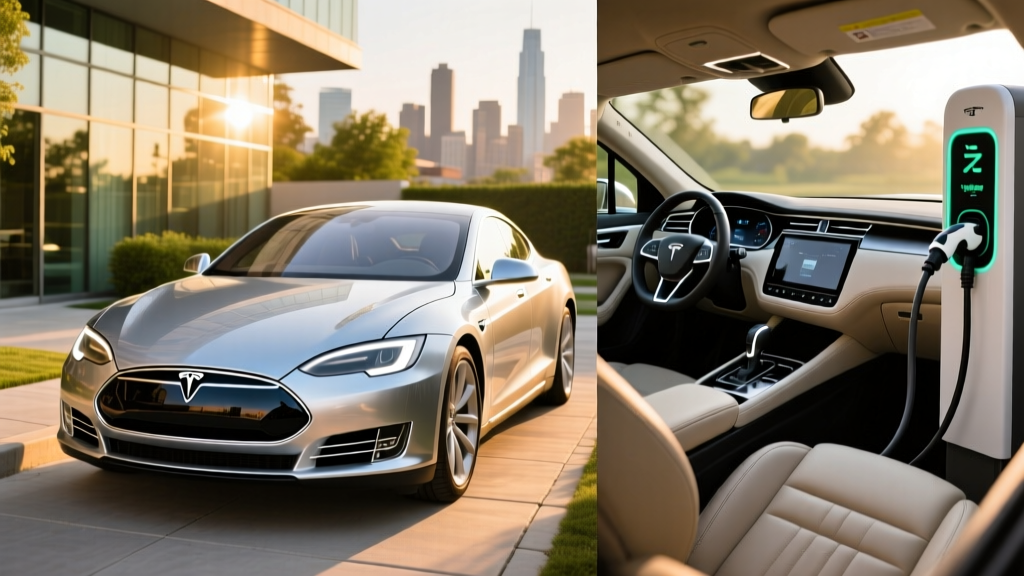
The 2014 Model S interior centers on a 17-inch touchscreen that controlled nearly every vehicle function — revolutionary in 2014, but showing its age in 2026. The screen uses older resistive-capacitive hybrid touch technology that is noticeably less responsive than modern displays. Navigation, media, climate, and vehicle settings all route through this screen with no physical buttons for most functions.
Autopilot hardware note: The 2014 Model S was built before Tesla's Autopilot Hardware 1 (introduced in late September 2014). Most 2014 Model S85s do not have Autopilot hardware at all. Some late-2014 build examples may have HW1, but this is rare and should be verified by checking for the forward-facing camera near the rearview mirror and radar in the lower grille. Even if equipped, HW1 Autopilot is rudimentary by 2026 standards — basic lane-keeping and adaptive cruise, with none of the vision-based capabilities of HW3/HW4. Tesla no longer sells FSD upgrades for HW1 vehicles.
Notable tech features include:
- Over-the-air (OTA) software updates (though the 2014 hardware limits how much new functionality Tesla can push)
- Tesla mobile app for remote climate control, charging status, and location
- Panoramic glass roof (standard on most S85s)
- Power-folding side mirrors, heated front seats, and keyless entry via the key fob
Notable drawbacks:
- No Apple CarPlay or Android Auto (not available on any Tesla)
- MCU1 (Media Control Unit) is known to fail — the eMMC flash memory degrades over time, causing the screen to go black. Tesla issued a recall for this, but verify the MCU has been replaced with the updated MCU2 unit
- Rear seat legroom (35.4 inches) is tight for a car of this exterior size
- No rear-seat USB-C ports; original USB-A ports charge slowly
Pricing, Used Market Value, and Tax Credit Eligibility
The 2014 Tesla Model S85 originally carried an MSRP of $79,900 before any incentives. Well-equipped examples with the Tech Package, Premium Lighting, and air suspension pushed past $90,000.
In the 2026 used market, expect to pay:
- High-mileage / degraded battery: $12,000–$16,000
- Average condition (70k–100k miles, ~80% SoH): $16,000–$22,000
- Low-mileage / excellent condition / new battery: $22,000–$30,000
Under IRS §25E, the used clean vehicle credit provides up to $4,000 (or 30% of the sale price, whichever is lower) for qualifying used EVs. Key requirements:
- Sale price must be $25,000 or less
- Buyer income caps: $75,000 (single), $112,500 (head of household), $150,000 (joint)
- Vehicle must be at least 2 model years old (2014 qualifies)
- Must be purchased from a licensed dealer (private-party sales do not qualify)
- Credit can only be claimed once per VIN
A 2014 Model S85 priced at or below $25,000 from a dealer could qualify a buyer within the income limits for up to $4,000 off. This is a meaningful discount on a $16,000–$22,000 vehicle, effectively bringing the net cost to $12,000–$18,000. Confirm eligibility with a tax professional before relying on the credit, as prior claims on the same VIN will disqualify it.
How It Compares: 2014 Model S85 vs. Key Used-EV Alternatives
| Attribute | 2014 Tesla Model S85 | 2017 Chevrolet Bolt EV | 2018 Nissan Leaf (60 kWh) |
|---|---|---|---|
| Used Price Range (2026) | $12,000–$30,000 | $10,000–$16,000 | $10,000–$15,000 |
| Original EPA Range | 265 mi | 238 mi | 226 mi |
| Expected Range Today | 190–220 mi | 180–210 mi | 160–190 mi |
| DC Fast Charge Peak | ~120 kW | ~55 kW | ~100 kW |
| Liquid-Cooled Battery | Yes | Yes | No (passive air) |
| Charging Standard | NACS (native) | CCS1 | CHAdeMO |
| 0–60 mph | 5.4 sec | 6.5 sec | 7.9 sec |
The Model S85's main advantages over same-era used EVs are its superior range, liquid-cooled battery (which degrades more predictably than the Leaf's passively cooled pack), native Supercharger access, and performance. Its disadvantages are higher purchase price, costlier repairs (air suspension, MCU, drive unit), and the age of its technology platform.
The Bolt EV is a more practical and affordable used-EV choice for city commuting, though its 55 kW DC charging rate makes road trips tedious. The Leaf's CHAdeMO connector is increasingly orphaned as networks shift to NACS and CCS, making it the riskiest of the three for long-term charging access.
Who Should Buy the 2014 Tesla Model S85?
- You want a spacious, fast luxury EV for under $20,000 (after tax credit) and accept the maintenance risk
- You have reliable home Level 2 charging and mostly drive within 150 miles round-trip
- You value native Supercharger access for occasional road trips
- You're mechanically inclined or budget $2,000–$4,000 for potential repairs in the first year
- You need reliable 250+ mile range in cold weather
- You want modern driver assistance (Autopilot HW3+, adaptive cruise with lane centering)
- You cannot absorb a potential $12,000–$18,000 battery replacement
- You want a warranty — no 2014 Tesla has remaining factory coverage
Frequently Asked Questions
What is the real-world range of the 2014 Tesla Model S85 in 2026?
Expect 190–220 miles in mixed driving with a battery at roughly 80% State of Health. Highway driving at 70+ mph reduces this to 170–195 miles, and cold weather (below freezing) can drop range to 140–170 miles due to resistive cabin heating and reduced battery efficiency.
How fast does the 2014 Model S85 charge?
On DC fast charging (Supercharger), it peaks at approximately 120 kW, achieving a 10–80% charge in roughly 45–55 minutes. At home on a Level 2 (240V, 40A) charger, it adds about 29 miles of range per hour, fully charging overnight in 7–8 hours.
Does the 2014 Tesla Model S85 qualify for any tax credit?
It may qualify for the federal used clean vehicle credit (§25E) of up to $4,000 if purchased from a licensed dealer for $25,000 or less, and the buyer meets income limits ($75K single / $150K joint). It does not qualify for the new-vehicle §30D credit. Always verify with a tax professional and check whether the credit has already been claimed on that specific VIN.
Is the 2014 Model S85 worth buying versus a newer used EV?
It depends on your budget and risk tolerance. The S85 offers more space, performance, and range than most same-price used EVs, but carries higher repair risk and outdated tech. A 2018–2020 Model 3 Long Range ($20,000–$28,000 used) offers newer hardware, Autopilot HW3, faster charging, and lower maintenance risk for a modest premium.
What are the biggest problems with the 2014 Model S85?
The most common and costly issues are: MCU1 screen failure (recall-repairable), air suspension strut/compressor failure ($1,500–$2,500 per corner), door handle mechanism failure ($400–$700 each), drive unit whine or bearing wear, and 12V battery drain from the always-on telematics system. Budget $2,000–$4,000 for first-year maintenance.
Can the 2014 Model S85 use non-Tesla chargers?
Not natively. The car has a Tesla (NACS) port. As of 2026, most non-Tesla DC fast chargers use CCS1 connectors. Tesla sells a CCS adapter, but the 2014 Model S predates CCS protocol support in its firmware — compatibility is not guaranteed and varies by software version. Supercharger access remains the most reliable charging option.
Has the battery warranty expired on all 2014 Model S85s?
Yes. The original 8-year/125,000-mile battery and drive unit warranty expired no later than December 2022 for all 2014 vehicles. Unless a subsequent owner purchased an extended service agreement, the battery is entirely out of warranty. A replacement costs $12,000–$18,000 from Tesla or independent EV shops.
The 2014 Tesla Model S85 remains a compelling used EV for buyers who understand what they're signing up for: an aging but historically significant electric sedan with genuine performance and range, offset by real maintenance costs and technology that has been surpassed by a decade of progress. Run the numbers, check the battery, and buy with your eyes open.