The Quick Answer: 2014 Spark EV as a Used EV in 2026
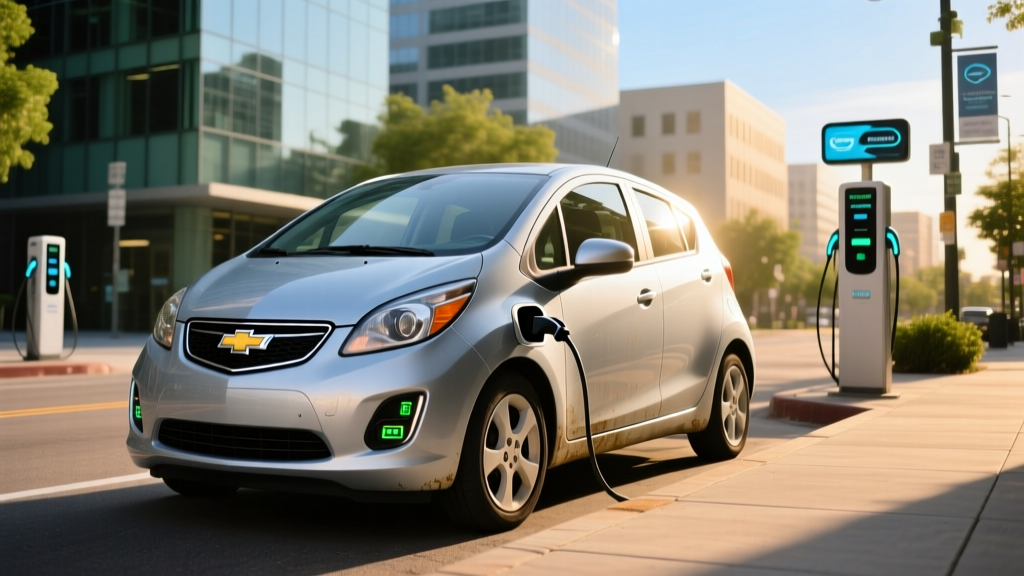
The 2014 Chevrolet Spark EV is a discontinued, early-generation electric subcompact with an EPA-rated 82 miles of range and a 21.3 kWh usable battery. In 2026, expect a used example with 10+ years of battery age to deliver roughly 60–72 real-world miles depending on State of Health (SoH), climate, and driving style. With used prices hovering between $4,000–$7,500 in the private-party market, it can serve as a low-cost city commuter if you have reliable home Level 2 charging — but it is not a primary vehicle for anyone with highway commutes, cold winters, or no garage outlet.
What the 2014 Spark EV Actually Is
Chevrolet introduced the Spark EV for the 2013 model year as a compliance car — an electric vehicle produced primarily to satisfy California and other ZEV-mandate state requirements. It was built on the same platform as the gasoline Spark but fitted with an electric powertrain co-developed with LG Chem. The 2014 model year carried over the same hardware with minor software tweaks.
Chevrolet discontinued the Spark EV after the 2016 model year, replacing its role in the lineup with the far more capable Bolt EV (and later Bolt EUV). That means any Spark EV you find today is at least a decade old, well past its battery warranty window, and operating on chemistry that has seen meaningful degradation.
| Specification | 2014 Spark EV |
|---|---|
| EPA Range | 82 miles |
| Battery (Usable) | 21.3 kWh (NMC lithium-ion) |
| Motor Output | 140 hp / 400 lb-ft torque |
| 0–60 mph | |
| EPA Efficiency | 119 MPGe combined (28 kWh/100 mi) |
| DC Fast Charge (CCS) | ~50 kW peak (SAE Combo option) |
| Level 2 Charge Rate | 3.3 kW (onboard charger) |
| Level 2 Time (0–100%) | ~6–7 hours |
| 10–80% DCFC | ~30 minutes (50 kW station) |
| Cargo Volume | 9.6 cu ft (rear seats up) |
| Original MSRP (2014) | $26,685 (before incentives) |
| Battery Warranty (Original) | 8 years / 100,000 miles (expired) |
Real-World Range: What to Expect in 2026
The 82-mile EPA figure was measured when the battery was new. Lithium-ion batteries lose capacity over time and with charge cycles. A 2014 Spark EV in 2026 has a battery that is 11–12 years old. Based on typical NMC degradation curves for passively and actively thermally managed packs of this era, expect a State of Health (SoH) between 70% and 85% for most surviving examples.
EPA Sticker: 82 miles (new battery, 2014)
Realistic 2026 Range (SoH ~78%):
- Mild weather, city driving: 62–70 miles
- Highway (65+ mph): 50–58 miles
- Cold weather (below 35°F): 40–52 miles
The Spark EV's liquid-cooled battery management system was a notable advantage over the air-cooled Nissan Leaf of the same era, meaning degradation tends to be more gradual. But age alone causes calendar degradation regardless of mileage.
Before purchasing any used Spark EV, ask the seller to pull a battery health report through a Chevrolet dealer's GDS2 diagnostic tool or use an OBD-II reader with compatible EV software (such as Torque Pro with the right PID set) to read remaining capacity. This is the single most important step in evaluating a used early-generation EV.
Charging: The 3.3 kW Bottleneck
The 2014 Spark EV's onboard charger is limited to 3.3 kW on Level 2 (240V). That means even with a 40-amp home wall connector capable of delivering 9.6 kW, the Spark will only accept 3.3 kW — adding roughly 13–15 miles of range per hour of charging.
| Charging Level | Power | Miles Added/Hour | Full Charge Time |
|---|---|---|---|
| Level 1 (120V outlet) | ~1.4 kW | ~5–6 miles | ~15–17 hours |
| Level 2 (240V) | 3.3 kW (limited) | ~13–15 miles | ~6–7 hours |
| DC Fast Charge (CCS) | ~50 kW peak | N/A | 10–80% in ~30 min |
DC fast charging caveat: Not all 2014 Spark EVs came with the SAE Combo (CCS) DC fast-charge port — it was a $750 option. If the car you're looking at only has a J1772 port, you are restricted to Level 2 charging at all times, which makes road trips impractical and means a full recharge from near-empty takes nearly seven hours.
For a car with 60–70 miles of real-world range, Level 2 overnight charging at home is perfectly adequate — you'll replenish a day's worth of driving in 4–5 hours. But rely on public DCFC and you'll discover that 50 kW peak charging on a 21 kWh battery means the session is brief yet still limited by the car's taper curve above 80% SoC.
Cost Breakdown: 2014 Spark EV vs. a Comparable Gas Car
The economic case for a used Spark EV rests on rock-low purchase price and minimal fuel cost. Here's how it compares to a typical gas subcompact (e.g., a 2014–2016 Honda Fit or Toyota Yaris getting ~33 MPG combined) over a 5-year ownership period at 8,000 miles per year.
| Cost Factor | 2014 Spark EV | Gas Subcompact (~33 MPG) |
|---|---|---|
| Purchase Price (used) | $5,500 (avg.) | $8,500 (avg.) |
| Annual Fuel/Energy (8k mi/yr) | $240 (at $0.13/kWh, home) | $970 (at $3.20/gal) |
| 5-Year Fuel/Energy Total | $1,200 | $4,850 |
| Annual Maintenance | ~$200 (tires, wipers, cabin filter) | ~$650 (oil, brakes, filters) |
| 5-Year Maintenance Total | $1,000 | $3,250 |
| Estimated Insurance (annual avg.) | $900 | $850 |
| 5-Year Insurance Total | $4,500 | $4,250 |
| 5-Year Total Cost | ~$12,200 | ~$20,850 |
The Spark EV saves roughly $8,650 over five years in this scenario — driven primarily by the lower purchase price and dramatically lower energy cost. At 28 kWh/100 miles and $0.13/kWh (national residential average per the U.S. EIA), you're paying about 3.6 cents per mile for electricity versus 9.7 cents per mile for gasoline.
Important caveats:
- If you pay public DCFC rates ($0.35–$0.55/kWh), your per-mile cost roughly triples to ~10–15 cents/mile — still below gas but no longer a bargain.
- A battery replacement (if needed) would cost $3,000–$5,000+ from a dealer or salvage source, potentially totaling the car.
- The original 8-year/100,000-mile battery warranty expired no later than 2022 for any 2014 model. You are fully on your own for battery failure.
Tax Credits and Incentives in 2026
The 2014 Spark EV does not qualify for the federal §30D new-vehicle EV tax credit — that applies only to new vehicle purchases. However, it may qualify for the Used Clean Vehicle Credit (up to $4,000 or 30% of sale price, whichever is less) under current IRS rules, subject to these requirements:
- Sale price must be $25,000 or less — virtually all used Spark EVs meet this.
- Buyer income limits: AGI must not exceed $75,000 (single), $112,500 (head of household), or $150,000 (joint).
- Vehicle must be at least 2 model years old — a 2014 model qualifies.
- Must purchase from a licensed dealer — private-party sales do not qualify.
- Battery capacity must be at least 7 kWh — the Spark EV's 21.3 kWh pack qualifies.
- Credit can be transferred at point of sale as a price reduction (dealer must be registered with IRS).
- Can only be claimed once per buyer every 3 years.
At a typical dealer price of $6,000–$7,500, the 30% calculation yields $1,800–$2,250 — below the $4,000 cap. This credit can meaningfully reduce your out-of-pocket cost, but confirm eligibility with a tax professional before relying on it.
Common Misconceptions About the 2014 Spark EV
| Myth | Fact |
|---|---|
| "82 miles is plenty for anyone." | EPA rated when new. Expect 60–70 miles real-world with a degraded battery. Cold weather can drop this below 50. |
| "It charges fast on DC." | 50 kW peak on a 21 kWh battery sounds quick, but the charge curve tapers significantly above 80%. And many units lack the CCS port entirely. |
| "The battery will need replacing soon." | Not necessarily. GM's liquid-cooled pack design has aged better than air-cooled competitors. Many examples still show 75–85% SoH. But a pre-purchase battery health check is essential. |
| "It qualifies for the $7,500 federal tax credit." | The $7,500 credit applies only to new EVs. Used EVs are eligible for up to $4,000 under different rules with income caps. |
| "Any mechanic can work on it." | High-voltage system servicing requires EV-trained technicians. Independent EV shops exist but are not as common as general mechanics. |
Who Should (and Shouldn't) Buy a 2014 Spark EV
Choose the 2014 Spark EV if:
- You have a dedicated Level 2 (240V) charging setup at home or work
- Your daily round-trip commute is under 40 miles
- You live in a mild climate (rarely below freezing)
- You want a second car for errands and local driving at the lowest possible cost
- You can verify battery SoH before purchase and accept the degradation risk
- You qualify for the used-EV tax credit and buy from a registered dealer
Do NOT choose the 2014 Spark EV if:
- Your daily driving exceeds 50 miles round-trip
- You regularly drive at highway speeds (70+ mph) in cold weather
- You lack home or workplace charging access
- You need a primary/only vehicle
- You live in a region with harsh winters and need reliable range buffer
- You cannot budget $3,000–$5,000 for a potential battery replacement
Ownership Practicalities: What First-Time EV Buyers Should Know
If the 2014 Spark EV is your entry point into electric driving, here are the realities that go beyond the spec sheet:
Home charging is non-negotiable. Level 1 (standard 120V outlet) charging at 1.4 kW adds only about 5–6 miles per hour. Replenishing a full day's 50-mile drive would take 9–10 hours on a wall outlet. A Level 2 installation (240V, 16-amp circuit minimum) costs $500–$2,000 depending on your electrical panel's capacity and the distance from panel to parking spot, per data from HomeAdvisor. For a 3.3 kW car, a basic 16-amp Level 2 unit ($250–$400 for equipment) is sufficient — no need for an expensive 48-amp charger.
Tires and brakes are different. The Spark EV weighs approximately 2,989 lbs — about 600 lbs more than the gas Spark — due to the battery pack. That extra mass increases tire wear. Budget for tire replacement every 30,000–40,000 miles. On the upside, regenerative braking significantly reduces brake pad wear; many EV owners report original brake pads lasting 80,000+ miles.
Insurance may be slightly higher. Even as a low-value used EV, some insurers charge modestly more for electric vehicles due to specialized repair costs. Shop quotes before purchasing — the difference is typically $50–$150/year.
Parts availability is narrowing. The Spark EV was a low-volume compliance car. Body panels, trim pieces, and EV-specific components (charger, inverter) are not stocked at every Chevy dealer. The aftermarket and salvage network can fill gaps, but plan for longer wait times on specialty parts.
How the 2014 Spark EV Compares to Other Used EVs
| Spec | 2014 Spark EV | 2014 Nissan Leaf | 2015 VW e-Golf | 2017 Chevy Bolt EV |
|---|---|---|---|---|
| EPA Range (new) | 82 mi | 84 mi | 83 mi | 238 mi |
| Battery (usable) | 21.3 kWh | 21.6 kWh | 24.2 kWh | 60 kWh |
| Thermal Mgmt | Liquid-cooled | Air-cooled | Liquid-cooled | Liquid-cooled |
| L2 Charge Rate | 3.3 kW | 3.3 kW (6.6 kW opt.) | 7.2 kW | 7.2 kW |
| DCFC Peak | ~50 kW | ~50 kW | ~50 kW | ~55 kW |
| Est. 2026 Used Price | $4,000–$7,500 | $4,500–$8,000 | $6,000–$10,000 | $10,000–$15,000 |
| Best For | Cheap city runabout | City use (mild climates) | Better-rounded commuter | Real primary EV |
The Spark EV's liquid-cooled battery gives it a degradation edge over the same-era Nissan Leaf, whose air-cooled packs in hot climates have suffered well-documented capacity loss (often below 70% SoH by year 10). If your budget is strictly under $8,000 and your needs are strictly local, the Spark EV and Leaf compete closely — but the Spark's superior thermal management makes it the safer bet for battery longevity.
If you can stretch to $10,000–$15,000, the 2017+ Chevy Bolt EV offers nearly three times the range, faster Level 2 charging, and a far more usable vehicle — making it the better value for anyone who needs more than a neighborhood car.
Frequently Asked Questions
Is the 2014 Spark EV still a good buy in 2026?
It can be — as a second car or city commuter for someone with home charging and a short daily drive. At $4,000–$7,500, it's one of the cheapest ways to drive electric. But verify battery health before purchase, understand that range will be 60–70 miles at best, and accept that the car is well past its warranty coverage.
How much does it cost to charge a 2014 Spark EV at home?
A full charge from empty to full uses about 21.3 kWh. At the U.S. residential average of $0.13/kWh, that's roughly $2.77 for a full charge — enough for about 60–70 real-world miles. Monthly home charging for 8,000 miles/year works out to about $20/month.
Can I take a 2014 Spark EV on a road trip?
Technically yes, if your unit has the optional CCS DC fast-charge port. You'd stop every 50–60 miles for a 30-minute charge. Practically, this is tedious and not recommended for trips over 150 miles. This is a city and suburban car.
What happens if the battery fails?
A replacement battery from a Chevrolet dealer can cost $5,000 or more, which may exceed the car's value. Salvage batteries from wrecked Spark EVs are available for $2,000–$3,500 but come with unknown history. Some independent EV shops offer cell-level repair for $1,500–$3,000. Factor this risk into your purchase decision.
Does the 2014 Spark EV qualify for any tax credits?
Not the new-vehicle §30D credit. But if you buy from a registered dealer, meet income limits ($75K single / $150K joint), and the sale price is under $25,000, you may qualify for the Used Clean Vehicle Credit — up to $4,000 or 30% of the sale price. Consult a tax professional and check IRS guidance for current rules.
How do I check the battery health on a used Spark EV?
Ask a Chevrolet dealer to run a battery diagnostic via GDS2, or use an OBD-II adapter with EV-compatible software to read State of Health (SoH) percentage. A reading above 80% is good for a 2014 pack; below 70% is a red flag that significantly reduces the car's usability and value.