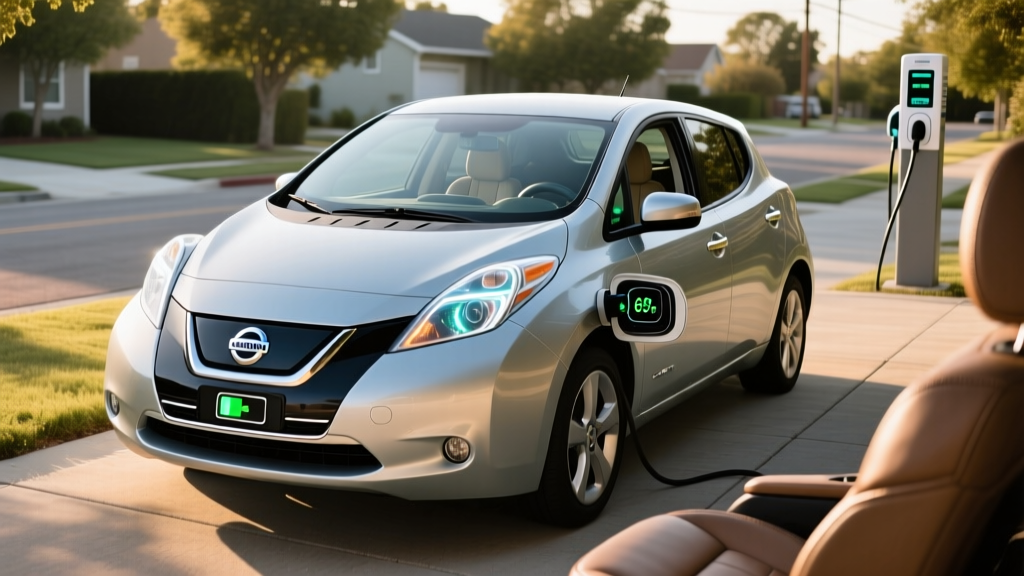
The 2014 Nissan Leaf holds a unique place in electric vehicle history. As one of the first mass-market, purpose-built EVs sold in the United States, it proved that battery-electric daily driving was viable — even if early adopters had to accept serious range limitations. More than a decade later, thousands of these cars remain on the road, and they've become an entry point into EV ownership for budget-conscious buyers. But buying a used 2014 Leaf in 2026 requires a clear-eyed understanding of battery degradation, obsolete charging standards, and what this car can and cannot do.
This review covers the 2014 Leaf with exact specs, real-world ownership data, and a practical framework for deciding whether one belongs in your driveway — or whether you should look elsewhere.
Quick Verdict: The 2014 Leaf in 2026
The 2014 Nissan Leaf is a short-range city commuter best suited for a second car, a college student's campus runabout, or a budget shopper with reliable home charging and a sub-30-mile daily round trip. Its 84-mile EPA range was modest when new; with typical battery degradation, expect 55 to 70 real-world miles on a full charge today. The CHAdeMO fast-charging connector is now a legacy standard with dwindling public infrastructure support. Yet for the right buyer — someone who can charge at home overnight and doesn't need highway range — a well-maintained 2014 Leaf at $3,500–$6,000 can still deliver remarkably low per-mile operating costs.
Range and Battery: What to Expect From an 11-Year-Old Pack
| Spec | Value |
|---|---|
| Battery capacity (original) | 24 kWh (usable ~21.3 kWh) |
| Battery chemistry | NMC (nickel manganese cobalt) — air-cooled |
| EPA estimated range (new) | 84 miles |
| Real-world range today (degraded) | 55–70 miles (typical) |
| Efficiency (EPA combined) | 114 MPGe / 30 kWh per 100 mi |
| Battery warranty (original) | 8 years / 100,000 miles (capacity retention) |
The EPA rated the 2014 Leaf at 84 miles when new. In 2026, most surviving examples show 20–35% battery capacity loss, depending on climate and charging habits. Expect 55–70 miles in mild conditions with a mix of city and suburban driving. Highway driving at 70+ mph drops that to 45–55 miles. In cold weather (below 40°F), plan on 40–50 miles — the Leaf's air-cooled battery lacks the active thermal management that modern EVs use to precondition and protect cells in extreme temperatures.
The Air-Cooled Battery Problem
Nissan chose passive air cooling for the Leaf's battery pack rather than the liquid thermal management systems used by Tesla, GM, and most other automakers. This decision keeps costs down but has long-term consequences. Repeated fast charging, hot-climate parking, and high-SoC storage accelerate degradation in air-cooled NMC cells. Owners in Arizona, Texas, and the Southeast have historically seen faster capacity loss than those in cooler Pacific Northwest or Northeast climates.
Nissan's battery capacity warranty guaranteed the pack would retain at least 70% of original capacity (roughly 9 capacity bars out of 12 on the dashboard display) for 8 years or 100,000 miles. For a 2014 model, that warranty expired in 2022 at the latest. Any battery replacement or refurbishment is now entirely out of pocket.
Checking Battery Health Before You Buy
The Leaf's instrument cluster displays a capacity bar gauge — 12 bars when new. Each lost bar represents roughly 6.25% of original capacity. A 2014 Leaf showing 10 bars has degraded about 12–15%; one showing 8 bars has lost roughly 25%. Use the free LeafSpy app with an OBD-II Bluetooth dongle to read precise State of Health (SoH) percentage — far more accurate than the dash bars alone. Target cars with 75%+ SoH if you want any practical range buffer.
Charging: CHAdeMO in a CCS and NACS World
| Charging Level | Power | Time / Rate | Connector |
|---|---|---|---|
| Level 1 (120V household) | 1.2–1.4 kW | ~3–4 miles per hour / ~18+ hours full charge | J1772 |
| Level 2 (240V home/public) | 3.3 kW (standard) / 6.6 kW (optional) | ~7 hours (3.3 kW) or ~4 hours (6.6 kW) full charge | J1772 |
| DC Fast Charge | ~50 kW peak (CHAdeMO) | 0–80% in ~30 minutes (when battery is healthy) | CHAdeMO |
The 2014 Leaf uses the CHAdeMO DC fast-charging standard — the same connector adopted by early Mitsubishi i-MiEV and Kia Soul EV models. Here's the critical problem for 2026 buyers: CHAdeMO infrastructure is disappearing. Electrify America never supported it. Tesla Superchargers use NACS. Most new public stations install CCS or NACS connectors. While some legacy CHAdeMO stations remain (particularly older Nissan dealer locations and early ChargePoint/EVgo installations), the network is shrinking, not growing.
Home Charging Is the Real Story
For a car with 55–70 miles of degraded range, public fast charging is largely irrelevant. The 2014 Leaf lives and dies by home Level 2 charging. The standard onboard charger is 3.3 kW, which adds about 12–14 miles per hour of charging — enough to fully replenish the pack overnight. The optional 6.6 kW onboard charger (available on SL trim and as a package on SV) cuts full-charge time roughly in half and is worth seeking out on a used example.
A basic 240V Level 2 home installation typically costs $500–$1,500 if your electrical panel has capacity. Factor that into your total acquisition budget.
Performance and Drivetrain
| Spec | Value |
|---|---|
| Motor output | 80 kW (107 horsepower) |
| Torque | 187 lb-ft |
| Drivetrain | Front-wheel drive (FWD), single-speed reduction gear |
| 0–60 mph | ~9.9 seconds |
| Top speed | ~90 mph (electronically limited) |
| Curb weight | ~3,274 lbs |
The 2014 Leaf is not a performance car, and it doesn't pretend to be. The 107-hp front-mounted motor delivers its 187 lb-ft of torque instantly from zero RPM, which makes it feel surprisingly peppy around town — 0–30 mph acceleration is brisk enough for confident merging. But above 50 mph, the single-speed gearing and modest power show their limits. Highway passing requires planning, and sustained 75+ mph cruising drains the small battery rapidly.
Regenerative braking offers two modes: standard D mode with moderate regen and Eco mode with stronger regen that enables near one-pedal driving in city traffic. There is no true one-pedal mode that brings the car to a complete stop and holds it — you'll still need the friction brake pedal at low speeds.
Interior, Cargo, and Technology
Passenger and Cargo Space
| Measurement | Value |
|---|---|
| Seating capacity | 5 passengers |
| Front legroom | 42.1 inches |
| Rear legroom | 33.5 inches |
| Cargo volume (rear seats up) | 24.0 cu ft |
| Cargo volume (rear seats folded) | 30.0 cu ft |
| Frunk (front trunk) | None — charge electronics occupy the space |
The Leaf is a compact hatchback with surprisingly generous front-seat room. The rear seat is tighter — adults over 5'10" will find knee room limited. The 24 cu ft cargo area behind the rear seats is practical for groceries, a stroller, or a couple of suitcases, and folding the 60/40 split rear bench opens up useful space for larger items. The battery pack sits beneath the floor, so there's no cargo-floor height penalty and no frunk.
Tech and Driver Assists
By 2026 standards, the 2014 Leaf's technology suite is minimal:
- Infotainment: 5-inch (S trim) or 7-inch (SV/SL) touchscreen with navigation on upper trims, Bluetooth, USB input. No Apple CarPlay or Android Auto — these weren't available until the 2016 model year.
- Instrument cluster: Digital display with range estimator, capacity bars, Eco score, and power consumption readout.
- Driver assists: Rearview camera (standard on SV/SL), no adaptive cruise, no lane-keeping, no automatic emergency braking.
- Unique feature: The CARWINGS telematics system (now rebranded NissanConnect EV) originally offered remote climate control activation and charging status via smartphone — useful for preconditioning while plugged in. Check whether the SIM-based connectivity still functions on any used example.
- Climate: SL trim includes a heat pump-assisted HVAC system that's more energy-efficient than resistive heating, preserving range in cold weather. This is a meaningful advantage for cold-climate buyers.
Pricing and Tax Credit Reality
| Trim (2014 MSRP) | Original MSRP | Estimated Used Price (2026) |
|---|---|---|
| S (base) | $28,980 | $3,000–$4,500 |
| SV (mid) | $31,700 | $3,800–$5,500 |
| SL (top) | $34,840 | $4,500–$6,500 |
Federal Tax Credit Status
The 2014 Leaf originally qualified for the full $7,500 federal tax credit under the pre-2023 rules (before the Inflation Reduction Act restructured eligibility). That credit was claimed by the original purchaser. Under current IRS §30D rules, used EVs may qualify for a separate credit of up to $4,000 (or 30% of the sale price, whichever is less) under the previously-owned clean vehicle credit. However, the vehicle must meet specific requirements:
- Sale price must be $25,000 or less (the Leaf easily qualifies)
- Buyer income must not exceed $75,000 single / $112,500 head of household / $150,000 joint
- Vehicle must be at least 2 model years old (the 2014 qualifies)
- The credit can only be claimed once per vehicle — if a prior buyer already claimed the used credit on this specific VIN, it cannot be claimed again
- Must be purchased through a licensed dealer for point-of-sale transfer (private-party sales don't qualify)
At typical 2026 used prices of $3,000–$6,500, the used EV credit would be 30% of the purchase price — roughly $900–$1,950. Consult a tax professional to confirm eligibility for your specific situation.
Who Should Buy a 2014 Nissan Leaf — and Who Shouldn't
- Your daily round-trip commute is under 30 miles and you can charge at home every night
- You want a dirt-cheap second car for local errands, school runs, or neighborhood driving
- You live in a mild climate (minimal extreme heat or deep cold)
- You value low operating costs (~$0.04–$0.06 per mile on residential electricity) over range and tech
- You can verify battery health (75%+ SoH via LeafSpy) before purchase
- You need more than 60 miles of reliable daily range
- You plan to rely on public DC fast charging (CHAdeMO is dying)
- You regularly drive in extreme heat (degradation accelerates without liquid cooling)
- You want modern safety tech (AEB, lane-keeping, blind-spot monitoring)
- This would be your only vehicle and you take road trips
Pros and Cons
Pros
- Extremely low purchase price ($3K–$6.5K)
- Cheap to operate — ~$0.04–$0.06/mi on home electricity
- Smooth, quiet, instant-torque driving around town
- Practical hatchback cargo space (24 cu ft)
- Heat pump on SL trim preserves cold-weather range
- Simple mechanicals — minimal maintenance (no oil, no transmission fluid)
Cons
- Severe battery degradation (55–70 mi range typical today)
- Air-cooled battery — poor thermal management
- CHAdeMO fast-charging standard is obsolete
- No Apple CarPlay / Android Auto
- No modern driver-assist features (AEB, lane-keep)
- Battery warranty long expired — replacement costs $5,000–$8,000+
- Slow Level 2 charging on base 3.3 kW onboard charger
2014 Leaf vs. Alternatives: What Else Should You Consider?
If the 2014 Leaf's limitations give you pause, here are used EV alternatives in a similar or slightly higher price bracket:
| Model | Typical Used Price (2026) | Original EPA Range | Charging Standard | Key Advantage Over 2014 Leaf |
|---|---|---|---|---|
| 2016–2017 Nissan Leaf (30 kWh) | $6,000–$9,000 | 107 miles | CHAdeMO | Larger battery, less degradation, CarPlay on some |
| 2017–2018 Chevrolet Bolt EV | $10,000–$14,000 | 238 miles | CCS | Massively more range, liquid-cooled battery, CCS standard |
| 2015–2017 Volkswagen e-Golf | $8,000–$12,000 | 83–125 miles | CCS | Better build quality, CCS charging, more refined driving |
| 2013–2016 BMW i3 (BEV) | $7,000–$11,000 | 81–114 miles | CCS | CCS standard, carbon-fiber construction, unique design |
The 2017+ Chevrolet Bolt EV stands out as the strongest alternative. At roughly $10,000–$14,000, it delivers 238 miles of EPA range, a liquid-cooled battery that degrades far more slowly, and the CCS charging standard with broad public infrastructure support. For anyone who can stretch their budget, the Bolt is a dramatically more capable and future-proof used EV.
Frequently Asked Questions
What is the real-world range of the 2014 Nissan Leaf today?
Originally rated at 84 miles EPA, most 2014 Leafs in 2026 deliver 55–70 miles on a full charge in mild conditions with a mix of city and suburban driving. Highway driving at 70+ mph drops this to roughly 45–55 miles. In cold weather below 40°F, expect as little as 40–50 miles. Actual range depends heavily on battery State of Health — always check with LeafSpy before buying.
How fast does the 2014 Leaf charge at home and on DC fast chargers?
At home on a 240V Level 2 outlet, the standard 3.3 kW onboard charger takes about 7 hours for a full charge (or ~4 hours with the optional 6.6 kW charger). On a CHAdeMO DC fast charger, a healthy battery can reach 80% in roughly 30 minutes at up to ~50 kW. However, finding a working CHAdeMO station is increasingly difficult as the industry has moved to CCS and NACS.
Does the 2014 Nissan Leaf qualify for the federal EV tax credit?
The original $7,500 new-vehicle credit was claimed by the first buyer. Under current IRS rules for used EVs, a buyer may qualify for up to $4,000 or 30% of the sale price (whichever is less) if purchased through a licensed dealer, income is under the cap ($75K single / $150K joint), and the specific VIN hasn't already had the used credit claimed. At typical 2014 Leaf prices, expect a credit of roughly $900–$1,950. Verify with a tax professional.
How much does a battery replacement cost?
A replacement battery for the 2014 Leaf typically costs $5,000–$8,000+ including labor, depending on whether you source a new OEM pack, a refurbished unit, or a used pack from a salvage vehicle. Given that the entire car is worth $3,000–$6,500, a battery replacement often exceeds the vehicle's value. This is the single biggest financial risk of buying a first-generation Leaf.
Is the 2014 Leaf worth buying vs. competitors?
It depends entirely on your use case and budget. If your budget is strictly under $5,000 and you need a local commuter with home charging, the 2014 Leaf is one of the cheapest ways to drive electric. But if you can spend $10,000–$14,000, a used Chevrolet Bolt EV gives you 238 miles of range, CCS charging, and a liquid-cooled battery — a far more capable and future-proof vehicle. The Leaf makes sense only when price is the overriding constraint and range expectations are modest.
Can I charge a 2014 Leaf at Tesla Superchargers?
No. The 2014 Leaf uses a CHAdeMO DC fast-charging connector and a J1772 AC connector. Tesla Superchargers use NACS (North American Charging Standard). There is no practical adapter to charge a Leaf at a Supercharger. For Level 2 public charging, a J1772 adapter is standard on all Leafs and works at most non-Tesla public Level 2 stations.
What should I inspect before buying a used 2014 Leaf?
Prioritize these checks:
- Battery SoH via LeafSpy: Target 75%+ State of Health
- Capacity bars on dash: 10+ bars preferred; 8 or fewer means significant degradation
- Charging port condition: Check for corrosion or loose connections on both J1772 and CHAdeMO ports
- Service records: Evidence of regular cabin air filter changes and brake fluid flushes
- Tire wear: EVs are heavier and wear tires faster — check tread depth and age
- 12V battery: The auxiliary 12V battery often dies before the traction battery — check its age and condition