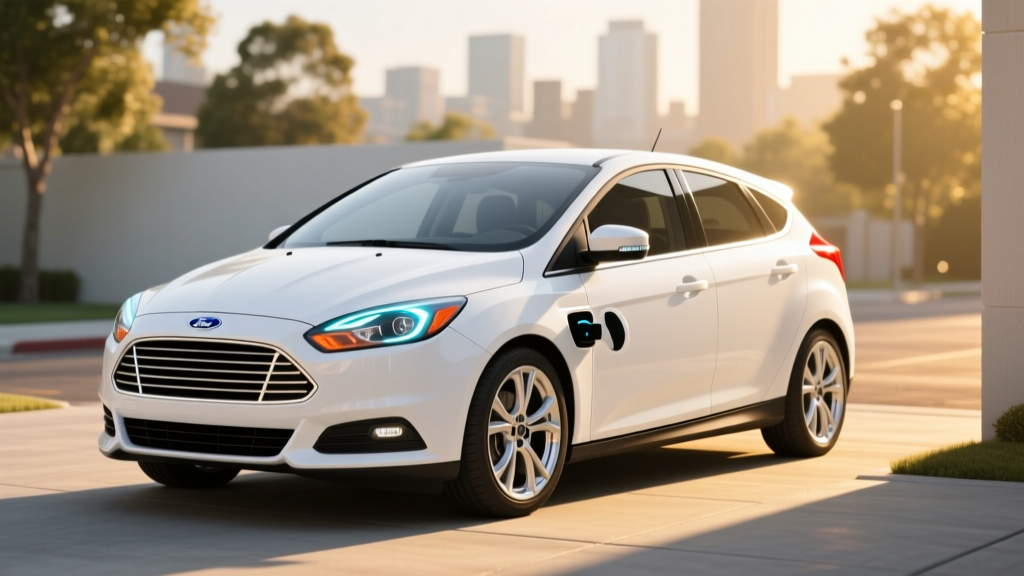
Quick Verdict: The 2014 Ford Focus Electric is a budget-priced used EV best suited as a second car or short-distance commuter. With just 76 miles of EPA-estimated range and a 23 kWh usable battery, it cannot handle road trips or cold-climate driving without serious planning. However, at used prices typically between $5,000–$9,000 in 2026, it remains one of the cheapest ways to get into a battery-electric vehicle for daily errands under 40 miles round-trip — provided you can charge at home.
Why Anyone Still Considers the 2014 Ford Focus Electric
Ford discontinued the Focus Electric after the 2018 model year, but the 2014 version still circulates on the used market as an entry-level electrified option. It was built on the third-generation Focus hatchback platform, meaning it shares the same practical five-door layout, decent cargo space (roughly 14.5 cu ft behind the rear seats), and a comfortable ride that reviewers praised even at launch.
The 2014 model year carried a 23 kWh lithium-ion battery pack (liquid-cooled, using LG Chem cells) paired with a 107 kW (143 hp) electric motor driving the front wheels. EPA-rated range was 76 miles, with a combined efficiency of 105 MPGe. These numbers were competitive in 2014 — the Nissan Leaf offered 84 miles that year — but they are severely limiting by 2026 standards, where new EVs routinely exceed 250 miles.
The question for today's buyer is not whether the Focus Electric is a good EV in the abstract. It is whether a $5,000–$9,000 used car with 76 miles of range makes financial and practical sense for your specific driving pattern.
Specs That Matter: Range, Battery, and Charging
| Specification | 2014 Ford Focus Electric |
|---|---|
| EPA Range | 76 miles |
| Real-World Range (70°F, mixed driving) | ~60–70 miles |
| Real-World Range (cold weather, below 32°F) | ~40–55 miles |
| Battery Capacity (usable) | 23 kWh |
| Battery Chemistry | Lithium-ion (NMC, LG Chem) |
| Battery Thermal Management | Liquid-cooled and heated |
| Motor Output | 107 kW (143 hp) |
| 0–60 mph | ~8.1 seconds |
| Top Speed | 84 mph (electronically limited) |
| EPA Efficiency | 105 MPGe combined |
| DC Fast Charging | Not available |
| Level 2 AC Charging (onboard charger) | 6.6 kW |
| Level 2 Charge Time (0–100%) | ~3.5–4 hours |
| Level 1 Charge Time (120V, 12A) | ~20 hours |
| Charging Port | J1772 (no CCS, no NACS) |
| Original MSRP (2014) | $35,200 (before incentives) |
| Typical Used Price (2026) | $5,000–$9,000 |
Real-World Range Reality: The EPA sticker says 76 miles, but plan for 60–70 miles in normal conditions. Highway driving at 70+ mph drops efficiency sharply — expect 50–60 miles on a full charge at interstate speeds. In winter temperatures below freezing, the liquid-cooled battery helps, but you will still see 30–40% range loss, leaving you with roughly 40–55 usable miles. If your daily round-trip commute exceeds 40 miles, this car will require mid-day charging or will not work for you.
The No-DC-Fast-Charging Problem
The 2014 Focus Electric has no DC fast-charging capability whatsoever. There is no CCS port, no CHAdeMO port, and obviously no NACS connector. You are limited to Level 2 AC charging at 6.6 kW via a J1772 inlet. A full charge from empty takes about 3.5–4 hours on a 240V Level 2 station.
This single limitation defines the car's usability. Public Level 2 chargers add roughly 22–25 miles of range per hour of plugged-in time. You cannot pull into a DC fast-charging station and add 100 miles in 20 minutes. Any trip beyond the car's one-charge radius requires either a multi-hour stop at a destination charger or a tow home. For a second car used strictly around town, this is manageable. As a primary vehicle, it is a dealbreaker for most buyers.
Cost Breakdown: Buying and Owning in 2026
At $5,000–$9,000 on the used market, the 2014 Focus Electric is among the cheapest BEVs available. But purchase price is only part of the equation. Here is what ownership actually costs compared to a comparable used gas hatchback (such as a 2014 Ford Focus gasoline model averaging 30 MPG combined).
| Cost Factor | 2014 Focus Electric | 2014 Focus Gas (30 MPG) |
|---|---|---|
| Used Purchase Price (avg.) | $7,000 | $6,500 |
| Fuel/Energy Cost (12,000 mi/yr) | $450–$650 (home charging at $0.14/kWh) | $1,400 (gas at $3.50/gal) |
| Annual Maintenance | $200–$400 | $600–$900 |
| Insurance (annual avg.) | $1,100–$1,500 | $1,000–$1,400 |
| Estimated Annual Total (fuel + maint.) | $650–$1,050 | $2,000–$2,300 |
| 5-Year Fuel/Maint. Savings vs. Gas | ~$5,000–$7,000 saved with EV | |
Key takeaway: The Focus Electric saves roughly $1,000–$1,400 per year in fuel and maintenance over the gas equivalent. Over five years of ownership, that translates to $5,000–$7,000 in savings — effectively paying for the car itself. The math works best if you charge at home on a standard electricity rate. Public Level 2 charging (often $0.25–$0.49/kWh) erodes savings significantly.
Maintenance Advantages
Electric vehicles eliminate oil changes, spark plugs, timing belts, and exhaust system repairs. The Focus Electric's regenerative braking also extends brake pad life considerably — many owners report original brake pads lasting 80,000+ miles. The primary maintenance items are cabin air filter replacement, tire rotation, brake fluid checks, and coolant system service for the battery thermal management loop.
Battery Replacement Risk
This is the single biggest financial risk. A 2014 Focus Electric is now 12 years old. The liquid-cooled battery pack has held up better than the passive-air-cooled packs in early Nissan Leafs, but degradation is inevitable. Expect 15–25% capacity loss at this age, meaning your real-world range may be closer to 55–65 miles even in ideal conditions. A replacement battery pack, if available through Ford or a third-party rebuilder, can cost $6,000–$10,000 — potentially exceeding the car's value. Before purchasing, request a battery health diagnostic or use an OBD-II reader with EV-compatible software (such as LeafSpy-style tools adapted for Ford) to check the State of Health (SoH) percentage.
EV vs. Gas vs. Hybrid: Which Makes Sense?
| Factor | 2014 Focus Electric (Used BEV) | Used Gas Hatchback | Used PHEV (e.g., Prius Prime) |
|---|---|---|---|
| Used Price (2026) | $5,000–$9,000 | $5,000–$10,000 | $12,000–$18,000 |
| Daily Range | 60–70 mi (real-world) | 350+ mi | ~25 mi electric + 500+ mi gas |
| Annual Fuel Cost | $450–$650 | $1,200–$1,600 | $500–$900 |
| Road-Trip Capable? | No | Yes | Yes |
| Home Charging Required? | Strongly recommended | No | Recommended but optional |
| Cold-Weather Range Loss | 30–40% | Negligible | Minimal (gas engine supplements) |
| Federal Tax Credit (used) | Up to $4,000 (§25E, income-limited) | None | Up to $4,000 (§25E, income-limited) |
The Focus Electric wins on operating cost but loses on versatility. If your household has a second vehicle for longer trips, and your daily driving stays under 40 miles, the EV math is compelling. If this is your only car, a used PHEV like a Toyota Prius Prime offers electric commuting with gas-engine flexibility — at a higher purchase price but far less range anxiety.
Common Misconceptions: Myth vs. Fact
| Myth | Fact |
|---|---|
| "It qualifies for the full $7,500 federal tax credit." | The §30D new-vehicle credit applies only to new EV purchases. Used EV buyers may qualify for the §25E credit of up to $4,000 (30% of sale price, capped at $4,000), subject to income limits ($75K single / $150K joint) and a dealer-reporting requirement. The vehicle must be purchased from a licensed dealer, not a private party. |
| "76 miles of range is enough for anyone's commute." | The average US one-way commute is roughly 16 miles, but that masks wide variation. If your round-trip exceeds 40 miles — or you make side trips for errands, school, or appointments — 60–70 real-world miles may not suffice, especially in winter. |
| "The battery will need replacing immediately." | Not necessarily. The liquid-cooled pack degrades more slowly than air-cooled alternatives. Many 2014 Focus Electrics still retain 75–85% of original capacity. However, you should budget for eventual replacement or accept further range loss over time. |
| "I can use Tesla Superchargers." | No. The Focus Electric uses a J1772 port and has no DC fast-charging hardware. Even with adapters, it cannot connect to Superchargers, CCS stations, or CHAdeMO stations. You are limited to Level 2 AC public chargers and home charging. |
| "Electric cars have no maintenance costs." | Lower maintenance, not zero. You still need tire rotations, cabin filters, brake fluid, windshield wipers, and coolant service. The 12V auxiliary battery also needs replacement every 4–6 years, just like in a gas car. |
Who Should Buy the 2014 Ford Focus Electric?
Buy it if:
- Your daily driving is under 40 miles round-trip, predictable, and mostly local
- You have reliable access to Level 2 home charging (a 240V outlet or installed wallbox)
- This is a second vehicle in a multi-car household
- You want the lowest possible cost-per-mile for commuting
- You live in a moderate climate (not extreme cold)
- You can verify battery State of Health before purchase (ideally above 80% SoH)
Skip it if:
- This would be your only car
- Your commute exceeds 40 miles round-trip or involves significant highway driving
- You live in an apartment or lack access to home or workplace charging
- You regularly drive in temperatures below 20°F
- You need to take road trips of 100+ miles without a backup vehicle
- The battery SoH is below 75% and you cannot negotiate a significant price reduction
Pre-Purchase Checklist for Buyers
- Battery State of Health: Insist on a diagnostic reading. Accept only packs above 80% SoH unless the price reflects a future replacement.
- Charging Equipment: Confirm the car includes its original Level 1 (120V) charging cord. Verify whether a Level 2 home charger is included or budget $500–$1,200 for a new unit plus $800–$2,000 for electrician installation if you need a 240V circuit.
- Service History: Look for records of coolant system service on the battery thermal loop. Neglected coolant can lead to battery overheating or accelerated degradation.
- Tire Condition: EVs are heavier than their gas counterparts (the Focus Electric weighs roughly 3,624 lbs). Check for uneven wear that might indicate alignment issues.
- Software Updates: Ford issued several software updates for the Focus Electric's battery management and charging systems. Confirm these were applied at a dealership.
- Title and Recall Status: Check the VIN against NHTSA's recall database for any open recalls, including those related to the battery pack or charging system.
Charging at Home: What You Need
Home charging is essentially mandatory for the Focus Electric. Relying solely on public Level 2 infrastructure is impractical given the 3.5–4 hour charge time and the car's limited range.
Level 1 (120V household outlet): The included cord delivers roughly 1.4 kW, adding about 5–6 miles of range per hour. A full charge from empty takes approximately 20 hours. This works only if you drive very little and can leave the car plugged in overnight every night.
Level 2 (240V, 30–40A circuit): A dedicated Level 2 wallbox at 6.6 kW (matching the car's onboard charger maximum) adds roughly 22–25 miles per hour and fully charges the pack in 3.5–4 hours. Installation typically costs $800–$2,000 depending on your electrical panel's capacity and the distance from panel to charger location. If your home has a 100-amp electrical panel that is already near capacity, a panel upgrade to 200 amps can add $1,500–$3,000 to the project.
The J1772 connector used by the Focus Electric is the standard AC charging connector for all non-Tesla EVs sold in North America. Any Level 2 home charger with a J1772 plug will work. If you plan to eventually upgrade to a newer EV with a NACS port, consider a home charger that supports both or plan for a future adapter.
Frequently Asked Questions
Is the 2014 Ford Focus Electric a good buy in 2026?
It depends entirely on your use case. For a second car used for short local trips with home charging, it offers very low operating costs at a bargain purchase price. As a primary or sole vehicle, its 76-mile EPA range, lack of DC fast charging, and age-related battery degradation make it impractical for most drivers.
How long will the battery last?
At 12 years old, expect 75–85% of original capacity remaining in a well-maintained pack. The liquid-cooled thermal management system gives this battery an advantage over passively cooled packs from the same era. With proper care, the pack may last another 4–6 years before dropping below 70% capacity — the point at which range becomes noticeably restrictive.
Can I take road trips in the Focus Electric?
Realistically, no. Without DC fast charging, every recharge stop takes 3–4 hours. A 200-mile trip would require at least two multi-hour charging stops, assuming you can find Level 2 chargers along your route. This car is a local commuter, not a road-trip vehicle.
Does it qualify for any tax credits?
The new-vehicle §30D credit no longer applies. However, the §25E used clean vehicle credit may provide up to $4,000 (30% of the sale price, capped at $4,000). Eligibility requires: purchase from a licensed dealer (not private party), buyer income below $75,000 (single) or $150,000 (joint), and the vehicle must have a sale price of $25,000 or less — which the Focus Electric easily meets. The credit is non-refundable and can only reduce your tax liability to zero, not generate a refund. Consult a tax professional for your specific situation.
How does the Focus Electric compare to a used Nissan Leaf from the same year?
The 2014 Leaf offered 84 miles of EPA range versus the Focus Electric's 76 miles, and the Leaf had optional CHAdeMO DC fast charging (50 kW), which the Focus Electric lacks entirely. However, the Leaf's battery is passively air-cooled, leading to faster degradation in hot climates. The Focus Electric's liquid-cooled pack generally ages better. If DC fast charging matters to you, the Leaf is the better choice; if long-term battery health is your priority, the Focus Electric has the edge.
What happens if the battery fails?
Ford's original battery warranty was 8 years/100,000 miles — long expired on a 2014 model. Third-party EV battery rebuilders can sometimes refurbish the pack for $4,000–$7,000, and full replacement packs (if available) cost $6,000–$10,000. This cost can easily exceed the car's value, which is why verifying battery SoH before purchase is critical.
The 2014 Ford Focus Electric occupies a narrow niche in 2026: an ultra-budget commuter EV for disciplined drivers with short routes and reliable home charging. Its operating costs are genuinely compelling, and its driving dynamics remain pleasant. But its severe range limitations, total lack of fast charging, and aging battery demand clear-eyed evaluation before purchase. Know your commute, test the battery, and make sure this car fits your life — not just your budget.