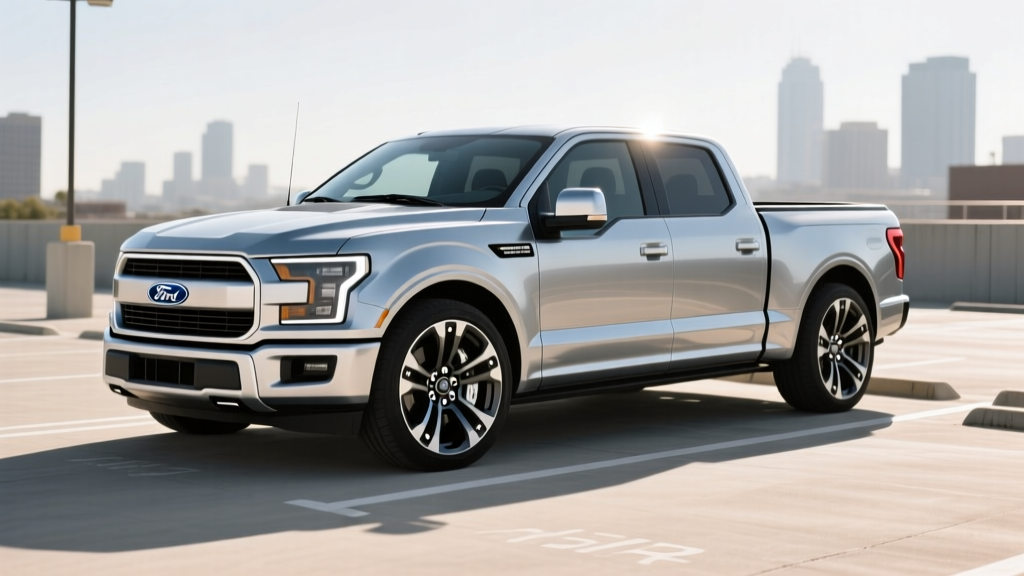
If you own a 2014 Ford F-150 and are exploring aftermarket wheels, an electric drivetrain swap, or simply want to understand your truck's hub compatibility, the bolt pattern is where every modification starts. The 2014 F-150 uses a 6x135mm bolt pattern — six lug nuts arranged on a 135-millimeter bolt circle diameter. This spec governs which wheels bolt on, which hub-centric rings you need, and whether components from modern electric trucks like the Ford F-150 Lightning or Rivian R1T can cross over.
In this guide, we decode the 2014 F-150 bolt pattern in detail, compare it to today's electric pickup platforms, and explore the mechanical realities of converting a 12th-generation F-150 to electric power — including range expectations, charging logistics, and cost.
2014 F-150 Bolt Pattern: The Exact Specifications
The 12th-generation Ford F-150 (model years 2009–2014) shares a single bolt pattern across all trims — XL, XLT, Lariat, King Ranch, Platinum, and the high-performance SVT Raptor.
| Specification | Value |
|---|---|
| Bolt Pattern | 6x135mm (6 lug, 135mm circle) |
| Center Bore | 87.1mm |
| Lug Nut Thread Size | M14 x 2.0 |
| Stock Wheel Sizes | 17" / 18" / 20" / 22" (Raptor) |
| Typical Offset Range | +30mm to +44mm (varies by wheel) |
| Lug Nut Torque Spec | 150 lb-ft (203 Nm) |
The 87.1mm center bore is critical: wheels with a smaller bore won't physically mount, while wheels with a larger bore require hub-centric rings to eliminate vibration above 60 mph. Always torque lug nuts to 150 lb-ft in a star pattern — under-torqued lugs on a 5,000+ lb truck can lead to stud fatigue and wheel separation.
How the 2014 F-150 Bolt Pattern Compares to Modern Electric Trucks
If you're researching the 2014 F-150 bolt pattern because you're comparing it to an electric pickup, here's how the legacy platform stacks up against current BEV trucks on the market.
| Vehicle | Bolt Pattern | Center Bore | Platform Type |
|---|---|---|---|
| 2014 Ford F-150 | 6x135mm | 87.1mm | Body-on-frame (steel) |
| 2025 Ford F-150 Lightning | 6x135mm | 87.1mm | Modified body-on-frame (steel + aluminum cab) |
| 2025 Rivian R1T | 6x139.7mm (6x5.5") | 106.1mm | Skateboard monocoque |
| 2025 Chevrolet Silverado EV | 6x139.7mm (6x5.5") | 78.1mm | BT1 skateboard (Ultium) |
| 2025 GMC Sierra EV | 6x139.7mm (6x5.5") | 78.1mm | BT1 skateboard (Ultium) |
| 2025 Tesla Cybertruck | 6x139.7mm (6x5.5") | 110.1mm | Stainless exoskeleton |
The headline takeaway: the F-150 Lightning retains the exact 6x135mm bolt pattern as the 2014 F-150. That means many aftermarket wheels designed for the 12th-gen F-150 will physically bolt onto a Lightning, provided the offset and load rating are compatible with the Lightning's heavier curb weight (roughly 6,000–6,500 lbs vs. the 2014's ~4,800–5,600 lbs). Rivian, GM's BT1 trucks, and Tesla use the more common 6x139.7mm pattern — nothing from those platforms cross-fits a 2014 F-150 without adapters.
Converting a 2014 F-150 to Electric: What's Actually Involved
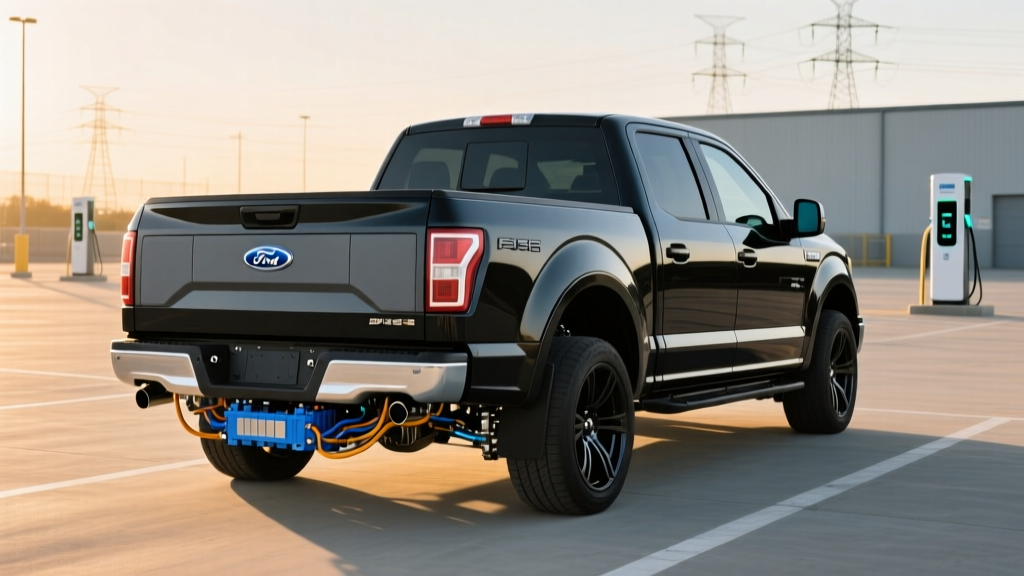
The 12th-generation F-150's body-on-frame architecture makes it one of the more popular candidates for EV conversions. The engine, transmission, fuel tank, and exhaust can be removed, leaving a clean frame to mount electric motors and battery modules. Several conversion shops and DIY builders have completed these projects. Here's a realistic breakdown.
Typical EV Conversion Specs (2014 F-150)
| Component | Typical Specification |
|---|---|
| Motor | Tesla Large Drive Unit or NetGain HyPer 9 (single rear motor, RWD) |
| Battery Capacity | 40–75 kWh (salvaged Tesla, Nissan LEAF, or Chevy Volt modules) |
| Battery Chemistry | NMC (most common in salvage modules) |
| EPA-Equivalent Range | 60–120 miles (depending on pack size and truck weight) |
| Charging (Level 2) | 6.6–11.5 kW onboard charger (30–50 miles/hr) |
| DC Fast Charging | Rare — most conversions lack CCS/CHAdeMO capability |
| 0-60 mph | 6.5–9.0 seconds (motor and pack dependent) |
| Horsepower | 200–450 HP (motor dependent) |
| Conversion Cost | $15,000–$40,000+ (parts + labor) |
Key Conversion Challenges
- Weight distribution: Batteries are heavy. Mounting 800+ lbs of modules in the bed without reinforcement can overload the rear axle and degrade handling. Proper conversions distribute battery weight between the frame rails and the former engine bay.
- Power steering and brakes: The 2014 F-150 uses an engine-driven power steering pump and vacuum booster. Conversions must add an electric power steering pump and an electric vacuum pump (or upgrade to a hydroboost system) to maintain safe braking and steering.
- No DC fast charging: Most DIY conversions rely on Level 2 AC charging only. Without a CCS or CHAdeMO integration (which requires a high-voltage BMS handshake and expensive hardware), road-trip charging isn't practical. This is the single biggest limitation versus buying a factory EV truck.
- Registration and insurance: Converted vehicles require a state inspection, a new title designation (often "converted" or "specially constructed"), and specialized insurance. Some states make this straightforward; others are bureaucratic nightmares. Check your local DMV before starting.
- No tax credits: IRS §30D federal tax credits apply only to new, factory-built EVs from qualified manufacturers. A DIY conversion of a 2014 F-150 does not qualify for the $7,500 credit. Neither does a used EV conversion.
2025 Ford F-150 Lightning: The Factory Electric Alternative
If the goal is an electric F-150, the factory-built Lightning is the path of least resistance — and it shares the same 6x135mm bolt pattern as your 2014 truck, so wheel compatibility carries over.
| Spec | Standard Range | Extended Range |
|---|---|---|
| EPA Range | 240 miles | 320 miles |
| Battery Capacity | 98 kWh (usable), NMC | 131 kWh (usable), NMC |
| Max DC Fast Charge | 150 kW | 150 kW (peak; sustained ~110 kW) |
| 10–80% DC Charge Time | ~38 minutes | ~41 minutes |
| Level 2 Home Charging | 11.3 kW (~26 mi/hr) or 19.2 kW (~44 mi/hr) with optional charger | 19.2 kW (~31 mi/hr) |
| 0–60 mph | ~5.0 sec | ~3.8 sec |
| Horsepower | 452 HP (dual-motor AWD) | 580 HP (dual-motor AWD) |
| Towing Capacity | 7,700 lbs | 10,000 lbs |
| MPGe (Combined) | 68 MPGe | 66 MPGe |
| Cargo Volume (Bed) | 52.8 cu ft (5.5' bed) | 52.8 cu ft (5.5' bed) |
| Frunk Volume | 14.1 cu ft | 14.1 cu ft |
| Battery Warranty | 8 years / 100,000 miles (≥70% capacity retention) | |
| Base MSRP (2025) | ~$54,995 (Pro) – $96,874 (Platinum) | |
F-150 Lightning Tax Credit Eligibility (2025–2026)
The F-150 Lightning's eligibility for the IRS §30D federal tax credit depends on several factors that change regularly:
- MSRP Cap: Pickup trucks must have an MSRP at or below $80,000 to qualify. This eliminates the Platinum and some high-trim Extended Range configurations.
- Buyer Income Cap: Modified adjusted gross income must not exceed $150,000 (single), $225,000 (head of household), or $300,000 (joint).
- Battery Sourcing: Critical minerals and battery components must meet phased-in domestic-content thresholds. Ford has worked to qualify partial or full credits, but specific eligibility varies by build date and supply chain sourcing. Always verify via the IRS's official qualifying vehicle list at the time of purchase.
- Point-of-Sale Transfer: Eligible buyers can transfer the credit to the dealer at purchase, reducing the sale price directly rather than waiting for a tax refund.
For a qualifying buyer purchasing an F-150 Lightning XLT Standard Range (~$59,995 MSRP), the potential credit is up to $7,500 — bringing the effective price to roughly $52,495 before state incentives. Consult a tax professional for your specific situation.
Which Path Makes Sense: Conversion, Lightning, or Keeping the 2014 Gas Truck?
Here's a practical decision framework based on your actual use case.
✅ Choose EV Conversion If...
- You want a weekend project with strong DIY mechanical skills
- Your daily commute is under 50 miles round-trip
- You have Level 2 home charging and rarely road-trip
- You value keeping and electrifying your existing truck
- You accept no DC fast charging and no factory warranty
✅ Choose F-150 Lightning If...
- You need a reliable daily driver with a full factory warranty
- You tow regularly (up to 10,000 lbs)
- You want DC fast charging for road trips (150 kW CCS)
- You qualify for the §30D tax credit (up to $7,500)
- You need Pro Power Onboard for job-site or camping use
✅ Keep the 2014 Gas F-150 If...
- You regularly drive 300+ miles between fuel stops
- You lack reliable home Level 2 charging access
- Your budget doesn't support a $55K+ new truck or $20K+ conversion
- You live in an area with sparse public DC charging infrastructure
Pros and Cons at a Glance
Pros: 2014 F-150 EV Conversion
- 6x135mm bolt pattern shares wheels with Lightning
- Body-on-frame simplifies motor and battery mounting
- Low base cost if you already own the truck
- Customizable power output and battery size
- Instant torque transforms the driving experience
- No emissions in daily driving
Cons: 2014 F-150 EV Conversion
- 60–120 mile range vs. Lightning's 240–320 miles
- No DC fast charging on most conversions
- $15K–$40K+ cost with no tax credit eligibility
- No factory warranty — you are the warranty
- Registration/insurance complexity varies by state
- Cold-weather range loss of 20–30% without thermal management
- Resale value is uncertain and niche
Frequently Asked Questions
What is the bolt pattern on a 2014 Ford F-150?
The 2014 Ford F-150 uses a 6x135mm bolt pattern with six lug nuts on a 135-millimeter bolt circle diameter. The center bore is 87.1mm, and lug nuts are M14 x 2.0 thread, torqued to 150 lb-ft.
Will 2014 F-150 wheels fit a Ford F-150 Lightning?
Yes — the F-150 Lightning uses the same 6x135mm bolt pattern and 87.1mm center bore. However, verify that the wheel's load rating is sufficient for the Lightning's heavier curb weight (up to 6,500 lbs). Offset and width should also be checked for clearance with the Lightning's brake calipers and suspension.
How much does it cost to convert a 2014 F-150 to electric?
A professional EV conversion typically costs $25,000–$40,000 including parts and labor. A DIY conversion using salvaged battery modules and a used Tesla drive unit can be done for $15,000–$20,000 if you have the skills. Neither qualifies for the federal EV tax credit.
What range can I expect from a converted 2014 F-150?
Most conversions with a 50–75 kWh battery pack deliver 70–120 miles of mixed-use range. Highway driving and cold weather reduce that significantly. For comparison, the factory F-150 Lightning Extended Range achieves 320 miles EPA.
Does the F-150 Lightning qualify for the $7,500 federal tax credit?
It can, depending on trim MSRP (must be ≤$80,000 for trucks), buyer income (≤$300,000 joint), and battery sourcing compliance. Eligibility changes as supply chains shift. Always check the IRS qualifying vehicles list before purchasing.
Can I use wheel adapters to fit 6x139.7mm wheels on a 2014 F-150?
Yes, 6x135mm-to-6x139.7mm adapters exist and are commonly used to fit wheels from Toyota, GM, and Rivian platforms. However, adapters add unsprung weight, alter offset, and can introduce vibration or stress on wheel studs if not precisely manufactured. Use hub-centric adapters from a reputable brand and re-torque after the first 50 miles.
What's the best wheel upgrade for a 2014 F-150 used for towing?
Prioritize load rating over aesthetics. Look for 6x135mm wheels rated at 3,000+ lbs per wheel (matching or exceeding your Gross Axle Weight Rating). Forged or flow-formed aluminum wheels offer the best strength-to-weight ratio. Keep the offset within +30mm to +44mm to avoid bearing wear and suspension geometry issues.