Quick Answer: The 2014 Chevy Spark EV is a budget-friendly used electric commuter with an EPA-estimated 82 miles of range, an 82 kW (110 hp) permanent-magnet motor, and a 21.3 kWh usable LG Chem NMC battery. In 2026, expect to pay between $5,500 and $9,000 on the used market. It's best suited as a second car for city commuting with reliable home charging access — not a road-trip vehicle. Federal used-EV tax credits (§25E) may apply if purchased from a dealer for under $25,000, but most Spark EVs fall below the income-cap threshold for the $4,000 credit. Battery degradation of 10–20% is typical after 12 years, so a pre-purchase battery health check is essential.
2014 Spark EV At a Glance: Key Specs
| Spec | 2014 Chevy Spark EV |
|---|---|
| EPA Range | 82 miles |
| Real-World Range (city/commute) | 65–80 miles |
| Real-World Range (highway/cold) | 50–65 miles |
| Battery Capacity (usable) | 21.3 kWh (NMC, LG Chem) |
| Motor Output | 82 kW / 110 hp / 400 lb-ft torque |
| 0–60 mph | ~7.6 seconds |
| DC Fast Charge (SAE Combo/CCS1) | Up to 50 kW (optional on some trims) |
| Level 2 Charge Rate | 3.3 kW (onboard charger) |
| Level 2 Time (0–100%) | ~7 hours |
| DC Fast Charge (10–80%) | ~20–30 minutes (if equipped) |
| MPGe (combined) | 119 MPGe |
| EPA Efficiency | 28 kWh/100 mi |
| Cargo Volume | 9.6 cu ft (rear seats up) |
| Original MSRP | ~$27,170 (before incentives) |
| 2026 Used Price Range | $5,500–$9,000 |
| Battery/Powertrain Warranty (original) | 8 years / 100,000 miles |
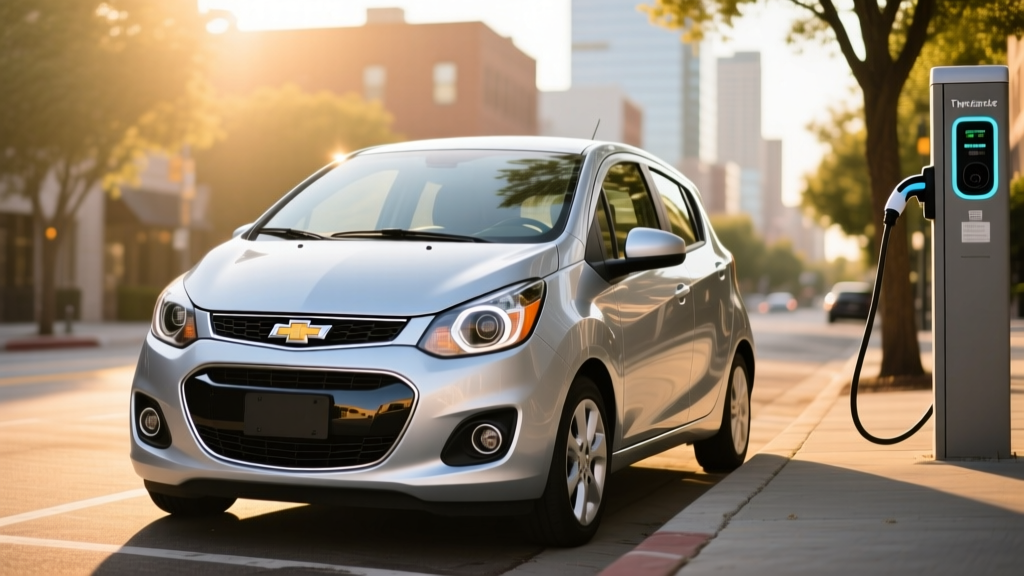
The 2014 Spark EV was Chevrolet's first purpose-built compliance EV, sold primarily in California and Oregon to meet zero-emission vehicle mandates. It shares its platform with the gasoline Spark but swaps the engine for an electric motor and a liquid-cooled lithium-ion pack. For its era, the motor output was surprisingly punchy — 400 lb-ft of torque delivered instantly makes this a genuinely quick city car.
Real-World Range: What to Expect in 2026
The EPA sticker says 82 miles, but a 12-year-old NMC battery will not deliver that new. Here's how range breaks down in real-world conditions:
EPA Range: 82 miles (new battery, 2014)
Expected Range in 2026: 65–80 miles in mild city driving with a battery at ~85% State of Health (SoH). Highway driving at 70 mph drops this to roughly 50–65 miles. In winter temperatures below 32°F, expect a further 20–30% reduction — meaning as little as 40–50 miles on a full charge in cold, highway-heavy conditions.
The Spark EV's 21.3 kWh usable battery (from a 23 kWh gross pack) was modest even in 2014. After 10–12 years of cycling, NMC chemistry typically retains 80–90% of original capacity depending on how the car was charged and stored. A vehicle that was repeatedly DC fast-charged or regularly stored at 100% SoC in hot climates will show more degradation.
Pre-purchase tip: Ask the seller to fully charge the vehicle and note the estimated range displayed. Alternatively, an OBD-II reader with EV battery diagnostic capability (such as LeafSpy-equivalent tools for GM) can report actual battery capacity in kWh. If the usable capacity has dropped below ~17 kWh, plan for significantly reduced range.
Charging: Speeds, Connectors, and Home Setup
The Spark EV uses a J1772 connector for Level 1 and Level 2 AC charging. Some 2014 models were equipped with an optional SAE Combo (CCS1) DC fast-charge port — this was a dealer-installed option and is not universal. Verify before purchasing.
| Charging Level | Connector | Max kW | Miles Added per Hour | 0–100% / 10–80% Time |
|---|---|---|---|---|
| Level 1 (120V household) | J1772 | ~1.2 kW | ~4 mi/hr | ~18+ hours |
| Level 2 (240V home/public) | J1772 | 3.3 kW | ~12 mi/hr | ~7 hours (full) |
| DC Fast Charge (if equipped) | CCS1 | ~50 kW | ~100+ mi/hr (peak) | ~20–30 min (10–80%) |
The 3.3 kW onboard charger limitation: The Spark EV's onboard AC charger maxes out at 3.3 kW. Even if you plug into a 7.2 kW or 11.5 kW Level 2 public charger, the car will only accept 3.3 kW. This means a full charge from empty takes roughly 7 hours on any Level 2 station — adequate for overnight home charging but slow for mid-day top-ups.
DC fast charging caveat: The 50 kW CCS1 option (when equipped) was competitive for 2014 but is slow by 2026 standards. At a modern 150–350 kW Electrify America or EVgo station, the Spark EV will still peak around 50 kW, and the charge curve tapers significantly above 80% SoC to protect the battery. Expect 10–80% in about 20–30 minutes under ideal battery-temperature conditions.
Home charging setup: Most Spark EV owners charge on a standard 120V outlet (Level 1), which adds roughly 4 miles per hour — enough to recover a 40-mile commute overnight (about 10 hours). A 240V Level 2 home installation (requiring a NEMA 14-50 outlet or hardwired EVSE) costs $500–$1,800 depending on electrical panel capacity and run length, according to typical electrician estimates. Always consult a licensed electrician for final installation specs.
Used Spark EV vs. Gas Car vs. Hybrid: Cost Breakdown
At $5,500–$9,000, the used Spark EV undercuts most new and used alternatives. But the real value question is total cost of ownership. Here's a 5-year comparison assuming 10,000 miles/year, $0.14/kWh home electricity, and $3.50/gallon gas:
| Cost Category | 2014 Spark EV (Used) | 2014 Honda Fit (Gas) | 2014 Toyota Prius (Hybrid) |
|---|---|---|---|
| Purchase Price | $7,000 | $8,500 | $10,500 |
| Annual Fuel/Energy (10k mi) | $392 (2,800 kWh) | $1,060 (303 gal) | $700 (200 gal) |
| 5-Year Fuel/Energy Total | $1,960 | $5,300 | $3,500 |
| Annual Maintenance | ~$150 | ~$550 | ~$450 |
| 5-Year Maintenance | $750 | $2,750 | $2,250 |
| Insurance (avg annual) | ~$900 | ~$950 | ~$950 |
| 5-Year Insurance | $4,500 | $4,750 | $4,750 |
| 5-Year Total Cost | $14,210 | $16,550 | $16,250 |
The Spark EV saves roughly $2,000–$2,300 over five years compared to a comparable gas subcompact, driven mostly by dramatically lower fuel and maintenance costs. There's no oil to change, no spark plugs, no transmission fluid, and regenerative braking extends pad life significantly. The main financial risk is battery replacement — though at this price point, a total battery failure would likely exceed the car's value.
According to fueleconomy.gov, the Spark EV's 119 MPGe combined rating was among the best of any 2014 vehicle. Its 28 kWh/100 mi efficiency figure means you're spending roughly 3.9 cents per mile on electricity at the national average rate — versus 10.6 cents per mile in a 33 MPG gas car.
Battery Health, Degradation, and Replacement Risk
This is the single most important factor when buying a 12-year-old EV. The Spark EV's 21.3 kWh NMC (nickel-manganese-cobalt) pack was manufactured by LG Chem and is liquid-cooled — a significant advantage over the passively cooled Nissan Leaf of the same era, which suffered accelerated degradation in hot climates.
Typical degradation data for 2014-era NMC packs:
- Year 1–3: ~2–5% capacity loss
- Year 4–7: ~5–10% cumulative loss
- Year 8–12: ~10–20% cumulative loss (highly dependent on charging habits and climate)
A Spark EV with 15% degradation will have roughly 18 kWh of usable capacity, translating to about 65–70 miles of real-world range. This is livable for short commutes but eliminates any margin for detours, cold weather, or highway driving.
Battery replacement cost: As of 2026, a replacement battery pack for the Spark EV is difficult to source and can cost $5,000–$8,000 if found — effectively totaling the vehicle. The original 8-year/100,000-mile battery warranty has expired for all 2014 models. Some salvage yards and EV recyclers offer used packs at lower prices, but availability is inconsistent. Factor this risk into your purchase decision: if the battery fails, the car is likely a write-off.
What to check before buying:
- Full-charge range estimate on the dashboard (compare to 82-mile EPA original)
- Charging history — was it mostly Level 2 at home, or frequent DC fast charging?
- Climate history — cars from Arizona/Nevada may show more heat-related degradation
- Any warning lights or reduced-power modes indicating cell imbalance
Common Misconceptions About the Spark EV
| Myth | Fact |
|---|---|
| "82 miles of range is useless" | The average American drives 37 miles per day (FHWA data). An 82-mile range covers most daily commutes with margin — if you can charge at home overnight. |
| "The battery will need replacing soon" | Liquid-cooled NMC packs from LG Chem have shown good longevity. Many 2014 Spark EVs still retain 80–88% of original capacity. Failure is not inevitable. |
| "It charges on any fast charger" | Only Spark EVs equipped with the optional CCS1 DC port can fast-charge. Many were sold without it. Verify the charge port configuration — look for the two additional DC pins below the J1772 connector. |
| "It qualifies for the $7,500 federal tax credit" | The §30D new-vehicle credit does not apply to used purchases. The §25E used-EV credit offers up to $4,000 (30% of sale price, capped at $4,000) but only from licensed dealers, with income caps ($75k single / $150k married) and a $25,000 maximum sale price. See IRS §25E guidelines. |
| "It's too old to be practical" | At $6,000–$8,000 with $400/year in electricity, it's one of the cheapest-per-mile vehicles on the road — if your commute fits the range envelope. |
Who Should Buy a Used 2014 Spark EV?
Buy it if:
- Your daily round-trip commute is under 50 miles
- You have reliable home charging (garage, driveway, or dedicated outlet)
- You need an affordable second car for errands and commuting
- You live in a mild climate (coastal California, Pacific Northwest)
- You want the lowest possible cost-per-mile and can accept the range limitation
- You're comfortable with the risk that a battery failure would total the vehicle
Skip it if:
- Your commute exceeds 50 miles round-trip or includes significant highway driving
- You lack home charging access and would rely entirely on public infrastructure
- You live in a region with sustained sub-freezing winters (range drops to 40–50 miles)
- You need a primary/only vehicle for a household
- You regularly take trips over 80 miles
- You cannot afford the financial risk of a potential battery replacement
Ownership Practicalities: What First-Time EV Buyers Should Know
Maintenance is minimal. The Spark EV has no engine oil, no timing belt, no exhaust system, and no multi-speed transmission. Brake pads last far longer than on gas cars thanks to regenerative braking. Budget roughly $100–$200/year for cabin air filter replacement, wiper fluid, tire rotation, and brake fluid checks. Tires are a standard wear item — the Spark EV's 185/60R15 tires are inexpensive to replace.
Insurance is reasonable. The Spark EV is a low-value, low-speed commuter car, and insurers typically price it similarly to a gas Spark. Expect $75–$110/month depending on your driving record and state.
Parts availability is a concern. Chevrolet discontinued the Spark EV after 2016, and the gasoline Spark ended in the US after 2022. Body panels, interior trim, and EV-specific components (onboard charger, charge port assembly) are increasingly sourced from salvage yards. Mechanical parts shared with the gas Spark remain available, but the powertrain is unique to the EV.
Resale value will continue to decline. As newer, longer-range used EVs (Chevy Bolt, Nissan Leaf, early Tesla Model 3) drop below $12,000–$15,000, the Spark EV's appeal narrows further. Plan to drive it until it's no longer viable rather than expecting any resale return.
Frequently Asked Questions
Can I road-trip in a 2014 Chevy Spark EV?
Not practically. With 50–80 miles of real-world range and slow 3.3 kW AC charging (or 50 kW DC if equipped), a 200-mile trip would require 3–4 charging stops of 30–60 minutes each. It's technically possible on corridors with reliable CCS1 chargers, but the experience is tedious and stressful compared to modern long-range EVs.
Does the 2014 Spark EV qualify for any tax credits in 2026?
The §30D new-vehicle credit is unavailable. The §25E used clean vehicle credit may provide up to $4,000 (30% of the sale price) if you buy from a licensed dealer, your income is below the cap ($75,000 single / $112,500 head of household / $150,000 married filing jointly), and the sale price is under $25,000. Since most Spark EVs sell for $5,500–$9,000, the maximum credit would be 30% of the actual sale price — roughly $1,650–$2,700. Confirm eligibility with a tax professional and review IRS §25E rules.
Is the Spark EV safe?
The Spark EV received a 4-star overall rating from NHTSA (out of 5). It includes standard stability control, antilock brakes, and 10 airbags. However, it lacks modern ADAS features like automatic emergency braking, lane-keeping assist, or blind-spot monitoring — all common on 2020+ vehicles. It is adequate for low-speed urban driving but not comparable to modern safety standards.
What happens if the battery dies completely?
A complete battery failure on a 2014 Spark EV is effectively a total loss. Replacement packs cost $5,000–$8,000 — often exceeding the car's market value. Some owners have sourced used packs from salvage vehicles for $2,000–$4,000, but installation labor adds $1,000–$2,000 and compatibility is not guaranteed. This is the primary financial risk of owning an aging, low-value EV.
Can I charge the Spark EV at Tesla Superchargers?
No. The Spark EV uses J1772 (AC) and optionally CCS1 (DC). Tesla Superchargers use the NACS connector, and there is no adapter that allows a CCS1 vehicle to charge at a NACS-only Supercharger. You can use J1772-compatible Level 2 destination chargers with a Tesla-to-J1772 adapter (such as the TeslaTap), but not DC Superchargers.
How does the Spark EV compare to a used Nissan Leaf or Chevy Bolt?
The 2014 Nissan Leaf offers a similar 84-mile EPA range but uses passive air cooling, making it more susceptible to heat-related battery degradation and rapid-charge throttling (known as "Rapidgate"). The Chevy Bolt (2017+, 238-mile range) is a far more capable vehicle but costs $12,000–$16,000 used. If your budget can stretch to a Bolt, it's a significantly better long-term choice. If your budget is strictly under $9,000 and your commute is short, the Spark EV remains viable.