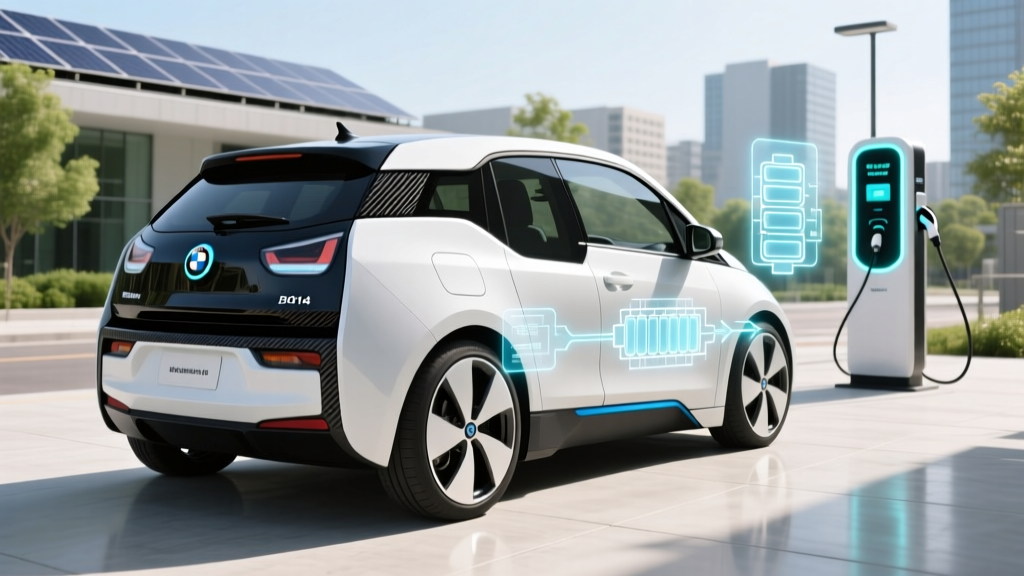
The 2014 BMW i3 was one of the first mass-produced electric vehicles to arrive with a carbon-fiber passenger cell, a purpose-built EV platform, and a quirky, city-focused design. More than a decade later, it remains a popular entry on the used-EV market for buyers who want premium German engineering at a bargain price. But with an EPA-estimated 81 miles of range and a modest 22 kWh battery, is the 2014 BMW i3 electric car still a practical daily driver in 2026? This review breaks down the real-world range, charging speeds, ownership costs, and the specific trade-offs you need to know before buying one today.
Quick Verdict: Who the 2014 BMW i3 Is For
The 2014 i3 is a city commuter first and a road-tripper never. Its carbon-fiber-reinforced plastic (CFRP) construction keeps weight low, its 25-foot turning circle makes it nimble in tight urban streets, and its 125 MPGe combined efficiency is genuinely excellent. But 81 miles of EPA range — closer to 60–70 in cold weather or at highway speeds — means this car demands a predictable routine and reliable home charging. If your commute is under 30 miles round-trip and you can charge at home every night, the i3 delivers a surprisingly premium experience at a used price typically between $7,000 and $13,000. If you need flexibility for longer trips, look at a used Chevrolet Bolt EV or Nissan Leaf with a larger battery.
Range, Battery, and Efficiency
Real-World Expectation: 65–75 miles in mild weather city driving; 50–60 miles at sustained highway speeds (70+ mph); as low as 45–55 miles in sub-freezing winter conditions. The REx (range-extender) variant adds roughly 60–70 miles of gasoline-assisted range from its 647cc two-cylinder engine, for a combined EPA rating of about 150 miles total.
The 2014 i3 uses a 22 kWh gross battery pack (approximately 18.8 kWh usable) built from Samsung SDI lithium-ion cells with NMC (nickel-manganese-cobalt) chemistry. BMW's thermal management system is passive — there is no active liquid cooling or heating — which means the pack is more susceptible to temperature extremes than modern EVs with active thermal management.
After 10+ years of service, battery degradation is a real factor. Most 2014 i3 packs tested by owners in 2025–2026 show 70–85% of original capacity, depending on climate and charging habits. A pack at 75% state of health (SoH) will deliver roughly 60 EPA-equivalent miles on a full charge. BMW's battery warranty covered 8 years/100,000 miles against defects and capacity loss below 70%, meaning most 2014 examples have aged out of factory battery coverage unless a CPO (certified pre-owned) extension was purchased.
| Specification | BEV (Pure Electric) | REx (Range Extender) |
|---|---|---|
| Battery (gross / usable) | 22 kWh / ~18.8 kWh | 22 kWh / ~18.8 kWh |
| Chemistry | NMC (Samsung SDI) | NMC (Samsung SDI) |
| EPA electric range | 81 miles | 72 miles electric + ~72 miles gas |
| MPGe (combined) | 125 MPGe | 117 MPGe (electric mode) |
| Energy consumption | 27 kWh/100 mi | 29 kWh/100 mi (electric) |
| Gasoline fuel economy (REx) | N/A | 39 MPG combined |
| Thermal management | Passive (air) | Passive (air) |
Charging: DC Fast, Level 2, and Level 1
Charging speed is one of the 2014 i3's most debated topics. The DC fast-charging option was not standard — BMW offered it as a $750 package. If the used i3 you're evaluating has the DC fast-charge port (a second port below the standard J1772 inlet, using the CCS1 Combo connector), you'll see peak rates around 47–50 kW. Without that option, you're limited to Level 2 AC charging only.
| Charging Level | Connector | Max Power | Time (0–80%) | Miles Added per Hour |
|---|---|---|---|---|
| Level 1 (120V) | J1772 | ~1.4 kW | ~13–15 hours (full) | ~4–5 mi/hr |
| Level 2 (240V, 32A) | J1772 | 7.4 kW | ~2.5 hours (full) | ~25 mi/hr |
| DC Fast Charge (CCS1) | CCS1 Combo | ~50 kW peak | ~28–30 min (0–80%) | ~100 mi/hr (peak) |
A few real-world caveats on DC charging: the 50 kW peak rate only holds between roughly 10–50% state of charge. Above 60%, the charge curve tapers significantly — expect the 50–80% portion to take nearly as long as the first 50%. On a 350 kW Electrify America or Tesla Supercharger (via adapter), the i3 will still only pull its 50 kW maximum, so there's no benefit from the newest ultra-fast stations. In cold weather, the passive thermal system means DC charging can be noticeably slower until the pack warms through use.
For home charging, the 7.4 kW onboard charger is adequate. A full charge from empty takes about 3 hours on a properly installed 240V Level 2 station — more than enough for overnight replenishment. Most owners install a 32-amp or 40-amp Level 2 unit (such as a ChargePoint Home Flex or Emporia Level 2) for roughly $500–$1,200 including equipment and electrician labor, assuming no panel upgrade is needed.
Performance and Driving Dynamics
The 2014 i3 produces 170 horsepower and 184 lb-ft of instant torque from a single rear-mounted electric motor driving the rear wheels. BMW quotes a 0–60 mph time of 7.0 seconds for the BEV and 7.7 seconds for the heavier REx variant — brisk for a subcompact and genuinely quick off the line in city traffic.
What sets the i3 apart dynamically is its carbon-fiber passenger cell. The CFRP structure keeps the curb weight to just 2,799 lbs (BEV) — roughly 500 lbs lighter than a Nissan Leaf of the same era. Combined with the low center of gravity from the under-floor battery and the narrow, tall 155/70R19 tires, the i3 corners flatly and feels more agile than its specs suggest. The steering is quick (2.5 turns lock-to-lock), and the regenerative braking is aggressive enough for near one-pedal driving in city traffic — lift off the accelerator and the car decelerates noticeably, though it does not come to a complete stop without touching the brake pedal.
The drawbacks are equally real. The narrow tires struggle for grip in wet conditions. The ride is firm over sharp bumps. Highway stability is acceptable but not confidence-inspiring past 75 mph, and wind noise becomes prominent. This is a car engineered for Munich and Manhattan, not for cross-country interstates.
Interior, Cargo, and Technology
The i3's interior was radical in 2014 and still looks distinctive. BMW used sustainable materials throughout: eucalyptus wood trim, recycled-plastic dash surfaces, and kenaf-fiber door panels. The result is an airy, loft-like cabin that feels nothing like a conventional BMW.
Practical space is the trade-off. The rear seats are surprisingly roomy for legroom (31.9 inches) thanks to the flat floor and high roofline, but the seats themselves are thin and upright. Cargo volume is just 15.1 cubic feet behind the rear seats — roughly half of what you'd find in a modern Hyundai Kona Electric. Fold the rear seats (a 50/50 split) and you get 36.9 cubic feet, enough for a week of groceries or a couple of suitcases but not furniture.
| Measurement | Value |
|---|---|
| Front legroom | 40.5 in |
| Rear legroom | 31.9 in |
| Front headroom | 39.6 in |
| Cargo (rear seats up) | 15.1 cu ft |
| Cargo (rear seats folded) | 36.9 cu ft |
| Curb weight (BEV) | 2,799 lbs |
| Turning circle | 32.3 ft |
Technology was advanced for 2014 but shows its age now. The iDrive infotainment system runs on a 6.5-inch screen (10.2-inch with the optional Technology package) and includes Bluetooth, USB, and basic navigation. There is no Apple CarPlay or Android Auto — a significant omission by 2026 standards. The optional ConnectedDrive services included remote climate preconditioning and charge-status monitoring via BMW's smartphone app, though app support for 2014 models has been reduced as BMW shifts focus to newer platforms.
Driver-assistance features are minimal by today's benchmarks. You get standard stability control, ABS, and six airbags. Optional were park-distance control (rear sensors) and a rear-view camera. There is no adaptive cruise, no lane-keeping assist, and no automatic emergency braking. The NHTSA awarded the 2014 i3 four out of five stars overall; the NHTSA rating page details sub-scores for each crash-test category.
Pricing, Tax Credits, and Ownership Costs
The 2014 BMW i3 originally started at $42,275 (BEV) and $45,125 (REx), before any incentives. In the 2026 used-EV market, prices have dropped substantially:
| Variant / Condition | Typical Price Range |
|---|---|
| BEV, high mileage (80k+ mi), average condition | $6,500 – $8,500 |
| BEV, moderate mileage (40k–80k mi), good condition | $8,500 – $11,000 |
| BEV, low mileage (under 40k mi), excellent/CPO | $11,000 – $14,000 |
| REx, average condition | $8,000 – $12,500 |
The federal IRS §30D clean vehicle credit of up to $7,500 applies only to new EV purchases, not used vehicles bought from private sellers. However, the separate used clean vehicle credit (IRC §25E) can provide up to $4,000 or 30% of the sale price (whichever is less) for a qualifying used EV purchased from a licensed dealer. For a $9,000 i3, that means a potential credit of $2,700 — bringing the effective cost to roughly $6,300. Eligibility requires:
- Purchase from a licensed dealer (not private party)
- Sale price at or below $25,000
- Buyer income at or below $75,000 (single) / $112,500 (head of household) / $150,000 (joint)
- Vehicle must be at least two model years old (2014 qualifies)
- Credit is non-refundable and can only be claimed once per vehicle (check VIN history via the IRS tool)
Running costs are the i3's strongest financial argument. At the U.S. average electricity rate of ~$0.16/kWh (per EIA data), charging the 18.8 kWh usable battery from empty costs about $3.00 — yielding a fuel cost of roughly 4–5 cents per mile. A comparable gasoline car at 30 MPG and $3.40/gallon costs about 11 cents per mile. Over 12,000 miles annually, the i3 saves approximately $700–$900 in fuel alone.
Insurance averages $1,200–$1,600/year depending on state and driving record — slightly above average for a subcompact due to the CFRP repair costs. Maintenance is minimal: no oil changes, no spark plugs, brake pad life extends well past 80,000 miles thanks to regenerative braking. The primary long-term cost risk is battery replacement. A refurbished 22 kWh pack from BMW or a third-party specialist runs $5,000–$8,000 installed — a significant fraction of the car's total value, making it essential to check battery SoH before purchasing.
Pros, Cons, and the Competition
- Exceptional city efficiency: 125 MPGe, 27 kWh/100 mi
- Carbon-fiber construction — lightweight, corrosion-resistant, structurally rigid
- Tight 32.3-ft turning circle; superb urban maneuverability
- Strong regenerative braking for one-pedal-style city driving
- Premium interior materials; distinctive, timeless design
- Very low running costs (~4–5¢/mile on electricity)
- REx option eliminates range anxiety for occasional longer trips
- 81-mile EPA range — severely limits use to commuting and errands
- Passive battery thermal management — cold-weather range loss of 30–40%
- No Apple CarPlay or Android Auto; dated infotainment
- Narrow tires and firm ride; limited highway comfort
- Tiny cargo area (15.1 cu ft); rear-suicide doors limit access
- DC fast charging was optional — not all used examples have it
- Battery warranty expired; replacement cost ($5k–$8k) approaches vehicle value
- No modern ADAS features (no AEB, no lane-keeping)
The 2014 i3 competes in the used market against several compelling alternatives. The 2014–2017 Nissan Leaf offers similar range (84 miles for the 24 kWh pack) but with more cargo space and a softer ride — though its passive-cooled battery degrades faster in hot climates. The 2017+ Chevrolet Bolt EV is the stronger all-around pick if budget allows: 238 miles of range, active thermal management, and a much more usable back seat, though used prices start around $12,000–$16,000. The Fiat 500e (2013–2019) is even more city-focused with 84 miles of range and a charming design, but with less power and no fast-charge option. If your budget is under $10,000 and your driving is strictly local, the i3 delivers a more premium experience than any of these rivals. If you need range flexibility, the Bolt EV is the smarter buy.
Frequently Asked Questions
What is the real-world range of the 2014 BMW i3?
In mild weather with city driving, expect 65–75 miles from a full charge. At highway speeds above 65 mph, range drops to 55–65 miles. In sub-freezing temperatures (below 32°F), expect 45–60 miles due to battery resistance and cabin-heating energy draw. The REx variant adds a gasoline engine that extends total range to approximately 150 miles.
How fast does the 2014 i3 charge at home and on DC fast chargers?
On a 240V Level 2 home charger (7.4 kW), a full charge takes about 2.5–3 hours. On a DC fast charger (CCS1, if equipped), the 10–80% charge takes approximately 28–30 minutes at a peak rate of ~50 kW. Note that DC fast charging was a $750 factory option — verify the vehicle has the CCS1 port before purchasing.
Does the 2014 BMW i3 qualify for the federal EV tax credit?
Not the $7,500 new-vehicle credit (§30D), which applies only to new purchases. However, it can qualify for the used clean vehicle credit (§25E) of up to $4,000 or 30% of the sale price when purchased from a licensed dealer, subject to buyer income caps ($75k single / $150k joint) and a $25,000 maximum sale price. Always verify eligibility via the IRS and your tax professional.
How long does the 2014 i3 battery last, and what does replacement cost?
Most 2014 i3 packs retain 70–85% of original capacity after 10+ years. At 75% SoH, real-world range is roughly 60 miles. A refurbished replacement battery costs $5,000–$8,000 installed. Before buying, request a battery health report (available via BMW diagnostic tools or third-party OBD apps like BimmerCode) to confirm remaining capacity.
Is the 2014 BMW i3 worth buying in 2026?
Yes — if your needs align with its strengths. For a single commuter or a second car used strictly for city errands and short commutes, the i3 offers premium build quality, excellent efficiency, and very low running costs at a used price under $10,000 (potentially under $7,000 after the used-EV credit). It is not suitable as a primary family vehicle or for anyone who regularly drives more than 50 miles in a day without mid-day charging access.
Does the 2014 i3 support Apple CarPlay or Android Auto?
No. The 2014 i3's iDrive system predates smartphone integration. Aftermarket solutions exist (third-party CarPlay adapter boxes that interface with the iDrive display), but they add cost and complexity. If modern infotainment is a priority, this will be a noticeable compromise.
Sources: EPA Fuel Economy — 2014 BMW i3, NHTSA Safety Ratings, IRS Clean Vehicle Credits.