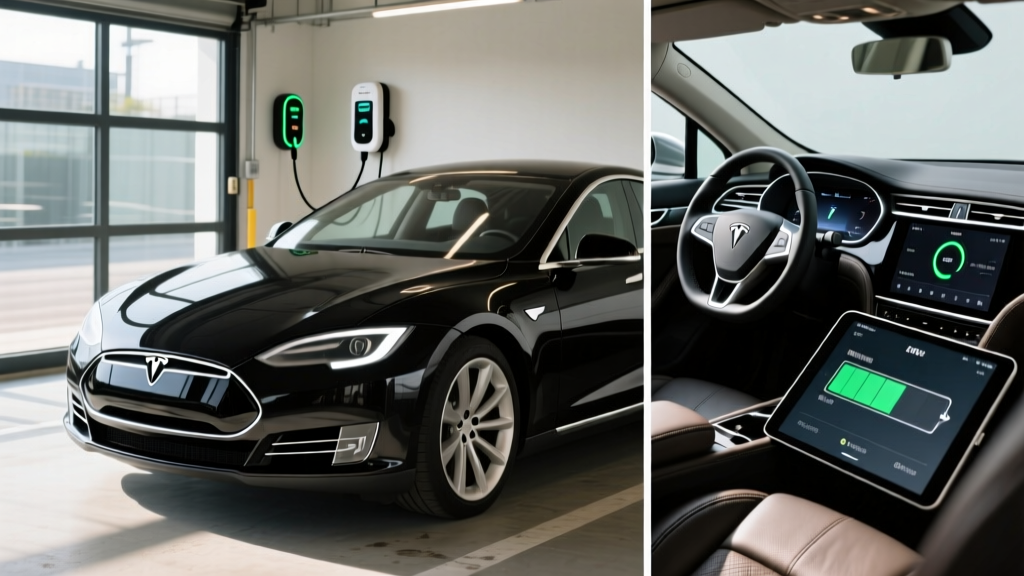
The 2013 Tesla Model S was the car that forced the entire auto industry to take electric vehicles seriously. More than a decade later, it remains one of the most-searched used EVs on the market — and for good reason. With its aluminum body, over-the-air updates, and a Supercharger network that was brand-new at launch, this sedan wrote the blueprint every modern EV still follows. But buying a 2013 Tesla in 2026 is a very different proposition than buying one in 2013. Battery degradation, expired warranties, discontinued hardware, and a shifting tax-credit landscape all reshape the value equation. This guide gives you the exact numbers and ownership realities you need before writing a check.
2013 Tesla Model S: Quick Spec Snapshot
| Specification | Model S 60 | Model S 85 | Model S P85 |
|---|---|---|---|
| EPA Range (original) | 208 mi | 265 mi | 265 mi |
| Battery Capacity (usable) | ~60 kWh | ~85 kWh | ~85 kWh |
| Battery Chemistry | NMC (Panasonic) | NMC (Panasonic) | NMC (Panasonic) |
| Drivetrain | RWD, single motor | RWD, single motor | RWD, single motor |
| Horsepower | 302 hp | 362 hp | 416 hp |
| 0–60 mph | 5.9 sec | 5.4 sec | 4.2 sec |
| MPGe (combined, EPA) | 95 MPGe | 89 MPGe | 89 MPGe |
| Efficiency | 35 kWh/100 mi | 38 kWh/100 mi | 38 kWh/100 mi |
| DC Fast Charge (peak) | ~90 kW | ~120 kW (V1 Supercharger) | ~120 kW |
| Level 2 Charge Rate | 10 kW (onboard) | 10 kW (onboard; 20 kW twin optional) | 10 kW (onboard; 20 kW twin optional) |
| Original Base MSRP | $69,900 | $79,900 | $93,400 |
| 2026 Used Price Range | $9,000–$14,000 | $12,000–$19,000 | $14,000–$22,000 |
| Battery Warranty (original) | 8 yr / 125,000 mi | 8 yr / unlimited mi | 8 yr / unlimited mi |
Real-World Range: What the EPA Sticker Doesn't Tell You
Expect in 2026 (typical used, ~10–15% degradation): 220–240 miles in mixed driving
Highway at 75 mph: ~190–210 miles
Cold weather (below 32°F): ~160–185 miles
The 2013 Model S 85 was rated by the EPA at 265 miles — a figure that seemed almost fictional when it debuted. In 2026, however, any 2013 Model S you encounter will have a battery with between 80,000 and 180,000+ miles on it. Panasonic NMC cells from this era typically show 10–18% capacity loss at 100,000 miles, with the steepest degradation occurring in the first 30,000 miles and then leveling off. The 60 kWh variant, originally rated at 208 miles, may realistically deliver 170–185 miles today in mixed conditions.
Highway driving at 75+ mph will cut range by roughly 15–20% versus the EPA combined figure — the Model S's large frontal area and 0.24 drag coefficient matter less than the simple physics of sustained speed. Cold weather compounds the loss further: without a heat pump (the 2013 model uses resistive cabin heating), expect 25–35% range reduction in sub-freezing temperatures. Preconditioning while plugged in mitigates this, but only if you have access to home charging.
Charging Speed: DC Fast, Level 2, and the Supercharger Reality
Charging infrastructure in 2013 was embryonic, and the Model S's hardware reflects that era. Here is what you are working with:
| Charging Level | Power (kW) | Rate / Time | Notes |
|---|---|---|---|
| Level 1 (120V household) | ~1.4 kW | ~3 mi/hr | Emergency/trickle only |
| Level 2 (240V, single charger) | 10 kW | ~29 mi/hr | Standard onboard |
| Level 2 (240V, twin chargers) | 20 kW | ~58 mi/hr | Optional; requires HPWC |
| DC Fast (V1 Supercharger) | ~90–120 kW peak | 10–80% in ~45–55 min | Tapers significantly above 80% |
| DC Fast (CHAdeMO w/ adapter) | ~50 kW | 10–80% in ~80 min | Tesla CHAdeMO adapter required |
The 2013 Model S uses Tesla's proprietary connector (the precursor to the modern NACS). With Tesla now opening Superchargers to NACS-equipped vehicles from other brands, the connector itself is future-proof — but the car's peak charge rate of ~120 kW on V1 Superchargers is far below the 250 kW that V3 stalls deliver to newer Teslas. Expect a 10–80% session to take 45–55 minutes, and plan for a taper that slows charging dramatically above 80% State of Charge.
At home, the single onboard charger delivers 10 kW — enough to replenish roughly 29 miles of range per hour, meaning a full charge from near-empty takes about 9–10 hours on a 48-amp Level 2 circuit. Cars equipped with the optional twin chargers (20 kW) can halve that, but this was a $3,650 option and not all cars have it. Verify before purchasing.
Battery Health, Degradation, and Replacement Costs
This is the single most important factor when buying a 2013 Model S in 2026. The 85 kWh battery pack uses Panasonic 18650 NMC cells — the same form factor Tesla used through 2020, but an earlier generation chemistry with less sophisticated thermal management than current packs.
Degradation data: Community-sourced data from Tesla owners forums and fleet analyses show the 85 kWh pack typically retains 82–88% of original capacity at 100,000 miles, and 75–82% at 150,000 miles. Packs that were frequently Supercharged or regularly charged to 100% tend toward the lower end. The 60 kWh pack, which was software-limited on a physically larger battery in some cases, can show slightly better retention.
Replacement cost: If the pack fails outside warranty, a remanufactured 85 kWh replacement from Tesla currently runs $12,000–$16,000 installed. Third-party options from shops like Electrified Garage or Gruber Motors can range from $8,000–$12,000. This is a critical consideration: a $14,000 battery replacement on a $15,000 car effectively doubles your cost of ownership.
Warranty status: The original 85 kWh battery warranty was 8 years / unlimited miles. For a 2013 model, that warranty expired in 2021 at the latest. The 60 kWh variant carried an 8-year / 125,000-mile warranty, also expired. You are buying this car entirely as-is unless a third-party extended warranty is in place.
Performance, Efficiency, and Drivetrain
Even by 2026 standards, a 2013 Model S P85 with its 416 hp rear-mounted AC induction motor and 4.2-second 0–60 time remains genuinely quick. The standard 85 delivers 362 hp and a 5.4-second sprint, while the base 60 manages 302 hp and 5.9 seconds. All variants are rear-wheel drive — Tesla did not introduce dual-motor all-wheel drive until late 2014.
Efficiency is the Model S's weak point relative to modern EVs. At 35–38 kWh per 100 miles (89–95 MPGe combined per the EPA), the 2013 Model S consumes noticeably more energy per mile than a 2025 Hyundai Ioniq 6 (24 kWh/100 mi) or even a 2025 Tesla Model 3 (25 kWh/100 mi). Over 15,000 annual miles at the US average electricity rate of $0.17/kWh, you will spend roughly $970/year on electricity — still far less than gas, but $300–$400 more than a more efficient modern EV.
Interior, Cargo, and Technology
The 2013 Model S's 17-inch portrait touchscreen was revolutionary at launch and remains visually striking. However, the hardware behind it matters: 2013 models use the NVIDIA Tegra 3 MCU (Media Control Unit), known as MCU1. This processor is slow by modern standards, struggles with current navigation maps, and cannot support the latest Tesla software features. Tesla offered an MCU2 upgrade (Intel Atom) for ~$1,500–$2,000, and some used examples will have had this performed. Confirm MCU status before buying — it significantly affects daily usability.
Cargo volume: 26.3 cubic feet behind the rear seats, expanding to 58.1 cubic feet with the rear seats folded. The front trunk (frunk) adds 5.3 cubic feet. These numbers still beat most midsize sedans and rival compact SUVs.
Passenger space: Front legroom is 42.7 inches; rear legroom is 35.4 inches. The rear seat is a three-passenger bench, though an optional rear-facing third row (for small children) was available, bringing total seating to seven. The optional third row is rare and not recommended for anything beyond short trips.
Driver assistance: The 2013 Model S predates Tesla's Autopilot hardware suite. HW1 (introduced late 2014) is not present on most 2013 builds. This means no adaptive cruise control, no lane-keeping assist, no automatic emergency braking — the car has basic cruise control and parking sensors only. It is a pure manual-driving experience, which some buyers actually prefer, but it eliminates a key selling point of newer EVs.
Pricing, Tax Credits, and Total Cost of Ownership
The 2013 Model S is far outside the window for the federal §30D new clean vehicle credit — it is a used vehicle. However, the Used Clean Vehicle Credit (§25E) may apply:
| Cost Factor | Amount / Detail |
|---|---|
| Typical used purchase price (85 kWh) | $12,000–$19,000 |
| Federal Used EV Credit (§25E) | Up to $4,000 or 30% of sale price, whichever is less |
| Income cap (§25E) | $75k single / $112,500 HOH / $150k MFJ (modified AGI) |
| Dealer requirement | Must purchase from a licensed dealer (private-party sales excluded) |
| Vehicle price cap | Sale price must be ≤ $25,000 |
| Effective price after max credit | ~$8,000–$15,000 |
| Estimated annual electricity (15k mi/yr) | ~$970 |
| Estimated annual insurance | $1,800–$2,600 |
| Potential battery replacement (one-time) | $8,000–$16,000 |
The §25E used EV credit is the key financial lever here. If you buy a 2013 Model S 85 from a dealer for $15,000 and meet the income thresholds, you could claim $4,000 (30% of $15,000 = $4,500, but the cap is $4,000). This is a point-of-sale transfer option as of 2024, meaning the dealer can reduce your purchase price directly. Verify eligibility with your tax professional and the IRS §25E guidance before committing.
2013 Model S vs. Key Used EV Competitors in 2026
| Vehicle | Real-World Range (2026) | DC Charge Speed | Used Price Range | Key Trade-Off |
|---|---|---|---|---|
| 2013 Tesla Model S 85 | ~220–240 mi | ~120 kW peak | $12,000–$19,000 | Range + Supercharger access vs. age + efficiency |
| 2017–2018 Chevrolet Bolt EV | ~200–220 mi | ~55 kW peak | $10,000–$15,000 | Efficient but painfully slow DC charging |
| 2018–2019 Nissan Leaf Plus | ~180–200 mi | ~50 kW (CHAdeMO) | $11,000–$16,000 | Air-cooled battery = faster degradation risk |
| 2017–2019 Tesla Model 3 LR | ~270–290 mi | ~250 kW (V3) | $16,000–$24,000 | Better efficiency + charging, higher entry price |
| 2018–2020 Hyundai Kona Electric | ~220–240 mi | ~77 kW peak | $13,000–$18,000 | Compact crossover form factor, no Supercharger |
The 2013 Model S wins on interior space, ride comfort, and Supercharger network access. It loses decisively on charging speed, efficiency, and the looming risk of out-of-warranty battery replacement. A 2017–2019 Model 3 Long Range offers substantially better range, 250 kW DC charging, and newer safety hardware — but costs $4,000–$8,000 more and gives up the Model S's executive-sedan spaciousness.
Pros, Cons, and Who Should Buy
- Supercharger network access (NACS connector, now the industry standard)
- Spacious interior: 26.3 cu ft cargo + 5.3 cu ft frunk
- Over-the-air software updates (though MCU1 limits modern features)
- Aluminum body resists rust better than steel competitors
- Strong §25E used-EV credit eligibility (up to $4,000 off)
- Timeless design; still turns heads
- Battery warranty expired — $8,000–$16,000 replacement risk
- MCU1 infotainment is slow; upgrade costs $1,500+
- No Autopilot or modern ADAS features
- Poor efficiency (35–38 kWh/100 mi) vs. modern EVs
- Slow DC charging by 2026 standards (~120 kW peak)
- Door handles, air suspension, and drive unit are known failure points
Look elsewhere if: You need reliable road-trip charging speed, modern driver assistance, minimal maintenance risk, or you lack home charging and depend entirely on public infrastructure.
Frequently Asked Questions
What is the real-world range of a 2013 Tesla Model S in 2026?
Expect 220–240 miles in mixed driving for an 85 kWh model with typical 10–15% battery degradation. Highway driving at 75 mph drops this to roughly 190–210 miles, and sub-freezing temperatures can reduce it further to 160–185 miles. The 60 kWh variant delivers roughly 170–185 miles in mixed conditions today.
How fast does the 2013 Model S charge?
On a V1 Supercharger, the 85 kWh model peaks at roughly 120 kW, taking about 45–55 minutes from 10–80% SoC. On a home Level 2 charger with the standard single onboard charger, you get roughly 29 miles of range per hour (10 kW). The optional twin-charger setup doubles this to 58 mi/hr at 20 kW.
Does the 2013 Tesla Model S qualify for any federal tax credit?
Not the §30D new-vehicle credit. However, it can qualify for the §25E Used Clean Vehicle Credit, which provides up to $4,000 or 30% of the sale price (whichever is less). Requirements include purchasing from a licensed dealer for $25,000 or less, and meeting income caps ($75k single / $150k married filing jointly). Confirm with your tax professional and review IRS §25E rules.
Is a 2013 Model S worth buying vs. a newer used EV?
It depends on your priorities. The 2013 Model S offers more interior space, a better ride, and Supercharger access for less money than a used Model 3. However, a 2017–2019 Model 3 Long Range gives you ~50 more miles of range, 250 kW charging, Autopilot hardware, and better efficiency — at a $4,000–$8,000 premium. If battery replacement risk concerns you, the Model 3's newer pack and remaining (or recently expired) warranty may justify the cost.
What are the biggest risks of buying a 2013 Model S?
The three highest-cost failure points are: (1) battery pack degradation or failure ($8,000–$16,000 replacement), (2) drive unit replacement ($3,000–$5,000), and (3) air suspension failure if equipped ($1,500–$3,000 per corner). The MCU1 infotainment system is also outdated. Budget $2,000–$3,000 annually for maintenance reserves beyond normal wear items.
Can I still use Tesla Superchargers with a 2013 Model S?
Yes. The 2013 Model S uses Tesla's proprietary connector, which is fully compatible with all Supercharger generations (V1, V2, V3, and V4). You will not need an adapter. However, the car's peak charge rate (~120 kW) means you will not benefit from the full speed of V3 (250 kW) or V4 stalls.