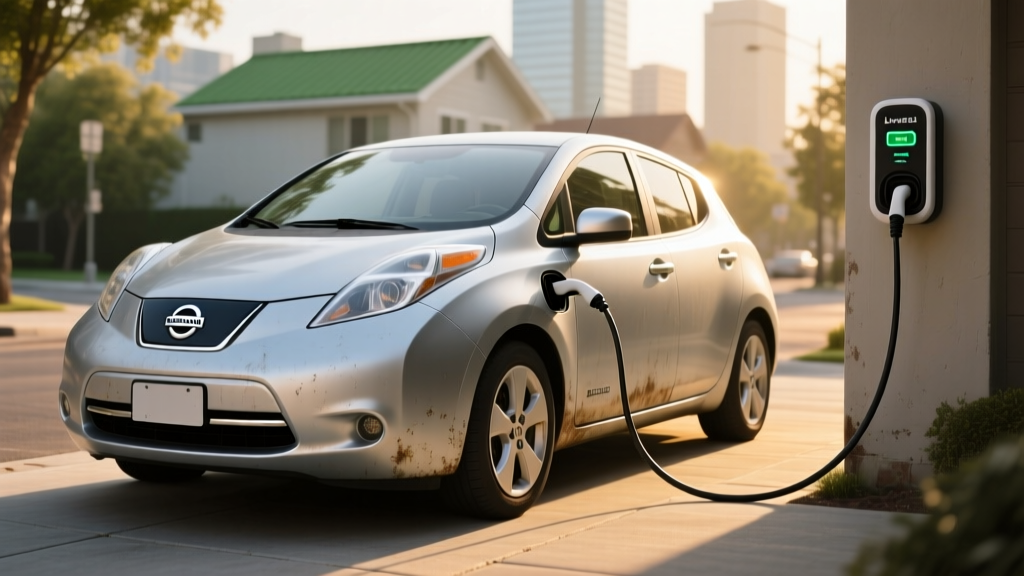
The Original Mass-Market EV: Is the 2013 Nissan Leaf Still Worth It?
The 2013 Nissan Leaf holds a unique place in electric vehicle history. As one of the first mass-produced, purpose-built battery electric vehicles sold globally, it proved that everyday drivers could live with a plug-in car. More than a decade later, thousands of these hatchbacks remain on the road — and they continue to show up on the used market at bargain prices, often between $4,000 and $8,000 depending on battery health and mileage.
But buying a 2013 Leaf in 2026 requires a very different calculus than buying a new EV. The 24 kWh lithium-ion battery pack was never designed for the long haul without some degradation, and Nissan's passive air-cooling system means these packs have aged differently depending on climate and charging habits. This review breaks down exactly what you're getting — and what to watch out for — if you're considering a used 2013 Leaf today.
| Spec | Value |
|---|---|
| Battery Capacity (Original) | 24 kWh total / ~21.3 kWh usable |
| Battery Chemistry | Lithium Manganese Oxide (LMO) |
| EPA Range (New) | 75 miles |
| Motor Output | 80 kW (107 hp), 187 lb-ft torque |
| 0-60 mph | ~9.9 seconds |
| Drivetrain | Front-wheel drive (FWD) |
| EPA Efficiency | 115 MPGe combined (29 kWh/100 mi) |
| DC Fast Charge (CHAdeMO) | ~50 kW peak |
| Level 2 Charge Rate | 6.6 kW (onboard charger) |
| Cargo Volume | 24.0 cu ft (rear seats up), 30.0 cu ft (folded) |
| Original Base MSRP | $28,800 (before incentives) |
| Battery Warranty (Original) | 8 years / 100,000 miles (capacity loss below 4 bars of 5) |
Real-World Range: What to Actually Expect in 2026
EPA Original Range: 75 miles (when new, with a full-capacity 24 kWh pack)
Real-World Range in 2026: Expect 50-65 miles on a typical used 2013 Leaf with moderate battery degradation. A well-preserved example in a mild climate may still achieve 65-73 miles. Highway driving at 70+ mph or cold-weather operation (below 40°F) can reduce this to 35-50 miles.
The single most important factor in evaluating any used 2013 Leaf is battery State of Health (SoH). Nissan's battery management system did not include active liquid cooling — the pack relies on passive air cooling, which makes it more susceptible to heat-related degradation in hot climates (Arizona, Texas, Florida) and accelerated capacity loss from frequent DC fast charging.
According to data aggregated by the Leaf owner community and fueleconomy.gov, the 2013 Leaf was rated at 75 miles EPA combined. In our assessment, a 2013 Leaf showing 10-15% degradation (roughly 11-12 bars out of 12 on the dashboard capacity gauge) will deliver about 63-68 miles in mixed city/highway driving at moderate temperatures. A heavily degraded pack — 8 bars or fewer — may only provide 40-50 usable miles.
Cold weather compounds the problem significantly. Without a battery heater or heat pump (the 2013 model uses resistive cabin heating), winter range loss of 30-40% is common. If you live in a northern climate and need reliable 50+ mile range in January, this car will struggle unless the battery is in exceptional condition.
Charging Speed: CHAdeMO, Level 2, and Infrastructure Reality
The 2013 Leaf uses the CHAdeMO DC fast-charging standard — a connector that has been largely abandoned by the North American market in favor of CCS and NACS (Tesla's connector). This is a critical consideration in 2026, as the public CHAdeMO network has shrunk relative to CCS and Supercharger availability.
| Charging Level | Power / Rate | Estimated Time / Range Added |
|---|---|---|
| Level 1 (120V household) | ~1.4 kW | ~4-5 miles per hour of charging; full charge in ~17 hours |
| Level 2 (240V, J1772) | 6.6 kW (with upgraded onboard charger; 3.3 kW on base trim) | ~18-22 miles per hour; full charge in ~4-5 hours (6.6 kW) |
| DC Fast Charge (CHAdeMO) | ~50 kW peak | 0-80% in approximately 30 minutes; tapers significantly above 80% |
Several nuances matter here. First, the base S trim came with a 3.3 kW onboard charger, meaning Level 2 charging takes roughly 7-8 hours from empty. The SV and SL trims included the 6.6 kW charger as standard or optional — always verify which onboard charger a specific used Leaf has before purchasing.
Second, the 50 kW CHAdeMO peak is modest by 2026 standards (many modern EVs accept 150-350 kW). However, with only ~21 kWh of usable battery capacity, 50 kW is actually a reasonable C-rate, and the Leaf charges briskly from 10-80% in about 30 minutes. The charge curve tapers hard above 80% SoC — plan to unplug at 80% at public stations to avoid wasting time at single-digit kW speeds.
Third, and most importantly: CHAdeMO stations are increasingly scarce. Electrify America never adopted CHAdeMO. EVgo and some ChargePoint locations still have CHAdeMO connectors, but availability varies by region. Before buying, use apps like PlugShare to map CHAdeMO stations along your regular routes. If you'll rely exclusively on home charging, this limitation matters far less.
Performance, Efficiency, and Daily Drivability
The 2013 Leaf's 80 kW (107 hp) AC synchronous electric motor delivers 187 lb-ft of torque to the front wheels. The 0-60 mph time of roughly 9.9 seconds won't impress anyone, but the instant torque makes the Leaf feel peppy around town — it's genuinely quick from 0-30 mph, which is where most city driving happens.
At 115 MPGe combined (29 kWh per 100 miles), the Leaf is efficient even by modern standards. For comparison, a 2025 Nissan Leaf achieves 111-123 MPGe depending on trim. The 2013 model's lighter weight (about 3,340 lbs) helps offset its older powertrain technology.
Driving dynamics are best described as comfortable and uninspiring. The suspension is tuned for comfort, the steering is light, and body roll is noticeable in corners. This is a commuter appliance, not a sports hatchback — and that's perfectly fine for its intended use case. The regenerative braking system offers a "B" mode for stronger regen, but it doesn't enable true one-pedal driving to a full stop like newer EVs. You'll still use the brake pedal regularly.
Interior, Cargo, and Technology
The 2013 Leaf's cabin is functional if dated. The dashboard features a color LCD display between the analog speedometer and a digital efficiency readout. The center stack houses either a basic radio (S trim) or a 7-inch touchscreen with navigation (SV/SL trims). Bluetooth phone connectivity is standard; Bluetooth audio streaming is available on higher trims.
Passenger space is genuinely good for a compact hatchback:
- Front legroom: 42.1 inches
- Rear legroom: 33.3 inches
- Front headroom: 40.5 inches
- Rear headroom: 38.0 inches
The 24.0 cubic feet of cargo space behind the rear seats is competitive with compact hatchbacks of the era, and folding the 60/40 split rear seat opens up 30.0 cubic feet. There is no frunk — the space under the hood houses the motor and power electronics.
Notable tech features for 2013 included the CARWINGS telematics system (which allowed remote charge monitoring and climate control scheduling via a smartphone app), a rearview camera (standard on SV/SL), and an optional solar panel on the SL trim that trickle-charged the 12V auxiliary battery. No modern ADAS features like automatic emergency braking, lane-keeping assist, or adaptive cruise control were offered.
Battery Degradation: The Make-or-Break Factor
This is the section that should drive your purchase decision. The 2013 Leaf's 24 kWh battery pack uses lithium manganese oxide (LMO) chemistry — different from the NMC (nickel manganese cobalt) or LFP (lithium iron phosphate) chemistries common in modern EVs. LMO offered good energy density for its time but is more prone to heat-related degradation.
Nissan's original battery warranty covered capacity loss below 4 bars out of 5 on the capacity gauge (roughly equivalent to dropping below ~66% of original capacity) for 8 years or 100,000 miles. As of 2026, every 2013 Leaf is outside this warranty window. You are buying the battery as-is.
Here's what degradation typically looks like based on owner-reported data:
| Climate Profile | Expected Capacity at 10-12 Years | Approximate Range |
|---|---|---|
| Mild (Pacific Northwest, coastal CA) | 80-88% SoH (11-12 bars) | 60-68 miles |
| Moderate (Midwest, Mid-Atlantic) | 72-82% SoH (10-11 bars) | 54-62 miles |
| Hot (Arizona, Texas, inland SoCal) | 60-75% SoH (8-10 bars) | 45-56 miles |
The dashboard capacity bars are your first diagnostic tool. A 12-bar car is in good shape; a 9-bar or lower car will have noticeably reduced range. For a more precise reading, use an OBD-II dongle with the LeafSpy app, which reports exact SoH percentage, cell voltage differentials, and battery temperature. A pre-purchase LeafSpy reading is non-negotiable — think of it as a compression test for an ICE car.
If the battery is severely degraded, a replacement is possible but expensive. Third-party refurbished 24 kWh packs cost approximately $3,500-$5,500 installed as of 2025-2026, though availability varies. Some owners have upgraded to 30 kWh or 40 kWh packs from later Leaf models, but this requires specialized knowledge and isn't a plug-and-play swap.
Pricing, Tax Credits, and Ownership Costs
Used 2013 Nissan Leaf prices in early 2026 typically fall in these ranges:
| Condition / Battery Health | Approximate Price |
|---|---|
| High mileage, degraded battery (8-9 bars) | $3,500 - $5,000 |
| Moderate mileage, average battery (10-11 bars) | $5,000 - $7,000 |
| Low mileage, excellent battery (12 bars) | $7,000 - $9,000 |
Federal tax credit eligibility: The used EV tax credit under IRS §25E (not §30D, which applies to new vehicles) offers up to $4,000 or 30% of the sale price, whichever is less, for qualifying used electric vehicles purchased from a dealer. Key requirements include:
- Sale price must be $25,000 or below (easily met by any 2013 Leaf)
- Buyer income caps: $75,000 single / $112,500 head of household / $150,000 joint (modified AGI)
- Vehicle must be at least 2 model years old (met)
- Purchase must be from a licensed dealer (private-party sales do not qualify)
- Credit can be transferred to the dealer as a point-of-sale discount
- The same vehicle can only have the used credit claimed once every three years — verify the specific VIN hasn't been claimed recently
For a $6,000 Leaf purchased from a qualifying dealer, the 30% calculation yields $1,800 — making the effective price as low as $4,200. Always verify current rules at irs.gov before finalizing a purchase, as incentive regulations are subject to change.
Ongoing ownership costs are remarkably low. Electricity at the national average of ~$0.16/kWh means a full "tank" costs roughly $3.40-$3.85 (for ~21-24 kWh). There are no oil changes, no spark plugs, and brake wear is minimal thanks to regenerative braking. Insurance tends to be inexpensive given the car's low value and modest performance.
Pros and Cons: An Honest Assessment
Pros
- Extremely low purchase price — one of the cheapest ways to get into an EV
- Very low running costs (electricity, maintenance, insurance)
- Comfortable ride quality and surprisingly spacious interior
- Simple, proven powertrain with minimal failure points
- Good visibility and easy maneuverability for city driving
- Qualifies for the used EV tax credit (§25E), further reducing cost
Cons
- Severely limited range, especially with battery degradation (50-65 mi typical)
- CHAdeMO fast-charging standard is disappearing from public networks
- No active thermal management — battery degrades faster in hot climates
- No modern safety features (AEB, lane assist, blind-spot monitoring)
- Dated infotainment with no Apple CarPlay or Android Auto
- Resistive cabin heater saps range in cold weather
- Battery warranty is expired on all 2013 examples
Who Should Buy a 2013 Nissan Leaf in 2026?
Buy it if:
- You need a dirt-cheap second car for a short daily commute (under 30 miles round trip)
- You can charge at home (Level 1 or Level 2) and don't need public fast charging
- You live in a mild climate where battery degradation has been slower
- You want to try EV ownership with minimal financial commitment
- You're buying it as a local errand car and have another vehicle for longer trips
Skip it if:
- Your round-trip commute exceeds 40 miles (especially with highway driving)
- You live in a hot climate and can't verify battery health before purchasing
- You need a primary vehicle for a one-car household
- You rely on public DC fast charging — CHAdeMO availability is too uncertain
- You need modern safety tech or infotainment features
Compared to other used EVs in the $5,000-$9,000 range — such as the 2013-2015 Chevrolet Volt (a PHEV with gas backup), the 2015-2016 VW e-Golf (CCS charging, slightly better range), or a later 2016-2017 Leaf with the 30 kWh battery — the 2013 Leaf wins on pure affordability but loses on range and charging infrastructure compatibility. If your budget can stretch to $10,000-$12,000, a 2018+ Leaf with the 40 kWh pack and 151-mile EPA range is a dramatically more capable vehicle. The NHTSA safety ratings for the 2013 Leaf show a 4-star overall score, which was respectable for its era but trails modern vehicles.
Frequently Asked Questions
What is the real-world range of a used 2013 Nissan Leaf?
With typical battery degradation at 10-12 years old, expect 50-65 miles in mixed driving at moderate temperatures. Highway driving or cold weather can reduce this to 35-50 miles. Always check the capacity bars on the dash or use LeafSpy for a precise State of Health reading before buying.
How fast does the 2013 Leaf charge at home and on DC fast chargers?
On a 240V Level 2 charger, the 6.6 kW onboard charger (SV/SL trims) adds about 18-22 miles per hour, with a full charge in 4-5 hours. The base S trim has a 3.3 kW charger that doubles those times. DC fast charging via CHAdeMO peaks at ~50 kW, reaching 80% in approximately 30 minutes.
Does the 2013 Nissan Leaf qualify for any federal tax credit?
It may qualify for the used EV tax credit (§25E) of up to $4,000 or 30% of the sale price (whichever is less) when purchased from a licensed dealer. Income caps apply ($75K single / $150K joint), and the sale price must be under $25,000. It does not qualify for the new-vehicle §30D credit, which is only for new purchases. Verify VIN eligibility and current rules at irs.gov.
Is the CHAdeMO connector a dealbreaker in 2026?
It depends on your use case. If you charge exclusively at home, CHAdeMO's declining public network is irrelevant. If you need public fast charging, check PlugShare for CHAdeMO stations in your area — they still exist at many EVgo and ChargePoint locations, but they're far less common than CCS or NACS. Adapters from CHAdeMO to other standards are not widely available or practical.
How much does a replacement battery cost for the 2013 Leaf?
Third-party refurbished 24 kWh battery packs typically cost $3,500-$5,500 installed as of 2025-2026. Given that a well-maintained 2013 Leaf might cost $6,000-$8,000, a battery replacement can represent a significant percentage of the car's value. Factor this into your purchase decision — buying a car with a strong battery is far more economical than buying a cheap one and replacing the pack.
Is the 2013 Leaf safe to drive?
The 2013 Leaf earned a 4-star overall NHTSA safety rating and was an IIHS Top Safety Pick for its era. However, it lacks modern active safety features like automatic emergency braking, lane departure warning, and blind-spot monitoring that are standard on most 2020+ vehicles. It has six airbags, stability control, and ABS.
How does the 2013 Leaf compare to a used Chevy Bolt or newer Leaf?
The 2017+ Chevy Bolt EV offers 238 miles of EPA range, CCS fast charging, and a liquid-cooled battery — a massive leap in capability, though used prices are typically $12,000-$18,000. The 2018+ Nissan Leaf (40 kWh) delivers 151 miles EPA but still uses CHAdeMO. If your budget allows, either is a substantially better daily driver than the 2013 Leaf. The 2013 model's sole advantage is its rock-bottom entry price.