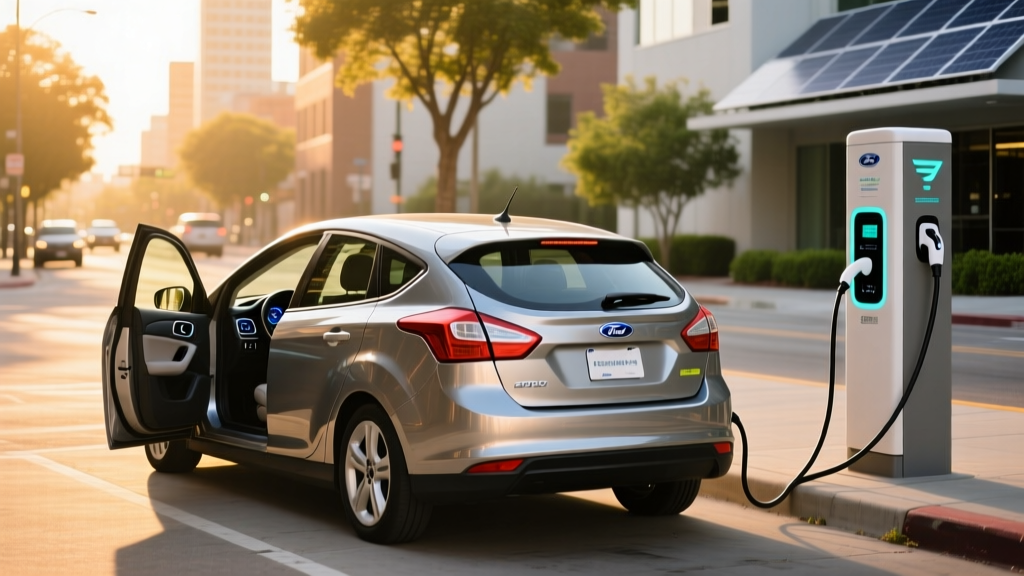
Quick Verdict: The 2013 Ford Focus Electric delivers an EPA-estimated 76 miles of range from a 23 kWh (usable) liquid-cooled lithium-ion battery, charges at up to 6.6 kW on Level 2, and has no DC fast charging. As a used EV in 2026, expect to pay $4,000–$8,000 depending on mileage and battery health. It works as a low-cost commuter if you can charge at home and drive under 50 miles round-trip — but its short range and aging battery make it a niche pick versus modern alternatives.
2013 Ford Focus Electric: The Numbers That Matter
Ford built the Focus Electric as a compliance car — an electrified version of the third-generation Focus hatchback, sold primarily in California and a handful of ZEV-mandate states. Understanding its spec sheet is essential before shopping for one on the used market.
| Specification | 2013 Ford Focus Electric |
|---|---|
| EPA Range | 76 miles |
| Battery (Usable) | ~23 kWh, lithium-ion (liquid-cooled) |
| Motor Output | 143 hp (107 kW), 184 lb-ft torque |
| 0–60 mph | ~9.5 seconds |
| EPA Efficiency | 105 MPGe combined (32 kWh/100 mi) |
| Level 1 Charging (120V) | ~1.4 kW — ~4–5 mi/hr |
| Level 2 Charging (240V) | 6.6 kW — ~22 mi/hr, full charge ~3–4 hrs |
| DC Fast Charging | Not available |
| Original MSRP | $29,200 (before $7,500 federal credit) |
| 2026 Used Price Range | $4,000–$8,000 |
| Battery Warranty (Original) | 8 years / 100,000 miles |
The 2013 model year carried over unchanged from the 2012 launch. Ford equipped it with a 123 kW electric motor and a liquid-cooled battery pack — an advantage over the air-cooled Nissan Leaf of the same era, which suffered more noticeable degradation in hot climates. According to fueleconomy.gov, the Focus Electric's combined 105 MPGe was competitive at launch, but the small battery limited its utility to city and suburban commuting.
Real-World Range Expectations: The EPA 76-mile sticker assumed a mix of city and highway driving in moderate temperatures. In practice, expect 60–70 miles on the highway at 70 mph, and potentially as low as 45–55 miles in freezing winter conditions (below 30°F). Battery degradation on a 13-year-old pack may reduce usable capacity by 15–25%, meaning some examples may deliver as little as 50–60 miles on a full charge. Always request a battery state-of-health (SoH) reading before purchasing.
How the Focus Electric Compares to Gas and Modern EVs
Buying a 2013 Focus Electric in 2026 means comparing it against two benchmarks: a similarly priced used gas car and a modern entry-level EV. Here's how the math works out.
| Metric | 2013 Focus Electric (Used) | 2013 Ford Focus Gas (Used) | 2026 Nissan Leaf S (New) |
|---|---|---|---|
| Purchase Price | $5,000–$8,000 | $5,000–$9,000 | ~$28,140 MSRP |
| EPA Range | 76 mi | ~370 mi (12.4 gal tank, 30 MPG) | 149 mi |
| Fuel/Energy Cost per Mile | ~$0.04–$0.06 (at $0.14/kWh) | ~$0.12 (at $3.40/gal, 30 MPG) | ~$0.04–$0.06 |
| Annual Fuel Cost (12,000 mi) | ~$480–$720 | ~$1,440 | ~$480–$720 |
| Annual Maintenance | ~$200–$400 | ~$600–$1,000 | ~$300–$500 |
| 5-Year Total Fuel + Maint. | ~$3,400–$5,600 | ~$10,200–$14,000 | ~$3,900–$6,100 |
The used Focus Electric's operating costs are genuinely low. At the national average residential electricity rate of roughly $0.16 per kWh (per the EIA), a full 23 kWh charge costs about $3.68. Over 12,000 miles of annual driving, that's roughly $600 in electricity — less than half the gasoline cost of a comparable Focus gas model. Maintenance savings are significant too: no oil changes, no spark plugs, no transmission fluid, and regenerative braking extends pad life considerably.
However, the range gap is stark. A 2026 Nissan Leaf S offers 149 miles EPA — nearly double — and includes DC fast charging (up to 50 kW). If your commute exceeds 50 miles round-trip or you need any highway flexibility, the 2013 Focus Electric's 76-mile ceiling becomes a daily constraint.
Charging: The 6.6 kW Limitation and What It Means
The 2013 Focus Electric charges at 6.6 kW on a Level 2 (240V) home charger. That translates to roughly 22 miles of range added per hour of charging, or a full 0–100% charge in about 3 to 4 hours. On a standard 120V household outlet (Level 1), you'll recover roughly 4–5 miles per hour — making Level 1 impractical as a primary charging method unless you drive fewer than 30 miles per day and can plug in overnight for 12+ hours.
The critical limitation: there is no DC fast charging port. You cannot use Electrify America, EVgo, Tesla Supercharger, or any public fast charger. This means road trips beyond the car's 76-mile radius are essentially impossible without multi-hour stops at Level 2 destination chargers — and even those are limited by the 6.6 kW onboard charger.
| Charging Level | Power | Miles Added per Hour | Full Charge Time | Availability |
|---|---|---|---|---|
| Level 1 (120V) | ~1.4 kW | ~4–5 miles | ~16–20 hours | Any standard outlet |
| Level 2 (240V) | 6.6 kW | ~22 miles | ~3–4 hours | Home (requires install) or public L2 |
| DC Fast Charge | N/A | N/A | N/A | Not supported |
For context, a modern EV like the Hyundai Ioniq 5 can accept up to 240 kW on DC fast charging, adding 200+ miles in 18 minutes. The Focus Electric was never designed for that use case — it's a home-and-commute vehicle, period.
Real Costs of Ownership in 2026
Let's build a realistic five-year ownership cost picture for a used 2013 Focus Electric purchased at $6,000 in 2026, assuming 10,000 miles driven annually and home Level 2 charging.
| Cost Category | 2013 Focus Electric | 2013 Focus Gas (30 MPG) |
|---|---|---|
| Purchase Price | $6,000 | $7,000 |
| Home Charger Install (Level 2) | $500–$1,500 | $0 |
| Fuel/Energy (5 yrs, 50,000 mi) | $2,500–$3,200 | $5,700–$6,500 |
| Maintenance (5 yrs) | $1,000–$2,000 | $3,000–$5,000 |
| Insurance (5 yrs, avg.) | $4,500–$6,000 | $4,000–$5,500 |
| Battery Replacement Risk | $4,000–$7,000 (if needed) | $0 (engine/trans risk instead) |
| Estimated 5-Year Total | $14,500–$21,200 | $19,700–$24,000 |
The Focus Electric can save $3,000–$5,000 over five years in fuel and maintenance alone — but that savings narrows or reverses if the battery requires replacement. At 13+ years old, the original 8-year/100,000-mile battery warranty has expired for every example on the road. A replacement pack, if available through Ford or a third-party rebuilder, runs $4,000–$7,000 installed. Some owners report finding used packs from salvage vehicles for $2,000–$3,500, but availability is limited and shrinking.
Insurance costs tend to be slightly higher for older EVs due to battery-replacement risk in collision claims, though the difference is modest — typically $100–$200 per year more than the gas equivalent. Get quotes from your insurer before purchasing.
Battery Health: The Single Biggest Risk
The 2013 Focus Electric uses a 23 kWh lithium-ion pack with liquid thermal management. Liquid cooling was a genuine engineering advantage over the passively cooled Nissan Leaf of the same era — it kept cell temperatures more stable, reducing degradation in both hot and cold climates.
That said, all lithium-ion batteries degrade over time. Industry data from sources like Recurrent Auto shows that EV batteries from this era typically retain 75–85% of their original capacity after 10 years. For the Focus Electric, that means a pack that originally delivered 76 miles may now deliver 57–65 miles — and that's before factoring in cold-weather losses.
Before buying, demand a battery health check. Some Ford dealerships can pull a state-of-health (SoH) report via OBD-II diagnostics. Third-party tools like LeafSpy (adapted for Ford) or a scan tool with EV battery module access can show individual cell voltage spread and overall capacity. Walk away from any example showing more than 30% degradation or significant cell imbalance (more than 200 mV spread between highest and lowest cells).
Tax Credits and Incentives: What Applies to a Used 2013 Model
The original $7,500 federal tax credit that applied to the Focus Electric when new is long gone for used purchases. Under current IRS §30D rules, the federal new clean vehicle credit applies only to new EVs meeting battery-sourcing, critical-mineral, MSRP, and buyer-income requirements.
However, the Used Clean Vehicle Credit (IRS §25E) offers up to $4,000 (30% of the sale price, capped) for qualifying pre-owned EVs. To be eligible, the vehicle must:
- Have a sale price of $25,000 or less (the Focus Electric easily qualifies at $4,000–$8,000)
- Be at least two model years old (2013 qualifies)
- Be purchased from a licensed dealer (private-party sales do not qualify)
- Buyer must meet income caps: $75,000 single / $112,500 head of household / $150,000 joint (modified AGI)
- Buyer must not have claimed the used-EV credit in the prior three years
- The vehicle must not have been transferred after August 16, 2022, to a buyer who claimed the credit already — this is a key restriction for older, resold vehicles
At a $6,000 purchase price, the maximum credit would be 30% × $6,000 = $1,800. This can be applied as a point-of-sale reduction through a participating dealer or claimed on your tax return. Consult a tax professional to confirm eligibility, as IRS rules around prior-transfer history can disqualify specific vehicles.
Common Misconceptions About the Focus Electric
| Myth | Fact |
|---|---|
| "It can do 100 miles if you drive carefully." | The EPA-rated range is 76 miles. Hyper-miling in ideal conditions might reach 85–90 miles, but planning around anything above 70 is risky. |
| "The battery will need immediate replacement." | Many packs retain 75–85% SoH at 10–13 years. Degradation is real but not catastrophic on liquid-cooled packs. Test before buying. |
| "I can fast-charge it on road trips." | There is no DC fast charge port. The car uses a J1772 connector for Level 1 and Level 2 only. Road trips are impractical. |
| "It qualifies for the full $7,500 tax credit." | The $7,500 credit applies to new vehicles only. A used Focus Electric may qualify for up to $4,000 under §25E — typically $1,200–$1,800 at actual sale prices. |
| "Maintenance is zero." | Tires, cabin air filters, brake fluid, coolant, wiper blades, and 12V battery replacement are still required. It's lower maintenance, not zero. |
Decision Framework: Is the 2013 Focus Electric Right for You?
Choose the 2013 Focus Electric if:
- Your daily round-trip commute is under 45 miles, even in winter
- You have reliable home charging (garage or driveway with a 240V circuit)
- You want the cheapest possible EV entry point under $8,000
- You have a second gas or hybrid vehicle for longer trips
- You can verify battery SoH above 75% before purchase
- You live in a mild climate (extreme cold compounds range loss significantly)
Skip the 2013 Focus Electric and look at alternatives if:
- Your commute exceeds 50 miles round-trip
- You lack home charging access and would rely on public infrastructure
- You need a single-vehicle household solution
- You live where winter temperatures regularly drop below 20°F
- You cannot find a battery health report or the SoH is below 70%
- You want DC fast charging for any occasional road-trip flexibility
If the Focus Electric doesn't fit your needs but budget is the priority, consider a used 2018–2020 Chevrolet Bolt EV (238-mile EPA range, DC fast charging, typically $10,000–$15,000 in 2026) or a 2016–2019 Nissan Leaf with the 30 or 40 kWh pack. Both offer dramatically more range and practicality for a modest price increase.
Frequently Asked Questions
What is the real-world range of a 2013 Ford Focus Electric in 2026?
With a healthy battery (80%+ SoH), expect 55–65 miles in mixed driving, 60–70 in warm city conditions, and as low as 40–50 miles in freezing weather or sustained highway driving. The original 76-mile EPA rating assumed a new battery in moderate conditions.
How much does it cost to charge a 2013 Focus Electric at home?
A full charge from empty to 100% uses about 23 kWh. At the U.S. average residential rate of ~$0.16/kWh, that's roughly $3.68 per full charge, or about $0.04–$0.05 per mile driven. Over 12,000 miles annually, expect $480–$600 in electricity costs.
Can I install a Level 2 charger for the Focus Electric at home?
Yes. The Focus Electric uses a standard J1772 connector, compatible with any Level 2 home charger. Installation typically costs $500–$1,500 for a 240V/30A circuit and a quality EVSE (like a ChargePoint Home Flex or Emporia Vue), assuming your electrical panel has capacity. A licensed electrician should assess your panel — a 200-amp service is usually sufficient, but older homes with 100-amp panels may need an upgrade ($1,500–$3,000 additional).
Is the 2013 Focus Electric safe?
The Focus Electric was not crash-tested separately by the NHTSA or IIHS as a dedicated model, but the third-generation Focus platform earned good ratings in its era. It includes standard stability control, anti-lock brakes, and six airbags. The battery pack is positioned under the rear cargo floor, which preserves interior space but slightly reduces cargo volume compared to the gas Focus (the battery eliminates the spare tire well).
What happens if the battery dies completely?
If the traction battery fails outside of warranty, replacement costs $4,000–$7,000. Some independent EV shops offer cell-level repair or module replacement for $2,000–$4,000. At that cost, it often makes more sense to sell the car for parts and put the money toward a newer used EV. Always factor battery replacement risk into your purchase price negotiation.
Does the 2013 Focus Electric qualify for any tax credits in 2026?
Not the $7,500 new-vehicle credit. It may qualify for the Used Clean Vehicle Credit (§25E) of up to $4,000 — but at typical sale prices of $4,000–$8,000, the actual credit would be $1,200–$1,800 (30% of sale price). You must buy from a licensed dealer, meet income caps, and the vehicle must not have been previously claimed under this credit by another buyer post-August 2022. Verify with a tax professional and the IRS §25E guidelines.