If you've been searching for a "2013 Acura ZDX EV" or wondering whether this distinctive crossover qualifies for federal tax credits, let's clear the air immediately: the 2013 Acura ZDX is not an electric vehicle. It's a gasoline-powered, V6 luxury crossover that Acura discontinued after the 2013 model year. However, the ZDX nameplate has returned — this time as a fully electric SUV — which is where much of the confusion originates.
This article will clarify exactly what the 2013 ZDX is, why it keeps appearing in EV-related searches, and then pivot to what actually matters for electrified-car shoppers: the 2025–2026 Acura ZDX EV and its key competitors. We'll give you the real range, charging speeds, pricing, and tax-credit data you need to make an informed decision.
The 2013 Acura ZDX: Gas-Powered, Discontinued, and Not Electrified
The 2013 Acura ZDX was a polarizing "coupe-crossover" built on Honda's MDX platform. Here are its actual specifications:
| Specification | 2013 Acura ZDX (Gas) |
|---|---|
| Powertrain | 3.7L V6, 300 hp, 275 lb-ft torque |
| Transmission | 6-speed automatic, SH-AWD (standard) |
| EPA Fuel Economy | 16 city / 23 hwy / 19 combined MPG |
| 0–60 mph | ~6.8 seconds |
| Cargo Volume | 26.3 cu ft (rear seats up), 55.8 cu ft (folded) |
| Original MSRP (2013) | $51,995 (base) |
| Electrification | None — no hybrid, PHEV, or EV variant |
Acura sold fewer than 7,000 ZDX units across its entire 2010–2013 production run. The model was discontinued due to poor sales. You can still find used examples on the secondary market, but there is zero electrification involved — no battery pack, no electric motor, no charging port, and no eligibility for any EV-related federal tax credit.
Why "2013 Acura ZDX" Keeps Appearing in EV Searches
There are two main reasons this legacy gas vehicle shows up in electric-car research:
- The ZDX nameplate returned as an EV. Acura launched the all-new ZDX EV for the 2024 model year, built on General Motors' Ultium platform. This is a battery-electric luxury SUV that's very much alive and available in 2025–2026. Shoppers searching for "Acura ZDX" without specifying a year often land on 2013 content by mistake.
- Used-car search overlap. Aggregator sites and forums sometimes surface the 2013 model alongside the new EV in comparison widgets, creating further confusion.
If your intent is to research an electric Acura, the vehicle you actually want is the Acura ZDX (2024–2026). Let's dig into that.
The Real Electric Acura: 2025–2026 ZDX EV Specs
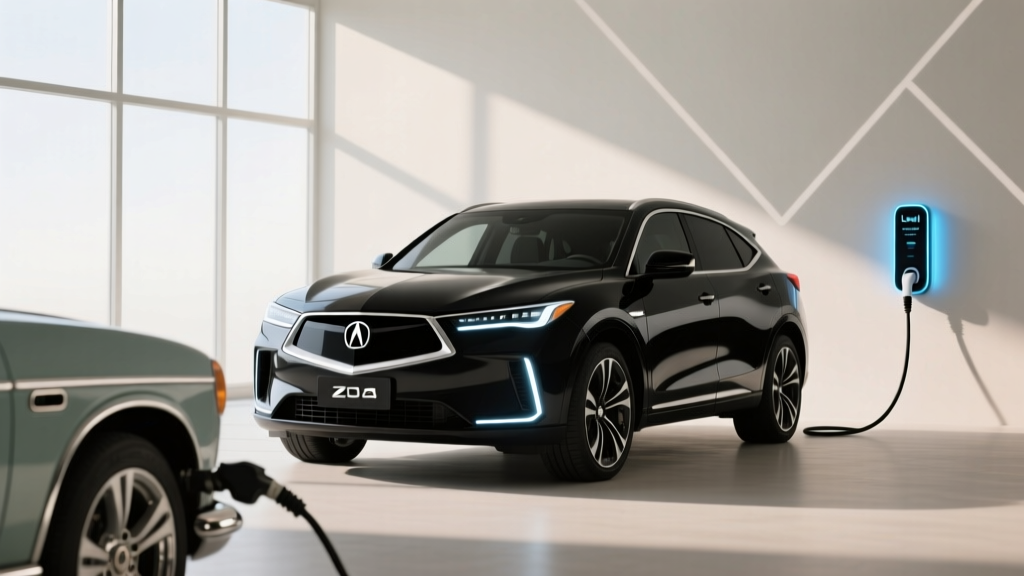
The current-generation Acura ZDX is a battery-electric midsize luxury SUV sharing its Ultium platform with the Cadillac Lyriq and Chevrolet Blazer EV. Here's the complete spec breakdown for the 2025 model year (2026 pricing and trims carry forward with minor adjustments):
| Spec | ZDX A-Spec (RWD) | ZDX A-Spec (AWD) | ZDX Type S |
|---|---|---|---|
| Battery (usable) | 102 kWh (NMC) | 102 kWh (NMC) | 102 kWh (NMC) |
| EPA Range | 313 miles | 304 miles | 278 miles |
| Horsepower | 358 hp | 490 hp | 500 hp |
| 0–60 mph | ~6.2 sec | ~5.0 sec | ~4.5 sec |
| Max DC Fast Charge | 190 kW | 190 kW | 190 kW |
| 10–80% DC Charge | ~32 minutes | ~32 minutes | ~32 minutes |
| Level 2 Home Charging | 11.5 kW (~31 mi/hr) | 11.5 kW (~31 mi/hr) | 11.5 kW (~31 mi/hr) |
| Efficiency (MPGe) | 94 MPGe combined | 91 MPGe combined | 85 MPGe combined |
| Base MSRP (2025) | $65,950 | $68,950 | $74,950 |
Sources: EPA fueleconomy.gov, Acura Newsroom
Real-World Range: What to Expect Beyond the EPA Sticker
EPA (ZDX A-Spec RWD): 313 miles
Real-world highway (70 mph, mild weather): ~265–280 miles
Real-world combined (mixed city/hwy): ~280–300 miles
Cold weather (below 32°F, highway): ~210–240 miles
Expect a 15–25% range reduction on sustained highway driving and up to 30% loss in freezing temperatures. The ZDX's large 102 kWh battery provides a meaningful buffer, but the Ultium platform's efficiency trails competitors like the Hyundai Ioniq 5 or Tesla Model Y.
The ZDX's NMC (nickel manganese cobalt) lithium-ion battery is liquid-cooled and thermally managed, which helps mitigate degradation and supports preconditioning for DC fast charging. When you route to a charger via the navigation system, the battery warms up to optimize charge speed — a critical feature in cold climates.
Charging Speed and Infrastructure
The ZDX's 190 kW peak DC fast-charging rate is adequate but not class-leading. Competitors like the Hyundai Ioniq 5 (peak 240 kW, 10–80% in ~18 minutes) and the Tesla Model Y (peak 250 kW on V3 Superchargers) significantly outpace it. Here's what ZDX charging looks like in practice:
| Charging Level | Power | Speed | Use Case |
|---|---|---|---|
| Level 1 (120V) | ~1.4 kW | ~3–4 miles/hour | Emergency/top-up only |
| Level 2 (240V home) | 11.5 kW | ~31 miles/hour | Daily overnight charging |
| DC Fast Charge | Peak 190 kW | 10–80% in ~32 min | Road trips |
Charging-curve reality: The ZDX does not sustain 190 kW throughout the session. Expect peak speeds between 20–50% State of Charge (SoC), with a taper beginning around 60% and a significant slowdown above 80%. A 10–80% session takes roughly 32 minutes under ideal conditions (warm battery, functional 200+ kW station). Above 80%, plan for an additional 20–25 minutes to reach full — which is why road-trip strategy focuses on the 10–80% window.
The ZDX uses the standard CCS1 connector for DC fast charging. Acura has confirmed that future models will adopt the NACS (Tesla) connector, and adapters are expected for current Ultium-based vehicles to access the Tesla Supercharger network. As of early 2026, ZDX owners rely on Electrify America, EVgo, and ChargePoint networks for public DC charging.
Pricing, Trims, and Federal Tax Credit Eligibility
Here's where the ZDX faces a significant headwind: it does not qualify for the federal §30D EV tax credit for new purchases. The MSRP caps under current IRS rules are $80,000 for SUVs/trucks and $55,000 for sedans. While the ZDX's base prices fall under the $80,000 SUV cap, the vehicle fails the critical-mineral and battery-component sourcing requirements — the Ultium cells are manufactured with materials that do not meet the 2025–2026 thresholds for domestic or free-trade-agreement sourcing.
| Trim | MSRP | §30D Credit Eligible? | Effective Price |
|---|---|---|---|
| ZDX A-Spec RWD | $65,950 | No | $65,950 |
| ZDX A-Spec AWD | $68,950 | No | $68,950 |
| ZDX Type S | $74,950 | No | $74,950 |
Important caveats on §30D (2026 rules):
- Buyer income caps apply: $300K joint / $225K head of household / $150K individual (MAGI)
- Vehicle MSRP must not exceed $80,000 (SUVs/trucks/vans) or $55,000 (sedans)
- Battery components must be manufactured or assembled in North America (percentage thresholds increase annually)
- Critical minerals must be sourced from the US or FTA partners (percentage thresholds increase annually)
- Credit can be transferred to the dealer at point of sale for an immediate price reduction — but only if eligible
Source: IRS.gov — Clean Vehicle Credits
Some ZDX buyers may qualify for state-level incentives (e.g., California's CVRP, Colorado's state credit, New York's Drive Clean rebate), but these vary by jurisdiction and are subject to funding availability. Check your state's energy or DMV website for current programs.
Interior, Technology, and Practicality
The ZDX EV is a genuinely spacious and tech-forward luxury SUV. Highlights include:
- 11.3-inch touchscreen with Google Built-In (Maps, Assistant, Play Store)
- 11-inch digital instrument cluster
- Wireless Apple CarPlay and Android Auto
- AcuraWatch safety suite: adaptive cruise, lane-keeping, blind-spot monitoring, rear cross-traffic
- Panoramic fixed glass roof
- Cargo space: 28.4 cu ft (rear seats up), 56.4 cu ft (folded) — competitive with the Cadillac Lyriq
- Legroom: 41.7" front / 38.2" rear
Notable drawbacks:
- No frunk (front trunk) — the Ultium platform's under-hood layout doesn't accommodate one
- Infotainment can be sluggish compared to Tesla or Rivian interfaces
- Rear visibility is compromised by the sloping roofline (a backup camera is standard)
- Regenerative braking is not strong enough for true one-pedal driving in most conditions
- GM's Super Cruise hands-free driving is not available on the ZDX — Acura opted not to include it, which is a significant omission at this price point
How It Compares: ZDX vs. Key 2026 Electric SUV Rivals
| Spec | Acura ZDX A-Spec AWD | Cadillac Lyriq AWD | Hyundai Ioniq 5 Long Range AWD | Tesla Model Y LR AWD |
|---|---|---|---|---|
| EPA Range | 304 mi | 307 mi | 290 mi | 311 mi |
| Battery | 102 kWh NMC | 102 kWh NMC | 84 kWh NMC | ~78 kWh NMC |
| Peak DC Charge | 190 kW | 190 kW | 240 kW | 250 kW |
| 10–80% Time | ~32 min | ~32 min | ~18 min | ~20 min |
| 0–60 mph | 5.0 sec | 5.3 sec | 5.1 sec | 4.8 sec |
| MSRP (AWD) | $68,950 | $67,295 | $54,550 | $48,990 |
| §30D Credit | No | No | Yes ($7,500)* | Yes ($7,500)* |
| Effective Price | $68,950 | $67,295 | ~$47,050 | ~$41,490 |
* §30D eligibility requires meeting income, MSRP, and sourcing thresholds. Verify current-year rules at IRS.gov.
The comparison is stark. The Ioniq 5 and Model Y charge faster, cost significantly less after credits, and offer comparable or better range. The ZDX's primary advantage is brand cachet and a more traditional luxury interior aesthetic. If you're cross-shopping, the Cadillac Lyriq is the ZDX's closest sibling (same platform, similar pricing) but also fails the §30D test.
Who Should (and Shouldn't) Buy the Acura ZDX EV
- You want a luxury-badged electric SUV with a spacious, quiet cabin
- You value Acura's dealership network and service experience
- You don't need the absolute fastest charging on road trips
- You're ineligible for the §30D credit anyway (income above caps) and the price fits your budget
- You want to maximize federal tax credits — the Ioniq 5 or Model Y save you $7,500+ at purchase
- Road-trip charging speed is a priority — 32-minute stops vs. 18-minute stops add up on long drives
- You want hands-free highway driving — Super Cruise on the Lyriq or Autopilot/FSD on Tesla are more advanced
- Price sensitivity is high — the ZDX costs $15,000–$20,000 more than a comparably equipped Ioniq 5 after credits
Frequently Asked Questions
Is the 2013 Acura ZDX an electric vehicle?
No. The 2013 Acura ZDX is a gasoline-powered V6 crossover with 19 MPG combined. It has no electric motor, battery pack, or charging capability. The ZDX nameplate was revived as a battery-electric SUV for the 2024 model year.
Does the Acura ZDX EV qualify for the $7,500 federal tax credit?
No. As of 2025–2026, the ZDX EV does not meet the battery-component and critical-mineral sourcing requirements under IRS §30D. It cannot receive the new clean vehicle credit, even though its MSRP falls below the $80,000 SUV cap. Always verify current rules at IRS.gov.
What is the real-world range of the Acura ZDX EV?
The EPA rates the ZDX A-Spec RWD at 313 miles and the AWD at 304 miles. In real-world highway driving at 70 mph, expect 265–280 miles. In freezing temperatures, range can drop to 210–240 miles. The 102 kWh battery provides a useful buffer, but efficiency trails more aerodynamic competitors.
How fast does the ZDX charge at home and on the road?
At home on a 240V Level 2 charger (11.5 kW), the ZDX adds about 31 miles of range per hour — a full overnight charge from 20% to 100% takes roughly 8–9 hours. On a DC fast charger, it peaks at 190 kW and charges from 10% to 80% in approximately 32 minutes under ideal conditions.
Is the Acura ZDX EV worth buying over a Tesla Model Y or Hyundai Ioniq 5?
For most buyers focused on value and charging speed, no. The Model Y and Ioniq 5 are $15,000–$25,000 cheaper after tax credits, charge significantly faster, and offer comparable range. The ZDX makes sense only if you prioritize Acura's luxury brand experience, prefer a more traditional interior layout, and are not dependent on the federal tax credit.
What's the battery warranty on the ZDX EV?
Acura covers the ZDX's high-voltage battery for 8 years or 100,000 miles (whichever comes first), with a capacity-retention threshold of 70%. The basic vehicle warranty is 4 years/50,000 miles, and the powertrain warranty is 6 years/70,000 miles.