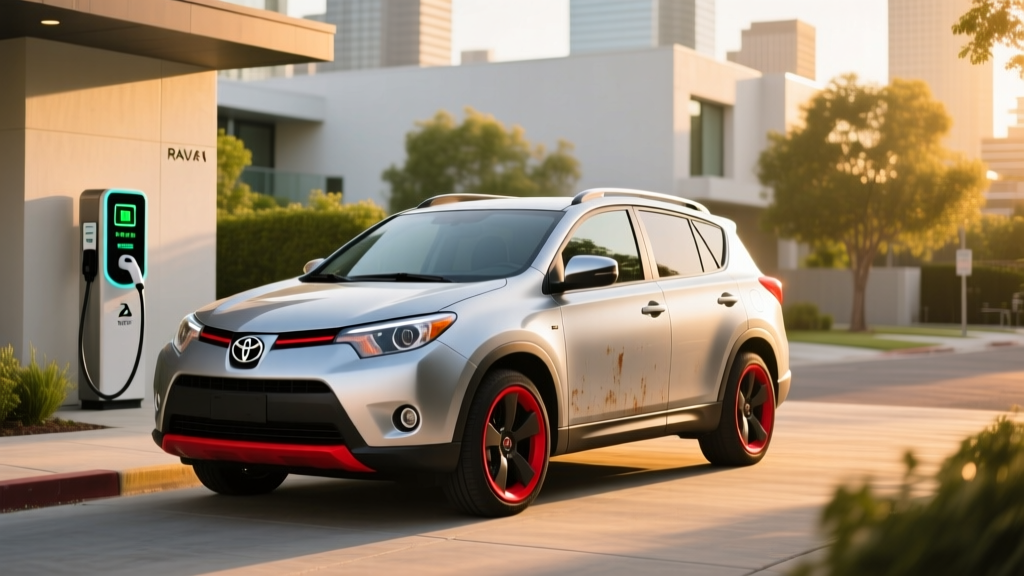
If you're researching the 2012 Toyota RAV4 EV, you're likely looking at one of the most unusual used electric vehicles on the market: a Toyota SUV powered by a Tesla drivetrain. Here's the quick answer most buyers need before going further.
Quick Verdict: Is the 2012 RAV4 EV Worth Buying in 2026?
The 2012 RAV4 EV delivers an EPA-rated 103 miles of range from a 41.8 kWh lithium-ion battery (Tesla-sourced). In 2026, expect real-world range of 70–90 miles due to battery degradation over 14 years. Used prices typically fall between $6,000–$11,000 depending on mileage and battery health. It's a viable budget commuter EV only if you have reliable home Level 2 charging, a short daily drive, and can verify the battery's State of Health (SoH) before purchase. It is not a road-trip vehicle and lacks modern DC fast charging.
What Is the 2012 Toyota RAV4 EV?
The second-generation RAV4 EV was a compliance-style electric SUV sold exclusively in California from 2012 to 2014. Toyota partnered with Tesla — which supplied the battery pack, electric motor, and power electronics — to create an EV version of the third-generation RAV4. The result was a compact SUV with 154 horsepower, a 0–60 mph time of approximately 8.6 seconds, and an EPA range of 103 miles, which was competitive at launch.
Only about 2,500–3,000 units were ever sold, making this a rare vehicle on the used market. The powertrain warranty was 8 years/100,000 miles, meaning every 2012 RAV4 EV is now well past factory warranty coverage as of 2026.
| Spec | Value |
|---|---|
| EPA Range | 103 miles (new) |
| Battery Capacity | 41.8 kWh usable (NMC chemistry, Tesla-sourced) |
| Motor Output | 115 kW (154 hp) |
| 0–60 mph | ~8.6 seconds |
| Top Speed | 85 mph (Sport mode: 100 mph) |
| EPA Efficiency | 76 MPGe combined |
| Onboard Charger | 10 kW (Level 2, J1772 connector) |
| DC Fast Charging | Not supported (no CHAdeMO/CCS/NACS) |
| Charge Time (Level 2, 240V) | ~5 hours (full charge) |
| Cargo Volume | 36.4 cu ft (rear seats up) |
| Original MSRP | $49,800 (before incentives) |
Real-World Range in 2026: What Degradation Means
The biggest question for any 14-year-old EV is battery health. The RAV4 EV's Tesla-sourced NMC (nickel-manganese-cobalt) pack was robust for its era, but all lithium-ion batteries lose capacity over time and charge cycles.
Based on owner reports and typical NMC degradation curves, most 2012 RAV4 EVs in 2026 will retain approximately 70–85% of original capacity, depending on climate exposure, charging habits, and mileage. That translates to:
- Best case (85% SoH): ~88 miles of usable range in mild weather
- Typical case (75% SoH): ~77 miles of usable range
- Worst case (65% SoH): ~67 miles — likely indicating a pack that needs attention
Cold weather further reduces range by 15–30%. If you live in a climate where winter temperatures regularly drop below freezing, plan for as little as 50–60 miles of real range on a cold day with highway driving and cabin heat running. The RAV4 EV uses resistive heating (no heat pump), which is a significant energy draw.
Charging at Home: What You Need to Know
The 2012 RAV4 EV accepts up to 10 kW on Level 2 (240V) via a J1772 connector. This was exceptionally fast for a 2012 EV and remains practical today. A full charge from empty takes roughly 5 hours on a 40-amp Level 2 circuit.
However, there are important caveats:
- No DC fast charging. The RAV4 EV has no CHAdeMO, CCS, or NACS port. You cannot use any public fast charger. All charging is AC only (Level 1 or Level 2).
- Level 1 (120V) is painfully slow. At roughly 1.4 kW, a full charge takes over 30 hours. Level 1 is only viable as a trickle top-up, not a primary strategy.
- Home Level 2 installation typically costs $800–$2,500 for a quality 40-amp charger (like a ChargePoint Home Flex or Emporia Level 2), including electrician labor and permits — assuming your panel has capacity. A panel upgrade to 200A can add $1,500–$3,500.
| Level | Power (kW) | Miles Added per Hour | Full Charge Time |
|---|---|---|---|
| Level 1 (120V, 12A) | 1.4 kW | ~4 mi/hr | ~30+ hours |
| Level 2 (240V, 40A) | 10 kW (max) | ~28 mi/hr | ~5 hours |
| DC Fast Charge | N/A | N/A | Not supported |
If you cannot install a Level 2 charger at home (apartment living, street parking, no dedicated circuit), the RAV4 EV becomes extremely impractical. Public Level 2 chargers can work, but you'll need to plan around multi-hour charging sessions with no fast-charge fallback.
Cost Breakdown: Purchase, Charging, and Ownership
One of the strongest arguments for a used 2012 RAV4 EV is the low entry price. Let's compare real ownership costs against a comparable used gas RAV4 from the same era.
| Category | 2012 RAV4 EV | 2012 RAV4 Gas (4-cyl AWD) |
|---|---|---|
| Used Purchase Price | $7,000–$11,000 | $10,000–$15,000 |
| Fuel/Energy Cost (annual) | $400–$650 (home charging at $0.14/kWh) | $1,500–$1,900 (at $3.50/gal, 25 MPG combined) |
| Maintenance (annual) | $200–$400 (no oil, fewer moving parts) | $600–$1,000 (oil, filters, belts, transmission fluid) |
| Insurance (annual) | $900–$1,300 | $900–$1,200 |
| Battery Replacement Risk | $8,000–$14,000 (if needed; rare but possible) | N/A |
| Federal Tax Credit | Not eligible (used EV credit §25E: up to $4,000 if under $25k sale price and income caps apply — see IRS §25E rules) | None |
Annual fuel savings: roughly $1,000–$1,400/year if you charge primarily at home. Over 5 years, that's $5,000–$7,000 in energy savings — enough to offset the purchase price in many cases.
The big risk: battery replacement. If the pack degrades below ~60% SoH or develops a fault, replacement costs are estimated at $8,000–$14,000 (if a replacement can even be sourced — parts availability is limited for this low-volume model). This single risk is the most important factor in the buying decision.
Used EV Tax Credit: Do You Qualify?
Under the IRS §25E Used Clean Vehicle Credit, you may qualify for up to $4,000 (or 30% of the sale price, whichever is less) when purchasing a used EV from a licensed dealer. Key eligibility requirements for 2026:
- Sale price must be $25,000 or less (the RAV4 EV qualifies easily)
- Buyer income caps: $75,000 single / $112,500 head of household / $150,000 joint (modified AGI)
- Vehicle must be at least 2 model years old (qualifies)
- Must purchase from a licensed dealer (private-party sales do not qualify)
- Credit is non-refundable — you need sufficient tax liability to use it
- You can only claim the used EV credit once every 3 years
Always verify current rules at irs.gov or consult a tax professional before relying on this credit. Rules have shifted annually since the Inflation Reduction Act.
Common Misconceptions About the 2012 RAV4 EV
| Myth | Fact |
|---|---|
| "It's a Tesla, so it charges at Superchargers." | False. The RAV4 EV uses a J1772 connector and has no DC fast-charge capability. It cannot use Tesla Superchargers or any DC fast-charging network. |
| "103 miles of range is still 103 miles today." | False. After 14 years, expect 70–90 miles at best. Always verify SoH before buying. |
| "Toyota means bulletproof reliability." | Partially true. The Toyota body and chassis are solid, but the Tesla-sourced powertrain is now a 14-year-old EV system with limited parts availability and no dealer support network for the EV-specific components. |
| "I can road-trip in it." | Not practical. No DC fast charging means multi-hour stops at Level 2 chargers. This is a local commuter, not a travel vehicle. |
| "Battery replacement is easy and cheap." | False. Replacement packs are scarce, expensive ($8k–$14k), and few shops have expertise with this specific Tesla-Toyota hybrid system. |
Decision Framework: Should You Buy One?
Choose the 2012 RAV4 EV if:
- Your daily round-trip commute is under 50 miles
- You have reliable home Level 2 charging (garage or driveway with a 240V circuit)
- You live in a mild climate (minimal freezing weather)
- You want an affordable entry into EV ownership and accept the range limitations
- You can verify battery SoH before purchase (request a diagnostic report or use an OBD2 EV scanner)
- You have a second gas or hybrid vehicle for longer trips
Look elsewhere if:
- You need more than 80 miles of daily range
- You lack home charging access (apartment, street parking)
- You live in a cold climate with extended sub-freezing winters
- You want DC fast charging for road trips or flexible public charging
- You cannot afford the risk of an $8,000–$14,000 battery replacement
- You want modern tech features (the 2012 RAV4 EV has no adaptive cruise, no lane-keeping, basic infotainment)
How Does It Compare to Alternatives?
At the $7,000–$11,000 price point, the 2012 RAV4 EV competes with other early-era used EVs and older gas/hybrid SUVs:
| Vehicle | Typical Used Price | Range / MPG | DC Fast Charge? | Notes |
|---|---|---|---|---|
| 2012 RAV4 EV | $7,000–$11,000 | 70–90 mi (degraded) | No | Tesla drivetrain, rare, no fast charge |
| 2013–2015 Nissan Leaf (24 kWh) | $5,000–$9,000 | 50–70 mi (degraded) | Yes (CHAdeMO) | More common, but worse degradation; CHAdeMO network shrinking |
| 2016–2017 Chevy Bolt EV | $10,000–$15,000 | ~180–210 mi | Yes (CCS) | Far better range, modern, CCS charging |
| 2012 Toyota RAV4 (gas) | $10,000–$15,000 | 25 MPG combined | N/A | No range anxiety, higher fuel cost, proven reliability |
| 2012 Toyota RAV4 Hybrid | $11,000–$16,000 | 32 MPG combined | N/A | Best of both for some; no plug, no range limits |
If your budget can stretch to $12,000–$15,000, a used 2017+ Chevy Bolt EV offers dramatically more range (~238 miles EPA new), DC fast charging, and better parts availability. For buyers who simply want low-cost, reliable transportation without charging logistics, a gas or hybrid RAV4 remains a pragmatic choice — especially if you lack home charging.
Pre-Purchase Checklist: What to Inspect
Before handing over cash for a 2012 RAV4 EV, take these steps:
- Check battery State of Health (SoH). Use an OBD2 EV diagnostic tool (like Leaf Spy Pro, which supports some Toyota/Tesla protocols) or have a qualified EV technician pull the battery health report. Avoid any pack below 70% SoH unless priced accordingly.
- Inspect for coolant leaks. The Tesla-sourced thermal management system uses glycol coolant loops. Check for residue around the battery enclosure and coolant reservoir.
- Test the onboard charger. Plug into a known-good Level 2 station and verify the vehicle pulls close to its 10 kW rated charge rate. Slow charging may indicate an onboard charger fault.
- Verify title status. Some early RAV4 EVs were sold as lease returns or salvage. Confirm a clean title.
- Check for recalls. Visit NHTSA.gov and enter the VIN to confirm all recalls were addressed.
- Assess tire and suspension wear. EVs are heavier than their gas counterparts, which accelerates tire and suspension component wear.
Frequently Asked Questions
Can I charge the 2012 RAV4 EV at a Tesla Supercharger?
No. Despite the Tesla-sourced powertrain, the RAV4 EV has a standard J1772 AC charging port and no DC fast-charge hardware. It is physically and electronically incompatible with Tesla Superchargers, Electrify America, EVgo, or any DC fast-charging network.
What happens if the battery fails?
Replacement is possible but expensive and logistically difficult. Expect $8,000–$14,000 for a refurbished or used replacement pack plus labor. Very few independent shops specialize in this specific Tesla-Toyota system. Factor this risk into your purchase price negotiation.
Is the 2012 RAV4 EV eligible for any tax credits in 2026?
It may qualify for the IRS §25E Used Clean Vehicle Credit (up to $4,000) if purchased from a licensed dealer for $25,000 or less, and if your income falls under the caps. It is not eligible for the §30D new EV credit (that's only for new vehicles). Confirm details at irs.gov.
How does the RAV4 EV compare to a modern EV like the 2025 Hyundai Ioniq 5?
It's not a fair comparison. A new Ioniq 5 offers 300+ miles of range, 240 kW DC fast charging (10–80% in ~18 minutes), modern ADAS, and full warranty — starting around $42,000. The RAV4 EV is a budget used option for short commutes only. They serve completely different use cases and budgets.
Should I buy a 2012 RAV4 EV or a used Nissan Leaf?
The RAV4 EV has better original range (103 vs. 73–84 miles for early Leafs), a more robust Tesla-sourced battery, and SUV practicality. But the Leaf has DC fast charging (CHAdeMO), a larger dealer/parts network, and lower prices. If fast charging matters to you, the Leaf wins. If range and battery quality matter more, the RAV4 EV has the edge — but neither is ideal for anything beyond local commuting.