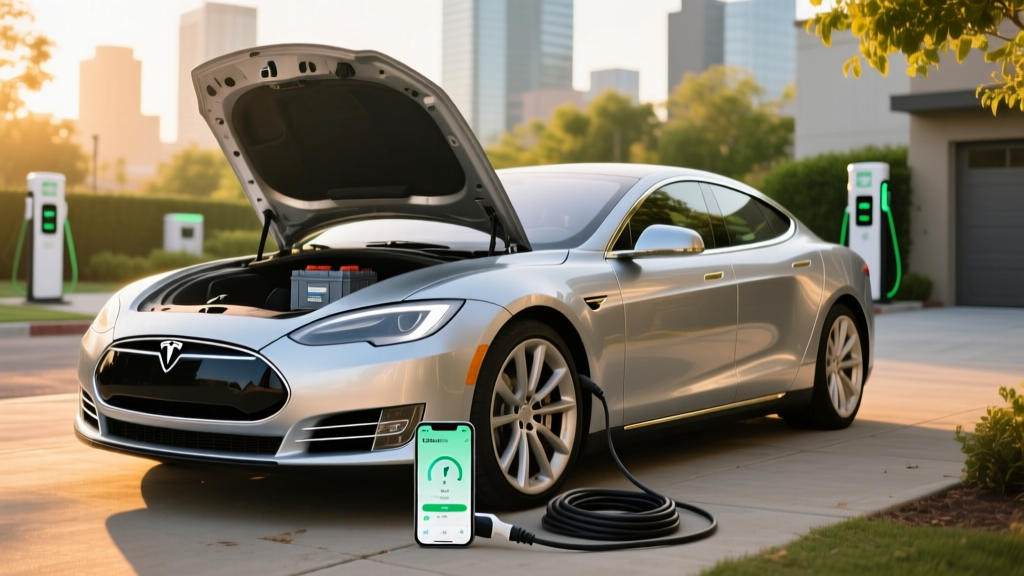
The 2012 Tesla Model S is a landmark vehicle — the car that proved a battery-electric sedan could compete with luxury German sedans on performance, tech, and daily usability. More than a decade later, thousands of these early Model S vehicles remain on the road. But buying or owning a 2012 Model S in 2026 is a very different proposition than when it debuted. Battery degradation, outdated charging hardware, and the reality of a 14-year-old high-voltage system demand honest evaluation.
This review treats the 2012 Model S not as a museum piece, but as a real used-EV purchase decision. We'll cover what the original EPA ratings meant, what owners actually experience today, how charging works on legacy hardware, and whether the math still makes sense.
2012 Model S: Original Specifications at a Glance
Tesla offered the 2012 Model S in two battery configurations at launch, with a third (40 kWh) announced but rarely delivered. The 60 kWh and 85 kWh variants were the volume sellers. Here are the factory specifications as published by Tesla and the EPA:
| Specification | Model S 60 | Model S 85 |
|---|---|---|
| Battery Capacity (usable) | ~60 kWh (NMC) | ~85 kWh (NMC) |
| EPA Range (new) | 208 miles | 265 miles |
| Motor | Single rear motor | Single rear motor |
| Horsepower | 302 hp | 362 hp |
| 0-60 mph | 5.9 seconds | 5.4 seconds |
| Drivetrain | RWD | RWD |
| MPGe (combined) | 95 MPGe | 89 MPGe |
| kWh/100 mi | 35 kWh | 38 kWh |
| Base MSRP (2012) | $59,900 | $69,900 |
| Battery Warranty | 8 yr / 125,000 mi | 8 yr / unlimited mi |
The NMC (nickel-manganese-cobalt) chemistry used in 2012 was energy-dense for its era but is more susceptible to calendar and cycle degradation than the LFP (lithium iron phosphate) packs Tesla later adopted for standard-range vehicles. This distinction matters enormously for a 2026 buyer.
Real-World Range in 2026: What the Battery Actually Delivers
Expected Real-World Range (2026, Degraded): ~160–210 miles (85 kWh) / ~120–165 miles (60 kWh)
Highway at 75 mph: Subtract ~10-15% from current degraded range
Cold Weather (below 32°F): Subtract an additional 20-30%
The single most important question for a 2012 Model S buyer in 2026 is battery state of health (SoH). After 13-14 years of calendar aging and potentially hundreds of charge cycles, NMC packs from this era typically show 15-30% capacity loss, depending on charging habits, climate, and mileage.
Data from Tesla owner communities and third-party battery analyses suggest that a well-maintained 85 kWh pack at ~120,000 miles retains roughly 75-85% of original capacity. That means your "full charge" now delivers the equivalent of 64-72 usable kWh — translating to roughly 170-210 miles of mixed driving. A 60 kWh pack with similar aging may deliver only 120-165 miles.
Highway driving at 75+ mph pushes consumption well above the EPA-rated 38 kWh/100 mi. Expect 42-48 kWh/100 mi at sustained highway speeds, which compresses range further. In freezing temperatures, the 2012 Model S lacks a heat pump (it uses resistive cabin heating), and battery thermal management is less sophisticated than modern Tesla packs. Cold-weather range loss of 25-35% is common, making sub-130-mile winter range a reality for many 85 kWh examples.
Key takeaway: Request a battery SoH reading or a full charge-range screenshot from the seller. A car displaying less than 180 miles at 100% SoC (for the 85 kWh) likely has significant degradation or a replaced-but-smaller loaner pack.
Charging Speeds: Legacy Hardware in a Modern Network
The 2012 Model S uses Tesla's proprietary connector (the precursor to NACS) and was designed for an earlier generation of Supercharger and home charging infrastructure. Here's what to expect:
| Charging Level | Max Power | Speed / Notes |
|---|---|---|
| Level 1 (120V) | ~1.4 kW | ~3-4 miles per hour |
| Level 2 (240V, single charger) | 10 kW | ~28-30 miles per hour |
| Level 2 (240V, twin chargers)* | 20 kW | ~58-60 miles per hour |
| DC Fast Charge (Tesla Supercharger V2) | ~90-120 kW (peak) | 10-80% in ~45-55 min |
| CHAdeMO (via adapter) | ~50 kW | Slow by modern standards |
*Twin onboard chargers were a $3,650 option on the 2012 Model S. Many examples were not equipped with them. Verify with the seller — it makes a significant difference for Level 2 home charging.
The 2012 Model S cannot access Tesla's V3/V4 Superchargers at full speed (250+ kW) because its battery management system and thermal hardware predate those charge rates. On a V2 Supercharger (150 kW cabinets), the 85 kWh pack typically peaks around 90-120 kW and tapers significantly above 60% SoC. A 10-80% session takes roughly 45-55 minutes — acceptable for road trips but noticeably slower than a modern Model 3 or Model Y, which can do the same in 18-25 minutes.
For home charging, a single-charger 2012 Model S on a 48-amp Level 2 circuit (like a Tesla Wall Connector) will accept only 10 kW (40 amps). That's a full overnight charge for most daily needs but slower than the 11.5-19.2 kW rates modern EVs accept. If the car has twin chargers, you can pull 20 kW from an 80-amp circuit — genuinely fast for home charging, even by 2026 standards.
CCS compatibility is not native. Tesla provides a CCS adapter for newer vehicles, but 2012 Model S hardware does not support CCS protocol without significant aftermarket modification. You're effectively locked into the Tesla Supercharger network and CHAdeMO stations (with the optional Tesla CHAdeMO adapter, which is now rare and expensive on the used market).
Performance and Driving Dynamics
Even in 2026, the 2012 Model S 85 feels quick off the line. The single rear motor delivers 362 hp and instant torque, yielding a 5.4-second 0-60 mph time that still outpaces most gas-powered sedans in its price bracket. The 60 kWh model's 302 hp and 5.9-second run remain respectable.
The 2012 Model S is rear-wheel drive only — dual-motor all-wheel drive didn't arrive until the 2014 model year. In rain and snow, this matters. The car's weight (4,647 lbs for the 85) provides decent traction, but winter tire investment is strongly recommended for cold-climate owners.
Ride quality was praised at launch for its air suspension (optional, $2,500), which offers adjustable ride height and a comfortable highway cruise. However, 14-year-old air struts are a known failure point. Budget $2,000-$4,000 for air suspension replacement if the previous owner hasn't already addressed it. Many owners convert to conventional coil springs to eliminate future air-suspension costs.
Interior, Cargo, and Technology
The 2012 Model S interior was minimalist and tech-forward for its time, anchored by a 17-inch touchscreen that controlled nearly every vehicle function. In 2026, that screen hardware feels dated — it's a resistive-era capacitive panel that can be sluggish compared to modern infotainment. Tesla has provided over-the-air updates for years, but the 2012 MCU1 (Media Control Unit) hardware is limited. Tesla offered an MCU2 upgrade program ($2,500) that brought faster processing and better navigation — check whether the car you're evaluating has received this upgrade.
Passenger space remains generous. The Model S is a full-size sedan with:
- Front legroom: 42.7 inches
- Rear legroom: 35.4 inches
- Cargo (rear trunk): 26.3 cu ft
- Frunk (front trunk): 5.3 cu ft
- Total with rear seats folded: 58.1 cu ft
The frunk and flat floor (no transmission tunnel) were revolutionary in 2012 and remain practical. An optional rear-facing third row added two small child seats, bringing total seating to seven — though this was rarely optioned and is cramped for anyone over age six.
Driver assistance on the 2012 Model S is limited to basic features. Tesla's Autopilot hardware (cameras, radar, ultrasonic sensors) wasn't introduced until late 2014. A 2012 model has no adaptive cruise control, no lane-keeping assist, and no automatic emergency braking. You're driving a 2012 car with 2012-era safety assists — a significant consideration for family buyers accustomed to modern ADAS.
Pricing, Used Market Value, and Tax Credit Reality
The 2012 Model S originally started at $59,900 (60 kWh) and $69,900 (85 kWh), before incentives. In the 2026 used market, these cars trade at a fraction of that:
| Condition / Config | Typical Price Range |
|---|---|
| 85 kWh, high mileage (100k+), original battery | $8,000 – $12,000 |
| 85 kWh, moderate mileage, battery replaced | $13,000 – $18,000 |
| 60 kWh, any mileage | $6,500 – $10,000 |
| 85 kWh, low mileage, excellent condition | $14,000 – $20,000 |
Federal Tax Credit Eligibility
Under IRS §30D rules, the used clean vehicle credit (technically §25E for used EVs) offers up to $4,000 or 30% of the sale price, whichever is less, for qualified used EVs purchased from a dealer. Key requirements:
- Sale price must be $25,000 or less (the 2012 Model S easily qualifies)
- Buyer income caps: $75,000 (single) / $150,000 (married filing jointly)
- Vehicle must be at least two model years old (qualifies)
- Must purchase from a licensed dealer — private-party sales do not qualify
- The vehicle's original MSRP when new is irrelevant for the used credit
In practice, a $12,000 dealer-purchased 2012 Model S 85 could yield a $3,600 credit (30% of $12,000), bringing the effective cost to ~$8,400. This makes it one of the cheapest entry points into a full-size electric sedan — but only if the battery is healthy.
Battery Replacement, Warranty Status, and Long-Term Costs
The original 8-year/unlimited-mileage battery warranty on the 85 kWh model expired no later than 2020. The 60 kWh's 8-year/125,000-mile warranty is also fully expired. Any battery failure in 2026 is the owner's financial responsibility.
Tesla battery replacement for a 2012 Model S currently costs between $12,000 and $20,000 depending on whether you receive a new, remanufactured, or used pack. Tesla's service centers sometimes offer remanufactured packs at lower cost (~$12,000-$15,000), but availability varies. Third-party EV shops and salvage packs from wrecked Teslas offer alternatives in the $8,000-$12,000 range.
This creates a painful economic equation: a $12,000 car that needs a $15,000 battery is effectively a $27,000 vehicle with 2012 technology, no Autopilot, and aging suspension. Some owners choose to sell rather than replace. Others view the replacement as a reset that gives the car another 150,000+ miles of life.
Beyond the battery, budget for:
- Drive unit (motor) replacement: $5,000-$8,000 (known failure point at high mileage)
- Air suspension: $2,000-$4,000 (struts and compressor)
- MCU1 screen failure: $1,500-$3,000 (yellowing, delamination, or total failure are common)
- Door handles: $500-$1,000 per handle (a notorious Model S weakness)
- 12V battery: $300-$500 (standard maintenance item)
Pros and Cons: The Honest Assessment
Pros
- Extremely low purchase price for a full-size electric luxury sedan
- Spacious cabin and cargo area (26.3 cu ft trunk + frunk)
- Strong performance (5.4 sec 0-60 for 85 kWh) even with degradation
- Access to Tesla Supercharger network (with legacy speed limits)
- Over-the-air updates still supported for core functions
- Qualifies for up to $4,000 used EV tax credit (§25E)
Cons
- Significant battery degradation — 160-210 real miles typical for 85 kWh
- No Autopilot, no AEB, no adaptive cruise — 2012-era safety tech only
- DC fast charging capped at ~120 kW — 45-55 min for 10-80%
- Expired battery and powertrain warranty — replacement costs $12k-$20k
- MCU1 infotainment is slow and prone to failure
- Air suspension, door handles, and drive unit are known expensive failure points
- CCS charging not natively supported
- No heat pump — poor cold-weather efficiency
Who Should (and Shouldn't) Buy a 2012 Model S
Consider it if:
- You need a spacious EV commuter on a tight budget ($8,000-$15,000)
- Your daily round-trip commute is under 80 miles (well within degraded range)
- You have reliable home Level 2 charging and don't depend on public fast-charging
- You're mechanically inclined or have a trusted independent EV shop
- You want a large, comfortable EV as a second car
Look elsewhere if:
- You need reliable 250+ mile range for road trips
- You drive in extreme cold regularly (below 20°F) — range will be punishing
- You want modern driver-assistance features (AEB, lane-keeping, adaptive cruise)
- You can't absorb a potential $12,000-$20,000 battery replacement
- You need fast DC charging for frequent highway travel
- This would be your only vehicle for long-distance driving
For budget-conscious buyers who can accept the risk, a well-maintained 2012 Model S 85 with a documented battery replacement or strong SoH reading can be a remarkably capable daily driver at a fraction of the cost of a new EV. For everyone else, a used 2018+ Model 3 or a 2020+ Model Y offers far better range, charging speed, safety tech, and warranty coverage for $20,000-$30,000.
Frequently Asked Questions
What is the real-world range of a 2012 Model S in 2026?
For the 85 kWh model with typical degradation (15-25% loss), expect 160-210 miles in mixed driving, 140-180 miles at highway speeds, and as low as 110-150 miles in freezing weather. The 60 kWh model delivers proportionally less: roughly 120-165 miles mixed.
How fast does the 2012 Model S charge?
On a Tesla V2 Supercharger, peak charge rate is approximately 90-120 kW, with a 10-80% session taking 45-55 minutes. At home on Level 2 (240V), a single-charger car accepts 10 kW (~29 mi/hr), while twin-charger cars accept 20 kW (~58 mi/hr). Level 1 (120V) adds only 3-4 miles per hour.
Does a 2012 Model S qualify for any federal tax credit?
It does not qualify for the new-vehicle §30D credit (production ended long ago). However, if purchased from a licensed dealer for $25,000 or less, it may qualify for the §25E used clean vehicle credit — up to $4,000 or 30% of the sale price, subject to buyer income limits ($75k single / $150k joint).
Is the 2012 Model S worth buying versus a newer used EV?
It depends on budget and risk tolerance. At $8,000-$12,000, it's the cheapest large electric sedan available. But a 2018+ Model 3 Long Range ($18,000-$24,000 used) offers 310 miles of EPA range, 250 kW Supercharging, Autopilot, and likely remaining battery warranty. The Model 3 is the safer financial bet unless you specifically need the Model S's cargo space and ride comfort.
Can I upgrade a 2012 Model S to modern Autopilot or FSD?
No. The 2012 Model S was built before Tesla introduced Autopilot hardware (which debuted in September 2014). There is no retrofit path for cameras, radar, or the computing hardware required for Autopilot or Full Self-Driving. You are limited to the car's original safety systems.
What should I check before buying a used 2012 Model S?
Prioritize: (1) Battery SoH — request a screenshot of the car's rated range at 100% charge, (2) service history for drive unit, air suspension, and MCU replacements, (3) whether the car has single or twin chargers, (4) title status (avoid salvage/rebuilt titles — battery safety may be compromised), and (5) Supercharger access (some salvaged Teslas have had Supercharging permanently disabled by Tesla).