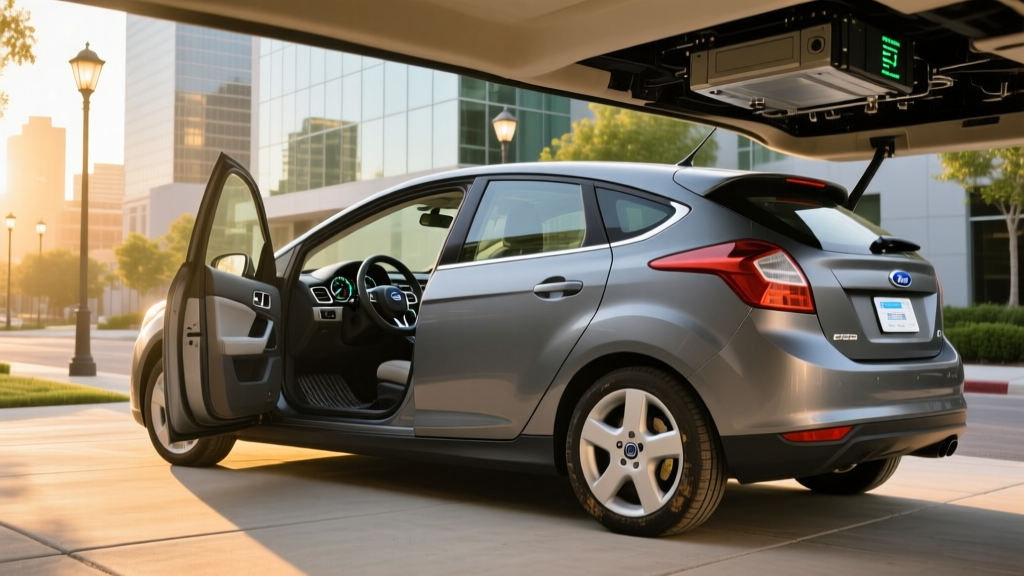
Quick Verdict: Is the 2012 Ford Focus Electric Worth Buying in 2026?
The 2012 Ford Focus Electric is a budget-priced used EV best suited as a short-commute city car. With an EPA-estimated 76 miles of range from its 23 kWh liquid-cooled battery, it falls far short of modern EVs that routinely deliver 250+ miles. Expect to pay between $4,000–$8,000 on the used market. It can work if your daily round trip is under 50 miles, you have reliable home charging, and you live in a mild climate. For longer commutes or cold-weather drivers, a used Chevrolet Bolt (238–259 mi EPA) or a newer PHEV is a far more practical choice.
The Numbers: 2012 Ford Focus Electric Spec Sheet
Before evaluating this car as a used purchase, here are the factory specifications and real-world adjustments every buyer should know. Ford built the Focus Electric on the same global C-platform as the gas Focus, stuffing a liquid-cooled lithium-ion battery pack under the rear seats and cargo floor. The result is a competent city runabout with serious range and cargo limitations by 2026 standards.
| Specification | Figure |
|---|---|
| EPA Range | 76 miles |
| Battery Capacity (total / usable) | 23 kWh / ~19.5 kWh |
| Battery Chemistry | Lithium-ion (NMC-type pouch cells, LG Chem) |
| Motor Output | 107 kW (143 hp), 184 lb-ft torque |
| 0–60 mph | ~9.5 seconds |
| Top Speed | 84 mph (electronically limited) |
| EPA Efficiency | 110 MPGe combined (105 city / 93 hwy) |
| Onboard Charger (Level 2) | 6.6 kW |
| Level 2 Charge Time (0–100%) | ~3–4 hours |
| DC Fast Charging | Not available |
| Charge Port | SAE J1772 (Level 1 & Level 2 only) |
| Cargo Volume | 14.5 cu ft (reduced by battery pack) |
| Original MSRP (2012) | $39,200 (before incentives) |
| Estimated Used Price (2026) | $4,000–$8,000 |
| Battery Warranty (original) | 8 years / 100,000 miles (expired) |
The single biggest limitation is the absence of DC fast charging. The 2012 Focus Electric can only accept AC power through its J1772 port. That means road trips require careful planning around Level 2 public chargers at 6.6 kW, adding roughly 20–25 miles of range per hour of plugged-in time. This is a dealbreaker for anyone who needs highway flexibility.
Real-World Range: What to Actually Expect
The EPA sticker says 76 miles, but real-world range in a 14-year-old EV depends heavily on battery degradation, climate, and driving style. Here is a realistic breakdown:
Range Expectations for a 2012 Focus Electric in 2026
- Mild weather, city driving (55°F, under 45 mph): 60–70 miles on a full charge, assuming ~10–15% battery degradation
- Highway driving (70 mph, 75°F): 50–60 miles — higher speeds increase aerodynamic drag significantly on a small battery
- Cold weather (30°F, mixed driving, heater on): 35–50 miles — resistive cabin heating in this model draws heavily from the traction battery, and lithium-ion cells lose efficiency in cold temperatures
- Worst case (15°F, highway, aged battery): 25–35 miles — buyers in northern climates should treat this as a summer-only or backup vehicle
The Focus Electric uses a resistive heater rather than a heat pump, which is one of the biggest range penalties in cold weather. Modern EVs like the Hyundai Ioniq 5 or Tesla Model Y use heat pumps that consume roughly 30–50% less energy for cabin heating. This matters enormously when your total battery is only 23 kWh.
According to EPA data on fueleconomy.gov, the Focus Electric achieves 110 MPGe combined, which was competitive in 2012 but trails the 120–140 MPGe of modern compact EVs like the Chevrolet Bolt EV or Nissan Leaf Plus.
Battery Health: The Critical Used-EV Question
The original 8-year/100,000-mile battery warranty on every 2012 Focus Electric has expired. You are buying this car as-is, so battery State of Health (SoH) is the single most important factor in your purchase decision.
Expected Degradation
LG Chem pouch cells in the Focus Electric have aged reasonably well compared to early passive-air-cooled packs (like the first-generation Nissan Leaf), thanks to the liquid thermal management system. Based on owner reports and industry degradation curves for NMC chemistry of this era:
- Average SoH at 14 years: 80–90% of original capacity, meaning 15.6–17.6 kWh usable
- High-mileage or hot-climate examples: 70–80% SoH, dropping real range to 50–55 miles
- Well-maintained, garage-kept examples: Up to 92% SoH is possible but uncommon
How to Check Battery Health Before Buying
The Focus Electric's MyFord Touch display shows an estimated range figure but not a direct SoH percentage. Before purchase:
- Full-charge test: Charge to 100% and note the displayed estimated range. A healthy pack should show 65–76 miles. Below 60 miles suggests significant degradation.
- OBD-II scan: Use a tool like LeafSpy (compatible with some Ford EV protocols) or have a dealer pull the battery health report via the vehicle's onboard diagnostics.
- Charge-discharge cycle: Drive from 100% to near empty and measure actual miles driven against the displayed starting range.
Battery Replacement Cost
If the pack fails outside warranty, a replacement 23 kWh battery from Ford was originally quoted in the $12,000–$15,000 range — a figure that exceeds the car's entire market value. Third-party refurbished packs may be available for $5,000–$8,000 through independent EV shops, but availability is limited for a low-volume model. Factor this risk into your purchase: if the battery dies, the car is likely totaled economically.
Charging at Home and in Public
The 2012 Focus Electric supports Level 1 (120V) and Level 2 (240V) AC charging only. There is no DC fast-charge port.
| Charging Level | Power | Time (0–100%) | Miles Added per Hour |
|---|---|---|---|
| Level 1 (120V outlet) | ~1.4 kW | ~16–20 hours | ~3–4 miles |
| Level 2 (240V, 30A circuit) | 6.6 kW | ~3–4 hours | ~20–25 miles |
| DC Fast Charging | N/A — not supported | N/A | N/A |
Home Charging Setup
With a 6.6 kW onboard charger, the Focus Electric takes full advantage of a Level 2 home station. A 240V/30A circuit is sufficient. Installation costs for a home Level 2 charger typically run:
- Level 2 EVSE unit (e.g., ChargePoint Home Flex, Emporia Level 2): $300–$600
- Electrician labor (new 240V circuit, standard panel): $500–$1,500
- Panel upgrade (if needed, 100A to 200A): $1,500–$3,000
- Permit fees: $50–$200 depending on jurisdiction
Total home install: $850–$2,300 for most homes with adequate panel capacity. If you can only use a standard 120V outlet, expect overnight charging to add roughly 35–45 miles — enough to refill the pack, but barely. Level 1 is viable only if you drive under 30 miles daily.
Public Charging Reality
Without DC fast charging, the Focus Electric is limited to public Level 2 stations (typically 6.6–19.2 kW, but the car caps at 6.6 kW). This means:
- A 30-minute stop at a grocery-store Level 2 charger adds only ~10–12 miles
- You cannot use Tesla Superchargers, Electrify America, EVgo, or any CCS/NACS DC fast-charging network
- Road trips over 80 miles one-way are impractical without an overnight stop
Cost Breakdown: 2012 Focus Electric vs. Comparable Gas Car
The main financial argument for a used Focus Electric is low operating cost. Here is a 5-year comparison against a used 2012 Ford Focus SE (gas, 2.0L, 30 MPG combined) assuming 10,000 miles/year.
| Cost Category | 2012 Focus Electric | 2012 Focus SE (Gas) |
|---|---|---|
| Purchase Price (est.) | $6,000 | $5,500 |
| Fuel / Electricity (5 yr, 50,000 mi) | $1,750 (at $0.14/kWh) | $5,833 (at $3.50/gal, 30 MPG) |
| Maintenance (5 yr) | $800 (tires, cabin filter, wipers) | $3,500 (oil, filters, brakes, belts) |
| Insurance (5 yr avg.) | $5,500 ($1,100/yr) | $5,000 ($1,000/yr) |
| Battery Replacement Risk | $0–$12,000 (out of warranty) | N/A |
| 5-Year Total (no battery failure) | $14,050 | $19,833 |
| 5-Year Total (with battery replacement) | $26,050 | $19,833 |
The electric Focus saves roughly $5,800 over five years in fuel and maintenance — but only if the battery holds up. A single battery replacement erases all savings and then some. This is the core gamble of buying an early, out-of-warranty EV.
Note: The federal §30D tax credit does not apply to used vehicles purchased from private parties. The Used Clean Vehicle Credit (§25E) offers up to $4,000 or 30% of the sale price (whichever is less) for qualified used EVs purchased from a licensed dealer, subject to income caps ($75,000 single / $150,000 joint) and a sale price cap of $25,000. A $6,000 Focus Electric from a dealer could qualify for roughly $1,800 under §25E if all criteria are met. Verify current rules with a tax professional.
Common Misconceptions About the 2012 Focus Electric
| Myth | Fact |
|---|---|
| "It can use Tesla Superchargers with an adapter." | False. The Focus Electric has no DC fast-charge hardware. Adapters only work for AC charging (Level 2). You cannot physically or electronically connect to a DC fast charger. |
| "76 miles of range is enough for most people." | The average American drives ~37 miles/day (FHWA data), but that average hides long tail-commute days, errands, and detours. With cold-weather losses of 30–50%, a 76-mile EPA car drops to 40–50 real miles in winter — a tight margin. |
| "The battery will need replacing soon." | Not necessarily. Liquid-cooled NMC packs from LG Chem have shown 80–90% capacity retention at 10–15 years in moderate climates. But without a warranty, you assume the replacement risk entirely. |
| "It qualifies for the $7,500 federal tax credit." | The §30D new-vehicle credit is long expired for this car. Only the §25E used-vehicle credit (up to $4,000) may apply, with strict income, dealer-sale, and price-cap requirements. |
| "It charges fast on Level 2." | At 6.6 kW, a full charge takes 3–4 hours. That is adequate for overnight home charging but slow for mid-day top-ups on the go. Modern EVs charge at 7.2–19.2 kW on Level 2. |
Decision Framework: Should You Buy This Car?
Buy the 2012 Ford Focus Electric IF:
- Your daily round-trip commute is under 40 miles (under 25 miles in cold climates)
- You have access to Level 2 home charging (240V garage or driveway)
- You live in a mild climate (rarely below 35°F)
- This is a second or third vehicle in the household, not your only car
- You can purchase it for under $6,000 with verified battery health above 80%
- You value near-zero maintenance and low per-mile electricity cost over range
Do NOT buy it if:
- You need to drive more than 50 miles in a day regularly
- You lack home charging and would rely on public infrastructure
- You live in a cold-winter climate and need reliable year-round range
- This will be your only vehicle
- You need cargo space — the battery intrusion cuts trunk volume to 14.5 cu ft vs. 23.8 cu ft in the gas Focus
- You want any modern driver-assistance features — this car has basic ABS and stability control, no adaptive cruise, no lane-keep, no automatic emergency braking
Better Alternatives in the $6,000–$15,000 Used EV Market (2026)
- 2017–2019 Chevrolet Bolt EV: 238-mile EPA range, 60 kW DC fast charging, ~$10,000–$15,000 used. Dramatically more capable.
- 2018–2020 Nissan Leaf Plus (62 kWh): 226-mile EPA, CHAdeMO DC fast charging, ~$10,000–$14,000. Note: passive air cooling means faster degradation in hot climates.
- 2016–2018 BMW i3 (94 Ah / 120 Ah): 114–153-mile range, DC fast charging available, ~$10,000–$16,000. Unique carbon-fiber construction, more premium interior.
- Used Toyota Prius Prime (PHEV): 25-mile electric-only range + 54 MPG gas. Eliminates range anxiety entirely. ~$12,000–$18,000 used.
Frequently Asked Questions
What is the top speed of the 2012 Ford Focus Electric?
The Focus Electric is electronically limited to 84 mph. It can sustain highway speeds of 65–75 mph, but doing so drains the small battery rapidly. Expect roughly 50–55 miles of range at 70 mph in warm weather.
Can I install a DC fast-charge port on the Focus Electric?
No. The vehicle was not designed with DC fast-charge hardware, and there is no retrofit pathway. The onboard power electronics, battery management system, and wiring do not support DC input above the 6.6 kW AC onboard charger.
How much does it cost to charge the Focus Electric at home?
Fully charging the ~19.5 kWh usable battery at the U.S. average residential rate of $0.14/kWh costs approximately $2.73. That delivers roughly 60–70 real-world miles, or about $0.04 per mile — compared to $0.12 per mile in a 30 MPG gas car at $3.50/gallon.
Does the 2012 Focus Electric qualify for any tax credits in 2026?
The original $7,500 §30D new-vehicle credit is expired. The §25E Used Clean Vehicle Credit may provide up to $4,000 (or 30% of the sale price) if purchased from a licensed dealer, subject to buyer income limits ($75K single / $150K joint AGI) and a $25,000 maximum sale price. Consult a tax professional to confirm eligibility for your specific situation.
Is the 2012 Focus Electric safe?
The 2012 Focus platform earned good crash-test scores in its era, including a Top Safety Pick designation from IIHS for the gas model. The electric variant shares the same structure. However, it lacks any modern ADAS features — no automatic emergency braking, no blind-spot monitoring, no lane-departure warning. By 2026 safety standards, it is a basic vehicle. Check NHTSA ratings for specific crash-test data.
What should I look for when test-driving a used Focus Electric?
Charge the car to 100% before the drive and note the displayed range estimate (65+ miles is encouraging). Drive a mix of city and highway for at least 20 miles, then check how much range was consumed versus miles driven — a ratio close to 1:1 indicates a healthy pack. Listen for unusual motor whine, test the regenerative braking (it should slow the car noticeably when you lift off the accelerator), and verify that the climate control blows cold and hot without excessive battery drain displayed on the dash.