Quick Verdict: The 2012 Ford Focus Electric in 2026
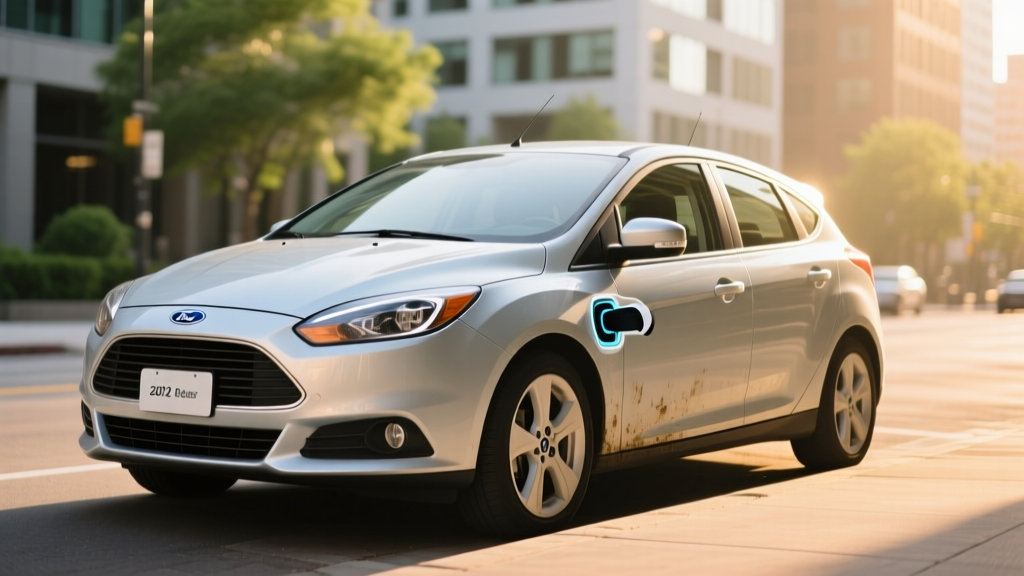
The 2012 Ford Focus Electric hatchback delivers an EPA-estimated 76 miles of range from its 23 kWh liquid-cooled lithium-ion battery, charges at a peak 6.6 kW on Level 2 (roughly 4 hours from empty), and has no DC fast-charging capability. On the used market in 2026, expect to pay between $4,500 and $8,000 depending on mileage and battery state of health. It works as a low-cost city commuter if you can charge at home and your daily round trip stays under 50 miles. It is not a road-trip vehicle, and cold-weather range can drop to 50–55 miles. The Focus Electric was discontinued after 2018 and receives no federal or state EV incentives as a used purchase under current §30D rules (the used-EV credit expired for new claims after 2025). Buy it only if the math works for your commute and you have reliable Level 2 home charging.
Range, Battery, and Efficiency: What 23 kWh Gets You
When Ford launched the Focus Electric for the 2012 model year, the 23 kWh usable battery (out of a ~23 kWh gross pack) and 107 kW (143 hp) electric motor were competitive with the Nissan Leaf. By 2026 standards, this is a small, short-range pack, but understanding the exact numbers helps you decide whether it fits your life.
| Specification | Value |
|---|---|
| EPA Range | 76 miles |
| Real-World Range (mild weather, city) | 65–75 miles |
| Real-World Range (highway 70 mph) | 55–65 miles |
| Real-World Range (cold, below 32°F) | 45–55 miles |
| Battery Capacity (usable) | 23 kWh |
| Battery Chemistry | Lithium-ion (NMC) |
| Battery Thermal Management | Liquid-cooled |
| Motor Output | 107 kW / 143 hp / 184 lb-ft torque |
| 0–60 mph | ~9.5 seconds |
| EPA Efficiency | 105 MPGe combined (32 kWh/100 mi) |
| Level 1 Charging (120V, 12A) | ~1.4 kW — adds ~4–5 mi/hr |
| Level 2 Charging (240V, 30A) | 6.6 kW — full charge in ~3.5–4 hours |
| DC Fast Charging | Not equipped (no CCS/CHAdeMO port) |
| Connector | J1772 (Level 1/2 only) |
| Original MSRP (2012) | $39,200 (before $7,500 federal credit at the time) |
| Typical Used Price (2026) | $4,500–$8,000 |
| Original Battery Warranty | 8 years / 100,000 miles (expired) |
Real-World Range vs. EPA Sticker
The EPA rates the 2012 Focus Electric at 76 miles. In practice, expect 65–75 miles in mixed city driving in mild weather. Sustained highway speeds of 70+ mph push consumption higher, dropping range to roughly 55–65 miles. In freezing temperatures, the resistive cabin heater and cold battery chemistry can cut range to 45–55 miles. This vehicle has no heat pump — it uses a PTC resistive heater, which draws significant power from the small pack. If your daily commute exceeds 50 miles round-trip, this car will require mid-day charging you cannot do quickly.
The liquid-cooled battery was a genuine advantage over the 2012 Nissan Leaf's passively cooled pack. Active thermal management slows degradation and maintains more consistent charging performance in hot climates. After 14 years on the road, most surviving 2012 Focus Electrics will show some capacity loss. Request a battery state-of-health (SoH) reading from a Ford dealer or use an OBD-II tool with an EV-capable app to check remaining capacity before purchasing. A pack at 75–80% SoH means your usable range drops to roughly 55–60 miles in mild weather.
Charging Reality: Level 2 Only, No Fast Charging
The single biggest limitation of the 2012 Ford Focus Electric for a 2026 buyer is the complete absence of DC fast charging. There is no CCS, CHAdeMO, or NACS port. You cannot use any public fast-charging network — not Tesla Superchargers, not Electrify America, not EVgo. Every charge happens at Level 1 or Level 2 speeds.
| Level | Voltage / Amperage | Power (kW) | Miles Added per Hour | Full Charge Time (0–100%) |
|---|---|---|---|---|
| Level 1 (standard outlet) | 120V / 12A | ~1.4 kW | ~4–5 miles | ~16–18 hours |
| Level 2 (home/public) | 240V / 30A | 6.6 kW | ~20–23 miles | ~3.5–4 hours |
| DC Fast Charge | N/A | N/A | N/A | Not equipped |
This means home Level 2 charging is essentially mandatory. A standard 120V outlet adds only about 4–5 miles of range per hour — adequate only if you drive 20 miles or fewer per day and can plug in overnight for 10+ hours. For realistic daily use, you need a 240V Level 2 station.
Home Level 2 installation costs typically run $500–$1,200 for the charger hardware (a basic 32A J1772 station from brands like Emporia, Lectron, or ChargePoint) plus $500–$2,000 for electrician labor, depending on whether your panel needs an upgrade. Total: roughly $1,000–$3,200 installed. If your home's electrical panel is already at capacity, a panel upgrade can add $1,500–$3,000. Since the Focus Electric maxes out at 6.6 kW, you do not need a 48A hardwired charger — a 32A plug-in unit on a 40A circuit is more than sufficient and keeps costs lower.
Cost of Ownership: EV vs. Gas Comparison
The economic case for a used 2012 Focus Electric in 2026 comes down to fuel savings versus the limitations you accept. Here is a realistic five-year cost projection assuming 8,000 miles driven per year (appropriate given the range constraint).
| Cost Category | 2012 Focus Electric (used) | Comparable Used Gas Car (e.g., 2014 Focus Gas, 30 MPG) |
|---|---|---|
| Purchase Price | $6,000 | $8,000 |
| Fuel / Electricity (5 years) | $1,800 (home charging at $0.14/kWh) | $4,667 (at $3.50/gal, 30 MPG) |
| Maintenance (5 years) | $800 (tires, cabin filter, brake fluid) | $2,500 (oil changes, filters, belts, brakes) |
| Insurance (5 years, avg) | $4,500 ($900/yr) | $4,200 ($840/yr) |
| Battery Replacement Risk | $0–$5,000 (reserve fund) | $0 |
| Tax Credits / Incentives | $0 (used-EV credit no longer available) | $0 |
| Estimated 5-Year Total | $13,100–$18,100 | $19,367 |
| Cost Per Mile | $0.33–$0.45 | $0.48 |
The electricity cost assumes exclusively home Level 2 charging at the 2026 national average of ~$0.14/kWh. The Focus Electric consumes roughly 32 kWh per 100 miles (per EPA data on fueleconomy.gov). That works out to about $0.045 per mile on home electricity versus $0.117 per mile for a 30 MPG gas car at $3.50/gallon. Over 40,000 miles in five years, you save approximately $2,867 on fuel alone.
Maintenance savings are real: no oil changes, no spark plugs, no transmission fluid, and regenerative braking extends pad life significantly. However, the battery replacement risk is the wildcard. The original 8-year/100,000-mile battery warranty has expired on all 2012 models. If the battery fails or degrades below usability, a replacement or refurbished pack could cost $4,000–$6,000 at a Ford dealer, though independent EV shops may offer less expensive options. Most 2012 packs that have survived to 2026 still function, but capacity loss is inevitable. Budget accordingly.
How It Compares: Focus Electric vs. Gas Focus vs. Used EV Alternatives
| Vehicle | EPA Range / MPG | Used Price (2026 est.) | DC Fast Charge | Best For |
|---|---|---|---|---|
| 2012 Ford Focus Electric | 76 mi (105 MPGe) | $4,500–$8,000 | No | Short city commutes, home charging |
| 2012 Ford Focus (gas, 2.0L) | 28 city / 38 hwy / 31 combined MPG | $5,000–$8,000 | N/A | Longer commutes, no home charging |
| 2013–2015 Nissan Leaf (24 kWh) | 73–84 mi | $4,000–$7,500 | CHAdeMO (optional) | Similar range, CHAdeMO availability |
| 2017+ Chevy Bolt EV (used) | 238 mi | $10,000–$15,000 | CCS (55 kW) | Real daily driver with fast-charge capability |
| 2018+ Nissan Leaf Plus (62 kWh) | 212–226 mi | $12,000–$17,000 | CHAdeMO | Longer range, still CHAdeMO |
The Focus Electric sits at the bottom of the used-EV market in both price and capability. Its 76-mile range is the most limiting factor. The 2013–2015 Nissan Leaf offers a similar experience but had optional CHAdeMO DC fast charging (50 kW), which at least allows for occasional longer trips — though CHAdeMO infrastructure is declining in the U.S. as CCS and NACS dominate.
If your budget can stretch to $10,000–$15,000, a used 2017+ Chevy Bolt EV is dramatically more capable: 238 miles of EPA range, 55 kW CCS fast charging, and a more usable hatchback. The Bolt is the real threshold where a used EV becomes a genuine primary vehicle rather than a secondary commuter pod.
Myths and Misconceptions About the 2012 Focus Electric
| Myth | Fact |
|---|---|
| "The battery will need replacing immediately." | Liquid-cooled NMC packs from this era often retain 70–85% SoH after 12–14 years if not abused. Always verify with an OBD-II SoH check before buying, but immediate failure is not a given. |
| "I can use public fast chargers on road trips." | The 2012 Focus Electric has no DC fast-charging port. Road trips require multi-hour Level 2 stops and careful planning. This is strictly a local-use vehicle. |
| "I'll get the $4,000 used-EV tax credit." | The federal used clean vehicle credit under §30D (up to $4,000) was available through 2025 but has expired for new claims as of 2026. Check IRS guidance for current rules. No federal incentive applies to this purchase now. |
| "76 miles of range is enough for anyone's commute." | The average U.S. one-way commute is approximately 16 miles, so 32 miles round-trip fits. But add errands, detours, climate control use, and cold-weather losses, and 76 miles becomes tight for many drivers. Plan for a 50-mile realistic daily ceiling. |
| "It charges fast on Level 2." | 6.6 kW is modest by 2026 standards (many modern EVs accept 11–19 kW on Level 2). A full charge takes ~3.5–4 hours. For daily top-ups of 30–40 miles, you need about 1.5–2 hours plugged in. |
Decision Framework: Should You Buy the 2012 Ford Focus Electric?
If / Then Buying Guide
- IF your daily round-trip driving is under 45 miles AND you have access to Level 2 home charging AND this is a second vehicle in your household → The Focus Electric can work as a low-cost, low-maintenance city commuter. Budget $5,000–$7,000 and keep $2,000 in reserve for potential battery work.
- IF your daily driving exceeds 50 miles regularly OR you experience winters below 30°F → Skip it. Cold-weather range loss of 25–35% on a 76-mile car leaves you with an impractical 45–55 miles. Look at a used Bolt EV or Leaf Plus instead.
- IF you cannot install Level 2 charging at home AND have no reliable Level 2 charging at work → Do not buy this car. Level 1 (120V) charging at 4–5 miles per hour is not viable as a primary charging strategy for a 76-mile-range EV. You would spend 15+ hours plugged in daily.
- IF you need a single primary vehicle for all driving needs, including occasional road trips → This is not the right EV. No DC fast charging means any trip beyond ~70 miles requires an hours-long Level 2 stop. A used Bolt EV, Model 3, or even a PHEV like a used Chevy Volt is far more practical.
- IF you are buying for a teen driver's school commute or a short urban delivery route AND the price is under $6,000 with verified battery SoH above 75% → Strong use case. Low purchase price, minimal maintenance, and low fuel cost make this an economical niche vehicle.
What First-Time EV Buyers Must Know Before Purchasing
If the 2012 Focus Electric is your entry point into EV ownership, understand these realities before signing the title:
- Verify battery state of health (SoH) before purchase. Use a tool like LeafSpy (adapted for Ford via OBD-II) or have a Ford dealer run a battery diagnostic. A pack below 70% SoH means your real range is under 55 miles in good weather. Walk away or negotiate aggressively.
- Confirm your home electrical capacity. A Level 2 charger on a 240V/40A circuit requires a dedicated breaker. If your panel is older or near capacity, budget for an electrician visit and possible panel upgrade. Get a quote before buying the car.
- Understand kW vs. kWh. The battery stores 23 kWh of energy (capacity — like gallons in a tank). The charger delivers up to 6.6 kW of power (flow rate — like gallons per minute). These are not interchangeable. A 6.6 kW charger takes about 3.5 hours to fill a 23 kWh battery.
- Plan for winter. The Focus Electric uses a resistive PTC heater, not a heat pump. Cabin heating at full blast in January can draw 3–5 kW continuously, which on a 23 kWh battery is devastating to range. Precondition the cabin while still plugged in to mitigate this.
- Check parts availability. Ford discontinued the Focus Electric after 2018 and ended Focus production in the U.S. entirely. Body panels and standard Focus parts are widely available, but EV-specific components (onboard charger, electric A/C compressor, battery modules) may require salvage yards or independent EV specialists.
- Insurance may not be cheaper. Despite the low vehicle value, some insurers charge EV premiums that don't fully reflect the car's age. Get an insurance quote before purchasing to avoid surprises.
Frequently Asked Questions
Can the 2012 Ford Focus Electric use Tesla Superchargers?
No. The 2012 Focus Electric has only a J1772 connector for Level 1 and Level 2 AC charging. It has no DC fast-charging port of any kind — not CCS, not CHAdeMO, and not NACS. Even with a NACS-to-J1772 adapter, you cannot use a Supercharger because the vehicle lacks the DC charging hardware entirely. Superchargers deliver DC power; the Focus Electric can only accept AC power through its onboard charger.
How much does it cost to charge a 2012 Focus Electric at home?
A full charge from empty to 100% uses about 23 kWh. At the 2026 U.S. average residential rate of ~$0.14/kWh, a full charge costs approximately $3.22. That gives you 65–75 real-world miles, working out to about $0.045–$0.05 per mile. For comparison, a 30 MPG gas car at $3.50/gallon costs ~$0.12 per mile in fuel.
What happens if the battery dies on a 2012 Focus Electric?
If the high-voltage traction battery fails completely, the car will not move. It cannot be driven on the 12V auxiliary battery. The vehicle would need to be flatbed-towed to a repair facility. A replacement battery pack from Ford, if still available, could cost $4,000–$6,000 plus labor. Independent EV battery rebuilders may offer cell-level replacement for less. Given the vehicle's $5,000–$8,000 market value, a full battery replacement may total the car economically.
Is the 2012 Focus Electric safe?
The 2012 Focus Electric was not crash-tested separately by NHTSA or IIHS in significant volume, but it shares the third-generation Focus platform, which earned an IIHS Top Safety Pick designation for the 2012 model year in gas form. The EV version includes standard stability control, six airbags, and anti-lock brakes. It lacks modern ADAS features like automatic emergency braking, lane-keeping assist, or blind-spot monitoring — all common on 2026 vehicles. Drive accordingly.
Can I tow with the 2012 Ford Focus Electric?
Ford did not rate the Focus Electric for towing, and the owner's manual states the vehicle is not designed to tow a trailer. Attempting to tow could damage the drivetrain and void any remaining coverage. This is strictly a passenger vehicle with 14.9 cubic feet of cargo space behind the rear seats (reduced from the gas Focus due to the battery packaging).
Does the 2012 Focus Electric qualify for any tax credits in 2026?
No. The federal new clean vehicle credit (§30D) applies only to new EV purchases and has specific MSRP, income, and battery-sourcing requirements — none of which apply to a 2012 used vehicle. The used clean vehicle credit (up to $4,000 under §25E) was available through the end of 2025 for qualifying used EVs under $25,000, but this credit has expired for new claims in 2026. Always check current IRS guidance for the latest rules. Some states or utilities may offer small rebates for used EV purchases or home charger installation — check your local programs.
Bottom Line
The 2012 Ford Focus Electric hatchback occupies a specific niche in the 2026 used-EV market: an ultra-low-cost commuter for drivers with short trips, reliable home charging, and realistic expectations about range. At $4,500–$8,000, it is one of the cheapest ways to drive on electricity. But 76 miles of EPA range (less in real-world and cold conditions), no DC fast charging, and an expired battery warranty make it a calculated risk, not a carefree purchase. Run the numbers on your commute, verify the battery SoH, and confirm your home charging setup before committing. If your needs exceed what 76 miles can cover, invest the extra $5,000–$8,000 into a used Chevy Bolt EV or Nissan Leaf Plus — the capability jump is enormous.