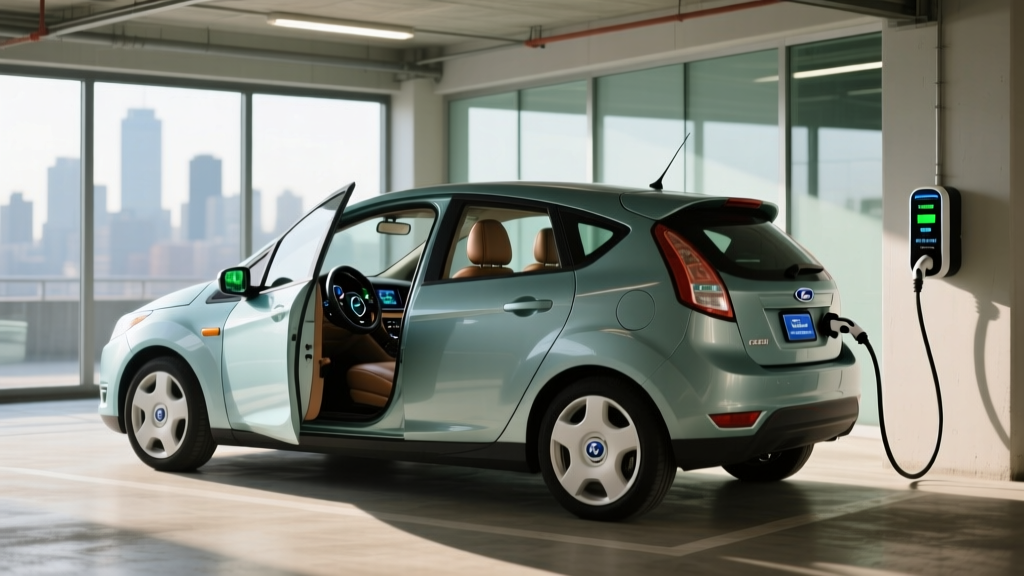
Quick Answer: The 2012 Ford Focus Electric offers an EPA-rated 76 miles of range from its 23 kWh liquid-cooled lithium-ion battery. In real-world driving, expect 55–70 miles depending on temperature and highway use. With used prices hovering between $4,000–$7,500 in 2026, it can serve as an ultra-low-cost city commuter — but only if you have reliable Level 2 home charging, a short commute, and realistic expectations about its aging battery. It is not a viable primary vehicle for most households.
The 2012 Ford Focus Electric at a Glance
Ford launched the Focus Electric as its first mass-market battery-electric vehicle, built on the global Focus platform and sold in limited volumes from late 2011 through the 2018 model year. The 2012 model year represents the earliest production run, meaning these are now 14-year-old EVs with batteries that have seen significant calendar aging. Understanding the exact specifications is essential before evaluating one on the used market.
| Spec | Value |
|---|---|
| EPA Range | 76 miles |
| Battery (total / usable) | 23 kWh / ~20 kWh usable |
| Battery Chemistry | LG Chem NMC (lithium-ion, liquid-cooled) |
| Motor Output | 107 kW (143 hp), 184 lb-ft torque |
| 0–60 mph | ~9.2 seconds |
| EPA Efficiency | 105 MPGe combined (110 city / 99 hwy) |
| Energy Consumption | 32 kWh/100 mi |
| Onboard Charger (Level 2) | 6.6 kW |
| DC Fast Charging | Not available |
| Charge Port | J1772 (Level 1 & Level 2 only) |
| Level 2 Charge Time (0–100%) | ~3.5–4 hours |
| Level 1 Charge Time (120V) | ~20+ hours |
| Cargo Volume | 14.5 cu ft (reduced by battery packaging) |
| Original MSRP | $39,200 (before incentives) |
| 2026 Used Price Range | $4,000–$7,500 |
| Original Battery Warranty | 8 years / 100,000 miles (expired) |
Sources: fueleconomy.gov, Ford Motor Company press archives.
Real-World Range: What 76 EPA Miles Actually Means
The EPA rated the 2012 Focus Electric at 76 miles. That figure was modest when new; in 2026, it places this car firmly in "neighborhood runabout" territory. But the EPA sticker is a best-case blended cycle — real-world results vary considerably.
EPA Sticker: 76 miles
Real-World Expectations:
- Mild weather, city driving (45–55°F): 65–75 miles
- Highway driving (65–70 mph): 55–65 miles
- Cold weather (below 30°F, heater on): 40–55 miles
- Hot weather (above 90°F, A/C on): 55–65 miles
- With 14 years of battery degradation (est. 20–35% capacity loss): Subtract 10–25 miles from all figures above
The critical factor for a 2012 model in 2026 is battery degradation. NMC chemistry from this era, even with Ford's liquid-cooling system, will have lost meaningful capacity over 14 years of calendar aging — regardless of mileage. A vehicle that originally delivered 70 real-world miles may now deliver 50 or fewer. Before purchasing, insist on a battery health assessment. Tools like an OBD-II reader with EV-capable software (such as FORScan for Ford vehicles) can read the battery's State of Health (SoH) and remaining capacity in kWh. If SoH reads below 70%, the effective range may drop below 45 miles in mixed driving — making it extremely difficult to use as anything beyond a grocery getter.
Charging: No DC Fast Charging Is the Dealbreaker
The 2012 Focus Electric was designed before the DC fast-charging ecosystem matured. It has no CCS, no CHAdeMO, and obviously no NACS port. The only charging options are:
| Level | Connector | Power (kW) | Miles Added Per Hour | Full Charge Time |
|---|---|---|---|---|
| Level 1 (120V household) | J1772 | ~1.2–1.4 kW | ~3–4 mi/hr | 20+ hours |
| Level 2 (240V home/public) | J1772 | 6.6 kW (max onboard) | ~20–22 mi/hr | ~3.5–4 hours |
| DC Fast Charge | N/A | Not supported | N/A | N/A |
This is the single biggest practical limitation. Without DC fast charging, road trips are effectively impossible — even a 100-mile round trip requires planning around a multi-hour Level 2 stop. The 6.6 kW onboard charger was competitive for 2012, but it means a depleted battery still needs nearly four hours on Level 2 to reach full charge. For daily commuting with home Level 2 access, this is manageable: plug in overnight, wake up to a full charge. But it means public charging infrastructure is of limited use unless you have hours to spare.
If you do not have access to Level 2 home charging — for example, if you park on the street or in an apartment without EV infrastructure — Level 1 charging at ~3 miles per hour is painfully slow for even this small battery. A full Level 1 charge takes over 20 hours, making daily use impractical unless your commute is under 15 miles round trip.
Cost Breakdown: Purchase, Charging, and Ownership
The financial case for a used 2012 Focus Electric rests on its rock-bottom purchase price and low operating costs. Here's how the numbers stack up.
Purchase Price
Used 2012 Focus Electric listings in 2026 typically range from $4,000 to $7,500, depending on mileage, condition, and crucially, battery health. This is among the cheapest EVs available on the used market, undercutting even a used Nissan Leaf from the same era.
Federal and State Incentives
The original $7,500 federal tax credit under IRC §30D applied only to the original purchaser when the car was new. For used buyers in 2026, the Used Clean Vehicle Credit (IRC §25E) may apply: up to $4,000 or 30% of the sale price (whichever is less), subject to income caps ($75,000 single / $150,000 joint filer), a $25,000 maximum vehicle sale price, and purchase through a licensed dealer. Since the Focus Electric sells for well under $25,000 used, it qualifies on price — but the 30% cap means the actual credit would be roughly $1,200–$2,250 depending on the purchase price. Always verify current-year rules on IRS.gov and consult a tax professional.
Charging Cost vs. Gasoline
| Cost Factor | Focus Electric (EV) | Focus Gas (2.0L, 30 MPG combined) |
|---|---|---|
| Energy consumption | 32 kWh/100 mi | 3.33 gal/100 mi |
| Energy rate (national avg) | $0.16/kWh (home charging) | $3.30/gal |
| Annual fuel/energy cost | ~$614 | ~$1,320 |
| Annual savings (EV vs gas) | ~$706/year | |
At typical residential electricity rates, the Focus Electric costs roughly $0.05 per mile to fuel versus $0.11 per mile for its gasoline counterpart. Over five years of 12,000-mile annual driving, that's approximately $3,530 in fuel savings. If your utility offers off-peak EV charging rates (common in many states), savings can be even greater.
Maintenance and Insurance
EVs eliminate oil changes, spark plugs, timing belts, and exhaust-system repairs. Brake wear is significantly reduced thanks to regenerative braking. Budget approximately $200–$400/year for maintenance (cabin air filter, wiper fluid, tire rotation, brake fluid checks). Insurance for a low-value used EV is generally inexpensive — expect $600–$1,000/year depending on your profile and state.
The major cost risk: battery replacement. A new or refurbished 23 kWh pack for the Focus Electric is difficult to source and could cost $4,000–$8,000+ if the original battery fails catastrophically. Given the car's total value, a battery failure likely totals the vehicle economically. This is the single biggest financial risk of ownership.
EV vs. Gas vs. Hybrid: Where the Focus Electric Fits
| Factor | 2012 Focus Electric | 2012 Focus Gas | 2012 Toyota Prius (HEV) |
|---|---|---|---|
| Used Price (2026) | $4,000–$7,500 | $3,500–$6,000 | $5,500–$9,000 |
| Range / Tank | ~55–75 mi (degraded) | ~380 mi | ~500 mi |
| MPGe / MPG | 105 MPGe | 30 MPG | 50 MPG |
| Annual Fuel Cost | ~$614 | ~$1,320 | ~$792 |
| Home Charging Needed? | Yes, strongly | No | No |
| Road-Trip Capable? | No | Yes | Yes |
| Cold-Weather Penalty | 30–45% range loss | Minimal | Minimal |
| Maintenance Cost/Year | $200–$400 | $600–$1,000 | $500–$800 |
| Battery Replacement Risk | High (costs exceed car value) | None (standard 12V) | Moderate (~$2,000–$3,500 hybrid battery) |
The Focus Electric only wins on per-mile fuel cost and maintenance simplicity. For anyone who needs road-trip flexibility, lacks home charging, or lives in a cold climate, the gasoline Focus or a Prius hybrid is the more rational choice. The Focus Electric makes sense exclusively as a dedicated second car for short, predictable commutes in mild climates.
Common Misconceptions — Fact-Checked
| Myth | Fact |
|---|---|
| "76 miles of range is plenty for most commutes." | The average US one-way commute is ~16 miles (per the Census Bureau), so round-trip is ~32 miles. But add errands, detours, climate control, and battery degradation, and a 76-mile EPA car may deliver just 45–55 usable miles. It's enough for some — but not with margin for error. |
| "The battery will need replacing immediately." | Not necessarily. Ford's liquid-cooled thermal management was ahead of the passive-cooled Nissan Leaf of the same era, and many Focus Electric batteries have degraded more gracefully. However, 14 years of calendar aging means 20–35% capacity loss is typical. Always verify SoH before purchase. |
| "I can use public fast chargers on road trips." | The 2012 Focus Electric has no DC fast-charging capability whatsoever. You are limited to J1772 Level 2 at 6.6 kW — meaning even public charging takes 3–4 hours for a full charge. |
| "Used EVs qualify for the full $7,500 tax credit." | The $7,500 credit (IRC §30D) is for new vehicles only. Used EVs may qualify for up to $4,000 under IRC §25E, but the credit is capped at 30% of the sale price. On a $5,000 Focus Electric, the maximum credit is $1,500. Check IRS §25E guidelines. |
| "EVs don't work in cold weather." | EVs work in cold weather — but range drops significantly. Expect 30–45% range reduction below freezing due to battery chemistry limitations and cabin heating demand. On a degraded Focus Electric battery, this could mean 35–45 miles of real range in winter. |
Decision Framework: Is the 2012 Focus Electric Right for You?
Choose the 2012 Focus Electric if:
- Your daily round-trip commute is under 30 miles
- You have access to Level 2 (240V) home charging
- You live in a mild climate (rarely below 30°F)
- You need an inexpensive second car for errands and commuting
- You can verify battery SoH above 75% before purchase
- You accept the risk that a battery failure could total the car
Do NOT choose the 2012 Focus Electric if:
- This would be your only vehicle
- Your commute exceeds 35 miles round trip
- You lack home Level 2 charging access
- You live in a region with harsh winters
- You ever need to drive more than 60 miles in a single day
- You cannot absorb a potential $5,000+ battery replacement cost
Consider instead:
- 2016+ Chevrolet Bolt EV (used): 238 miles EPA, DC fast charging, ~$8,000–$12,000 used — dramatically more capable
- 2013+ Nissan Leaf (used): 75–84 miles EPA (similar range), but far greater parts availability and community support
- Toyota Prius (HEV): No range limitations, 50 MPG, no charging infrastructure needed, $5,500–$9,000 used
What a First-Time EV Buyer Should Know
If the 2012 Focus Electric is your entry point into EV ownership, understand these fundamentals:
kW vs. kWh: Kilowatts (kW) measure power — the rate at which the car charges. Kilowatt-hours (kWh) measure energy — the size of the battery tank. The Focus Electric has a 23 kWh battery (energy) and charges at up to 6.6 kW (power). Think of kWh as your "gallon" tank size and kW as the "gallons per minute" at the pump.
Level 2 home charging is non-negotiable: A 240V Level 2 home charger (like a ChargePoint Home Flex or Emporia Vue) typically costs $500–$800 for the unit plus $500–$2,000 for professional electrical installation, depending on whether your panel needs an upgrade. This investment is essential — Level 1 charging is too slow for practical daily use even with this small battery.
Preconditioning matters: The Focus Electric allows you to set a departure time while plugged in, which warms or cools the battery and cabin using grid power rather than battery power. Use this feature — it preserves precious range in extreme temperatures.
Regenerative braking: The Focus Electric has moderate regen but does not offer true one-pedal driving like newer EVs. You'll still use the friction brakes regularly, though pad wear will be slower than in a gas car.
Parts and service: Ford discontinued the Focus Electric years ago, and the Focus platform itself ended US sales after 2018. Body parts, interior trim, and some EV-specific components are becoming scarce. Before buying, confirm that a local Ford dealer or independent EV-capable shop can service the vehicle.
Frequently Asked Questions
What is the real-world range of a 2012 Ford Focus Electric in 2026?
With 14 years of battery degradation, expect 45–65 miles in mixed driving depending on the battery's State of Health, ambient temperature, and driving style. Highway speeds and cold weather will push you toward the lower end of that range.
Does the 2012 Ford Focus Electric support DC fast charging?
No. The 2012 Focus Electric has no DC fast-charging port. It can only charge via J1772 at Level 1 (120V, ~1.4 kW) or Level 2 (240V, 6.6 kW max). This is the car's most significant limitation.
How much does it cost to charge a 2012 Focus Electric at home?
A full charge from empty using a 23 kWh battery at the national average residential rate of $0.16/kWh costs approximately $3.68. For a typical 30-mile daily commute consuming ~10 kWh, daily charging costs about $1.60.
Can I get a tax credit for buying a used 2012 Ford Focus Electric?
Possibly. The Used Clean Vehicle Credit (IRC §25E) offers up to $4,000 or 30% of the sale price (whichever is less), subject to income limits and dealer-sale requirements. On a $5,000 purchase, the maximum credit would be $1,500. Verify eligibility on IRS.gov and consult a tax professional.
Is the 2012 Focus Electric battery warranty still valid?
No. Ford's original battery warranty was 8 years/100,000 miles. For a 2012 model, this warranty expired no later than 2020. Any battery issues are the owner's financial responsibility.
How does the 2012 Focus Electric compare to a 2012 Nissan Leaf?
Both offer similar EPA range (76 vs. 73 miles for the 2012 Leaf). However, the Focus Electric has liquid-cooled battery management (the 2012 Leaf is passively air-cooled), which generally results in slower degradation and more consistent performance in extreme temperatures. The Leaf, however, has a much larger owner community, better parts availability, and optional CHAdeMO DC fast charging on some trims.
Should I buy a 2012 Focus Electric as my first EV?
Only if your needs are narrow: a short commute, home Level 2 charging, mild climate, and acceptance of the car's limitations. For most first-time EV buyers, a used 2017+ Chevy Bolt EV (238 mi EPA, DC fast charging) offers dramatically more capability for roughly $3,000–$5,000 more.