The 2012 Fisker Karma: A Pioneering Plug-In Hybrid Revisited
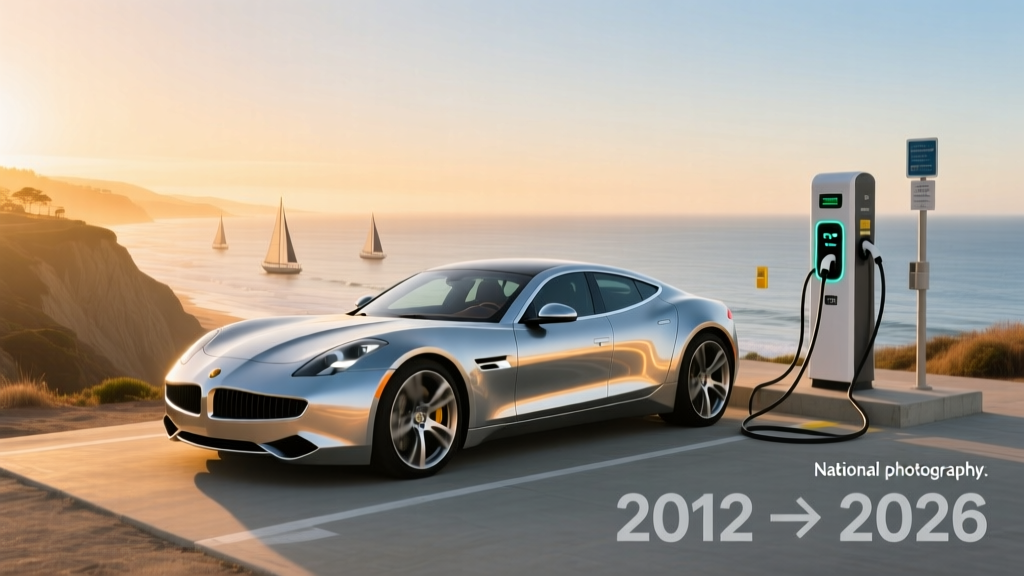
The 2012 Fisker Karma was one of the most visually striking electrified vehicles ever sold in the United States — a low-slung, four-door luxury sedan with a plug-in powertrain that blended battery-electric driving with a gasoline range extender. Fisker Automotive produced roughly 2,450 units before filing for bankruptcy in 2013, making the Karma a rare collector-grade vehicle on the used market today. For 2026 buyers researching the 2012 Fisker Karma electric capabilities, this profile breaks down exactly what the car offers, where it falls short against modern EVs and PHEVs, and what ownership realistically looks like more than a decade after production ended.
The Karma is technically a series plug-in hybrid (often called an EREV — extended-range electric vehicle). It drives its rear wheels exclusively via two electric motors, while a 2.0-liter turbocharged GM Ecotec gasoline engine acts solely as a generator to recharge the battery on the go. There is no mechanical connection between the engine and the wheels. This architecture was ahead of its time, predating the BMW i3 REx and the Chevrolet Volt's series-parallel approach.
Spec Sheet: 2012 Fisker Karma at a Glance
| Specification | Value |
|---|---|
| Powertrain Type | Series Plug-In Hybrid (EREV) |
| Drivetrain | Rear-Wheel Drive (dual rear electric motors) |
| Total System Horsepower | 403 hp (combined electric motors) |
| Total System Torque | 959 lb-ft |
| 0–60 mph | 5.8 seconds (Sport mode, full charge) |
| Battery Capacity (usable) | 20.1 kWh (lithium-ion, NMC chemistry) |
| Battery Supplier | A123 Systems |
| EPA Electric-Only Range | 32 miles |
| EPA Combined Range (gas + electric) | 230 miles |
| EPA MPGe (electric mode) | 54 MPGe |
| EPA MPG (gas-only, charge-sustaining) | 20 MPG combined |
| Fuel Tank Capacity | 9.5 gallons (premium required) |
| Level 2 Charge Rate | 3.3 kW (J1772 connector) |
| DC Fast Charging | Not supported |
| Level 2 Charge Time (0–100%) | ~6 hours |
| Cargo Volume (trunk) | 6.9 cu ft |
| Seating Capacity | 4 passengers |
| Original Base MSRP | $96,850 |
| Original As-Tested Price (EcoSport trim) | $105,000–$110,000+ |
| Original Battery Warranty | 5 years / 60,000 miles |
Electric Range and Real-World Efficiency
Real-world expectation: 20–28 miles in mixed driving. Highway speeds (70+ mph) may yield as few as 16–20 miles. Cold weather (below 40°F) can reduce electric range by 25–40%, dropping to 12–22 miles. Battery age is a major variable — expect significant degradation on a 2012 pack unless it has been replaced.
The Karma's 20.1 kWh lithium-ion battery pack, manufactured by A123 Systems, was considered large for a PHEV in 2012. For context, the first-generation Chevrolet Volt offered only 16 kWh. However, the Karma's heavy curb weight — approximately 5,300 pounds — consumed that energy rapidly. The EPA rated the car at 54 MPGe in electric mode, which translates to roughly 62 kWh per 100 miles of electric driving. That efficiency figure is poor by modern standards; a 2026 Tesla Model 3 achieves around 25 kWh/100mi, and even the heavy BMW iX manages roughly 42 kWh/100mi.
When the gasoline generator engages, the Karma returns just 20 MPG combined — a consequence of the energy conversion losses inherent in a series-hybrid drivetrain pushing over 5,000 pounds. The 9.5-gallon fuel tank yields roughly 190 miles of additional range after the battery depletes.
For modern buyers, this is the critical reality: a 2012 Karma with its original battery will likely deliver 15–22 miles of usable electric range in 2026 due to cell degradation. A123 Systems' NMC cells from this era typically lose 25–40% of their original capacity over 12–14 years, depending on climate exposure and charging habits. Any used Karma listing should include a battery state-of-health (SoH) reading, and buyers should budget for a potential pack replacement or refurbishment.
Charging Capabilities: Level 2 Only
| Charging Level | Power | Connector | Time / Rate |
|---|---|---|---|
| Level 1 (120V household) | ~1.4 kW | J1772 | ~14–16 hours (0–100%); ~4 mi/hr |
| Level 2 (240V home/public) | 3.3 kW | J1772 | ~6 hours (0–100%); ~6 mi/hr |
| DC Fast Charging | N/A | N/A | Not supported |
The Karma's onboard charger maxes out at 3.3 kW, meaning even if you plug into a 7.2 kW or 11.5 kW Level 2 station, the car will only draw 3.3 kW. This is a significant limitation by 2026 standards — most modern PHEVs accept at least 7.2 kW, and full EVs routinely accept 11.5 kW or more on Level 2.
The absence of DC fast charging is the Karma's most glaring infrastructure limitation. There is no CCS, CHAdeMO, or NACS port. Road-trip charging is impractical; the Karma was designed for overnight home charging and daily commuting within its electric range. If you cannot install a 240V Level 2 charger at home, the Karma's electric capabilities become nearly irrelevant, as Level 1 charging at 1.4 kW adds only about 4 miles of range per hour.
According to the EPA's fueleconomy.gov listing for the 2012 Karma, the charge time from a standard 240V Level 2 source is approximately 6 hours for a full charge. In practice, because most owners will charge from partial depletion rather than zero, expect 3–4 hours for a typical overnight top-up.
Performance and Driving Dynamics
The Karma's dual rear electric motors produce a combined 403 horsepower and a claimed 959 lb-ft of torque, routing all power to the rear wheels. In Sport mode with a fully charged battery, the car hits 60 mph in 5.8 seconds — respectable, though not supercar territory despite the dramatic styling. In Stealth (electric-only) mode, output drops to roughly 260 hp, and 0–60 stretches to approximately 7.6 seconds.
The driving experience is a study in contrasts. The Karma rides on a sophisticated aluminum-intensive platform with double-wishbone front suspension and a multi-link rear, delivering composed handling and a firm but compliant ride. The steering is hydraulically assisted — heavy and communicative in a way modern electric power steering rarely matches. But the weight is ever-present: 5,300 pounds is felt in corners, and the regenerative braking system, while offering two levels of aggressiveness, does not enable true one-pedal driving.
The gasoline range extender — a 260-hp 2.0L turbo four-cylinder — is audible when it engages, producing a droning generator hum that contrasts with the near-silent electric driving experience. The transition between Stealth and Sport modes is seamless mechanically, but the acoustic shift is noticeable.
Interior, Technology, and Cargo Practicality
The Karma's interior was hand-trimmed with eco-conscious materials, including reclaimed wood from California wildfire salvage, recycled glass for the roof panel, and "Diamond Dust" eco-suede or optional leather. The center console features a distinctive 10.2-inch touchscreen — large for 2012 — controlling climate, audio, and vehicle settings. However, the infotainment system is dated: there is no Apple CarPlay, no Android Auto, no over-the-air updates, and the navigation maps are stored on an SD card that is no longer updated.
Practicality is the Karma's weakest area. The battery pack runs longitudinally through the center of the car, creating a high, wide transmission tunnel that eliminates any possibility of a fifth seat. Rear passengers get only 29.6 inches of legroom — tight for adults on anything beyond short trips. The trunk holds just 6.9 cubic feet, smaller than a Mazda MX-5 Miata's, and the trunk opening is narrow and shallow, making even grocery loading a challenge. There is no frunk (front trunk), as the engine bay houses the gasoline generator and power electronics.
The Karma includes several unique touches: a solar panel integrated into the roof that powers cabin ventilation and ancillary systems (but does not meaningfully charge the traction battery), a "Diamond Dust" glitter-infused paint option, and the distinctive mustache-like front grille. But from a technology standpoint, there are no driver-assistance features beyond basic stability control and parking sensors. No adaptive cruise, no lane-keeping, no automatic emergency braking — systems that are standard on 2026 economy cars.
Pricing, Tax Credits, and 2026 Used Market Value
The 2012 Fisker Karma originally started at $96,850 (base EcoStandard trim) and climbed past $110,000 for the EcoSport and EcoChic trims with premium interior packages. In 2012, it qualified for the full $7,500 federal tax credit under the original §30D rules, but those credits are long since irrelevant for new purchases.
| Item | Details |
|---|---|
| 2026 Used Market Range | $18,000–$45,000 (condition & battery SoH dependent) |
| Collector/Low-Mileage Examples | $50,000–$75,000+ |
| Federal Used EV Credit (§25E) | Potentially up to $4,000 — but subject to strict rules |
| §25E Price Cap | Vehicle sale price must be ≤ $25,000 |
| §25E Income Cap | AGI ≤ $75,000 single / $112,500 HOH / $150,000 MFJ |
| §25E Model-Year Requirement | Vehicle must be at least 2 model years old (Karma qualifies) |
| §25E Dealer Requirement | Must be purchased from a licensed dealer (private sales excluded) |
Under the current IRS §25E used clean vehicle credit, a buyer could theoretically claim up to $4,000 (30% of the sale price, capped at $4,000) if the Karma is purchased from a licensed dealer for $25,000 or less, and the buyer's adjusted gross income falls below the thresholds above. In practice, finding a Karma under $25,000 from a licensed dealer is extremely difficult — most examples sell through private parties, auctions, or specialty dealers at prices well above the cap. Consult a tax professional before counting on this credit.
Battery Health, Warranty Status, and Replacement Costs
The Karma's original battery warranty — 5 years / 60,000 miles — expired no later than 2017 for all examples. There is no remaining factory battery coverage. A123 Systems, the original battery supplier, filed for bankruptcy in 2012, complicating parts sourcing.
Battery replacement or refurbishment is the single largest ownership risk. Third-party specialists have offered Karma battery refurbishment services, typically replacing degraded A123 pouch cells with modern equivalents. Costs range from approximately $5,000 to $12,000 depending on the extent of cell replacement and labor. A complete new battery pack, if one can be sourced, has been quoted in the $15,000–$20,000 range through specialty shops. Given the car's used market value, a battery failure can easily total the vehicle economically.
Buyers should request a battery diagnostic showing cell voltage balance, total capacity in kWh, and any fault codes before purchasing. The Karma's onboard diagnostic system can display remaining battery capacity, though it is less granular than modern SoH readouts.
Who Should (and Shouldn't) Buy a 2012 Fisker Karma in 2026
- You want a rare, head-turning collector vehicle with genuine electric commuting capability
- Your daily commute is under 20 miles and you have home Level 2 charging
- You understand and accept the maintenance risks of a defunct automaker's orphan vehicle
- You value the Karma's design and coachbuilt-quality interior over technology and practicality
- You need a reliable daily driver with modern safety and infotainment
- You require more than 2 seats in the rear or meaningful cargo space
- You want DC fast charging for road trips
- You are unwilling to budget $5,000–$15,000 for potential battery work
- You want federal tax credit benefits (most Karma transactions won't qualify)
Compared to a modern PHEV like the 2026 Toyota Prius Prime (44 miles electric range, 127 MPGe, $33,000 MSRP, full tax credit eligibility) or the BMW 330e (22 miles electric, $45,000), the Karma is not a rational transportation appliance. It is a collector car that happens to have a plug — and should be evaluated on those terms.
Pros and Cons
Pros
- Stunning, one-of-a-kind Henrik Fisker design
- 403 hp and 959 lb-ft deliver strong straight-line performance
- Eco-luxury interior with unique reclaimed materials
- Rear-wheel-drive dynamics with hydraulic steering feel
- Collector rarity — only ~2,450 built
- Solar roof panel for cabin ventilation
Cons
- No DC fast charging; 3.3 kW Level 2 only
- Severely degraded battery likely (12–22 real-world EV miles)
- Defunct manufacturer — no dealer network, limited parts
- Only 6.9 cu ft trunk; 4 seats with tight rear legroom
- 20 MPG on gasoline — worse than many non-hybrid sedans
- No modern driver-assist or infotainment features
- Battery replacement can exceed vehicle value
Frequently Asked Questions
What is the real-world electric range of the 2012 Fisker Karma in 2026?
With an original, un-replaced battery, expect 15–22 miles of electric range in mixed driving. The EPA rated it at 32 miles when new, but 12+ years of NMC cell degradation typically removes 25–40% of capacity. Highway driving and cold weather will push range toward the lower end of that estimate.
How fast does the Karma charge at home?
The onboard charger is limited to 3.3 kW on a 240V Level 2 connection, taking approximately 6 hours for a full 0–100% charge. That translates to roughly 6 miles of electric range per hour of charging. DC fast charging is not supported in any form.
Does the 2012 Fisker Karma qualify for any federal tax credit in 2026?
It may qualify for the §25E used clean vehicle credit of up to $4,000, but only if the purchase price is $25,000 or less, the sale is through a licensed dealer, and the buyer's income falls under IRS caps ($75,000 single / $150,000 married filing jointly). Most Karma transactions exceed the $25,000 price cap or occur through private sales, making credit eligibility uncommon. The original §30D new-vehicle credit is no longer available. Always verify current rules at IRS.gov.
Is the 2012 Karma worth buying over a modern PHEV or EV?
As a daily driver, no. A 2026 Toyota Prius Prime, Hyundai Tucson PHEV, or BMW 330e offers more electric range, better efficiency, modern safety tech, warranty coverage, and tax credit eligibility — all at lower risk. The Karma makes sense only as a collector vehicle or weekend car for enthusiasts who value its design and rarity above practicality.
What happens if the Karma's A123 battery fails?
A123 Systems went bankrupt in 2012, so OEM replacement packs are unavailable. Third-party EV battery specialists can refurbish the pack by replacing individual pouch cells, typically costing $5,000–$12,000. A full aftermarket replacement pack may cost $15,000–$20,000. Given the car's market value, a full battery failure is often an economic total loss unless the car has significant collector value to the owner.
Can I take a 2012 Fisker Karma on a road trip?
Technically yes — the gasoline generator gives a combined range of about 230 miles. However, the 20 MPG fuel economy, small 9.5-gallon tank (requiring fuel stops every ~180 miles), and lack of DC fast charging make road trips expensive and inefficient. The Karma was designed as a commuter car with a range-extender safety net, not a touring vehicle.