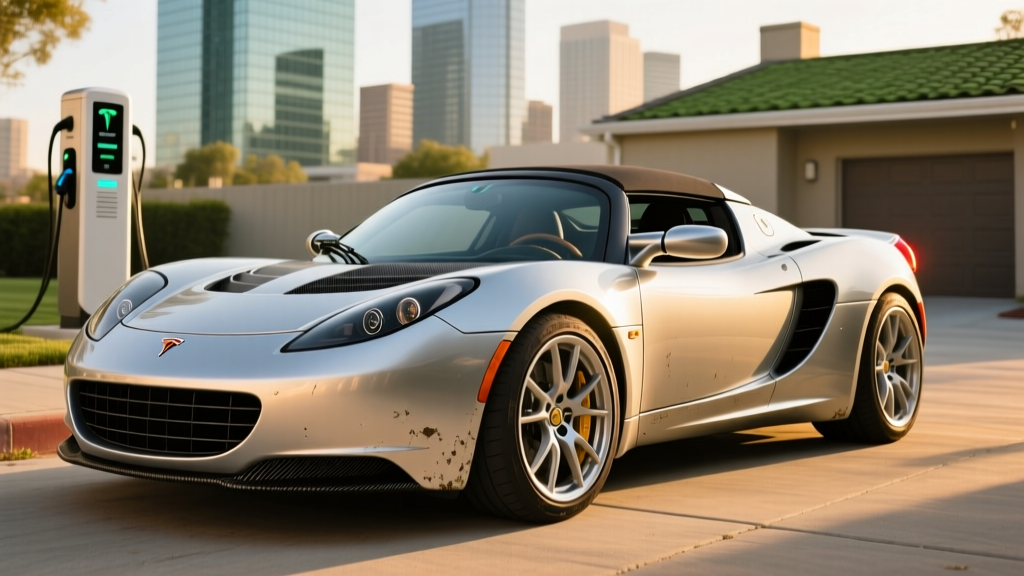
The original Tesla Roadster is more than a collector's curiosity—it's the vehicle that proved electric cars could be desirable, fast, and capable of real-world range. If you've been searching for 2011 Tesla Roadster images, you're likely either a prospective buyer eyeing the used EV market, an EV historian, or someone trying to understand how far battery technology has come. This profile dissects the 2011 Roadster (the final iteration of the first-generation model) with the same rigor we apply to modern EVs: exact numbers, real-world caveats, and honest ownership economics.
Quick Verdict: A Pioneer With Real Limitations
The 2011 Tesla Roadster (Sport and 2.5 trims) remains an exhilarating driver's car with a 244-mile EPA range that was extraordinary for its era. But prospective buyers must understand this is a 15-year-old EV with obsolete charging infrastructure, no DC fast-charging capability, and battery replacement costs that can exceed the car's market value. It's a weekend toy or collector piece—not a daily commuter in 2026.
Range & Efficiency: The Numbers That Made History
Real-World Expectation: 180–210 miles in moderate weather at highway speeds (65–70 mph). Expect 140–170 miles in cold weather (below 40°F) due to the air-cooled battery pack lacking active thermal preconditioning. City driving with heavy regenerative braking can approach or slightly exceed the EPA figure.
The Roadster's 244-mile EPA rating was revolutionary in 2011, when the Nissan Leaf offered just 73 miles. The secret was a massive (for the time) 53 kWh lithium-ion battery pack using NMC (nickel-manganese-cobalt) chemistry—specifically, 6,831 individual 18650-format cells arranged in 11 modules. This is the same cell format Tesla later used in the Model S and Model 3, though modern cells have far higher energy density.
Efficiency is rated at approximately 135 MPGe combined, translating to roughly 25 kWh per 100 miles. That's less efficient than modern EVs (the 2026 Tesla Model 3 achieves around 26 kWh/100mi with far more power and space), but respectable given the Roadster's lack of a heat pump and its air-cooled thermal management system.
| Specification | Value |
|---|---|
| EPA Range | 244 miles |
| Battery Capacity (usable) | 53 kWh |
| Battery Chemistry | NMC (18650 cells) |
| Max DC Charge Rate | None (AC-only charging) |
| Level 2 Charge Rate | 16.8 kW (70A) via HPC |
| Level 1 Charge Rate | 1.4 kW (120V/12A) |
| 0–60 mph | 3.9 seconds (Sport) |
| Horsepower | 288 hp (215 kW) |
| Drivetrain | RWD, single-speed gearbox |
| Efficiency | 135 MPGe / ~25 kWh/100mi |
| Cargo Space | ~3.5 cu ft (rear trunk) |
| Seats | 2 |
Charging: The Roadster's Biggest 2026 Pain Point
Here's where the 2011 Roadster shows its age most starkly. This vehicle has no DC fast-charging capability whatsoever. It charges exclusively via AC power through its proprietary Tesla connector (pre-NACS, pre-CCS). There is no adapter that will let you use a modern Tesla Supercharger, Electrify America station, or any other DC fast-charging network.
| Charge Level | Power | Miles Added Per Hour | Full Charge Time |
|---|---|---|---|
| Level 1 (120V portable) | 1.4 kW | ~5 mi/hr | ~48 hours |
| Level 2 (240V standard, 30A) | 7.2 kW | ~27 mi/hr | ~8 hours |
| Level 2 (240V HPC, 70A) | 16.8 kW | ~62 mi/hr | ~3.5 hours |
| DC Fast Charge | N/A | N/A | Not supported |
The High Power Connector (HPC) at 70 amps was Tesla's original high-speed AC solution, requiring a dedicated wall unit and a 90-amp electrical circuit. Most Roadster owners today charge on a standard 240V/30A circuit (like a dryer outlet), adding roughly 27 miles of range per hour. A full charge from near-empty takes about 8 hours—meaning overnight charging is mandatory for regular use.
Connector compatibility note: The Roadster uses Tesla's original proprietary connector, which is incompatible with the modern NACS (North American Charging Standard) used on current Teslas, or CCS1 used by most other manufacturers. Third-party adapters exist for Level 2 J1772-to-Roadster charging, but no adapter enables DC fast charging.
Performance: Still Thrilling After 15 Years
The 2011 Roadster Sport hits 60 mph in 3.9 seconds—still quick by 2026 standards (a base Model 3 RWD does it in 5.8 seconds). The rear-mounted AC induction motor produces 288 horsepower and 273 lb-ft of torque, delivered through a single-speed fixed-gear transmission. Top speed is electronically limited to 125 mph.
Driving dynamics are raw and engaging. The Roadster is based on the Lotus Elise chassis, giving it mid-engine-weight-balance characteristics with a low center of gravity from the floor-mounted battery. Steering is unassisted and heavy at low speeds. There is no traction control or stability control on early models (later 2.5 models added basic traction control). Regenerative braking is aggressive and enables near-one-pedal driving once you adapt.
The trade-off: this is a stripped-down sports car. There is no power steering, the cabin is cramped, road noise is significant, and the ride is firm. It's a driver's car in the purest sense—thrilling but uncompromising.
Interior, Tech & Practicality
The Roadster's interior reflects its Lotus Elise roots: minimal, lightweight, and focused on driving. The 2011 model (Roadster 2.5) received an updated dashboard with a 7-inch touchscreen display—a significant upgrade from earlier models' basic LCD. However, by 2026 standards, the infotainment system is rudimentary: no navigation, no Bluetooth audio streaming, no over-the-air updates, and no app connectivity.
Driver assistance: None. No Autopilot, no adaptive cruise control, no lane-keeping, no automatic emergency braking. The Roadster predates Tesla's driver-assist hardware by several years. This is a purely analog driving experience with modern-era electric powertrain.
Cargo and passenger space: The rear trunk offers approximately 3.5 cubic feet—enough for a couple of soft duffel bags. There is no frunk (front trunk). Headroom and legroom are tight for anyone over 6 feet tall. Entry and exit require physical effort due to the low roofline and wide door sills.
Notable drawbacks:
- No DC fast charging makes road trips impractical
- Air-cooled battery degrades faster in hot climates
- No modern safety features (airbags are present but no active safety)
- Spare parts availability is increasingly limited
- Tesla no longer services Roadsters at most Service Centers
Pricing, Tax Credits & Ownership Costs
The 2011 Roadster originally carried an MSRP of approximately $109,000 (base) to $129,000 (Sport). In the 2026 used market, well-maintained examples typically sell for $75,000–$150,000 depending on mileage, condition, and battery health. Low-mileage collector-grade examples have exceeded $200,000 at auction.
The 2011 Roadster does not qualify for the new EV federal tax credit when purchased used. The §30D used-EV credit (up to $4,000) applies only to vehicles with a sale price under $25,000—far below any Roadster's market value. The original $7,500 new-EV credit was available in 2011 but has long since been claimed by original purchasers. IRS used-EV credit rules confirm this price cap.
| Category | Estimated Cost |
|---|---|
| Purchase Price (avg) | $100,000 |
| Insurance (5 years) | $18,000–$25,000 |
| Electricity (15,000 mi/yr) | $3,500–$5,000 |
| Maintenance & Repairs | $8,000–$15,000 |
| Battery Replacement (if needed) | $30,000–$45,000 |
| Depreciation (5 years) | Variable (collector market) |
Battery Health & Warranty Reality
The original 53 kWh NMC battery pack came with an 8-year/100,000-mile warranty (with a capacity retention threshold of approximately 70%). That warranty expired no later than 2019 for a 2011 model. Today, battery replacement is entirely out-of-pocket.
Degradation reality: Roadster batteries have shown 15–30% capacity loss over 12–15 years, depending heavily on climate, charging habits, and storage conditions. Hot-climate cars (Arizona, Southern California) tend to show more degradation due to the air-cooled system's limitations. Tesla offered a battery replacement program, but replacement packs currently cost $30,000–$45,000 through third-party specialists, as Tesla's official Roadster support has become extremely limited.
Critical buyer tip: Before purchasing any used Roadster, demand a battery health report showing current State of Health (SoH) as a percentage of original capacity. An independent EV specialist can read this via the vehicle's diagnostic port. A pack below 75% SoH will significantly reduce real-world range and signals a costly replacement in the near future.
Pros & Cons: The Honest Assessment
Pros
- 244-mile EPA range still respectable for a sports car
- 3.9-second 0–60 time remains thrilling
- Historic significance as the car that launched Tesla
- Lotus-tuned chassis delivers exceptional handling
- Collector appreciation potential
- Low operating costs (electricity vs. comparable sports car fuel)
Cons
- No DC fast charging — road trips are impractical
- Battery replacement costs $30K–$45K if pack fails
- No modern safety or driver-assist technology
- Tesla service support is nearly nonexistent
- Proprietary connector limits charging options
- Cramped cabin, no cargo practicality
- No federal tax credit available at current used prices
Who Should Buy the 2011 Tesla Roadster?
Buy it if: You want a historically significant collector EV for weekend drives, you have access to Level 2 home charging, you accept the maintenance risks of a 15-year-old low-production vehicle, and you view it as an appreciating asset rather than practical transportation.
Skip it if: You need a daily driver, you want road-trip capability, you rely on public charging infrastructure, you want modern safety features, or you're looking for an EV that saves money versus a gas sports car. For a thrilling modern EV, a used Tesla Model 3 Performance or Porsche Taycan offers far more practicality with DC fast charging and active warranties.
Frequently Asked Questions
What is the real-world range of the 2011 Tesla Roadster?
Expect 180–210 miles in moderate temperatures at highway speeds, dropping to 140–170 miles in cold weather (below 40°F). The EPA sticker says 244 miles, but real-world highway driving and battery degradation on a 15-year-old pack will reduce that figure. City driving with regenerative braking can approach the EPA estimate.
How fast does the 2011 Roadster charge?
The Roadster charges exclusively via AC power—there is no DC fast-charging capability. On a 240V/30A home charger (most common), it adds about 27 miles of range per hour, taking roughly 8 hours for a full charge. The original High Power Connector (HPC) at 70A can add about 62 miles per hour, but this equipment is rare and requires a 90-amp dedicated circuit.
Does the 2011 Tesla Roadster qualify for any federal tax credit?
No. The IRS §30D used-EV credit caps eligible vehicles at a $25,000 sale price. Since the Roadster sells for $75,000+ on the used market, it does not qualify. The original $7,500 new-vehicle credit was claimed by first owners in 2011.
Is the 2011 Roadster worth buying versus modern EVs?
As a collector piece or weekend sports car, it has unique appeal. As practical transportation, no. A 2026 Tesla Model 3 Performance ($52,990 MSRP) offers 315 miles of range, 250 kW DC fast charging (10–80% in ~18 minutes), Autopilot, modern safety systems, a full warranty, and federal tax credit eligibility—for less than half the Roadster's used price.
Can I charge a 2011 Roadster at a Tesla Supercharger?
No. The Roadster uses Tesla's original proprietary connector, which is physically and electrically incompatible with the modern NACS connector used at Supercharger stations. No adapter exists to enable DC fast charging. You are limited to Level 2 AC charging via the Roadster's proprietary inlet or a J1772 adapter.
What should I check before buying a used 2011 Roadster?
Prioritize: (1) Battery State of Health percentage from a diagnostic readout—avoid packs below 75% SoH. (2) Service history and any battery module replacements. (3) Condition of the PEM (Power Electronics Module), a known failure point. (4) Functionality of the charge port and onboard charger. (5) Availability of a qualified independent EV technician in your area for future service.